Corporate Networking Event Ideas to Keep Guests Engaged (NYC Guide)

New York hosts corporate networking events all year long, and honestly, most of them blur together by the next morning.
I’ve spent more than ten years providing the music at these events, so I’ve seen what makes a room come alive and what makes people check their phones by 7:15. This guide shares the practical, NYC-ready ideas I’ve seen work: ways to keep guests engaged, start real conversations, and turn a room full of strangers into a room full of useful connections.
Key Takeaways
- Not every networking format fits every goal. Match an open mixer, speed networking or roundtable discussions to what your company actually needs from that particular event.
- NYC-specific ideas like rooftop mixers, salon nights and breakfast micro-meetups give you concrete concepts you can drop straight into your 2026–2027 calendar.
- Live entertainment, especially a hybrid live band and DJ like the ones we put together at DLE Event Group, does more than fill silence. Used well, it shapes the energy and flow of the room and actually helps people connect.
- Structured formats like speed networking and hosted roundtables beat unstructured mixers when the goal is real connections between professionals.
- The real return on your event comes from following up within 24 hours, so plan your follow-up before the event even starts.
What Makes a Corporate Networking Event Actually Work?
Picture two events in Flatiron in January 2026. The first is a fintech mixer: open bar, no agenda, 200 people standing in the same little groups they walked in with. The second has 80 hand-picked guests, printed conversation cards on every high-top, a 20-minute speed networking block, and a live saxophonist keeping the room warm. The first one produces business cards that end up in a desk drawer. The second one produces partnerships.
New York has every kind of networking event you can think of, from casual mixers to big industry conferences. The problem is that the city is so big, it’s hard to find (or create) the event that’s right for you, and that’s where good planning makes all the difference. The point of a corporate networking event isn’t a full room. It’s giving people a structured chance to have real conversations that turn into follow-up meetings and partnerships. In my experience, the best events focus on building relationships, not on closing a deal on the spot.
Here are the ingredients I see again and again: a deliberate format, a carefully chosen guest list, conversation prompts, the right atmosphere, and a plan for follow-up. A handful of good conversations beats a stack of business cards every time. New York’s corporate world rewards people who prepare and who show up genuinely interested in others. Everything in this guide comes from what my team and I have seen work on real NYC event floors over more than 10 years and 100+ corporate events.
Choosing the Right Networking Event Format for Your Goals
Not every format fits every mission. Winning new clients, recruiting, meeting investors, getting internal teams to collaborate, and helping small business owners meet their peers all call for different setups.
- Open mixers are best for brand visibility. They bring together people from lots of industries, and the loose format lets guests come and go on their own schedule. The risk: people stick to who they already know.
- Speed networking is built for volume. In about an hour, guests can meet a lot of people through timed rounds of 4 to 6 minutes, each with a clear prompt. It’s ideal for sales kickoffs or any time entrepreneurs need to meet many people fast.
- Roundtable discussions go deep. Groups of 6 to 10 people around a chosen topic produce the kind of insight and lasting relationships that quick small talk never will.
Match the format to the goal: an open mixer for a product launch, speed networking when you want the most contacts, a roundtable when you want to show thought leadership. If your audience works in one sector, build the event around that industry. Expo-style events that mix workshops with networking are another option, because people learn and connect at the same time. And if you’re looking for targeted events to attend or benchmark against, sites like Eventbrite and Meetup list networking events at venues all over New York.
My advice is to mix formats across your calendar: speed networking in Q1, an industry mixer in Q2, a rooftop happy hour in Q3, and a holiday gala in Q4. The entertainment, the room layout and the sound should change with each format so they help people interact instead of drowning them out.
Engaging Corporate Networking Event Ideas (With Real-World Angles)
Here’s my idea bank. For each concept I’ve included the goal, the ideal group size, and tips to keep the conversation going.
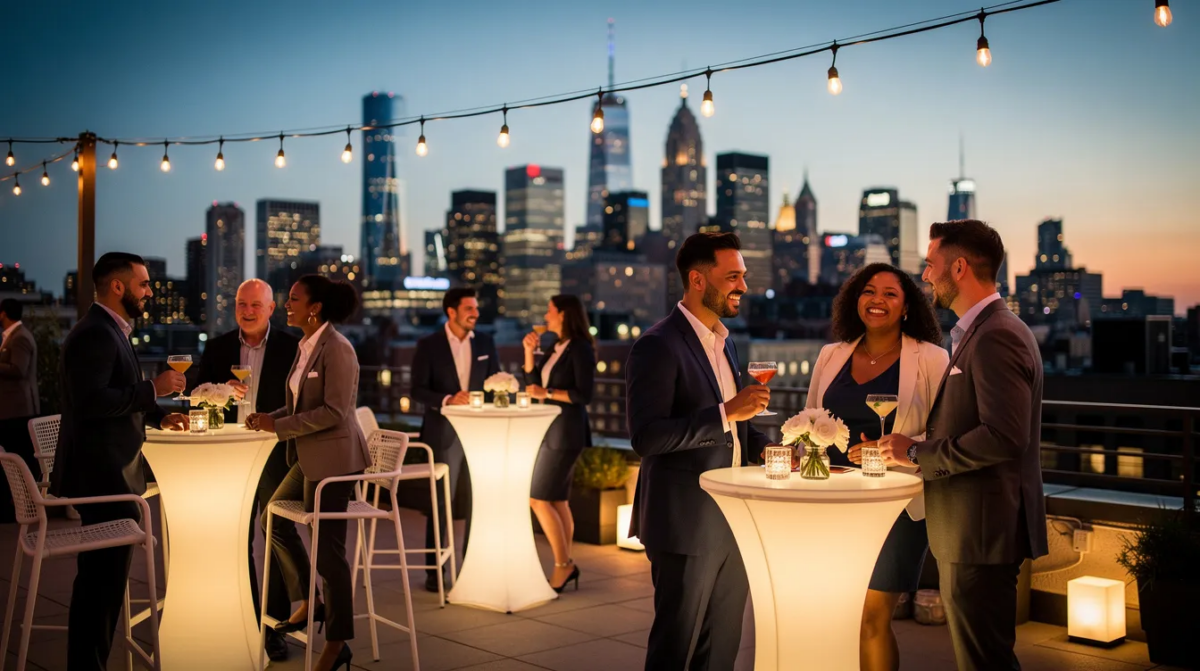
After-Work Rooftop Mixer (June, Midtown, 80–150 guests). A live DJ sets the mood while roaming musicians help break the ice as people arrive. Set up separate zones (a cocktail lounge, terrace games, a bar area) so guests can meet in different settings. Engagement tool: printed conversation cards with follow-up questions in each zone.
Industry-Specific Salon Night (Flatiron, 30–60 guests). Open with a short fireside chat on a topic like new technology in finance, then set up themed stations where guests rotate every 20 minutes. Recurring meetups like the NYC Tech Mixer show how much developers, founders and investors here love focused gatherings. Networking groups for women entrepreneurs and professionals use this same salon format very effectively.
Client + Colleague Appreciation Night (100 guests). Every employee brings one outside contact. The icebreaker: introduce your guest and name two people in the room they should meet. Turn it into a game with a “passport card” that guests fill with signatures from people in different fields. It’s a simple way to put potential investors and collaborators in the same room.
Innovation Showcase Pods (Chelsea, 50–80 guests). Internal teams or startups demo their products in lounge-style pods. Short guided breaks between demos keep people moving around the room. Events like this regularly lead to new business and referrals.
Breakfast Micro-Meetups (February–March, Midtown private dining room, 20–40 guests). Small, targeted groups (HR leaders, startup founders, executives) meet for 20-minute themed roundtables, followed by open networking. Spring is a great season for this format: it’s when big events like the Small Business Expo bring a lot of business owners to New York, so people are already in a networking mindset.
Hybrid Town Hall + Local Watch Party. This one is for remote or spread-out teams. Your NYC headquarters streams the program while team members elsewhere gather at a loft watch party. After the main content, breakout roundtables run both in person and online. It brings the open, come-as-you-are feel of a free community event into a corporate setting.
New York’s appetite for this is huge. The NYC Business Networking Group alone has run more than 350 events since it started in 2007.
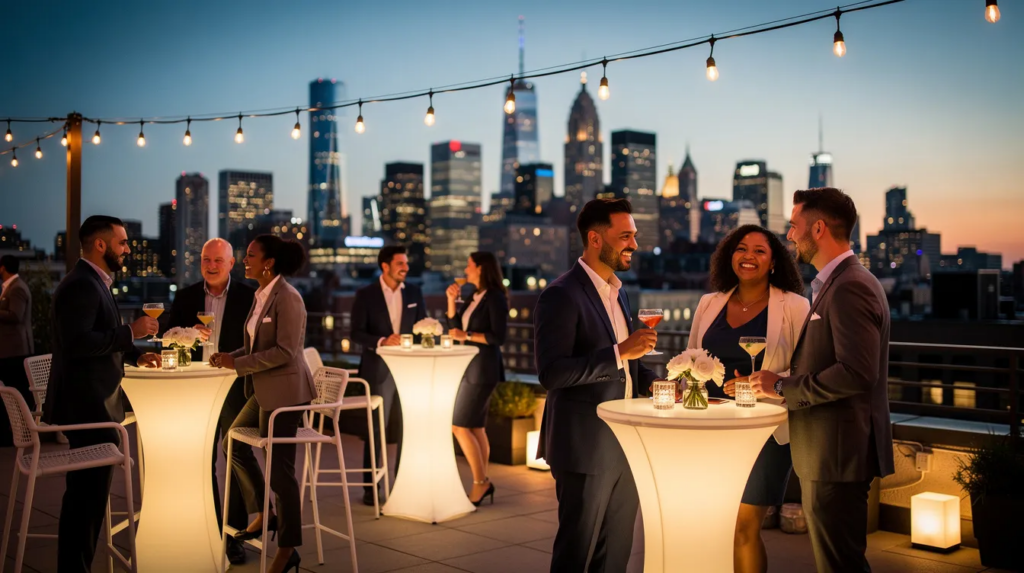
[Image: rooftop terrace in New York City at dusk, small groups of professionals talking around cocktail tables with the skyline behind them]
Using Roundtable Discussions and Speed Networking to Spark Real Conversations
Wandering around a ballroom hoping to bump into the right person isn’t a strategy. Sitting at a table where everyone knows the topic and the purpose is.
To run a great roundtable, seat 6 to 10 people per table, give each table a theme like “AI in retail” or “Sustainable event strategy for 2026,” and hand out a simple discussion guide. Run a 20 to 30 minute block, then rotate tables or have each table share highlights with the whole room. Open-ended questions lead to deeper conversations and keep things human.
For speed networking, say at a March sales kickoff in Manhattan, use 4 to 6 minute conversations, timers everyone can see, and clear prompts. This format works best for 30 to 80 people who need to meet a lot of contacts quickly. NYC networking events can feel competitive and crowded, and a structured format solves both problems.
A few practical tips: have water and light bites available, build in breaks, and hand out note cards so people can jot down next steps. Encourage guests to look up the attendee list and speakers ahead of time. It makes a big difference in the conversations they have.
For small business owners in particular, speed networking and roundtables are powerful when time and marketing budgets are tight. You sign up, show up, and leave with contacts that matter, and you don’t need an expensive booth to do it.
Entertainment as a Networking Catalyst (Not a Distraction)
This is the part I know best. Entertainment isn’t background noise. It affects how comfortable people feel talking to strangers, how energy moves through the room, and whether guests stay or slip out early. Networking events often draw senior professionals and decision-makers, and the atmosphere has to match that level.
With a hybrid live band and DJ, we plan the music in chapters: softer sets while guests arrive and during roundtable discussions, then higher-energy sets as people move into open networking. The early part of the night is often when the most relaxed conversations happen, and gentle live music at check-in makes arriving early feel worth it.
A few scenes from events like the ones we play: a saxophonist moving through the crowd at a fall gala in Hudson Yards, or a vocalist and DJ warming up the room at a spring product launch in SoHo. For planners, the practical benefits are smooth transitions between the formal program and open networking, custom walk-on music for speakers, and the ability to change the tempo the moment the room’s energy dips.
If you’d like to see how we do this, you can explore our corporate event live band and DJ options here: https://www.dleeventgroup.com/corporate-event-live-band-dj/.
Designing the Flow: Timelines, Spaces, and Networking Opportunities
Here’s a sample run of show for a 6:00 to 9:00 PM networking event in New York:
- 6:00–6:30 PM: Arrival, check-in, soft music, guided introductions.
- 6:30–7:00 PM: A short welcome and opening remarks.
- 7:00–7:30 PM: Structured activity: speed networking or roundtables.
- 7:30–8:45 PM: Open networking with rotating conversation zones.
- 8:45–9:00 PM: A closing moment and one last high-energy music set.
Use the space on purpose. Set up quiet zones for serious conversations, a bar area for casual mingling, and a dedicated area for the band or DJ. Clear signs help guests move between zones and find their people, whether that’s the tech, marketing or finance corner of the room.
Keep the volume at a level where people can talk without shouting. Use warm lighting so the room feels inviting. And build in what I call “planned serendipity”: a cue at 7:20 PM to switch tables, so guests get several waves of new introductions. When people see each other regularly, trust builds, and when the flow is designed well, networking leads to warmer leads and faster deals.
Measuring Success and Following Up After the Networking Event
Follow-up is where a corporate networking event proves its value: deals closed, candidates hired, sponsors who come back, referrals sent.
Set clear goals before the event, such as the number of meetings booked within 30 days, sponsor leads collected, introductions made between teams, or new deals in your pipeline. And tell your team to bring more business cards than they think they’ll need and to practice their introduction before they walk in.
Simple tools work well: a custom event QR code that links to a shared LinkedIn group, digital business cards, or automatic post-event emails with highlight photos and an easy way to share contact details. Taking notes during the event on who you met and what you talked about makes sure nothing falls through the cracks.
Follow up with new contacts within 24 hours. Then give attendees a clear next step: an invitation to a follow-up roundtable in two or three weeks, a list of upcoming NYC events where they can reconnect, or a short survey asking what kind of networking they want next year. Industry-specific events throughout the season are another good way to keep those relationships going. And we can help here too: at DLE Event Group we can provide short performance clips from your event that make your follow-up emails more engaging and give you fresh content for your website.
Planning Your Annual Networking Events Calendar (2026–2027)
Engagement gets easier when you plan networking events as a series, so relationships build over months. When guests know they’ll see the same people again, every event becomes a bigger opportunity.
Here’s an example 12-month calendar for a New York company:
- Q1 (February): A leadership breakfast with roundtable discussions for executives and members of your advisory group.
- Q2 (May): An industry mixer with a hybrid live band and DJ at a Midtown venue, a complete experience for clients, suppliers and partners.
- Q3 (September): An innovation night with product demos, panel discussions and a look at where your industry is headed. Seminars and workshops fit naturally into this agenda.
- Q4 (December): A holiday networking event with a full dance-floor experience. Don’t skip this one. It’s the event guests remember.
Line up your dates with key industry moments, conferences at the Javits Center or big trade shows, so you catch people who are already in the city. Vary the format, time of day and location across the year so introverts, extroverts, new hires and executives all find an event that suits them. And lock in your entertainment, venue and AV partners early, ideally six months or more ahead, so you get the best dates and avoid last-minute compromises that raise your costs without raising the impact.
FAQ: Corporate Networking Events and Entertainment
Plan on 4 to 6 months for a regular weeknight. For peak dates like December holiday parties or June rooftop events, book 8 to 12 months ahead. If you’re working on short notice (under 60 days), a flexible brief and budget can still get you a great result. Check availability early, even if your guest list isn’t final yet. Every week you wait, the options get smaller.
Speed networking usually works best for 30 to 80 people. Roundtables can scale from 20 to about 150 if you run several tables at once. Open mixers can handle bigger crowds, but they still need zones or small activities so guests don’t feel lost. For very large events where deep networking is a main goal, split the event into several sessions or tracks.
Absolutely. Our hybrid band and DJ can play at cocktail-lounge volume, with refined playlists and jazz, R&B or acoustic covers in the early part of the evening. We only turn up the energy when you want a livelier vibe. We also work closely with planners so that speeches, roundtables and presentations are always easy to hear.
Add quieter zones, clearly labeled conversation prompts and smaller breakout groups. Structured elements like roundtables and short guided activities take away the pressure of working the room alone. A thoughtful MC and warm, welcoming music also help people relax, making it easier for everyone to start a conversation and build confidence.
Our hybrid DJ and band packages usually start around $5,000 and go up with additional musicians, production and staging. The date, venue size and length of the performance also affect the price. Ask for an itemized quote so you can see exactly what each element adds to guest engagement and the overall impact. To get started, call us at 877-534-2424 or check availability on the DLE Event Group website.
QUESTIONNAIRE
Need Assistance? Directly reach us at contact@dleeventgroup.com or 877.534.2424
- Category: DLE Event Group