Hybrid DJ Band: The Best of Both Worlds for Unforgettable Celebrations

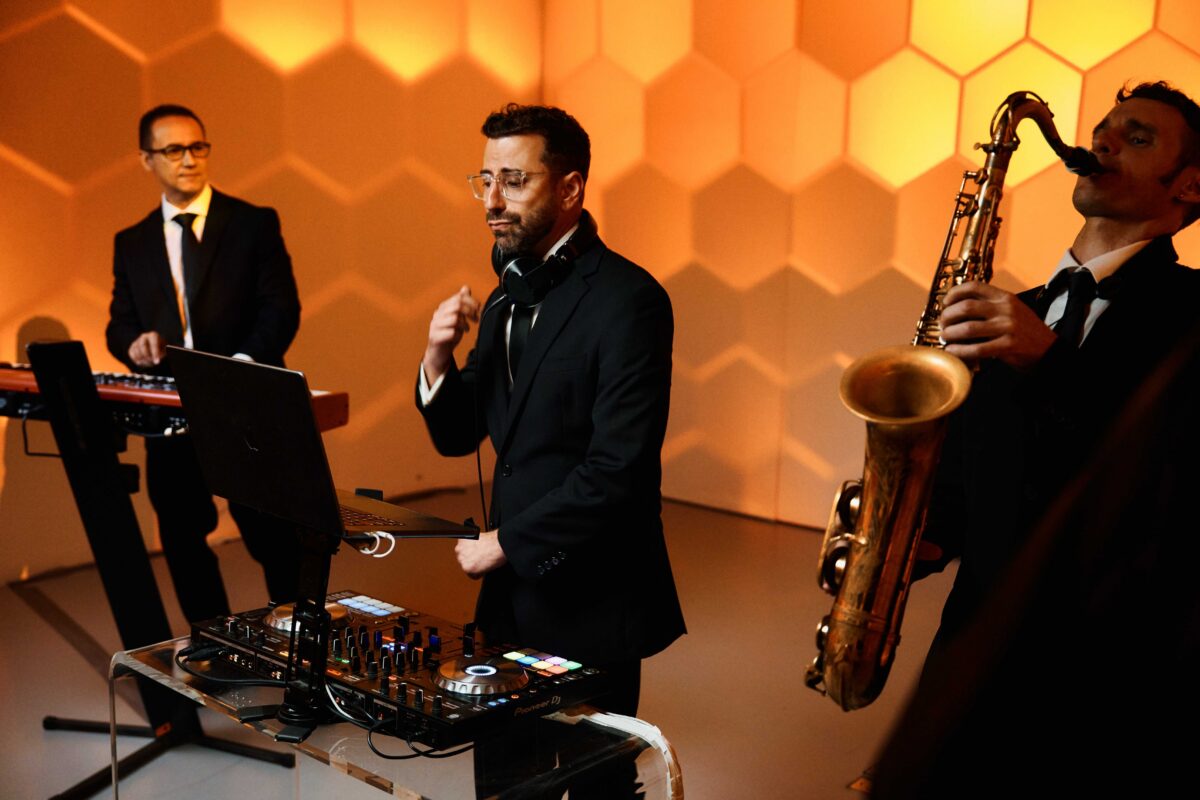
A hybrid DJ band blends digital audio with organic live performance for a concert-like experience that neither a solo DJ nor a traditional live band can replicate alone. 

This guide is for couples, event planners, and anyone seeking a high-energy, flexible entertainment option for weddings, corporate events, or private celebrations. Hybrid DJ bands are especially relevant for those who want to elevate their event with continuous music, genre versatility, and the excitement of live musicianship – all in one seamless package.

Here is what you need to know before booking one.

Key Takeaways

  • A hybrid DJ band combines a professional DJ with live musicians (vocals, saxophone, percussion, strings) performing simultaneously on every song, not in separate sets.
  • The hybrid format delivers the best of both worlds: continuous music and genre flexibility from the DJ, plus the emotion and excitement of live instruments and live music.
  • Hybrid setups are popular for events like weddings and corporate gatherings due to their versatility, scaling from intimate private events to large destination celebrations.
  • Packages start at $2,400 for entry-level configurations; most couples invest between $4,000 and $5,000 for their wedding entertainment.
  • The planning process involves choosing the right musician configuration, clarifying budget, and aligning the entertainment to the flow of your event.

What Is a Hybrid DJ Band?
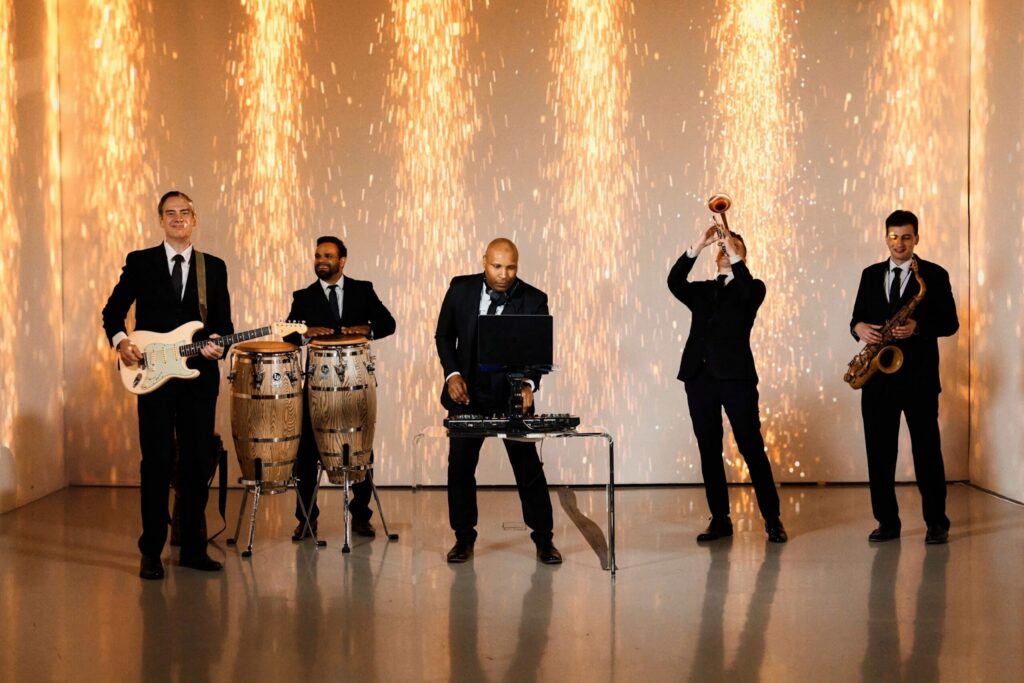
A hybrid DJ band is a single integrated act where a DJ and live musicians perform together on every song. The DJ supplies the tracks, manages tempo and transitions, and keeps energy high across genres, while live musicians layer parts like vocals, sax solos, and percussion hits over the mix in real time. Hybrid DJ bands create a unique blend of live music and DJ performance that feels intentional from start to finish.

This is not a live band that hands off to a DJ for the after-party.

In a true hybrid format, a saxophonist might roam the dance floor during a drop, a vocalist trades verses over the DJ’s mashup, or a percussionist builds intensity during a transition. A hybrid DJ band features continuous music flow from the DJ and live improvisation from musicians, so guests hear one cohesive act rather than two separate ones.

The appeal of hybrid DJ bands is combining a DJ’s extensive music catalog with live musician energy. Soft live music during dinner gives way to a DJ-led dance set with roaming sax and drums joining for high-energy sections. This format works well for modern weddings, upscale private events, and destination celebrations where you want a contemporary sound and a packed dance floor.
Hybrid DJ Band Formats and Configurations

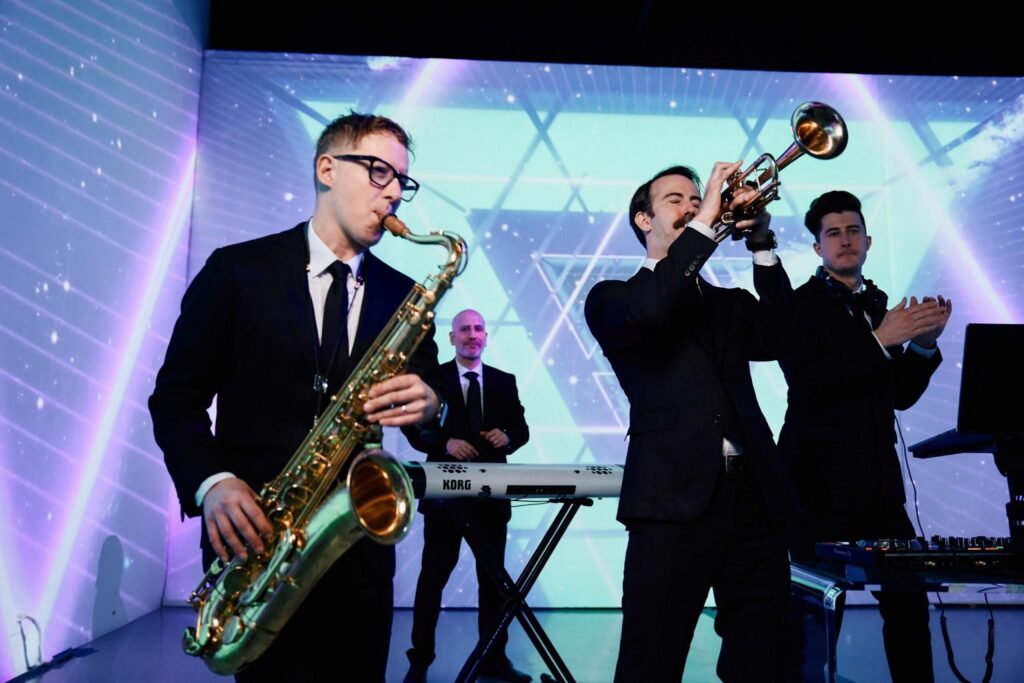
Hybrid band setups are modular. You tailor the number and type of live musicians to your event size, venue, and budget.

DJ-led hybrids use the DJ as the anchor. Live musicians drop in and out to build dynamic, festival-style peaks. A DJ-led hybrid band can feature 2 to 7 musicians depending on scale. DJ hybrid groups can include instruments like saxophone, drums, and violin. DJ/live fusion packages can include live drums and horns for maximum crowd impact.

Band-led hybrids put a core live band (rhythm section plus singers) at center stage for intros, special songs, and feature moments. The DJ covers transitions, remixes, and late-night club energy.

Duo and trio configurations suit smaller venues, rooftops, or cocktail-style receptions:

  • DJ + sax
  • DJ + vocalist
  • DJ + percussion
  • DJ + violin + trumpet

Horn sections, string players, or additional vocalists can rotate in for specific segments like ceremony, cocktail hour, first dance, and high-intensity dance sets. DJ hybrid groups offer combinations like DJ with saxophone or drums that keep the circle of entertainment tight without overwhelming the room.

Why Choose a Hybrid DJ Band Over a Traditional Live Band or DJ?

Three options sit on the table for most event planners: DJ-only, full live band, or hybrid band. Each has a personality. A DJ-only setup costs the least and covers any song ever recorded. A full live band delivers visual excitement and raw energy but typically costs $4,500 or more for a four-piece and requires breaks between sets. Hybrid bands offer a dynamic, high-energy experience for events while landing between the two in cost and stage footprint.

The hybrid format gives you the best of both worlds. DJs and live musicians working together means you get genre flexibility (the DJ can pivot between musical genres instantly based on crowd energy) plus improvisational elements that enhance audience interaction and performance energy. Live musicians enhance the energy of DJ performances at events in ways a speaker system alone cannot replicate.

Hybrid DJ bands can maintain seamless transitions without traditional breaks found in live bands. The DJ mixes continuously while live instruments play on top, keeping the dance floor packed all night. Hybrid formats provide flexibility and a packed dance floor whether the vibe calls for a romantic evening or a party that runs past midnight.

Hybrid formats can enhance the atmosphere of weddings, energetic corporate events, and chic rooftop parties equally. Hybrid bands provide a lively atmosphere for weddings and events because the creative direction shifts with the room rather than following a fixed setlist.
How to Choose a Hybrid DJ Band for Your Event

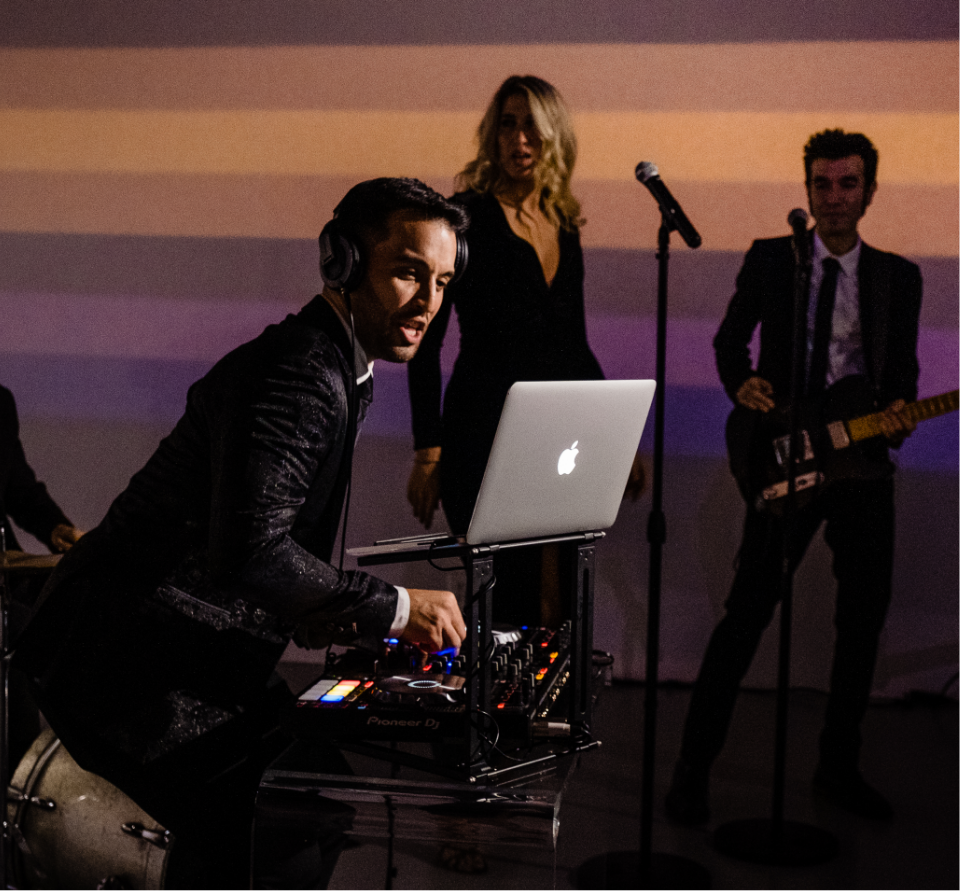
Choosing the right hybrid act goes beyond watching a flashy highlight reel. You need evidence of chemistry, experience, and fit with your event vision.

  • Request full-length, unedited videos showing the DJ and live musicians performing together through a full set, not separate footage spliced together.
  • Confirm the ensemble regularly performs as a unit. Many hybrid bands perform at over 100 weddings annually; acts with that volume of experience together tend to have tighter timing and musical cues. Look for past clients’ reviews that mention specific moments, not just generic praise.
  • Ask how they handle song requests outside pre-planned hybrid arrangements.
  • Check whether the act can perform within your venue’s sound limits.
  • Discuss how they cover if a musician gets sick close to the date.

Talk through your planning process in detail: how ceremony sound, cocktail hour, speeches, special dances, and after-party transitions will be managed so the whole night feels cohesive. The conversation should reveal whether the team’s personality and style match yours.

Hybrid DJ Band Pricing and What Affects the Cost

Hybrid DJ band pricing scales with configuration size, performance length, location, and event type. Packages start at $2,400 for a DJ-plus-one-musician duo. Most couples invest between $4,000 and $5,000 for a mid-size hybrid at their wedding. Larger configurations with multiple vocalists and horn sections push higher; hybrid DJ band packages start at $5,000 from some vendors, including DLE Event Group. Custom DJ/live fusion packages are available upon request.

Cost factors beyond the base fee:

Factor

Impact on Price

Each additional live musician

Per-performer rate added to base DJ package

Travel and accommodation

Adds cost for destination celebrations

Extended soundcheck and load-in

Longer venue rental, crew hours

Overtime beyond contracted hours

Typically billed per 30-minute block

Sound and lighting production

Extra gear, engineer fees

Weddings frequently cost more than similar-length corporate events due to extra planning calls, custom arrangements for first dances, and coverage from ceremony through after-party. The investment is real, but so is the difference between a memorable night and a forgettable one.


Book early in the planning process to lock in your preferred lineup. Searching 9 to 18 months ahead for peak Saturdays gives you flexibility to scale up or down as budget and guest count become clearer.

Planning the Perfect Hybrid DJ Band Experience

Thoughtful planning turns a good DJ live setup into an unforgettable celebration with intentional flow and energy across the whole evening.

Map music to your timeline:

  1. Arrival and cocktail hour: Ambient live vocals or acoustic guitar over soft DJ mixes
  2. Grand entrance and dinner: Live musicians plus DJ for key moments; lower volume during speeches
  3. Dance sets: Full hybrid energy with percussion, sax, and trumpet building hype on the dance floor

Build a “must play,” “nice to play,” and “do not play” list, but leave room for the DJ and live band to read the crowd and react. The best groups of musicians create excitement by responding to what the room gives them, not by running down a rigid setlist.

Coordinate with your planner or venue on logistics: stage or riser placement, power needs, sound limits, and how musicians can move through the room (a roaming sax on the dance floor, for example). Schedule a short call close to the date to lock in cues, special songs, and last-minute changes so the entertainment team manages the night without any worry.

Looking to hire DLE Event Group for your event? Contact us and request your quote! 

FAQ

These questions cover concerns about logistics, timing, and special requests that come up once you start talking to hybrid acts.

Hybrid setups are often easier to keep within decibel limits than full live bands because the DJ controls overall volume from one mixing board. Live instruments can use in-ear monitoring to reduce stage volume. For venues with limits below 90 dB, strategies include swapping acoustic drums for electronic pads, reducing horn section size, and focusing on quieter instruments like violin or guitar. Ask the venue for measured dB thresholds and share them with your hybrid act before signing the contract.

Individual live musicians rotate for short breaks, but the DJ keeps music going continuously, so there is no silence on the dance floor. Contracts typically specify total performance windows and short rest periods scheduled during speeches, dinner, or lower-energy segments. Many couples find this approach solves one of the biggest complaints about traditional live bands: dead air between sets.

Most hybrid bands can learn a select number of special songs for first dances, parent dances, or processional moments. This usually requires 6 to 8 weeks of advance notice for rehearsal. Confirm in your contract how many custom arrangements are included, whether extras incur an additional fee, and whether the DJ has a backup recorded version queued in case of any production issues on the night.

Many in-demand hybrid acts for weddings and corporate events book 9 to 18 months ahead for peak Saturdays, especially in markets like NYC. Weekday or off-season dates may have shorter lead times. Secure your preferred act as soon as your venue and date are confirmed, then refine the exact configuration later in the planning process.

Hybrid setups scale well for intimate guest counts and daytime private events. Compact lineups like DJ plus acoustic vocalist or DJ plus sax deliver lounge-style energy without overpowering a small room. Share your timeline, guest count, and vibe (brunch, cocktail, sunset) with the entertainment team so they can recommend an appropriate configuration that matches the atmosphere you want to create.

Hold the date. Send the shape of the night.

If you are holding a team day and the search results are still icebreakers, send the operational facts instead. Date, venue, headcount, standing or seated, hard stop. I will tell you whether a DJ-led hybrid, a full celebration close, or no live plot at all is the honest hire. Then we check the date and send an itemized quote you can walk into procurement.

Call 877-534-2424 · contact@dleeventgroup.com

QUESTIONNAIRE

Need Assistance? Directly reach us at contact@dleeventgroup.com or 877.534.2424
Corporate Team Building Event Ideas That Actually Use Live Music

HR sent the shortlist on Tuesday: an escape room, a trivia host, and a 6 p.m. rooftop that still needs people to stay after. They searched corporate team building event ideas and did what the results told them to do. That search and that rooftop are not the same job. One is a facilitated hour. The other is a night.

I run hybrid live band + DJ for company celebrations in New York City, on Long Island, and on destination programs. People Ops is not trying to book a trust fall. They need a room that feels like a reward, will not embarrass leadership, and will not empty at 7:15 because nobody can hear a colleague at a high-top.

If the day is a true workshop, hire a facilitator. A night people stay for is a different hire: entertainment as the mechanism — not another listicle.

The team day is a production problem, not a Pinterest board

People Ops is on the hook for whether the intern and the VP both had a decent night, and whether anyone has to explain a lyric or a volume complaint to leadership in the morning. You still need a clean-lyric set, a hard stop the hotel will enforce, and one person to call when someone adds a thank-you at 7:40.

Google will hand you forty numbered activities. Escape rooms. Scavenger hunts. Office Olympics. Fine at the edges of an offsite. They do not run a reception. On a team celebration, entertainment sits next to venue, catering, AV, and whatever remarks you still have to get through. Guests never see that stack. They get one room.

Too loud at welcome and they leave. A hole after the toast and the energy is gone before anyone has talked to a person from another floor. Corporate event live music either holds that room or spends the budget on a gimmick people opt out of.

This is written for the person holding a team day — summer garden, milestone, kickoff close. December is a different article. So is a gala. [INTERNAL LINK: Live band vs DJ vs hybrid for corporate events] is how you choose the plot. This one is whether live performance is the mechanism at all.

Why most corporate team building event ideas fail the room

The listicle is built for a search. It treats “ideas” as interchangeable widgets: a murder mystery, a cooking class, a name-that-tune app. Any of those can fill an hour. None of them answers the question you get blamed for at 9 p.m. — did people stay, talk, and leave feeling something decent about the company.

Forced participation is how it usually starts. A trust-adjacent game asks the quiet engineer to perform in front of their manager. Some will. Plenty will check email. A live band does not require anyone to be funny on cue. Shared attention is optional in the useful sense: listen, talk, or step onto a floor later.

Status is the next miss. A per-head virtual game can be the right object for a distributed Tuesday. It is the wrong object when you have already rented a terrace and invited two departments who do not sit together. A corporate live band — even a DJ-led hybrid with two or three players — tells the same people the company spent the night on them.

Then the close. Listicles stop when the activity stops. Your guests still have ninety minutes and a bar. I have watched a well-catered team reception empty because the “fun” was a playlist at dance volume during passed food. Nobody was angry at HR. They just left.

Live performance is the mechanism, not the workshop

A facilitator runs exercises. A producer runs a room. Confuse the two and you get a songwriting slam when you needed a celebration — or a seven-piece when you needed a workshop.

Live performance works on a team day because it creates shared attention without a worksheet. People face the same thing at the same time. That is status, morale, and a reason to stand next to someone you do not Slack. You do not need a debrief slide.

A participatory version of this market exists — write a company anthem, a drum circle, live karaoke with a house band. Those can be excellent when everyone opted in. They also put employees on a stage. If your VP of finance did not sign up to solo, you have manufactured the drama HR asked you to avoid.

Brand-safe is the test I use. A short, optional moment — a walk-up, a two-song stretch, a clean chorus people already know — is participation without a talent show. Forced “battle of the bands” is a workshop in a party hat. The night I am hired to run is atmosphere, then one controlled peak, then a close people will actually use.

Formats that work with a hybrid band + DJ

Take the shape from the team celebration, not from a holiday deck. These nights are summer, garden, milestone: inclusive, multi-generational, usually 1.5–3 hours. Hybrid live band + DJ is the object because the live layer can sit under talk and the DJ layer can open a floor without a second vendor.

Welcome / cocktail live layer. The first 45–90 minutes of a standing reception. DJ-led hybrid with two or three live players — sax, keys, a vocal — at conversation level. No drum kit competing with the bar. Most HR briefs under-specify this stretch. They asked for “energy.” What they needed was a finished room.

Short participatory-but-brand-safe moment. Ten to twelve minutes, not a second program. A stinger when the GM says thank you. One or two songs the room already owns. Roaming players if the brand can take it — total black, no risky banter. Employees on a microphone only if the brief says so. Default is they do not have to.

Celebration close. After the toast, the floor. Multi-generational, clean-lyric, no dead air. A Fully Capable Band with DJ owns the visual if the room can take the footprint. DJ-led hybrid owns the catalog if the terrace cannot. Peak Company / Holiday is the package shape — milestone, summer outing, company party.

Name that shape in the first email: cocktail-only, cocktail-plus-close, or a full 1.5–3 hour celebration. A hotel salon at The Pierre is a different object than a standing night at Guastavino’s.

Hold 62–68 dBA so people can actually talk

Morale dies when people cannot hear each other. I hold 62–68 dBA through welcome and the early reception — conversation level, not a courtesy fade. If they are leaning in and still missing a sentence, the early-evening plan failed.

A corporate event dj can do this if they treat 6 p.m. like 6 p.m. Thin the live arrangement and the same number holds. Club DJs who treat a team terrace like a Saturday night miss it the same way a full horn section does. The close is allowed to get louder. Starting there is the mistake. Blow the first hour and the dance floor at 8 is the same six people who always dance.

Hotel ballrooms fight a full plot. Mandarin Oriental and The Plaza will not thank you for planting the PA like a club during passed food. Gotham Hall and Guastavino’s absorb more; a private dining room does not. Oheka Castle on Long Island is a different load-in day, not a different dB rule.

Who has to sign: HR, the venue, sometimes an agency

A company books a chain. On an HR-led team day that chain is shorter than a gala, and it is still not one person.

HR / People owns morale, inclusion, zero drama, and a budget that will survive procurement if the number crosses a threshold. Decide whether this is a workshop, a reception, or both before you request quotes. The object you are buying changes with that answer.

Venue side: load-in, the house engineer, the noise neighbor, house system or carry-in. A rooftop with a service elevator is a poor place to insist on seven live players. Send the venue name with the date.

An agency appears when the company already uses one, or when internal comms handed the night off. Then the rider is theirs. One producer still matters: one load-in, one run of show, one person who answers when the toast moves. Two vendors for a three-hour team reception is a handoff you did not need.

First note, even if it is ugly: date, venue, headcount, standing or seated, hard stop, must-play / do-not-play, dress, house AV, who signs.

When hybrid is the wrong hire

Hybrid is how we run a segmented celebration. Some team days should not get that answer.

Keynote-only offsite. A half-day with a speaker, a breakout, and a sandwich. You need speech audio and maybe a sting at doors — not a live band + DJ machine. Hire the AV team.

True facilitated workshop. Trust exercises, a culture session, a songwriting lab, a drum circle with a debrief. That is a facilitator’s room. I will not pretend a hybrid plot is a workshop.

Tiny conference room. Twelve people, a board table, no floor. A DJ-led hybrid is still too much object. Use a playlist, or a single acoustic player if you must have a body in the room.

Those three stay off the hybrid plot. Everything else is usually a mis-specified format: you said team building and you meant a 90-minute reception with a toast. Tell us the night you actually have. We will recommend a config, not a package name.

If this is your team day, book this

If you are 40–80 people on a terrace for 90 minutes with a hard out, book a DJ-led hybrid with two or three live players. A full band is the wrong footprint and the wrong volume fight.

If you are 150–300 in a ballroom, with a welcome, a short thank-you, and a floor after, book Peak Company / Holiday — Fully Capable Band with DJ if the visual matters, DJ-led if the house window is tight. That is a celebration close, not a workshop.

If the afternoon is a facilitated session and the evening is the reward, split the hires. Do not ask one vendor to be both. The workshop ends. Then we load a different plot.

If the date is a Long Island summer outing at a place like Oheka, travel changes the call time, not the decision rule. Configs and the dB plan stay the same. Brooklyn lofts and Westchester hotels fail the same way when the floor plan showed a stage you cannot build.

If leadership already bought a celebrity act for the kickoff, we should not be the competing stage. Cocktail live layer before, or a DJ after.

What fails, and what moves the number

The cheap fails are obvious once you have sat through them. Dance volume through welcome. Two riders for a three-hour reception. A full band that cannot disappear for a toast. A club DJ through a thank-you. A “quick participatory moment” that becomes an hour of employees on a mic they did not ask for. A conference-room headcount with a ballroom plot. The expensive version is two vendors who have never shared a desk, arguing over the PA while the GM walks to the handheld. HR feels that as drama. Guests feel it as a night that never quite started.

The number moves for the same reasons it always does. Headcount of live players. Split sets across the timeline. Whether we carry audio and lights or ride the house. Load-in difficulty and a union house. Custom charts or a brand sting. Destination. A Saturday in a peak month. Corporate bookings start From $5,000 plus travel. That is a floor, not a typical 300-person ballroom. You get an itemized quote, not a vibe. COI on request. One producer contact.

You get one producer, one rider, and one load-in. The person who wrote the cue sheet is on the deck when the clicker hits. The live picture and the product launch dj spine are the same crew, so the sting and the speech mute are not a negotiation between two companies.

We have 100+ corporate events on the books in New York and on destination programs. When I talk about footprint at Gotham Hall or Mandarin Oriental, it is because we have loaded those rooms corporately. The corporate live band and DJ page is the offer — three hybrid configs, launch as a named format, itemized quote. Corporate bookings start From $5,000.

Call 877-534-2424 or write contact@dleeventgroup.com. Send the deck and the moment. I would rather turn down a full hybrid than fake a four-hour party inside your reveal.

Why DLE for a team celebration

You get one producer, one rider, and one load-in. The live layer and the DJ layer are the same crew — that is the point of hybrid. I am not here to sell you a gala cue board or a product-reveal sting. The job is a team night that can talk, hit a short brand-safe moment, and close without a second contract.

Most HR team days fit DJ-Led Hybrid (two to seven live players over a DJ core) or, when the room can take it, a Fully Capable Band with DJ under Peak Company / Holiday. Celebrity Hybrid is for a marquee. Most team receptions are not, and I will say so.

We have 100+ corporate events on the books. The Plaza and Oheka are on that list because we have loaded them for companies, not because they look good in a deck. NYC, Brooklyn, Long Island, Nassau, Westchester. The offer lives on the corporate live band and DJ page: three hybrid configs, itemized quote, corporate bookings From $5,000.

Call 877-534-2424 or email contact@dleeventgroup.com with the date, the venue, and whether this is a workshop, a reception, or both. I will tell you if hybrid is the wrong hire.

FAQ

No. A workshop puts employees in the exercise — anthems, drum circles, karaoke-as-the-activity. A hybrid live band + DJ runs the room so people can talk, watch, and dance. If your brief is facilitated culture work, hire a facilitator.

Conversation level through welcome and the early reception: 62–68 dBA. If guests are leaning in to finish a sentence, we failed the brief. The floor can come up after the toast.

Corporate bookings start From $5,000 plus travel. Live headcount, split sets, AV, load-in, custom cues, and destination move the number. You get an itemized quote.

Yes. A walk-up, a two-song stretch, roaming players — optional, brand-safe, no forced solos. Employees on a microphone has to be opt-in and in the brief.

Usually no. A tiny conference room or a keynote-only afternoon is the wrong hire. Save the budget for a night with a bar and a headcount.

Send the date as soon as it is real. Peak months and prime Saturdays move first. Date, venue, guest count, and format are enough to start a hold.

Hold the date. Send the shape of the night.

If you are holding a team day and the search results are still icebreakers, send the operational facts instead. Date, venue, headcount, standing or seated, hard stop. I will tell you whether a DJ-led hybrid, a full celebration close, or no live plot at all is the honest hire. Then we check the date and send an itemized quote you can walk into procurement.

Call 877-534-2424 · contact@dleeventgroup.com

QUESTIONNAIRE

Need Assistance? Directly reach us at contact@dleeventgroup.com or 877.534.2424

Product Launch Entertainment Ideas That Create Buzz

The rundown has a reveal at 7:12. Your CMO is on a clicker. Then the band the agency forwarded from a party rider is still warming a horn section in a 12-foot activation bay — or the DJ is already in a club mix while the keynote is still on the last slide. That is how product launch entertainment gets bought: someone copies a four-hour dance contract onto a marketing brief.

I produce hybrid live band + DJ rooms across NYC and the tri-state. Marketing managers call with a brand deck, a hard time on a rundown, and a room that is not a dance floor. The job is a 30–90 minute controlled peak that makes the product feel inevitable — then gets out of the way. Stilts and photo booths are not buzz. A cue that lands, a look that photographs on-brand, and a live layer that can disappear when the CEO stands up — that is.

A launch is a rundown, not a night out

Entertainment at a launch sits in the same stack as the LED wall, the demo table, and the press pit. Guests did not buy a ticket. They came to see a thing and leave with a sentence they can post or take to a buying committee. If the music fights that job, the brand owns the failure.

A company party can survive a loud first hour. A launch cannot survive a dead reveal. The film ends, the lights bump, and the room does not know whether to clap or talk. You hired a desk to keep that silence from happening. A four-hour party band creates it, every time nobody handed them a cue.

The live window I actually run is 30–90 minutes of peak impact, not an evening of sets. Arrival can be a bed. The keynote needs a walk-up and a clean speech PA. The unveil needs a sting that hits with the visual. After that, roaming live over a DJ can hold the demo floor without turning the showroom into a club. If your brief still reads like a reception, you bought the wrong format.

Product launch entertainment is not a party

A party has a dance floor as the destination. A launch has a moment as the destination. Those rooms share a freight elevator. They do not share a rider.

A 9-piece once counted in while the product film was still running because the band leader had a start time, not a cue. A corporate event dj treated a press preview like a Saturday night while analysts were trying to hear a spec. Both acts were competent. Both were hired for the wrong job.

The clock is short. Brand Launch & Keynote lives in a 30–90 minute peak. You might have a 45-minute arrival around it. You do not need four hours of players waiting for a floor that was never in the deck.

The audience is mixed and watching. Press, retailers, creators, sales, leadership. They are judging the brand, not the horn section. Energy has to read as the product.

The peak is the product, not the encore. If the most photographed minute is a sax solo that has nothing to do with the SKU, the entertainment won and the launch lost.

When marketing asks for ideas, I do not send magicians. I ask where the reveal sits, how wide the bay is, and what the brand is allowed to sound like. Those three answers decide the live plot.

Sync the live layer to the reveal and the keynote

Treat the reveal as a cue. Write it like a show.

One person owns the downbeat — producer, stage manager, or me on in-ear — and that person calls the sting. Split authority is how you get the drop on the wrong slide. Share a cue sheet with AV, lighting, and the DJ desk: pre-roll bed, mute for the line, sting on the visual, hold for applause, bed under the demo. Rehearse it at soundcheck.

Keynote walk-up is a different object. The speaker needs eight seconds of brand-safe music that ends when they hit the mark, not a chorus that fights the first sentence. After remarks, the live layer ducks so Q&A is speech-level. A product launch dj who only knows club blending will overplay both edges.

Arrival is not the peak. Keep it as a bed — DJ plus one roaming player — so the room still has a ceiling when you need volume. After the unveil, the live layer can bloom for 20–40 minutes: electric violin or LED sax over the DJ, wireless, timed to the film loop. That is the shareable minute. It dies if you spent your loudest look on cocktail.

Rundowns slip. The desk has to stretch or compress without looking like panic. A playlist cannot do it. Two vendors on the same PA cannot either.

Brand-safe look and repertoire

Marketing did not hire a cover band. They hired a surface the product can sit on.

Start with the look. Total black, no club-casual, no artist merch unless the deck asked for it. Roaming players should read as the activation, not as a sax walking tables. If the brand has a color, lighting can pick it up. If the brand is quiet, the plot should look expensive and small.

Repertoire is a clearance list. Send the do-not-play, the lyric standard, and any sonic identity the campaign already uses — film cue, ad bed, last year’s walk-on. We can build a branded intro and a reveal sting from that. Clean-lyric is the default with press in the room. Banter is off unless you wrote it. NDA and guest-privacy rules go on the same one-pager as the set.

Keep custom short. A 15–30 second sting, a motif that returns when the product hits the LED. A full custom book is the wrong spend. If you have a campaign track, tell us early enough to chart a live layer over it.

Would legal, brand, and the CMO all leave that song and that outfit in the recap cut? If any of the three would cut it, it does not ship.

Small footprint, or the activation dies

A 14-piece horn line is a concert object. A brand activation is usually a bay, a showroom, a hotel breakout, or a pit in front of an LED. Those rooms lose if the entertainment occupies the product.

DJ-Led Hybrid is the config that fits: a DJ core with two to seven live players layered on for the peak — often violin, sax, percussion. Brand Launch & Keynote is a 30–90 minute impact set with synchronized cues, a branded intro, and wireless roaming. Impact Stage Set is the same idea on a convention open. None of those plots need a drum riser in the demo path.

NYC makes footprint a load-in problem. Midtown hotels give you a window, a freight path, and a house engineer who already has a plot. A compact desk and wireless players can make that window. A full backline fighting catering for the same elevator cannot. Gotham Hall swallows more cubic volume than a private dining room at The Pierre. Mandarin Oriental will not thank you for a club PA pointed at a press row. If the floor plan shows the product in the middle, the band does not get the middle.

Ask house sound vs carried sound in the first email. Some rooms want speech, film, and music on one PA. Some want a discrete live rig that can die without killing the keynote. After the peak, players step off. If your act cannot disappear, it is too big for the brief.

When not to book a full hybrid

Hybrid is the right object when you need a live picture on a DJ spine, on a short clock, with one producer. Agencies ask for it on briefs that should not get it.

Keynote-only. A 20-minute remark, a film, out. You need speech audio and maybe a walk-up. Hire the AV team and a desk that can fire a sting. I will tell you that on the first call.

Jazz-trio hospitality with no reveal. Seated clients, product on a side table, conversation as the job. Keys/sax/bass without a DJ is cleaner than a plot you will spend the night turning down.

Celebrity act already on the stage. If marketing bought a national name for the unveil, we should not be the competing show. Cocktail bed before, or a DJ after. Two peaks in one bay is a volume war.

The brief is actually a party. If the rundown is three hours with a dance floor after the toast, you are not in this article. Do not force Brand Launch & Keynote onto a company-celebration clock because the invite says “launch.”

The room cannot take live players. A 10-foot booth with competing PA from every aisle is a DJ problem, maybe one roaming player. A full hybrid will get you a noise complaint and a dead demo.

Name the format. I will recommend DJ-Led Hybrid, a thin live layer, or not us.

If this is the brief, book this

If you have a 30–90 minute peak, a reveal time, and a brand deck, book DJ-Led Hybrid as a Brand Launch & Keynote set. One producer, live layer over the desk, sting on the visual.

If the room is a tight NYC showroom or a hotel breakout, keep live headcount at the low end of 2–7. Roaming over a compact desk. No riser in the product path.

If press and leadership are in the seats, send do-not-play, dress, and the campaign cue before anyone charts a song. Brand-safe is the floor.

If the unveil is film-plus-speaker and there is no social after, do not book a hybrid. Buy the sting and the speech PA.

If you also need a post-reveal reception that actually dances, say so. That is a second phase on the same producer — and a different quote than the 45-minute activation. Do not hire a second DJ for later.

If the date is a midweek press day, we can usually move faster than a December Saturday. Still send the rundown early enough to chart the sting. Custom audio is not a day-of favor.

What fails, and what moves the number

The reveal has no owner, so the drop hits late. The DJ plays a party through the keynote. A full band cannot duck, and speech fights horns. Two vendors share one PA and neither wrote the cue sheet. Look and lyrics were never approved, and the recap has to mute a chorus. The footprint ate the demo. Nobody rehearsed the mute. Club volume during a buying-committee conversation is the same failure in a quieter register.

Price moves on a short list, not a secret menu. Live headcount. Custom sting vs existing records. Whether DLE carries audio and lighting or rides the house. Load-in in a city hotel or union house. Travel. Split sets if you added a reception after the activation. Corporate bookings start From $5,000, plus travel, on an itemized quote. A 30–90 minute Brand Launch plot and a full-night hybrid are not the same number.

Send the date, the venue, the guest count, the reveal time, and the brand deck. You get a line-item back, not a vibe.

Why DLE for a launch, not a party band

This is the job we built a package for. Brand Launch & Keynote is a 30–90 minute peak: DJ plus electric violin, LED sax, or live percussion, wireless, synced to the unveil, then a bed that does not embarrass the brand. DJ-Led Hybrid is the config — live layer over the desk, not a concert band with a DJ plugged in at midnight.

You get one producer, one rider, and one load-in. The person who wrote the cue sheet is on the deck when the clicker hits. The live picture and the product launch dj spine are the same crew, so the sting and the speech mute are not a negotiation between two companies.

We have 100+ corporate events on the books in New York and on destination programs. When I talk about footprint at Gotham Hall or Mandarin Oriental, it is because we have loaded those rooms corporately. The corporate live band and DJ page is the offer — three hybrid configs, launch as a named format, itemized quote. Corporate bookings start From $5,000.

Call 877-534-2424 or write contact@dleeventgroup.com. Send the deck and the moment. I would rather turn down a full hybrid than fake a four-hour party inside your reveal.

FAQ

Put the unveil on a cue sheet with one caller. Bed under arrival, mute for the line, sting on the visual, then a brand-safe bed under demos. Rehearse it at soundcheck with AV.

Usually neither as a standalone. A launch wants a DJ spine and a small live layer for the peak — DJ-Led Hybrid — not a 9-piece with nowhere to stand. DJ-only is right when the room cannot take players.

Date, venue, guest count, the rundown with the reveal time marked, the brand deck, do-not-play, dress, and whether house AV is carrying speech and film. Put any NDA on the same page.

Keynote-only, a seated hospitality hour with no unveil, a celebrity act already on the stage, or a booth that cannot take live PA. Also when the rundown is actually a three-hour dance party. I will say so before you hold a date.

A compact DJ desk and two or three wireless players is a working Brand Launch plot in a hotel breakout or a showroom. Players roam; the product keeps the center. Pipe-and-drape with neighbors may mean DJ-only.

Corporate bookings start From $5,000 plus travel. Live headcount, custom stings, whether we carry AV, load-in, and any reception phase after the peak move the number. You get an itemized quote.

Send the brand deck and the reveal moment

If the rundown already has a time on the unveil, we can work. Send the deck, the do-not-play, the room, and the minute the product hits the LED. I will tell you whether DJ-Led Hybrid is the right object or whether you should buy a sting and sit down. Bring the rundown, not a mood board.

Call 877-534-2424. Email contact@dleeventgroup.com. New York, Brooklyn, Long Island, destination programs.

QUESTIONNAIRE

Need Assistance? Directly reach us at contact@dleeventgroup.com or 877.534.2424

Corporate Gala Entertainment: Live Music That Elevates the Night

The CEO added a remark at 8:42. The awards chair is still on name fourteen. The walk-up is sitting on a laptop nobody is watching, and the table by the stage cannot hear each other over the pad you left hot from cocktail. That is gala entertainment as it actually fails — not a missing playlist, and not a holiday party with nicer linens.

Agency producers and internal events leads call with a venue already held and a draft run of show in a shared doc. Marketing is on the thread because the brand is in the room. I run hybrid live band + DJ crews for those company galas in New York City, Brooklyn, Long Island, and on destination programs. Cocktail has to let people talk. Awards cues have to fire on the name. The floor has to start when the last plaque sits down. That is one producer — not three acts who have never shared a desk.

A company gala is a three-job night

You already have a venue, catering, AV, and a program. Entertainment sits inside that stack; it does not replace it. Guests never see the org chart. They notice whether they can finish a sentence during dinner, whether the honoree’s walk-up hits the first syllable of the name, and whether anyone is still in the room after the last speech.

On a company gala those three jobs are the whole night. Cocktail is not optional atmosphere. Awards are not a playlist gap. The floor is not “if we have time.” Hire a concert, a club set, or two vendors who meet at load-in, and the jobs start fighting each other.

A networking hour will empty if the corporate live band is still at dance volume during the second course. The same room recovers when the stingers are eight seconds and on the name, even after the program runs long. The players were not the difference. The difference was whether anyone treated corporate event live music as a clock.

The plot still has to hold when the board is in the room and the awards chair is improvising. One producer writes it and picks up the phone when the load-in shrinks.

The gala entertainment clock

Write the night as a clock before you write a setlist. A typical Mainstage Gala & Awards evening in this city is three to five hours, segmented. The minutes are not equal.

Doors / cocktail (45–90 minutes). Standing, passed food, clients and leadership in the same high-tops. Corporate event live music here is conversation-first: a thinned live layer — keys, sax, a vocal used sparingly — or a DJ bed with a live horn, without a club PA next to the bar. People are closing a conversation, not finding a downbeat.

Dinner (60–90 minutes). Seated. Courses. Glassware already raises the room. Underscore, not a set. If the live layer cannot sit at 62–68 dBA, you will spend the entrée explaining why table six is leaning in. A club corporate event dj fails this stretch in the first twenty minutes. A full horn section fails it if the only instruction the players have is “play.”

Program / awards (30–90 minutes, and it will run long). Walk-ups, a video, a CEO who added a remark, a presenter who did not send pronunciations. The live layer has to disappear. The DJ/producer owns the cue board. Stingers are 8–12 seconds, fired on the name, not after the honoree has already reached the podium. Handhelds and a podium mic that do not feedback when the house AV wakes up. Silence during the speech is a cue, not dead air.

Post-program dance (60–120 minutes, or until the hard stop). Multi-generational, clean-lyric, no hole while players drink water. Hybrid exists so the same crew that underscored dinner can open a floor without a second load-in.

Times flex. The sequence does not. Cocktail into dinner into awards into dance is the job. Best for this clock: one crew that can thin out, fire a cue, and then fill a floor. Not for this clock: a four-hour concert, or a DJ who treats 7 p.m. like 11.

The cue board

A gala without a cue board is a band with a good attitude. Marketing has a video. The awards chair has a stack of envelopes. Attitude will not fire either of them.

The board is a document. Name. Pronunciation. Walk-up title. Duration — 8–12 seconds unless the brief says otherwise. Who fires it: producer at the desk, not a vocalist who is also singing. What happens if the presenter skips a name. What happens if the video is 40 seconds longer than the deck. Who owns the handheld when the CEO stands up without warning.

Walk-up stingers are the part the room sees. Custom 8–12 second hits — a brand motif, a clean hook the honoree will recognize, a live horn stab over a DJ pad — timed to the first syllable. Start after they have already shaken the presenter’s hand and you missed. Run 40 seconds because someone loved the song and you stepped on the speech.

Dinner underscore belongs on the same page. Not “play jazz.” A written bed that can drop to a pad, then to silence, without a count-off. Video playback too: who hits play, who ducks the live layer, who brings the room back. Put the MC on the board even if you have an internal host — trained, briefed, pronunciations in hand. Internal hosts read names. They do not recover a missed cue.

I will not write your awards script. Send a draft run of show and I will put music, mics, and stingers on the same page as the names. Without that page, we are guessing in front of the board.

[INTERNAL LINK: What Is a Hybrid DJ-Band] is the format that lets one desk own that board. A standalone band with a laminated book cannot fire a video sting and a walk-up and a dinner pad as one object.

Volume by segment

Volume is not “keep it elegant.” It is a number by segment, written down, held.

Cocktail and dinner: 62–68 dBA. Conversation level. If guests are leaning in and still missing the toast, the early-evening plan failed — not the playlist. I hold that range as a cap, not a courtesy fade when someone complains. A corporate live band that cannot thin the arrangement will blow it. A corporate event dj who treats cocktail like a Saturday night will blow it the same way.

Awards and remarks: the live layer goes away. Pad or silence. Speech audio is the show. Feedback on a CEO handheld is the night. Wireless gets tested at soundcheck, not at 8:40. If the house already has a plot that will survive remarks, use it. If it will not, we carry speech mics and say so on the quote.

Dance: the cap lifts because the program called for it, not because someone got bored. Multi-generational floor, still clean-lyric, still brand-safe. Hotel ballrooms at The Plaza and Mandarin Oriental will fight a club PA if you plant it like a Saturday. Guastavino’s and Gotham Hall have the cubic volume to absorb more; a private dining room at The Pierre does not. The room is a constraint. I will not invent a house noise number the hotel did not give you. I will hold 62–68 through dinner in any of those rooms, then raise only when the last plaque is down.

Write the dB plan next to the clock. “Not too loud” is not a plan.

Nonprofit tone vs a corporate awards night

Same skeleton — cocktail, program, floor. Different job. Do not find-replace “gala” and keep the same MC jokes.

A nonprofit evening is sound with story. Donor mood. Tribute video. Sometimes a paddle raise. The entertainment supports the ask and then celebrates. Development owns that brief. I’m not writing it here.

A corporate awards night is brand, clients, board, and employees who have to come to work on Monday. Recognition without a telethon. Walk-ups can have lift. They should not have a comic doing seven minutes between plaques. Banter that would land at a fundraiser — giving, urgency, “one more time for the cause” — reads as off-brand in a company ballroom. Marketing will feel it before the second award.

Repertoire follows the room. Clean-lyric is not optional when clients are filming on phones. Must-play / do-not-play comes from brand and culture. Dress is total black or smart formal, not club-casual. Photo and NDA rules are the client’s; we follow them.

Borrow the discipline — disappear for the video, do not step on the speech — without borrowing the fundraising job. If the night is a charity gala with an ask, say so in the first email.

What fails: the club DJ and the band that cannot disappear

Two failures show up more than any other. People still buy them.

A club DJ through dinner. Continuous music, one energy, a light show that does not care that people are eating. Cocktail dies. Awards fight the pad. The floor at 10 cannot save a room that already decided the entertainment was in the way. A corporate event dj can own this clock if they treat 7 p.m. like 7 p.m. Most club plots will not.

A band that cannot disappear. Full arrangement through the entrée. A ten-minute set break when the video is cued. No one at a desk to fire the walk-up. Players need water; without a DJ layer the room goes dead, or someone hits a playlist that sounds like a different event. Guests sit down. Getting them back is harder than keeping them. Prestige was the brief. The reception emptied anyway.

Two vendors is the third way this night comes apart. A jazz trio for cocktail, a dance band after, a DJ “just in case.” Two riders, two load-ins, two people who think they own the PA when the CEO stands up. [INTERNAL LINK: Live Band vs DJ for Corporate Events] is the decision rule for that fork. This page is not that comparison. On a segmented gala, two contracts is how the handoff becomes the show.

If the live layer cannot duck to 62–68 dBA, cannot fire an 8–12 second sting on the name, and cannot open a floor without a second crew, you hired the wrong night.

If this is your gala, book this

If the night is a seated awards gala with a video, a stack of names, and a floor after the last plaque, book Mainstage Gala & Awards — a Fully Capable Band with DJ, or Celebrity Hybrid if the entertainment is part of the story. One producer. Cue board. Dinner at 62–68 dBA. Walk-ups on the name.

If the night is a 60–90 minute standing reception with a short recognition and a hard out, do not buy a five-hour gala plot. DJ-Led Hybrid with two or three live players will hold the room. A full horn section will not.

If there is no dance floor in the brief — seated, remarks, out — say so. A jazz-trio dinner without a DJ is cleaner than a hybrid plot you will spend the night turning down. I will recommend the trio.

If the client already bought a national name or a comedian for the program, we should not be the competing stage. Cocktail live layer before, or a DJ after. Two shows in one ballroom is a volume war.

If the venue is a midtown hotel ballroom — The Plaza, Mandarin Oriental, The Pierre — send the house contact and the load-in window in the first email. Gotham Hall or Guastavino’s changes the cubic volume, not the clock. Oheka Castle is a different logistics day; the sequence is still cocktail, cues, floor.

If you do not have a draft run of show yet, you are not ready for a setlist. Send the clock. We will put stingers on it.

What moves the number on a gala night

From $5,000 plus travel is the published floor for a hybrid live band + DJ package. It is a real entry. It is not a typical Mainstage gala at Gotham Hall with walk-ups, a video, and a late floor. Do not use the floor to buy that night and hope the quote stays put.

What moves a gala number: live headcount (four to six players over a DJ/producer is a different object from two), split sets (cocktail thin, dinner pad, awards cues, dance — that is four shapes, not one continuous party), whether we carry speech audio and a cue board or live on house, load-in at a hotel or union house, custom stingers and charts, the date (October–December is when this market peaks), destination. Overtime sits on its own line because awards run long.

I will not publish a second start price or a fake menu of gala SKUs. You get an itemized quote: date, venue, guest count, event type, config, window, what AV we carry, what is excluded. COI on request. One producer contact.

Two vendors can look cheaper on two pages. Duplicate desks, two certificates, a handoff in front of the board — that is a cost. A club DJ through dinner is cheaper still. It fails the clock.

Why DLE for this gala

Mainstage Gala & Awards is the package we built for this clock. Hybrid live band + DJ as one producer: dinner underscore, walk-up stingers, post-program dance, same crew — Fully Capable Band with DJ, or Celebrity Hybrid if the entertainment is part of the story.

We have 100+ corporate events on the books. The Plaza, The Pierre, Mandarin Oriental, Gotham Hall, Guastavino’s — those names are rooms we have played corporately.

Watch the hybrid DJ band in a corporate room:

Watch our hybrid DJ band perform live at a NYC corporate gala

You get a cue board written against your draft run of show, a dB plan by segment, speech mics that were tested before doors, and a live layer that can disappear. Duplicate backup audio on site. One itemized quote. The corporate live band and DJ page is the offer — three hybrid configs, gala and other formats, corporate bookings From $5,000, NYC and tri-state.

Call 877-534-2424 or write contact@dleeventgroup.com. Send the draft run of show. That is the brief I can quote.

FAQ

Segmented entertainment: conversation-level cocktail, dinner underscore, awards cues, then a dance floor. One producer who can do all four. A concert through dinner or a club set through awards will fight the program.

Yes. Live musicians are on the plot for cocktail and dinner, then as the visual on the floor after the program. During awards they duck — stingers and pads, not a set. Hybrid means the DJ/producer layer never leaves the desk.

Each honoree gets a written 8–12 second hit, fired on the name, with pronunciation on the cue board. Custom brand motifs if you send them. If the presenter skips, we skip. If the program runs long, the DJ bed holds the room so the live layer is not stuck in a set break.

Hold 62–68 dBA through cocktail and dinner. That is conversation level, measured as a cap, not a vibe. Awards are pad or silence. Dance volume starts when the program is done, not when the salad plates land.

Corporate hybrid bookings start From $5,000 plus travel, custom-quoted. A segmented awards night with walk-ups, speech audio, and a late floor will sit above the floor because headcount, split sets, and production move the number. You get an itemized quote. Send date, venue, guest count, and the draft run of show.

Fall galas and the October–December cluster book while the calendar is still open. Other months, a couple of months is usually comfortable. Send the date and venue as soon as they exist — I will not invent a hold policy, and I will tell you if the roster can take the night.

Send the draft run of show

Do not wait for a finished awards script. Send the clock you have — cocktail, dinner, program, floor, hard stop — and the names you already know. We will put stingers, volume, and mics on that page and send an itemized quote for a hybrid crew that can hold dinner and still open a floor.

877-534-2424 · contact@dleeventgroup.com

QUESTIONNAIRE

Need Assistance? Directly reach us at contact@dleeventgroup.com or 877.534.2424
How to Hire a Band for a Corporate Event

You have a date, a venue hold, and a client who wrote “band” in the deck. Catering is already in the shared folder. AV is a maybe. The program still has a blank where the walk-ups should be. This is the week you have to know how to hire a band for an event that is not a night of music — it is one line next to venue, catering, AV, and the run of show. If entertainment is late, loud through dinner, or missing a cue, the agency looks sloppy. Not the playlist.

I run hybrid live band + DJ rooms in New York City, Brooklyn, Long Island, and destination programs. The 20-minute call with an agency producer or an internal events manager is not “who is fun.” It is brief, shortlist, quote, hold — in that order — so corporate event entertainment lands as a system component instead of a last-minute act.

Send the sequence in the first email. Skip the talent catalog.

Entertainment sits in the stack

At a company event, guests do not see your org chart. They hear whether people can talk at a high-top, whether the CEO’s remark has a working microphone, and whether the floor starts after the last plaque without a hole in the sound. Entertainment is hired to make people feel something positive about the company, on schedule, on brand, without operational surprises.

Knowing how to hire a band for an event is a production skill. A marketplace listing gives you a name and a clip. A national menu gives you a player count. Neither tells you who owns the PA when the program slips, or who holds the do-not-play list when marketing and HR disagree.

Agency and internal events teams buy process. You already have a venue and catering. You may already have a house AV plot that will not survive a speech and a dance floor. Corporate event live music has to plug into that stack — load-in, dress, volume by segment, cues — or it fights the rest of the show.

Skip the brief and jump to a reel, and the hire is already crooked. Two vendors with two riders does the same damage. So does a round number with no venue and no AV assumption. The rest of this page is the order of operations so that does not happen on your date.

Pick the format before you pick the act

A corporate event is not one container. Skip the format and you shortlist the wrong plot: a dance band for a 45-minute welcome, or a lounge duo for a holiday floor. Match the music job to the night before you ask who is free.

Cocktail / welcome — conversation-first, 45–90 minutes. Mixers and openers. Not the only entertainment on a three-hour party.

Executive dinner / client hospitality — lounge through courses, optional peak, 1.5–3 hours, usually split sets. The live layer has to disappear. Best for a private dining room at The Pierre.

Awards gala — segmented 2–4 hours: dinner underscore, walk-up stingers, then a post-program floor. One producer on the cue board. Best for rooms with a program clock — Gotham Hall, Guastavino’s, Mandarin Oriental, The Plaza.

Holiday / company party — high energy, 2–3 hours, crowd reading, MC flow, multi-generational book. Not a keynote with a 20-minute open.

Team / summer / garden — inclusive, 1.5–3 hours, a hard stop the venue already printed.

Conference / convention — controlled 20–45 minute stage set. A sting, not a four-hour band billed as “a short set.”

Product launch / activation — 30–90 minute peak, brand-aligned, reveal sting. Tight footprint. Marketing owns this clock.

Fundraiser / nonprofit gala — sound with story: donor mood, speeches, tribute video, then celebration. Not a club DJ through the paddle raise.

Write the format in the first email. “We need a band” is not a format. “Cocktail 6:30–7:45, dinner underscore, awards 8:30, floor at 9:15, hard stop 11” is. Then you can shortlist.

Who actually signs — the buying chain

Corporate is a chain. Treat it as one inbox and the hold dies in procurement, or the venue kills the plot on load-in day.

HR / People owns employee nights — holiday, team, morale. They want inclusion, a fixed budget, and zero drama. They will also own the do-not-play list and whether the MC is an internal host or a trained one.

Marketing / Comms owns launches, brand moments, client hospitality. Tone, dress, brand cues, lyrics.

Internal events (you, inside the company) owns the rider, the backups, and the timeline. You need one producer, not a bandleader who texts from a different number on show day.

The agency (you, outside) is often the real gatekeeper. You need a vendor who takes a brief, returns an itemized quote, and does not freelance with the client.

Procurement / finance shows up above a spend threshold. They want inclusions, exclusions, overtime, and COI on request — not a paragraph about energy.

The venue can still veto the plot. Freight elevator, noise cap, house vs. outside sound. Guastavino’s and Gotham Hall swallow a larger footprint than a salon at The Pierre. Mandarin Oriental, The Plaza, and Oheka Castle will tell you what the dock will allow.

Map who has to say yes. Copy them on the brief. A shortlist that HR loves and the venue cannot load is not a shortlist.

How to hire a band for an event: send a brief, not a vibe

The sequence is brief → shortlist → quote → hold. Reels come after the brief. A hold without a brief is a calendar placeholder you will rewrite.

Send this. If a line is unknown, write “unknown” — do not skip it.

Goal. Employee morale, client hospitality, awards, launch, fundraising, conference open. One primary. If there are two, say which wins when they collide.

Audience. Who is in the room, and the age mix. What people should feel 30 minutes in, and at the end.

Hard stop. Curfew, hotel noise, union window. The last song is a production fact.

Do-not-play / must-play. Brand-safe lyrics. No surprise banter. Walk-up names that need pronunciation. If marketing and HR disagree, you decide before the band does.

Dress. Total black, smart formal, brand-aligned. Photo and video rules, NDA if you have one.

House system or outside sound. Load-in window. Soundcheck length. Stage plot, power, volume cap. Who is running speeches.

Also send date, venue, guest count, and who signs. That is enough to know if the date is holdable and which config fits.

Then shortlist two or three vendors who can answer the brief in writing — not ten reels. Ask for a producer contact, a sample run of show, and whether live and DJ are one crew. Request the quote. Hold the date only after the quote matches the brief. A hold that assumed house sound, when the hotel wants you to carry, is how the number moves after the client already saw it.

If you still need the format fork — live band, DJ, or hybrid as one vendor — [INTERNAL LINK: Live Band vs DJ for Corporate Events] covers it. This page assumes you are hiring.

Hybrid is one vendor, not two contracts

Agencies still split this: a jazz trio for cocktail, a DJ after dinner, maybe a second band for the floor. Two or three riders. Two load-ins. Two people who think they own the PA. A gap when the trio packs while the DJ is still in the freight elevator.

Hybrid live band + DJ puts one producer on that stack. Conversation-level early, dance later, same crew. The DJ layer keeps the room alive between live sets. The live layer gives you walk-ups and a floor that does not sound like a club in a hotel. A corporate event dj and a corporate live band are not two purchase orders.

You still pick a mix. Celebrity Hybrid DJ Band is a marquee plot. Fully Capable Band with DJ is the hire-process default for a segmented night that wants a real live band and no dead air. DJ-Led Hybrid (two to seven live players over a DJ lead) is the smaller footprint — launches, parties, rooms that cannot take a full horn section.

Hybrid is wrong for a keynote-only sting, a jazz-trio dinner that should never become a floor, or a celebrity act the client already signed. Say that in the brief.

Volume is part of the hire. Cocktail and dinner stay at 62–68 dBA so people can talk. The floor comes when the program says so. If a vendor cannot write a dB plan by segment, they are guessing in the room.

NYC load-in: house sound versus what you carry

New York is not a parking-lot stage. Put the venue in the first email.

A hotel ballroom has a freight window, a house engineer, and sometimes a union steward who does not care about your downbeat. Tight windows add labor. A private dining room at The Pierre will not take the same plot as Gotham Hall or Guastavino’s. Mandarin Oriental and The Plaza will tell you what the dock allows. Oheka Castle on Long Island is still this market — call time and trucking change the day.

House sound. Some hotels want you on their system. Some plots survive a speech and die on a dance floor. If the house can cover cocktail and remarks, do not pay to double-park a second desk. If it cannot cover a floor, the quote should say we carry.

Outside sound. Carried PA, lights, and wireless is a production line, not a surprise. You need a load-in window long enough for a tight soundcheck before guests, and one person talking to the house — not a bandleader and a DJ arguing over the same inputs.

Ask the venue in writing: house vs. outside, load-in time, noise cap, who runs speeches, union or in-house labor. Paste the answers into the brief. Corporate event live music that looked right on a reel can still fail at the dock. Brooklyn, Long Island, Nassau, Westchester, Hudson Valley, and the Hamptons change call time and travel — not the hire sequence. Travel is a line.

What a clean quote includes

A clean quote is a document the agency can drop into a client budget and procurement can read without a call. Missing a line, you cannot compare two vendors.

It names: date, venue, guest count, event type, musical config and live headcount, performance window, whether sets are split, what AV the vendor carries versus house, travel, exclusions, overtime as a named rate, one producer contact. COI on request. Itemized.

Corporate bookings start From $5,000, plus travel, custom-quoted. That is a floor, not a typical gala at Gotham Hall. Headcount, split sets, carried AV, load-in, custom charts, December, and destination move the number. There is no second public start price and no printed menu.

If you need the cost logic, [INTERNAL LINK: What Does Corporate Event Entertainment Cost] is the number. This page is the sequence that makes the number mean something. Do not hold a date on a teaser. Hold on a quote that assumed the same room you actually have.

If this is the room, hire this way

If you are an agency producer with a segmented gala — cocktail, awards, then a floor — hire a hybrid crew with a Fully Capable Band with DJ plot, a cue board, and a dB plan. One rider. Walk-ups in writing.

If you are internal events holding a company holiday in one room, with a hard stop the hotel already printed, DJ-Led Hybrid is often the right object — not a standalone corporate event dj on a second contract. Conversation-level open, a floor the team will actually use.

If the night is a 45-minute welcome or an executive dinner that should never become a dance floor, do not hire a party band. Lounge, split sets, permission to disappear. Hybrid can still be the vendor. The mix gets smaller.

If it is a 30–90 minute launch, hire for the reveal, not for four hours. Small footprint. Brand-safe look.

If procurement is in the thread, send the brief and ask for the itemized quote before anyone watches a reel. If the venue has not answered house vs. outside sound, you are not ready to shortlist a nine-piece.

If December is the date and you are reading this in October, check the weeknight and the DJ-led plot before you assume a Saturday full band is still sitting on the shelf. The sequence does not change: brief, then availability, then quote, then hold.

What fails — and what actually moves the night

A brief that said “upbeat” is how dinner dies. The band plays at club level. Networking stops. Leadership blames entertainment. The agency eats the room.

Two vendors is the other classic. The trio’s load-out collides with the DJ’s load-in. There is a hole after awards. Nobody owns the microphone for the surprise remark.

A full band that cannot disappear fails the same way as skipping the venue: the freight window was 2–4 p.m., the act wanted 5, guests arrive to a half-built plot.

What moves the night is the opposite. A written run of show. Volume by segment (62–68 dBA through cocktail and dinner). One producer. A do-not-play list someone actually enforced. A quote that named overtime so a late speech is a decision, not a fight. Dress that matches the room. A load-in that finished before the first high-top was set.

Price moves when the brief was vague. That belongs in the cost guide. On this page, the failure is sequence. Hire out of order and you will pay to rewrite the plot after the client already approved the wrong one.

What we take from that brief

You need a vendor who can take that brief and return a holdable quote — not a roster you have to produce yourself. DLE is a hybrid live band + DJ under one producer. One rider. One load-in. The live layer and the DJ layer are the same crew.

For this job — agency and internal events, sequence not spectacle — the config I put on the first quote is usually Fully Capable Band with DJ: a complete live band, a DJ who covers the gaps and widens the book, no dead air. If the room or the budget wants a smaller footprint, we scale to DJ-Led Hybrid.

We have 100+ corporate events on the books. When I name Guastavino’s, Mandarin Oriental, Oheka Castle, The Pierre, The Plaza, or Gotham Hall, it is because we have played them corporately. You get a dB plan, a run of show, walk-up support when the program needs it, duplicate backup audio, and one producer from the first email through load-out.

See the corporate live band and DJ page for the three configs and the floor: From $5,000, plus travel, itemized. Call 877-534-2424 or email contact@dleeventgroup.com with the brief above. We will check the date and send the corporate one-pager with the quote.

FAQ

Send the brief as soon as the date and venue are real. December Thursdays, Fridays, and Saturdays are inventory — June through September is when those dates get held. Other months, two to three months is usually comfortable.

Date, venue, guest count, format, goal, audience, hard stop, do-not-play, dress, house vs. carried sound, and who signs. Unknown is fine; blank is not.

Ask the venue first. Some NYC hotels want you on house; some house plots will not survive a floor. The quote should state the assumption. Carried PA, lights, and wireless is a line item.

It follows the format, not a default four hours: cocktail 45–90 minutes, a conference sting 20–45, a gala as a segmented 2–4 hours, a holiday floor often 2–3. Write the windows in the brief.

Yes, if you hire that way. Cocktail and dinner stay at 62–68 dBA so people can talk. The floor comes when the program says so. Put the cap in the brief and on the quote.

A producer. One name, from inquiry through load-out. That person owns the rider, the run of show, the house call, and the overtime decision.

Corporate bookings start From $5,000, plus travel, custom-quoted. The quote names config, live headcount, window, split sets, AV assumption, travel, exclusions, overtime, and one producer. COI on request. For drivers, use [INTERNAL LINK: What Does Corporate Event Entertainment Cost].

Check the date. Ask for the one-pager.

If the date is real, send the brief. We will check availability and return an itemized quote plus the corporate one-pager you can forward to the client or to procurement. Phone 877-534-2424. Email contact@dleeventgroup.com. Put date, venue, guest count, and format in the first line. Unknown is fine. A holdable quote needs a room and a clock. We will tell you which config fits that room, and which one does not.

QUESTIONNAIRE

Need Assistance? Directly reach us at contact@dleeventgroup.com or 877.534.2424
Live Band vs DJ for Corporate Events: A Complete Comparison Guide

Live band vs DJ for corporate events lands in the inbox after the venue is held and before anyone writes a clear plan. Compare costs, energy, and how guests actually behave — then pick the format that fits the agenda, not the one that photographed well at someone else’s party.

I produce hybrid live band + DJ rooms across New York City, Brooklyn, Long Island, and destination programs. Agency producers and internal events leads call me when the client said “band or DJ” and the room still has three jobs: let people talk, hit the program on time, and open a floor without a second failure point. This guide is that comparison — including when a hybrid beats either option alone.

Corporate success metrics are not private-party metrics. You are hiring reliability on brand, on schedule, and on volume. Spectacle helps. Dead air and a blown toast do not.

The core difference between a live band and a DJ at corporate events

A live band creates a performance. Visual energy, musicianship, and a stage picture that works even before anyone dances. Guests watch as much as they listen.

A DJ creates a continuous curated arc. Catalog depth, instant genre shifts, seamless transitions, no set break while players rest. Guests feel a room that never goes silent unless you want silence for a speech.

Each format signals tone before the first note. A seven-piece says “occasion.” A polished corporate DJ who can also host says “program control.” Neither is universally better. Corporate events punish the wrong tool harder than private parties do — because the audience includes clients, executives, and people who will leave early without drama.

Key factors that should drive your decision

Four variables matter more than taste debates.

  1. Who is in the room. Mixed-age employee parties need familiar songs early — soul, Motown, hits people already share — before the newest radio. Client dinners often want something calmer at the start. Younger product teams may want the DJ energy sooner.
  1. How the night is built. Awards, videos, and short walk-up songs favor someone who can go quiet for a speech and come back in a few seconds. A band locked into long sets fights a night full of remarks unless you plan around that on purpose.
  1. Venue, ceiling, and setup. Hotel ballrooms with tight hallways and noise limits change what a full band really costs in time and hassle. A DJ or a light hybrid fits rooms that simply cannot swallow a huge band.
  1. Total budget including production. Compare apples: talent + audio + lighting + crew + overtime risk. A “cheap” band on a venue sound system that cannot cover speech and music is not cheap. A DJ without hosting skill on an awards night is not flexible — it is a gap.

Also decide the night’s primary job: atmosphere only, program support, dance floor, or full arc. That job ranks the format.

Live band for corporate events: pros and cons

Pros

  • Prestige and shareable spectacle — reinforces premium brand perception at galas, milestones, and awards.
  • Live musicianship and visual energy — the stage is content, not only sound.
  • Real-time reading of a dance floor when the band is strong and the leader is watching the room, not only the setlist binder.
  • Emotional peak for moments you want remembered as “live.”

Cons

  • Set breaks — without a plan, silence or a weak fill kills momentum.
  • Fixed repertoire — last-minute genre pivots and deep catalog requests are limited compared to a DJ.
  • Space and setup — more players means more gear, more stage, and more coordination with the venue.
  • Cost — typically higher than a DJ for comparable hours; full dance bands in NYC luxury channels often land far above entry DJ rates.
  • Speech handling — not every band can disappear cleanly under a CEO toast or fire tight walk-ups.

Best when: entertainment is a headliner element, the room expects a show, and the agenda allows performance blocks.

DJ for corporate events: pros and cons

Pros

  • Continuous music across cocktail, dinner, program gaps, and dance — no mandatory set break.
  • Instant adjustment — energy, genre, and volume can move with the room.
  • Hosting skill is common among corporate DJs — one vendor for music + housekeeping + cues.
  • Smaller setup size and usually shorter setup.
  • Lower entry cost across more budget tiers.
  • Program-friendly for conferences, launches, and networking where speeches rule the clock.

Cons

  • Less visual spectacle unless you add lighting, a performance element, or live guests.
  • Quality depends on files, system, and operator skill — a club DJ who treats 7 p.m. dinner like 1 a.m. will empty your director table.
  • “Playlist with a person” risk if you hire on price alone.
  • Brand-read and clean-lyric discipline vary widely; corporate hygiene is not automatic.

Best when: the agenda is segmented, the room is tight, the budget is focused on reliability, or networking must stay conversation-level early.

Live band vs DJ: side-by-side comparison

Factor Live band DJ
Cost Higher — often multiple times a comparable DJ once production is honest Lower entry; production still required for ballroom-scale sound
Flexibility Rehearsed book; changes limited High — real-time catalog and energy shifts
Atmosphere Visual performance + live sound Consistent sonic control; spectacle needs design
Logistics Bigger setup, more people Smaller setup; easier in tight venues
Hosting / cues Uneven — many bands are not corporate hosts Strong when you hire a corporate DJ/producer
Set continuity Breaks unless filled Continuous by default
Speech support Needs deliberate arrangement Can fade for speeches and hit short intros when skilled
Dance floor High peak energy High endurance and genre range
What goes wrong Awkward silence between sets; too loud at dinner; cannot go quiet for speeches Club volume too early; little stage presence; no live “moment”

In the wider market, small bands often start in the low thousands and big luxury lineups climb much higher. Corporate DJs in major cities usually sit lower once you add proper sound. Our hybrid packages start From $5,000 plus travel — that is the public starting point, then we break out the rest.

When to choose a live band for your corporate event

Choose a band when:

  • The night is an annual gala, awards dinner, or milestone and live prestige is part of the brief.
  • Entertainment is the primary program element, not a background layer under a two-hour keynote.
  • You want a visually compelling stage for brand photography or internal media.
  • The audience responds to musicianship and a show (often stronger with mixed or older professional rooms — not a hard age rule, a tendency).
  • You have stage space, setup time, and budget for a setup that actually fits — not a wish.

Do not default to a full band for a 75-minute standing reception in a tight salon. That is how you buy a crowded photo and a bad conversation hour.

When to choose a DJ for your corporate event

Choose a DJ when:

  • The night is a conference, product launch, sales kickoff, or networking reception that needs uninterrupted underscore and instant cues.
  • The agenda is speech-heavy and timing will slip.
  • The venue is tight, outdoor-restricted, or setup hostile.
  • Budget should go to one strong operator + solid production rather than how many musicians you put on stage.
  • You need a single person handling hosting and music.

Do not hire a pure club DJ for an awards dinner without being clear about volume, appropriate lyrics, and walk-up moments. Flexibility without discipline is just noise.

The hybrid option: combining a live band and a DJ

A band-and-DJ hybrid is increasingly the corporate answer when the night must do both prestige and continuity — and it is the format we built the company around.

What hybrid means (and does not)

Not a band until nine and a separate DJ after — two separate contracts and a handoff that sounds like someone pulled a plug.

Yes — one person in charge, one team, one setup. Live musicians play with the DJ so the room never goes quiet while someone rests, a speech happens, or the mood changes.

Common corporate structures:

  1. Live layer for cocktail / dinner, DJ-led dance — still one team.
  2. Integrated hybrid all night — players step forward and back over continuous DJ tracks.
  3. DJ-led hybrid with a few live musicians — a lighter way in; you still see live players without a full band taking over the room.
  4. Fully Capable Band with DJ — band and DJ as equals across the arc.
  5. Celebrity Hybrid DJ Band — max production for flagship nights.

Why hybrid often beats “pick one”

  • Easy conversation early, dancing later — without changing vendors mid-room.
  • Short walk-up songs and music that drops under speeches with live energy still available for the floor.
  • Music that works across ages — live vocals over songs younger guests know, classics older guests already trust.
  • One point of contact when the CEO adds a toast at 8:40.
  • Less clutter than two separate acts — two crews, two invoices, and two ideas about how loud is loud.

Honest “hybrid is wrong when…”

  • Keynote-only or content summit — you need utility sound, not a dance machine.
  • True jazz-trio dinner with no floor — hire the trio.
  • Celebrity act already headlining — do not compete; support around them or stand down.
  • Activity-led night (bowling, escape, class) where music is arrival only.

Budget note

Hybrid usually costs more than a lone DJ and less than hiring a full band and a separate DJ with two full productions. We start From $5,000 plus travel. December, more musicians, a longer night with different moods, bringing our own sound, a difficult hotel setup, and custom songs all move the final number.

Check out our corporate live band and DJ page!

How to choose in one pass

If the night is cocktail-only networking → DJ or DJ-led hybrid, small live layer.
If dinner + awards + dance in a ballroom → hybrid under one producer.
If prestige show is the point and speeches are short → live band (with a continuity plan for breaks).
If conference / launch / multi-segment → DJ with corporate hosting skill.
If two vendors already quoted separately → price the hidden handoff before you call it a savings.
If December Saturday in NYC → hold early (June–September); format honesty beats leftover fantasy.

Venues we play corporately — Guastavino’s, Mandarin Oriental, The Pierre, The Plaza, Gotham Hall, Oheka Castle — punish unclear briefs. Send date, venue, guest count, agenda shape, and end time.

FAQ

Neither universally. Bands win on live prestige and visual performance. DJs win on continuity, cues, space, and often cost. Full-arc holiday parties and galas often win with a hybrid so you are not choosing prestige or continuity — you get both under one producer.

Often several times more once headcount and production are real, especially in NYC luxury rooms. Published market bands range from small combos in the low thousands to large bookings in the mid-five figures; corporate DJs often land lower. DLE hybrid starts From $5,000 plus travel with an clear quote with line items — compare scope, not headlines.

Usually no. Small acoustic trios can undercut a full production DJ package; full dance bands rarely do. Always compare inclusions (sound, lights, MC, overtime).

Yes — if you hire for it. A good corporate DJ can handle announcements, the end time, and walk-up moments. Internal executives should still deliver company remarks; the entertainment host keeps the night moving.

For a busy December date, start talking in summer. Most solid corporate nights want a couple of months, not a couple of weeks. Book late and you get fewer good options before you get a no.

Yes. Do it as one hybrid team when you can. Two separate vendors only work if someone owns the handoff and everyone knows who goes quiet for speeches — otherwise the join is awkward and everyone hears it.

Market ranges vary by city, production, and whether hosting and sound are included. Treat hourly social rates as the wrong benchmark for a gala with speeches. Ask for a clear corporate breakdown.

Tell us what the night is for

You do not need the perfect package name. Tell us whether people are mostly standing and talking, sitting through dinner and awards, launching something, or trying to network. That is enough to point toward a DJ, a band, or a hybrid. Call 877-534-2424 or email contact@dleeventgroup.com with the date, the venue, how many guests, and when the night has to end.

QUESTIONNAIRE

Need Assistance? Directly reach us at contact@dleeventgroup.com or 877.534.2424

Corporate Event Entertainment Costs: Complete Budget Breakdown

What does corporate event entertainment cost in 2026 once you leave the ballpark number behind? Lean solo setups, premium hybrid productions, and the line items that move the invoice after the first guess.

I produce hybrid live band + DJ nights in New York City, Brooklyn, Long Island, and farther when the brief calls for it. The calls I get from HR and procurement are almost never “make it fun.” They want a number they can take into a meeting, and they do not want a surprise the week of the party. So here is a plain answer to what corporate event entertainment costs when you stop treating the night as a vibe.

This breakdown covers typical market ranges by type, the drivers behind every quote, how format changes the budget, where entertainment sits next to food and the room, and how to pull an clear number with line items without hidden production landmines. DLE hybrid packages start From $5,000 plus travel. That is our only public floor – not a second menu of fake starting prices.

Typical price ranges by entertainment type

Read these as a map of the market, not a promise every city or every vendor lands here. New York luxury rooms usually sit above national averages.

Entertainment type Typical market range (US, directional) What you are usually buying
DIY playlist / consumer speaker $0–$300 No operator, no MC, high brand risk
Strolling / specialty acts
(magician, caricaturist, close-up)
~$500–$3,500 Timed sets; often no dance floor coverage
Solo musician or duo
(ambient)
~$800–$3,000 Cocktail underscore, limited program support
Corporate DJ (basic reception) ~$1,000–$3,500 Music + maybe light MC; production varies
Entertainment type Typical market range (US, directional) What you are usually buying
Corporate DJ + fuller setup
(gala / holiday)
~$3,500–$7,500+ Stronger audio/lights, cues, longer arc
Small live combo / jazz trio ~$1,200–$4,000 Cocktail or dinner ambience
Mid party band (approx. 6-piece class) ~$3,500–$12,000 Dance energy; watch break and speech plans
Large / luxury live band bookings ~$10,000–$25,000+ Premier rooms, bigger horn sections, agency channels
Hybrid live band + DJ (integrated) From $5,000 (DLE floor)
powered by a quote
Continuous arc, live layer, one producer
Keynote speakers / comedians ~$5,000–$100,000+ Content fee ≠ dance entertainment
Production-heavy branded shows $50,000–$150,000+ Staging, FX, full AV – entertainment is one line among many

Sources behind the ranges: published national franchise band menus, NYC DJ operator benchmarks, luxury band agency market estimates, and specialty-act directories (2025–2026 public web). Treat as 🔎 directional except DLE’s From $5,000, which is canonical.

Interactive acts and specialty talent often look “affordable” until you add a separate DJ for dancing and a separate AV vendor – three invoices for one night.

Key factors that affect corporate entertainment pricing

1. Performer experience and demand

Roster quality, corporate reps, and peak-date scarcity move price more than any centerpiece. December Thursdays–Saturdays in NYC behave like inventory, not a coupon category.

2. Duration and how the night is split

One continuous three-hour DJ set is not the same product as cocktail + dinner underscore + awards cues + dance peak. Music that changes through the evening and multi-segment coverage add musical jobs even when the guest still sees “one party.”

3. Live headcount

Two players over a DJ is a different night from seven. Headcount is the first lever on hybrid and band quotes.

4. Travel, overnight, and destination

Driving around the tri-state is not the same as flying a team in. Out-of-town dates add travel days and lodging.

5. The venue’s rules

Some hotels make setup slow and expensive before a note is played. What sails into a loft can stall on a hotel loading dock.

6. Who brings the sound and lights

If the musicians arrive as “talent only,” you are still buying sound and lights from someone. All-in packages cost more up front. They also spare you the false saving of a great band on a bad system.

7. Custom work

Custom walk-up songs, brand moments, a second room, special effects when they fit – fair add-ons when you name them early, ugly surprises when you do not.

8. Exclusivity / non-compete style clauses

When talent contracts limit other work around your date, fees can climb. Ask before you assume weekend social rates apply.

9. Audience size and staging

More guests usually means a stronger sound system and more care so dinner talk and dancing can share one room without a fight.

10. Peak calendar

December and year-end crunch the calendar. Holding a Saturday in summer protects your options. Booking late leaves fewer good choices before it leaves you with a no.

How event format changes your entertainment budget

Format Realistic entertainment posture Budget tendency
Cocktail-only / networking (60–150, ~75–90 min) DJ-led hybrid or small live layer; conversation-level volume Lower than full hybrid; do not buy a seven-piece for a standing salon
Seated dinner + short program + dance Hybrid or band-with-continuity plan Mid to high – three musical jobs
Awards gala Cues + underscore + post-program floor High on precision; hosting skill matters as much as song count
After-dinner show focus (75–300) Feature act and/or strong hybrid peak Wide band – define “show” vs “party”
Executive dinner under ~35 Duo / lounge; a small setup Often under full-party hybrid
Conference / launch / keynote-led Utility DJ + cues; live only if brand moment needs it Protect content budget; do not overbuy dance machinery
Activity venue (bowl, class, escape) Arrival + optional after Keep music scoped so you are not paying mainstage rates for unused stage
Holiday peak Saturday ballroom Full hybrid common December premium + inventory pressure

Volume is part of quality, not a free extra. While people eat and talk, the music should stay under the conversation. A cheaper operator who plays club-loud from the first guest will cost you in early exits even when the invoice looks friendly.

Rooms we already know from corporate nights – Guastavino’s, Mandarin Oriental, The Pierre, The Plaza, Gotham Hall, Oheka Castle – each behave a little differently. Put the venue name in the first email when you ask for pricing.

Where entertainment fits in the overall event budget

Directional industry patterns planners use internally:

  • Entertainment often lands around 10–20% of total event spend when the night is experience-led – less when the “event” is mostly a meeting with background music.
  • Catering commonly takes 30–40% and will always compete with entertainment in the same steering meeting.
  • AV is not the place to “save” by gutting the system under live talent. Bad sound makes expensive musicians sound cheap.
  • Contingency 10–15% on the entertainment+production block covers overtime, extra microphones, or a last-minute cue change.
  • Per-guest entertainment math people use in decks often spans roughly $15–$150+ per attendee depending on whether you are buying a specialty strolling act or a full hybrid full ballroom production. Use it as a rough gut-check, not a rate card.

SMB holiday party vs agency gala are different markets. A 90-person Thursday cocktail and a 400-person client gala should not share one “average corporate entertainment cost” in a CFO slide.

What a DLE-style hybrid quote is actually pricing

When we say packages start From $5,000 plus travel, the floor is an entry into integrated hybrid – not a 300-person Saturday at The Pierre with seven live players and full production.

Drivers that move our number (in practice):

  1. How many musicians are on stage
  2. Music that changes through the evening across cocktail / dinner / dance
  3. Whether DLE carries audio and lighting vs house systems
  4. Setup difficulty / a strict hotel ballroom
  5. Custom charts, brand walk-ups, multi-room
  6. December or other peak pressure
  7. Destination / overnight

Check out our corporate live band and DJ.

Two-vendor “band + separate DJ” often looks comparable on paper until you price duplicate engineers, rival stage setups, and the handoff that sounds like a power cut. Hybrid exists partly as cost hygiene – one continuity plan.

How to get accurate entertainment quotes and avoid hidden costs

  1. Demand an clear quote with line items – talent vs travel vs production vs overtime vs tax where applicable.
  2. Ask who provides sound and lights – included, house, or third party.
  3. Request the equipment list early – gear and power needs add thousands when discovered at walkthrough.
  4. Send a real brief up front: date, venue, guest count, event type, rough timeline, end time, songs to skip, dress, venue rules.
  5. Book 3–6 months out when you can; December prime dates want summer/early fall holds.
  6. Require COI capability before the venue asks at the worst moment.
  7. Clarify MC and speech support – walk-ups, pronouncers, who controls the sound during video.
  8. Name the format (cocktail-only / dinner-plus / full hybrid) so vendors cannot bid a fantasy setup.
  9. Compare continuity plans – what happens during band breaks or vendor handoffs.
  10. Keep a contingency rather than spending every dollar on the bid that ignored overtime.

The overruns I see most: crew meals, moving gear, safety watches for special effects, extra mics for presenters, logo looks sold as “simple,” and overtime when speeches run long with no DJ layer to hold the room.

FAQ

Specialty strolling or very small ambient acts can start in the hundreds to low thousands on the open market. A functional staffed experience with an operator responsible for the room usually wants more. DIY below ~$500 is playlist territory. DLE hybrid starts From $5,000 plus travel when you want integrated live + DJ under one producer.

There is no single average that survives contact with format. Cocktail DJ hours and luxury hybrid galas are different products. Use ranges by type above, then force a clear breakdown. NYC sits above national mid-market directories.

Full events (venue + food + beverage + AV + entertainment) vary wildly by city and headcount. Entertainment’s job in that total is usually a defined slice (often cited around 10–20% when experience-led), not the whole invoice.

Agencies may add commission or margin in exchange for vetting, backups, and paper. Direct booking can reduce middle layers and still require you to own coordination risk. Compare total delivered scope – not only the headline fee.

High engagement per dollar often comes from a strong DJ/MC, a tight DJ-led hybrid with a small live layer, or one excellent interactive beat plus continuous music – not five mediocre activations and no floor plan. Local/regional corporate specialists frequently beat national “name” premiums at the same quality bar.

Flame, aerial, and pyrotechnic looks need venue-approved permits and extra insurance. Standard band and DJ bookings still need COI for most premier venues. Budget time and fees when the idea involves fire or stunts; do not surprise the hotel.

For 50 guests, cocktail-appropriate DJ or small live layer is common; full hybrid may be oversized unless the night is a prestige dinner-and-dance. Price the arc, not headcount alone – 50 executives in a private dining room is not 50 people in a warehouse rave.

Vendors should charge for scoped labor, production, risk, and peak demand – not a copied social hourly. Buyers should expect itemization and overtime clarity.

Request an clear quote with line items

Send date, venue, guest count, and event type (holiday party, gala, launch, conference, executive dinner). Add the arc you think you need and the end time. I will tell you which setup fits and what moves the number – without a mystery second start price.

Call 877-534-2424 or email contact@dleeventgroup.com.

QUESTIONNAIRE

Need Assistance? Directly reach us at contact@dleeventgroup.com or 877.534.2424
Corporate Christmas Event Ideas Your Team Will Actually Enjoy

Corporate Christmas Event Ideas: 50 Engaging Options

Struggling to plan your corporate holiday event? Most lists of corporate christmas event ideas stop at sweaters and scavenger hunts. Fine for twelve minutes. At 8:20, when a third of the room eyes the coat check, “more dessert” is not a plan.

I produce hybrid live band + DJ entertainment for December nights across New York City, Brooklyn, Long Island, and the tri-state. HR and internal leads call after the theme deck is half-built and the real question lands: what will people actually stay for? Below are 50 corporate Christmas event ideas grouped by how you plan – budget, games, workshops, themes, unusual formats, charity, virtual, offsite – plus how to choose a format, keep the night inclusive, and avoid the mistakes that empty a ballroom.

Christmas-forward language is fine when your culture wants it. If the room is multi-faith, treat “Christmas” as one flavor of December, not the only door in.

Why corporate Christmas events matter for teams

Holiday events are one of the few shared rooms left in a hybrid company. Done well, they boost morale, cross-department relationships, and the sense that leadership notices people – not only output. Recognition nights make value visible. Culture shows up in who gets a mic, what music plays, and whether abstainers and remote staff feel designed-for or bolted-on.

Finance signs faster when the goal is clear: retention signal, client hospitality, awards-plus-celebration, pure fun, or give-back. Pick one primary job. Everything else is décor.

How to choose the right format for your team

Format decides venue, spend, and entertainment before any centerpiece does.

Survey before you lock. Preferences beat assumptions – especially on evening vs daytime, alcohol-forward vs not, and Christmas-specific vs broader holiday.

In-office wins attendance and cost. Offsite raises perceived value and helps people leave work mode. Virtual is required if a real share of the company never comes to HQ. Hybrid (room + remote) only works when remote gets a dedicated host and clean audio – not a laptop at the back of a loud ballroom.

Daytime during work hours often gets better attendance than a late evening. Small teams fit one room. Once you pass a few hundred people, you usually need zones in the space and music that can still pull a dance floor after the speeches.

Entertainment fit by format (operator view):

Format Music / entertainment usually needs
In-office lunch + games Light – host + playlist or small DJ-led hybrid
Activity venue (bowl, class, escape) Arrival + optional after only
Winter gala / awards + dance Easy talk early, support through speeches, then dancing
Virtual kit night Remote host; scale live music to people in the physical room only
Charity pack + social Underscore the social hour

While people are mingling and eating, keep the music under the conversation so nobody has to shout. Turn it up for dancing after the program – not before. When the night is really about live music and a floor, the hybrid packages we run start From $5,000 plus travel.

Budget-friendly corporate Christmas event ideas

High impact does not always mean high invoice.

1. Potluck holiday lunch with themed dishes

Near-zero catering. Label allergens. Leadership still brings a dish.

2. Desk or workspace decorating contest

Cheap, visible, shareable on internal channels. Optional entry only.

3. Cookie swap

Everyone brings a dozen. Set a nut-free table. Pair with cocoa, not a three-hour program.

4. Company-wide Secret Santa with a spend cap

Clear dollar limit. Optional charitable track for people who skip gifting.

5. Lunchtime trivia or holiday bingo

One host, printed cards or a simple app. End on time so people get afternoon work done – or release into a short lounge set.

6. White elephant with humor rules

Trust-dependent. Ban gifts that become an HR problem.

7. Carol-optional singalong corner

Never mandatory. One acoustic corner beats a forced all-hands medley that empties the bar.

8. Gratitude wall or kudos station

Sticky notes, Slack printouts, or video booth. Soft, inclusive recognition.

9. Hot chocolate / mocktail bar only

Alcohol-free by design for a daytime or dry culture night.

10. Department door decorating bracket

Tournament board, small prize, photos at week’s end.

Festive party games and team competitions

Games give mixed teams a low-pressure reason to talk.

11. Holiday scavenger hunt (office or virtual)

Scale clues to site knowledge so new hires are not locked out.

12. Minute-to-win-it with holiday props

Fast heats, no rehearsal. Great energy burst before food.

13. Department trivia tournament

Friendly rivalry. Give the quiz a clear ending so games do not steal the whole dance hour.

14. Winter Olympics-style office games

Relay medals, optional heats – kinder to non-drinkers and introverts.

15. Murder mystery dinner

Rewards lateral thinkers. Entertainment underscores scenes; it should not fight the detective host.

16. Holiday bingo with company lore

Mix Christmas prompts with inside jokes that still make sense to new joiners.

17. Two-truths-and-a-lie: holiday edition

Table-level, not stage-forced.

18. Photo-challenge scavenger (phones)

Hashtag optional. Keep it off the main mic.

19. Charity points tournament

Every point = dollars to a cause employees voted on.

20. Game-show extravaganza with buzzers

Hire a host if the culture wants polish. Then open the floor.

Creative workshop and skill-based event ideas

People leave with a thing and a shared memory.

21. Gingerbread house build

No skill gate. Messy tables, timed rounds, optional judging.

22. Festive cocktail and mocktail mixology

Equal dignity for drinkers and non-drinkers. Same class, two tracks.

23. Wreath-making or ornament craft

Keepsakes people actually take home. Facilitator helps.

24. Holiday cooking class with a chef

Above a standard dinner. Works offsite or with a roaming chef in a loft.

25. Pottery, life drawing, or printmaking with a festive twist

For creatively curious teams. Quiet rooms need quiet sound.

26. Cookie-decorating studio

Station format; good foyer activity while conversation runs elsewhere.

27. Fragrance or candle-making workshop

Strong for smaller groups; ventilation matters.

28. Floral centerpiece class

Guests build what goes on the table – then keep it.

29. Karaoke workshop (coached, not chaos)

Host who can cut a song and hold clean-lyric rules. Skip with clients present unless culture is fearless.

30. Improvisation warm-up with pros

Opt-in performance at the end – never mandatory stage time for every badge.

Themed corporate Christmas party ideas

A theme only works if décor, dress, and music can live inside it.

31. Winter Wonderland gala

White/silver transform, cocktail, dinner, program, dance. Music-led night: hybrid live band + DJ, one producer. Rooms we know corporately include Guastavino’s, Mandarin Oriental, The Pierre, The Plaza, Gotham Hall, and Oheka Castle.

32. Christmas Around the World

Build from traditions employees actually claim – food, music, dress – not costumes of cultures nobody asked for.

33. Retro decades Christmas (80s / 90s)

Nostalgia and easy costume cues. Play that decade for real if you sell the theme – balloons alone do not count.

34. Pajama / cozy comfort party

Low outfit anxiety, higher introvert attendance. Soft lounge music early.

35. Black-tie Christmas

Prestige signal. Conversation-level cocktail, sharp look on players, full floor after remarks.

36. Ugly-sweater formal (ironic black-tie + sweater)

Humor without abandoning a real party arc.

37. Ski-lodge / après-ski

Fake fireplace, cocoa, plaid – works in a loft without leaving the city.

38. Classic Hollywood holiday

Red carpet photo moment, short awards, then dance – not a three-hour roast.

39. “Quiet luxury” lounge

No costume pressure. Design + sound do the work. DJ-led hybrid with small live layer often fits.

40. Family-optional matinee

Daytime, kid-aware activities, earlier end time. Different entertainment density than an adults-only Saturday.

Unique and unusual corporate Christmas event ideas

41. Axe throwing + festive food package

Adventurous, competitive teams. Safety briefing non-negotiable.

42. Silent disco

Multiple channels, varied taste. Tough for shared toasts – use as a late segment unless the culture already loves it.

43. Holiday escape rooms

Natural team-building under time pressure. Stagger starts; reconvene for a meal.

44. Company talent show

Hidden skills, lasting stories. Hard time limits and a warm host.

45. Comedy club or improv show buyout

Outsource the entertainment burden. Reception before or after.

46. Harbor or river cruise

Great for mingling. Watch the wind and keep the music sensible – a full dance band on a boat is usually more than you need.

47. Retro arcade venue buyout

Mixed ages without alcohol as the only draw.

48. Mechanical / novelty activations (snow globe, robo-sketch)

Nice as a side moment. Do not let every photo gadget take over the night’s sound.

49. Progressive dinner across nearby restaurants

Course crawl, tight timing, final room if anyone will dance.

50. Overnight boutique hotel or manor retreat

Premium decompress. Music is hospitality + one peak night, not continuous mainstage.

Charity and CSR-focused Christmas event ideas

Purpose ranks high when the give-back is real.

  • Volunteer shift at a food bank or shelter, then a social hour (music belongs in the social hour).
  • Charity auction dinner – run like a mini gala: cues, underscore, bids, then celebration.
  • Toy packing or gift-wrapping as pre-party warm-up.
  • Company match on employee donations announced live.
  • Employee-voted charity published before the invite so ownership is real.

Pair meaning with a celebratory block so the night does not feel like unpaid overtime.

Virtual corporate Christmas event ideas for remote teams

  • Ship activity kits (cocktail, mocktail, craft, cookie) early – kit cost sits in per-head.
  • Virtual escape rooms with breakouts.
  • Sync cooking or baking classes.
  • Trivia on Kahoot-class tools with a live host.
  • Virtual awards with short personalized leadership videos – stronger than a generic email.
  • Hybrid game show: dedicated remote host and mix; never “point the laptop at the band.”

If half the company is on a feed, do not buy a full Peak Company / Holiday full ballroom production and hope the stream feels included. Scale live music to bodies in the room.

Offsite and adventure corporate Christmas event ideas

  • Country manor or boutique hotel hire – self-contained premium night.
  • Bowling private hire with festive catering – mid-size, moderate budget.
  • Harbor cruise, arcade buyout, axe/escape campuses as above.
  • Overnight retreat when the company will fund decompress time, not only a four-hour party.

When you go offsite, tell whoever handles music when the night ends, when they can set up, and whether the main event is the activity or the party after. Bowling and cooking classes need a welcome playlist – not a seven-piece band staring at people tying their shoes.

How to make your corporate Christmas event more inclusive

  • Halal, vegan, and allergy-friendly menus as standard – not a special request whispered to the waiter.
  • Check a multi-faith calendar before locking the date.
  • Non-drinking social options that look as considered as the bar.
  • Optional dress themes; no penalties for opting out.
  • Venue accessibility (mobility, sensory) confirmed before the deposit.
  • Christmas music in the stack is fine in moderation; a 90-minute carol medley is how diverse rooms leave early.
  • Remote staff get a designed seat at the night – kit, host, or satellite event – not a recording link the next day.

Corporate Christmas event planning tips and common mistakes

Book the room and the music earlier than feels comfortable. For a good Saturday in December, summer is smarter than October. In New York and the tri-state the best nights go first. What is left later is often a Thursday or a simpler setup – still a good party if you are honest about what it is.

Skip mandatory attendance. Compulsory fun reads as control, not culture.

Protect an internal organizer’s time. Christmas planning is a job, not a side quest on the HR manager’s calendar.

Set per-head before ideation so scope does not eat the night.

Collect structured feedback within 48 hours. Next year gets faster.

Common failures I see on music-led nights: too loud through dinner; two vendors and a dead handoff; a theme host still on the mic at ten; an internal host also trying to run cues; booking the Saturday in November and performing surprise. A clear “no inappropriate songs” rule and a short skip list, and one producer contact prevent most of that.

What moves entertainment price: how many live musicians (a few or a full group), music that changes through the evening, bringing sound and lights versus using the venue’s, setup and a strict hotel ballroom, custom walk-ups, December, travel. A clear quote. From $5,000 plus travel is our hybrid floor – not a 300-person Saturday at The Pierre.

For the music-led offer, check out our corporate live band and DJ page!

FAQ

Pick the goal, then the format (in-office, offsite activity, gala, virtual, charity). Add two or three ideas from this list – not fifteen. If you want a dance floor people stay on, budget entertainment and a volume plan, not only décor.
Budget: potluck, cookie swap, desk décor, lunch trivia. Games: scavenger, minute-to-win-it, department trivia. Workshops: gingerbread, mixology, wreaths. Themes: Winter Wonderland, Around the World, decades, black-tie. Unusual: silent disco, escape, comedy buyout, cruise. Remote: kits, virtual escape, hosted trivia.
Door brackets, gratitude walls, craft stations, mocktail bars, timed gingerbread builds, optional sweater contests, and a short hosted game block that ends before people need the afternoon.
Professional timeline for the night, inclusive defaults, optional fun, clear end time, and entertainment that protects conversation early. Prestige can be black-tie or a polished lounge – tone is intentional either way.
For December Saturdays in NYC / tri-state, start venue and entertainment holds June–September. October is late for prime inventory. Theme can flex after the date is held.
Menu, date, alcohol, dress, accessibility, music mix, and remote design – all decided on purpose. Survey once; publish the norms on the invite.
Attendance vs RSVP, voluntary stay-time after the toast, pulse survey within 48 hours, and whether people reference the night positively in January – not only photo volume.

Ready to turn ideas into a December night?

Choose a format, two or three ideas that match your culture, and whether entertainment runs the night or only supports it. If the date and venue are already real, send guest count and arc (cocktail-only, dinner-plus, or full hybrid). I will say which setup fits and whether that Saturday is still real inventory.

Call 877-534-2424 or email contact@dleeventgroup.com.

QUESTIONNAIRE

Need Assistance? Directly reach us at contact@dleeventgroup.com or 877.534.2424

Company Holiday Party Entertainment: Ideas, Themes & Live Music

50 Company Holiday Party Ideas Your Team Will Love

Struggling to plan your company holiday party? You are not missing another Pinterest board. You are missing a plan that fits the budget, the headcount, and a night people still mention in January.

I produce hybrid live band + DJ entertainment for year-end parties across New York City, Brooklyn, Long Island, and the tri-state. HR and internal leads usually call after they have already scrolled the same company holiday party ideas you are scrolling now – ugly sweaters, bowling, virtual trivia – and still need the room to work. Here are 50 ideas grouped the way planners actually decide: in-office, venue-based, outdoor, virtual, charitable, and unexpected. After the list, I mark which ones need real entertainment, which only need a playlist, and how to lock a December date before you are stuck with leftovers.

Why company holiday parties matter for team morale

A well-run holiday night does more than fill a calendar cell. It is one of the few times the company shares a room instead of a thread. People who only meet on Slack get a face. Leadership gets to close the year out loud. Employees who feel celebrated are easier to re-engage in January – that is the case you take to finance when someone asks why this is not pizza in the lobby.

Inclusive programming matters. Multi-faith and multi-generational teams notice when December is treated as a single tradition. Set the goal before you fall in love with an idea: pure morale, client hospitality, awards-plus-dance, give-back, or a short standing reception. Venue, spend, and whether you need a live band, a DJ, both, or neither all hang off that goal.

How to plan a company holiday party on any budget

You do not need a full ballroom production for every team. You need the version of the night people will still talk about in January.

Lock a per-head or total number first. Build venue, food, and entertainment under it – not the reverse. The hybrid packages we run start From $5,000 plus travel; an 80-person Thursday cocktail and a 350-person Saturday ballroom are different products.

Hold prime nights early. Venue and entertainment holds for a December Saturday belong in late summer. Midweek often costs less than Friday or Saturday because inventory pressure is lower, not because the music is worse.

Fund one thing people will remember. A real dinner-and-dance night beats five thin stations. Food stations or a potluck can stretch catering. Do not stretch the music so thin the room dies between moments.

Match the idea to the room. An office party needs a light touch. A ballroom needs time to set up and someone watching the volume so dinner still feels like dinner. Bowling alleys and escape rooms already give people something to do – music is mostly for arrival and whatever happens after.

Send one real brief. Date, venue, guest count, format, end time, list of songs to skip, who hosts remarks. That page saves more money than another theme meeting.

In-office holiday party ideas

Familiar walls, lower commute friction, usually higher attendance.

1. Ugly sweater contest

Cheap, high participation. Publish the voting rule and a small prize. Pull the contest off the main mic once music or remarks start.

2. Gingerbread house building competition

Kits, timers, messy tables. Executives and interns meet over icing instead of hierarchy.

3. Holiday trivia tournament

Team brackets beat a shouting free-for-all. Cap how long the host controls the sound.

4. Cookie and hot cocoa decorating bar

Self-serve, allergen labels, foyer placement so conversation can happen elsewhere.

5. White elephant gift exchange

Hard spend cap. Humor rules that will not become an HR case. Best where trust already exists.

6. Festive photo booth with holiday props

Easy internal-channel content. Keep it off the speaker sightline so flashes do not kill remarks.

7. Secret Santa with a spending limit

Still works. Offer a charitable track for people who would rather donate than swap gadgets.

8. Holiday karaoke night

Real energy, real risk. Use a host who will cut a song and enforce clean lyrics. Skip it if clients are in the room.

9. Office scavenger hunt with holiday clues

Moves bodies across floors. Write clues new hires and first-time HQ visitors can solve.

10. Holiday craft workshop

Ornaments, wreaths, care packages. Bring a facilitator if craft is not already in the culture.

Entertainment note: these formats rarely need a full mainstage band. A DJ-led hybrid with two or three live players – or a tight set with one producer – keeps talk alive without turning the open office into a club.

Venue-based holiday party ideas

Off-site says the night is special and pulls logistics out of your conference rooms.

11. Corporate bowling night

Scoring and noise come built in. Slide a short toast between strings. Music stays background until any after-party.

12. Cooking or mixology class

Shared task, edible result. Strong for teams that hate forced icebreakers. Add a lounge set if you want people to linger.

13. Holiday murder mystery dinner

Scripted fun for role-play cultures. Entertainment should underscore scenes, not fight the detective host.

14. Casino night at a rented event space

Easy theme, high motion. Prizes only unless compliance already cleared real stakes.

15. Night at the theater or comedy club

Block seats, private reception after. The show is the content; you need arrival music and a short host.

16. Wine and cheese tasting party

Works with clients when the guide is good. Keep the music under the conversation – soft enough that nobody has to lean in.

17. Escape room team challenge

Natural squads of six to eight. Stagger starts, then one shared meal so the night has a single ending.

18. Winter wonderland gala at a ballroom

Cocktail, dinner, program, dance floor. This is where hybrid live band + DJ pays for itself – one producer for atmosphere, walk-up cues, and the floor. Corporately we already know Guastavino’s, Mandarin Oriental, The Pierre, The Plaza, Gotham Hall, and Oheka Castle on Long Island.

19. Silent disco dance party

Three channels, novelty headphones. Younger rooms love it; shared toasts hate it. Use as a late segment unless the culture already owns the format.

20. Holiday game show extravaganza

Host, buzzers, hard time-box. Then release people to food and music so introverts get an exit.

Outdoor and winter activity holiday party ideas

Cold novelty sticks. Always hold a heated indoor fallback so nobody is sidelined.

21. Synthetic ice skating rink rental

Courtyard or lot install, cocoa on the side. Budget floor protection and the insurance the site will demand.

22. Giant snow tubing slide

High output for active cultures. Transport and waivers matter more than garland.

23. Outdoor winter wonderland with fire pits

Blankets, s’mores, lounge furniture. Acoustic or lounge duo outside; save a fuller set for indoors.

24. Curling tournament

Instructors level first-timers. Club time, then a meal to close.

25. Winter Olympics office games

Silly brackets, company colors, optional heats. Watch accessibility the whole way.

Virtual and hybrid company holiday party ideas

Remote staff deserve the same intentional night as the people in the ballroom.

26. Virtual cooking or cocktail class with mailed kits

Ship early. Put kit cost in the per-head number, not in a panic invoice.

27. Online holiday trivia with live host

Timezone-aware slots beat “HQ prime time only.” Breakouts for team answers.

28. Virtual ugly sweater contest via video call

Fast, cheap, screenshot-ready. Charity voting gives it weight.

29. Remote white elephant with shipped gifts

Logistics-heavy, high delight when addresses land on time. Freeze the deadline.

30. Hybrid holiday game show with in-person and remote teams

Remote needs a dedicated on-screen host and clean audio – not a laptop at the back of a loud room. If half the company is on a feed, do not overbuy ballroom production they cannot feel.

Charitable and giving-back holiday party ideas

Meaning ranks high in feedback when the give-back is real.

31. Volunteer packing party for a local food bank

Service block, then social hour. Music belongs in the social hour, not over the sorting line.

32. Toy drive collection with team competition

Department boards, clear drop-off, nonprofit already chosen.

33. Charity auction fundraiser dinner

Program discipline: item order, bid tech, speeches. Run it like a mini gala – cues, underscore, then celebration.

34. Company-matched donation drive

Light logistics. Announce the match live so the moment lands.

35. Giving-back games tournament with charitable stakes

Points convert to dollars for a cause employees picked. Competition with a point.

Unique and unexpected company holiday party ideas

Reach for these when the default hotel ballroom will not cut through.

36. Holiday movie marathon with themed concessions

Afternoon or early evening. Soft seating beats banquet chairs.

37. Company talent show

Shows sides work never shows. Hard time limits and a warm host stop the cringe spiral.

38. International holidays around the world theme

Build from traditions people in the company actually claim – food, music, dress – not costumes of cultures nobody asked for.

39. AI holiday photo booth with instant prints

Fast line, on-brand filters. Keep it off the bar and stage choke points.

40. VR holiday experience station

Rotating headsets, wipe-down between uses. Side activation, never the whole night.

41. Holographic DJ or live musician performance

Spectacle budget. Confirm sightlines and whether you still need a real dance floor when the bit ends.

42. Giant snow globe photo activation

High share rate. Power and weather plan for outdoor installs.

43. Mechanical reindeer ride

Family-allowed parties only, with real safety staffing.

44. Holiday robo-sketch portrait station

Soft arrival entertainment. Pairs cleanly with soft live music while people arrive.

45. Automated cotton candy art machine

Visual, kid-friendly if families attend. Hard floor only – sugar and carpet lose.

46. Bumper cars on synthetic ice

Big wow, big production. Campus or large outdoor site territory.

47. Roll-a-ball reindeer racing game

Carnival pull without a full fairground. Strong foyer draw.

48. Holiday scavenger hunt across the city

Small teams, transit-aware clues, one reunion restaurant at the end.

49. Improv comedy workshop with team participation

Hire pros. Opt-in final performance beats forced stage time for every badge.

50. Progressive dinner across multiple nearby restaurants

Course-by-course crawl. Tight timing, transit plan, and a final room if anyone is going to dance.

Which ideas need real entertainment (and which do not)

Night Shape Best Entertainment Fit
In-office stations, crafts, gift swaps A playlist or a light DJ setup with a couple of live players; keep games off the main mic once the night is rolling.
Bowling, class, escape, theater Arrival + optional after-party only.
Winter outdoor novelty Lounge or acoustic outside; fuller set only indoors.
Virtual / hybrid all-hands Dedicated remote host; scale live music to the physical room.
Charity packing then social Underscore the social hour.
Winter gala, awards-plus-dance, progressive dinner finale The full night: easy conversation over cocktails, support through speeches, then dancing — hybrid live band + DJ with one person in charge.

While people are still arriving and eating, keep the music under the conversation – soft enough that nobody has to lean in. Save the louder dancing for after the speeches, not for the moment the first coat is checked. Mix eras so younger and older colleagues can both find something. And keep the lyrics appropriate. A company party is not the night for a surprise in the chorus.

Your people leader can hand out awards. Someone on the music side should still watch the clock, cue the next moment, and fill the quiet gaps. Company stories stay with leadership; keeping the room alive stays with the entertainment team.

What moves the number on a music-led night: how many live musicians, music that shifts through the night, whether we bring sound and lights, setup or strict hotel rules, custom walk-ups, December demand, travel. A clear quote, always. From $5,000 plus travel is the floor – not a 300-person Saturday at The Pierre.

Check out our corporate live band and DJ page. One team, one setup, one person accountable for the night.

Holiday party planning tips for HR and event organizers

  1. Survey early – diet, accessibility, opt-outs, music eras people actually want.
  2. Invite 3–4 weeks out – longer with travel or plus-ones.
  3. Book entertainment when you book the venue – summer is better if you want a Saturday in December. By October you are often looking at a weeknight or a simpler setup.
  4. Name a day-of point person who is not tasting cake at T-minus one hour.
  5. Check inclusion – stage access, captioning, quiet space, non-alcoholic drinks that are not an afterthought.
  6. Time-box activities so the night still shares an ending.
  7. Pull short feedback inside 48 hours while memory is sharp.
  8. Ship the entertainment brief in one email: date, venue, guest count, arc (cocktail-only / dinner-plus / full hybrid), end time, songs to skip, dress, who speaks.

FAQ

Goal first (morale, clients, awards, give-back), then shape (in-office, activity venue, or full gala). Add one or two foyer ideas from the list. If you want a floor people stay on, budget hybrid entertainment and a volume plan – décor alone will not hold them.
A clear goal, optional activities for different personalities, and a timeline that protects conversation early and energy later. Food and theme help. What sticks is a room people can talk in – and later dance in.
In-office: sweater contest, trivia, cookie bar, Secret Santa. Off-site: bowling, mixology, murder mystery, winter gala. Distributed teams: kit cooking class, hosted trivia, hybrid game show. High-meaning: food bank pack, toy drive, charity auction dinner.
Optional and time-boxed: photo booth, scavenger hunt, craft station, white elephant, improv workshop, game-show round. Skip mandatory mic time for every employee.
Stop forcing one format on everyone. Stations and seating for people who hang back. A floor and a host for people who do not. Short speeches. Entertainment that can vanish for remarks and return without a dead gap.
Dinner-plus-dance in a ballroom: hybrid live band + DJ, one producer. Cocktail-only or in-office: smaller live layer or DJ-led hybrid. Activity venues: short sets around the main program. Keynote-heavy nights: underscore and cues, then a floor – not a band that cannot go quiet.
Theme and catering can flex. Venue and entertainment holds for December Saturdays should start June–September. By late October you are usually on weeknights, Fridays, or leaner production.

Format decides it. Our hybrid packages start From $5,000 plus travel. How many musicians, music that changes through the evening, sound and lights, setup, custom cues, and December move the quote. Send date, venue, and guest count for an clear number with line items.

Ready to turn an idea into a December night?

Choose two or three ideas that match your culture – not fifteen. Decide whether entertainment runs the night or only supports it. If the date and venue are already real in NYC or the tri-state, send them with guest count and the arc you want. I will say which setup fits and whether that Saturday is still actual inventory.


Call 877-534-2424 or email contact@dleeventgroup.com.

QUESTIONNAIRE

Need Assistance? Directly reach us at contact@dleeventgroup.com or 877.534.2424

Questions to Ask Your Luxury Wedding Entertainment Provider: An Essential Guide for Discerning Couples

The first tell is usually the contract.

I’ve seen it more times than I care to count — a couple hands me a one-page agreement they’re about to sign with a different entertainment company, asking if it looks normal. It doesn’t. One page at a five-figure price point, no named performers, no backup clause, “overtime rates to be determined.” The vendor had great videos. A beautiful website. Zero specific answers when anyone dug below the surface.

The wedding they were planning was at a historic property in New York. The entertainment package was nearly $20,000. And until that conversation, they hadn’t thought to ask who, specifically, was going to show up.

This guide is the conversation most couples don’t know to have before signing. Luxury wedding entertainment — whether you’re booking a 12-piece hybrid band, a full lighting installation, a string quartet for the ceremony, or all of it — involves production complexity that’s easy to hide behind polished videos and enthusiastic sales calls. The questions below exist because the pleasant questions aren’t enough.

Who, Exactly, Are You Booking?

Start here, because it’s the most overlooked category — and the one that causes the most regret.

“Who specifically will be performing at our wedding, and can we see them in unedited footage?”

Large entertainment agencies frequently promote their top performers in polished promotional reels, then staff events with whoever is available on your date. This isn’t necessarily fraud — it’s standard practice in a business built around a brand rather than specific performers. The problem is that at a high-end wedding, the vocalist who closes the room at 11 PM shapes the energy of the entire night.

Ask for the legal names of the lead vocalists, the DJ or band leader, and any key instrumentalists. Then ask to see those specific people perform — not a two-minute highlight reel with studio-quality mixing, but a longer, less-edited video from a recent event. What you’re evaluating isn’t just vocal talent. You’re watching how they read a room, manage transitions, and sustain energy across a full set.

A confident answer sounds like: “Here are the performers at your wedding, and here’s a 20-minute video of this exact group.” An evasive one sounds like: “All our performers work at the highest level.” Those aren’t the same thing.

“Are these performers exclusive to our event, or could they be double-booked?”

For marquee agencies, a Saturday in peak season means multiple simultaneous events. Find out whether your lead performers are committed exclusively to your date or part of a rotating roster. The contract should reflect that commitment in writing — not just a verbal assurance.

“Can your musicians learn custom arrangements, and is there a fee for that?”

A ceremony processional with a standard transcription is serviceable. The same piece with a custom string arrangement built around your specific musical vision is something guests actually remember. Most professional ensembles can do this, but it’s often a quietly omitted line item in the initial quote. Ask upfront what’s included and what triggers an additional fee.

The Numbers (Which Are Never Just One Number)

Luxury entertainment pricing in the US gives you a rough range: a 9-to-10-piece showband runs $15,000–$25,000; expand to 11–14 pieces with a dedicated horn section and you’re at $25,000–$45,000; elite configurations — 15+ musicians, string sections, tour-grade production — start at $50,000 and climb. A high-end DJ or DJ-hybrid package ranges from $3,500 to over $10,000 for full production. Lighting installations run $4,000–$15,000 depending on scope.

Knowing that context before your first call matters, because the quote you receive is almost never the final number.

“What’s included in the base package, and what’s an add-on?”

At a luxury wedding, you’ll typically want coverage across multiple moments — ceremony, cocktail hour, reception. Each location usually requires its own sound setup, which means ceremony with live musicians, a jazz trio for cocktails, and a 10-piece band for the reception are three separate productions. Make sure the quote accounts for all of them, not just the headline reception set.

“What are your travel, accommodation, and rider requirements?”

If the venue is more than 50–100 miles from the vendor’s base, expect travel fees from $0.65 to $1.50 per mile per vehicle. For large ensembles traveling to estate weddings or destination events, add hotel bookings (typically one room per two to three performers), per diem food allowances, and a private green room. These costs aren’t hidden — but they’re rarely in the first quote. Ask to have them itemized before you commit.

Other fees worth addressing directly: sound zone multipliers ($500–$1,500 per additional setup location), rigging and lift rentals for overhead lighting ($600–$1,200 per day for equipment, $100–$250/hour for union riggers), and vendor meals for 10–25 crew members ($1,000–$3,500 depending on the caterer).

“What’s the overtime rate, and who has authority to authorize it?”

This is the most consistently misunderstood financial detail in entertainment contracts. A spontaneous extension on the night — the party’s running hot and nobody wants to stop — typically runs 1.5x–2x the standard hourly rate for a showband: that’s $2,000–$4,000 per additional hour. For a DJ, $500–$1,000 per unplanned hour.

The authorization question matters equally: the contract needs to specify whether you, your partner, or your designated planner can approve overtime. Without that in writing, the band might extend based on a guest’s enthusiasm and send a bill you didn’t consciously authorize.

“What does your payment schedule look like, and how are cancellations handled?”

Standard practice: 25–50% non-refundable deposit at signing, final balance 14–30 days before the event. A request for 100% payment upfront should give you pause — it removes your leverage if the vendor goes quiet during planning and eliminates their financial incentive to stay responsive.

A fair cancellation structure: 180+ days out means forfeiting the deposit only; 90–180 days means the deposit plus 50% of the remaining balance; under 30 days typically means 100% of the contract total, since the vendor has almost certainly turned away other bookings for your date. Ask whether the policy is reciprocal — if they cancel without a comparable replacement, what’s the refund structure?

The Technical Questions Most Couples Skip

These don’t feel romantic. They’re also the questions that prevent catastrophes.

“Do you bring your own PA system, and do you include a dedicated sound engineer?”

Some high-end bands include a Front-of-House (FOH) engineer who manages the live mix in real time from the center of the room. Others require you to separately contract an AV production company to meet their technical rider. That distinction can add $2,000–$5,000 to your production budget — and it’s the kind of thing that surfaces three months before the wedding if you don’t ask on the first call.

“What are your specific electrical power requirements?”

A standard DJ hybrid setup draws two to three dedicated 20-amp circuits. A larger band with custom lighting can require four to six — and those circuits need to be dedicated, meaning nothing else runs on them: not the caterer’s warming ovens, not the photo booth, not anything. If the venue can’t supply dedicated power at that scale, you may need a silent generator rental ($500–$1,500) and potentially a licensed electrician. This isn’t an emergency fix — it’s a months-in-advance planning item.

“How do you handle wireless microphone interference?”

A dropout or feedback squeal during vows is not recoverable. Professional-grade wireless systems scan for clean, unlicensed frequencies before an event rather than hoping for the best. If a vendor can’t describe that process specifically, or if they’re using consumer-grade equipment at professional prices, you’ll hear the difference at exactly the wrong moment.

Before Anyone Plays a Note

“How much time do you need for load-in, setup, and soundcheck?”

A DJ typically needs one to two hours. A hybrid band or full live ensemble with serious production needs three to four — and that window needs to close before the first guest walks in. The soundcheck alone runs 45–60 minutes at full volume to calibrate the room. If that’s happening during cocktail hour, you’ve just exposed cable runs, incomplete setup, and sustained noise to guests you’ve spent months preparing an experience for.

When a vendor’s load-in timeline conflicts with the venue’s access windows, resolve that conflict before signing — not on setup day.

“What are your staging and space requirements?”

An eight-to-ten-piece group needs at minimum 24 feet wide by 12 feet deep of stage space. That footprint, plus the dance floor, plus guest tables, plus entrances all have to coexist within your venue’s layout. Get the specific dimensions to your planner and venue coordinator at the six-month mark. Discovering a staging conflict at the two-week walkthrough is a problem. Discovering it the morning of is a different category of problem entirely.

“What happens to the music during performer breaks?”

Live bands typically play 45-to-60-minute sets. Between sets, the dance floor empties fast if nothing fills the silence. A professional ensemble either has a DJ component that continues without interruption or curates a recorded playlist through the break that holds the room’s energy. “We take a break and things go quiet for fifteen minutes” is not an acceptable answer at this level.

Venue Rules and Why They Matter More Than You Think

“How do you handle sound limiters and noise ordinances?”

Many historic properties — and a surprising number of rooftop and outdoor venues — operate under decibel restrictions enforced by automatic limiters that cut venue power when sound levels exceed a threshold. A professional company has specific solutions ready: electronic drum kits where acoustic ones would breach the limit, directional speaker arrays focused toward the dance floor rather than broadcasting outward, and custom EQ settings designed for restricted rooms.

If the vendor hasn’t encountered this before and doesn’t have a practiced answer, that’s your answer.

“Can you provide a Certificate of Insurance naming our venue as additional insured?”

Most luxury venues require a COI before allowing any vendor on-site. The standard is $1,000,000–$2,000,000 in general commercial liability coverage, with the venue listed by name as an additional insured. This needs to arrive 30–45 days before the event — not the week of. A professional company handles COI requests without friction. Confusion or pushback here means the vendor hasn’t regularly worked at serious venues.

“Have you performed here before? If not, will you do a site visit?”

Venue familiarity is worth more than it looks on paper. A company that’s performed in your space before knows where the freight elevator is, which circuit breakers are dedicated, where the sound bounces, and what time the venue’s engineering team needs the loading dock cleared. If they haven’t been there, a site visit should be standard preparation on their end — not a special request or an added charge.

When Something Goes Wrong

Every professional who’s spent enough time in these rooms has a story about the night a key performer called in sick, a piece of equipment failed mid-reception, or the ceremony musician’s flight was grounded. The companies that handle those moments well aren’t lucky — they planned for them.

“What’s your backup plan if a key performer can’t make it?”

A credible entertainment company keeps a roster of vetted understudies at equivalent skill levels. The contract should state that substitutions require your advance written consent except in genuine emergencies, that the replacement has reviewed your custom requests and timeline, and that if no comparable substitute is available, you’re entitled to a full refund of all deposits paid.

Vague answers here are a legitimate reason to keep looking.

“What’s your contingency plan for equipment failure?”

Backup gear isn’t a luxury — it’s a professional baseline. Every critical piece should have a duplicate on-site: backup mixer, spare amplifiers, extra cables, music stored locally rather than streamed over venue Wi-Fi. Ask them to describe the redundancy setup specifically. “We’ve never had a problem” is not a contingency plan.

“What is the dress code for performers and production crew?”

Production crews show up in work clothes during load-in. That’s expected and fine. But by the time guests arrive, everyone visible in your event space should be dressed to match the event’s formality. Confirm the specific standards for both performers and crew in the contract. A black-tie reception with production staff in branded polo shirts is a visual distraction that photographs and lingers in memory.

Red Flags Worth Acting On

In the contract: A one-page agreement at a five-figure price point. No named performers clause — the agency can send whoever’s available. Vague backup language with no specific replacement standards. Setup time counted as performance time. Full payment required at signing.

During the inquiry process: Slow email responses before the contract is signed. Defensiveness when asked to explain specific clauses or rider requirements. Reliance only on polished highlight reels rather than raw footage. Inability to produce a COI on a reasonable timeline.

In the pricing: A quote dramatically below market for the scope described. Surprise fees for items that should be standard — basic gear, travel, setup. No itemized breakdown, just a single number. After-the-fact additions once you’ve emotionally committed.

Format-specific: For bands, ask whether the same core musicians rehearse and perform together regularly, or whether the agency assembles a different group per-event. For DJs, ask specifically about on-site redundancy for the mixer and laptop. For orchestras, confirm that a dedicated sound engineer and stage manager are part of the arrangement — without them, balancing 15+ acoustic instruments in a high-ceilinged ballroom tends to produce a wall of sound rather than music.

How We Answer These Questions at DLE Event Group

These aren’t abstract questions to us — they’re the conversations we’ve had at every stage of planning, at the Plaza, at Oheka Castle, at Gotham Hall, at venues from the Hamptons to Westchester. Our hybrid DJ band model, which pairs a professional DJ and MC with two to seven or more live musicians and vocalists, was built around exactly the concerns this guide raises.

Our packages start at $5,995, and every quote is fully itemized — no hidden fees for setup, breakdown, or the planning process itself. We start working with couples roughly six months before their wedding, through five to ten Zoom planning sessions covering custom song arrangements, day-of timeline coordination with your planner, name pronunciation guidance for the MC, and a detailed technical review against your venue’s specific requirements.

We handle COI submissions and rider reviews directly with venue coordinators. We bring duplicate backup equipment to every event — the mixer has a backup, the critical gear has a backup, everything your night depends on has a redundant replacement on-site. And the performers named in your contract are the performers at your wedding. That’s in the agreement, not a verbal promise.

We’ve performed in all eight event spaces at The Plaza Hotel, along with the Mandarin Oriental, Gotham Hall, Oheka Castle, The Pierre, and dozens of other venues across New York and beyond. The Knot has recognized us with their Best of Weddings Hall of Fame award eleven consecutive years. That track record matters — but more practically, it means your venue coordinator has probably heard of us, your planner may have worked with us before, and we’ve already solved the specific logistical challenges your venue presents.

FAQs About Booking a Luxury Wedding Entertainment Provider

For peak dates — June through October and holiday weekends — twelve to eighteen months out is realistic for marquee entertainment companies. If you want custom song arrangements or specialty instrumentation, the rehearsal process begins roughly six months before the event, so the booking needs to happen well before that window opens. Eighteen months out for a Saturday in peak season isn’t excessive; it’s how couples who know what they want actually secure it.

Many high-end entertainment companies offer multi-phase coverage — an acoustic ensemble for the ceremony, a jazz configuration for cocktails, and a full band or hybrid for the reception. Confirm specifically whether multi-phase coverage is included in the quoted price or carries per-setup fees. The difference usually comes down to whether the same equipment can serve multiple spaces or whether separate systems are required.

Yes, and a short contract at a high price point should concern you. A professional agreement specifies named performers, technical rider details, payment schedule, overtime rates, cancellation tiers, backup policies, COI requirements, dress code, and force majeure provisions. One page at five figures almost certainly omits protections you’ll wish you had.

The contract covers business terms: who, what, when, payment structure, and liability. The technical rider is a separate attachment covering operational requirements — stage dimensions, electrical draw in dedicated circuits, staging surface specifications, green room needs, and AV specifications. Both documents need review before signing, and both need to reach your venue coordinator early in the planning process.

Any entertainment company worth hiring will expect it. Your planner reviews the technical rider against the venue’s actual capabilities, coordinates the load-in schedule with other vendors, manages the COI delivery timeline, and serves as the real-time liaison on the day. A company that pushes back on working directly with your planner is signaling that they operate independently of the broader vendor team — at a complex event, that creates real risk.

Noise curfews are legally binding — violating them can mean substantial fines or the venue shutting down the music mid-reception. A professional company handles this through directional speaker arrays, electronic drum kits where acoustic ones would exceed the limit, and a pre-planned transition from live performance to lower-volume DJ sets as the curfew approaches. This is a solved problem at companies that regularly work with historic properties and outdoor venues. The question is whether the company you’re interviewing has actually solved it.

Take the base quote and add, conservatively: 10–15% for travel and accommodation depending on venue distance, $500–$2,000 for additional sound zones if you’re covering multiple spaces, $1,000–$3,500 for vendor meals depending on crew size, and overtime reserves if your parties tend to run long. Building that buffer into your entertainment budget upfront is far less stressful than discovering it two weeks before the wedding.

Start the Conversation

A vendor who can answer every question in this guide clearly, without hesitation, is a vendor who’s operated at a serious level and can handle the complexity your event requires. That’s the whole point — not to make the process harder, but to filter out the ones who can’t follow through.

At DLE Event Group, we welcome all of them.

Phone: 877-534-2424
Email: contact@dleeventgroup.com
Website: dleeventgroup.com

QUESTIONNAIRE

Need Assistance? Directly reach us at contact@dleeventgroup.com or 877.534.2424