Top 5 Historic Mansion Wedding Venues in Massachusetts: An Insider’s Guide

The first thing I noticed wasn’t the chandelier. It was the floor. I was wheeling a road case through the lobby of a Back Bay hotel that had been hosting Presidents since William Howard Taft, and the marble under my wheels had a polish so deep you could see your own reflection six feet down. A surface like that doesn’t happen by accident — it takes a century of footsteps, bellhops, diplomats, debutantes, brides, all wearing the stone smooth until it develops its own light. I stopped and just listened. Two in the afternoon on a Thursday, the room empty, but not quiet. Marble and gilded plaster carry their own hum, an ambient resonance that tells you the ceiling is high and the walls are hard before you even look up.
Over the years I’ve run cables past plaster moldings hand-carved in the 1790s, loaded gear through doors hung before the Civil War, and done sound checks in ballrooms where the gilding went up the same year the Titanic launched. The architects behind these rooms have other commissions in the Smithsonian. Every one of these spaces has an opinion about how music should sound inside it. The smart move is to listen before you play.
What makes Massachusetts almost unfair is the density. A 59-room Stuart-style estate overlooking the Atlantic. A Copley Square grand dame with a canine ambassador. A Renaissance Revival library where the murals alone are worth the trip. A small-town meeting hall hiding Swarovski chandeliers and a four-sided balcony. They all qualify as “historic.” Beyond that label, they share almost nothing — not in scale, not in sound, not in how they shape a wedding. That’s what this guide is for.
Why Historic Mansions and Estates Work for Weddings in Massachusetts
Among the best wedding venues in Massachusetts, historic mansions do half the decorating before you arrive. Thirty-foot gilded ceilings and crystal chandeliers that have been hanging since 1912 don’t need a florist to generate drama. The drama was poured into the plaster a hundred years ago.
For a performer, these spaces are the most interesting — and the most demanding — rooms to work. High ceilings and hard surfaces (marble, plaster, stone, original hardwood) create natural reverb that makes live instruments sound extraordinary. A saxophone in a ballroom with 30-foot ceilings carries a warmth and presence you cannot fake with studio effects. But that same reverb will wreck a bass-heavy DJ mix, turning low-end frequencies into an indistinct wall of noise that swallows the vocals. Understanding which setup fits which room — and dialing it in before the first guest arrives — separates a good night from a mediocre one.
Then there’s flow. Historic Massachusetts estates were designed for entertaining — parlors, courtyards, terraces, gardens, each one a separate space that naturally guides guests from ceremony to cocktails to dinner to dancing. That built-in progression keeps energy moving. Nobody sits at the same table for five hours wondering when something’s going to happen. Each room change is a small reveal, and when the music leads the transition instead of chasing it, the whole evening builds momentum. These buildings already know how to host a party. Your job is to work with the blueprint they laid down a century ago.
The Venues
Castle Hill on the Crane Estate (Ipswich)
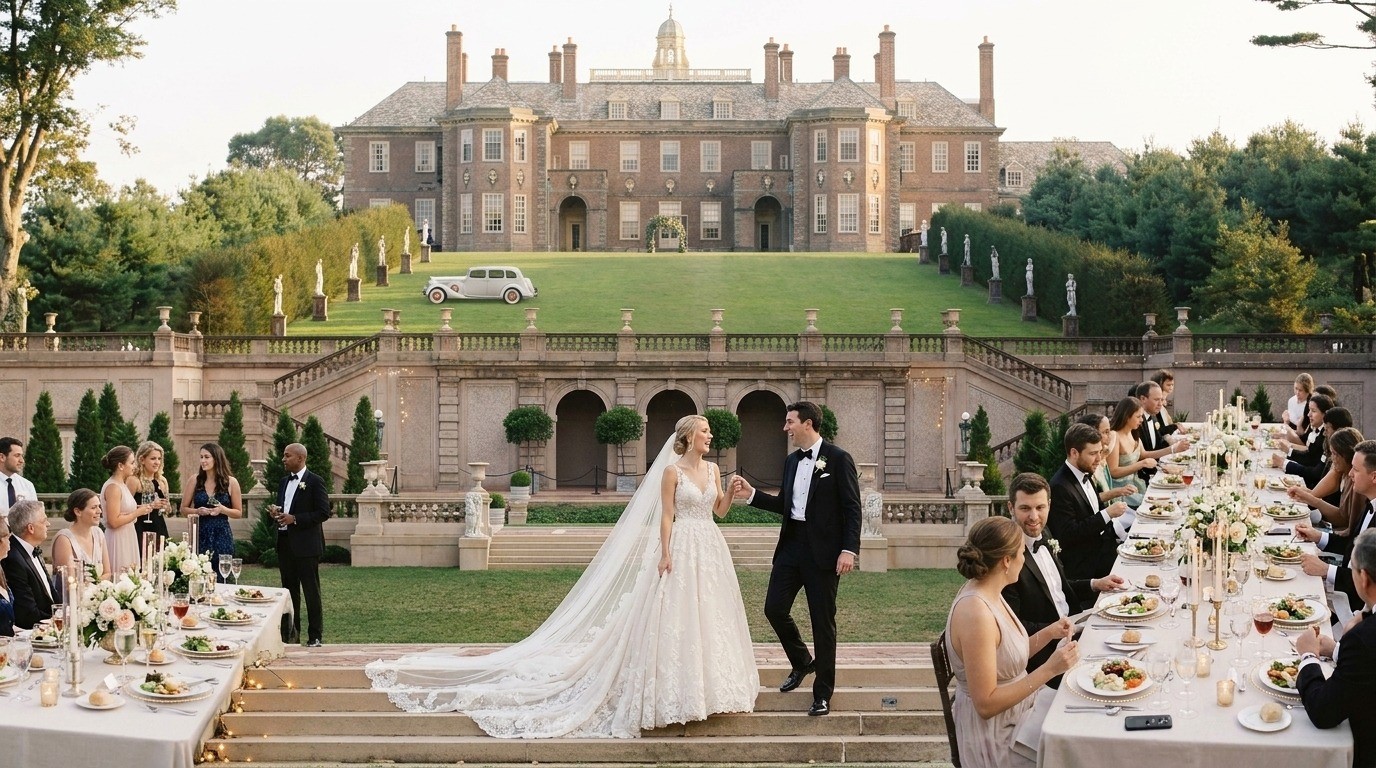
A 59-room mansion on 2,100 acres with a half-mile grass allée that ends at the Atlantic Ocean — and yes, it looks exactly like it did in the movies..
The approach alone tells you something. Protected marshland gives way to old-growth canopy before the Great House finally reveals itself — a Stuart-style mansion designed by Chicago architect David Adler in 1928 for plumbing magnate Richard T. Crane Jr. Adler’s commission was specific: build something that matched the scale of the landscape. On 2,100 acres of North Shore coastline, that meant going big. Fifty-nine rooms. A library paneled in English oak. An Italian-inspired loggia. And the Grand Allée — that manicured lawn flanked by statuary and hedgerows, stretching from the mansion’s rear terrace a full half-mile down to Crane Beach and the Atlantic..
The Trustees of Reservations manage the estate, which means preservation standards are serious. Receptions at the Great House happen under a sailcloth tent for up to 250 seated. The Barn handles 130 for couples who want the estate address without the mansion formality, and Steep Hill Beach accommodates 600-plus for truly large-scale gatherings. Venue fees for the Great House run $8,500 to $11,500, with food and beverage minimums of $18,000 to $25,000 and catering drawn from an exclusive approved list..
Capacity: 250 seated (Great House tent); 130 seated (The Barn); 600+ (Steep Hill Beach) Spaces: Great House sailcloth tent, The Barn, Steep Hill Beach, Grand Allée, Italian Garden Price Range: $8,500–$11,500 venue fee (Great House); $18,000–$25,000 F&B minimums Peak Season: June–September Best For: Couples who want Gilded Age grandeur on a cinematic North Shore estate Pet-Friendly: No (strict Trustees of Reservations policy).
Acoustically, a sailcloth tent is nothing like a ballroom. Fabric absorbs highs, open sides bleed sound, and wind off the ocean is constant on that exposed hilltop. A horn or a vocalist projects where a speaker loses clarity to wind, which is why live instruments cut through this environment far better than a purely electronic setup. The five-hour event window is tight — your entertainment team arrives with a plan built for this specific site, no on-the-fly adjustments. And shuttle logistics between parking and venue eat into your timeline more than the schedule suggests on paper..
Hollywood has used Castle Hill as a location for decades — you might recognize it from The Witches of Eastwick or Greta Gerwig’s 2019 Little Women. The grounds where the Agawam tribe once lived are now one of the most photographed landscapes in North America. And the current mansion is technically the second attempt: Crane’s wife, Florence, rejected the original 1912 Italian Renaissance version because she preferred something more “English.” Adler demolished the first house entirely and built the Stuart-style mansion you see today in 1928.
Official website: https://theinnatcastlehill.com/the-crane-estate
Lyman Estate (Waltham)
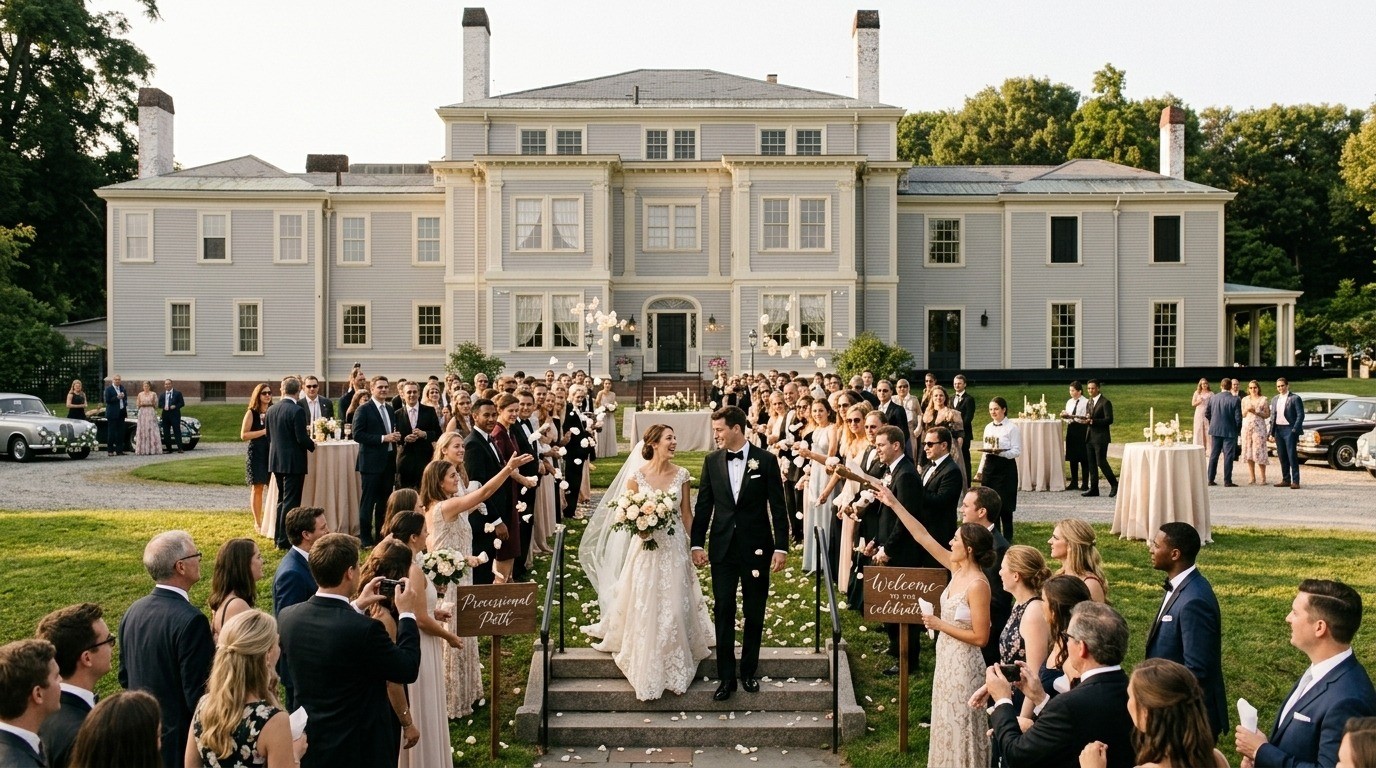
The ballroom where Boston first scandalously danced the waltz — and where the oldest surviving greenhouse in the United States still grows rare camellias.
From the street, the Lyman Estate barely registers. A Federal-style mansion, restrained, almost austere — the kind of building you’d walk past without a second glance. Then you step through the door into rooms that have been hosting social events since George Washington was President. Built in 1793 and known as “The Vale,” the architectural details are original — not restored, not reproduced, but the actual moldings and mantels crafted when the Federal style was brand new.
But the grounds are where Lyman Estate earns its devotion. Greenhouses dating to 1804 — among the oldest surviving in the country — hold rare camellias, grapevines that have been producing for generations, and the kind of botanical density that makes a skeptic stop and stare. Couples use them for portraits: warm light filtering through century-old glass onto plants that were growing before the War of 1812. The lawns accommodate tented events for up to 200, while the mansion interior seats 125 for a more intimate dinner.
Pricing is remarkably approachable for an estate of this caliber — peak Saturday rentals at $6,200, off-peak Saturdays dropping to $2,800. Couples bring their own alcohol through a licensed bar service and choose from an approved vendor list for catering. Historic New England, which manages the property, earned a Preservation Award for its stewardship. This is not a building that’s been gutted and rebuilt for events.
Capacity: 125 seated (mansion interior); 200 (tented lawn events) Spaces: Federal-era ballroom, mansion parlors, century-old greenhouses, tented lawn Price Range: $2,800–$6,200 (venue rental varies by date); approved vendor catering; BYOB with licensed service Peak Season: May (wisteria and greenhouse blooms) and October (foliage) Best For: Garden-loving couples on a realistic budget who want genuine history Pet-Friendly: Yes — pets allowed for outdoor ceremonies and cocktail hours (restricted from mansion interior)
Intimate rooms mean every sonic choice is magnified. Low ceilings relative to the larger estates on this list, original plaster walls, and compact dimensions create an acoustic environment where live instruments breathe beautifully but amplified sound needs a careful hand. A three-piece acoustic ensemble — violin, guitar, vocals — fills the ballroom with exactly the right presence. Crank a PA to standard wedding volume and the room pushes back inside thirty seconds, every surface bouncing sound into mush. The tented lawn flips the problem entirely: open air, no walls, ambient noise from the surrounding neighborhood. Out there, directional speakers and a performer who can project energy without relying on the room’s help are essential. Plan the transition between indoor and outdoor spaces carefully — the walk from the greenhouse to the tent is not a quick pivot.
In the early 1800s, the Lyman Estate ballroom hosted one of Boston’s most delicious social scandals. The waltz — that close-contact, face-to-face dance European society had already embraced — was introduced to Boston here for the first time. Local elders were so scandalized by the “indecent” proximity of the dance partners that they temporarily banned the waltz from other Boston venues. Two centuries later, the room where polite society clutched its pearls over a dance is the same room where couples now have their first dance as newlyweds.
Official website: https://www.historicnewengland.org/property/lyman-estate/
The Fairmont Copley Plaza (Boston)
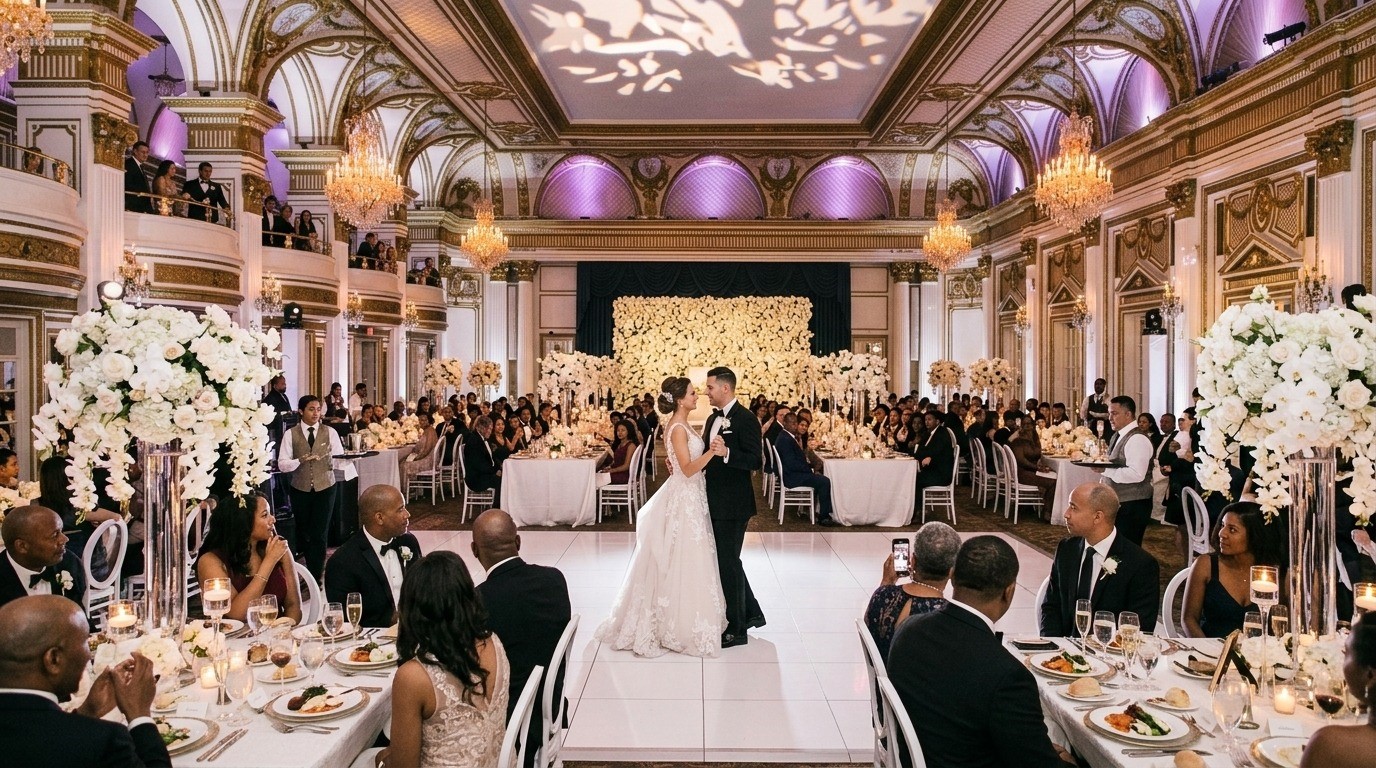
Every U.S. President since Taft has walked through this lobby — and the hotel’s Labrador retriever might be the most popular wedding guest in Boston.
Nothing about the Copley Plaza is understated. Step in from Copley Square — Trinity Church on one side, the Boston Public Library on the other — and the lobby delivers the full Beaux-Arts treatment: soaring ceilings, gilded mirrors, marble everywhere. This hotel has been the center of Boston’s social life since it opened in 1912, standing on the original site of the Museum of Fine Arts.
The Grand Ballroom anchors everything. Thirty-foot ceilings. Crystal chandeliers. Gilded mirrors lining the walls. Capacity for 600 seated — one of the few rooms in Massachusetts that can absorb a truly large-scale celebration without feeling like a convention center. The Oval Room (320 seated) and Venetian Room (230 seated) offer the Copley address at a more intimate scale, while “Peacock Alley” — the long gilded corridor named for the early 1900s socialites who used to parade there — remains one of the most popular bridal portrait locations in the city.
Where the Copley Plaza breaks from the grand-hotel template is its aggressively pet-friendly policy. Pets are welcome in all event spaces for a $50 fee, and the hotel’s resident “Canine Ambassador” — a Labrador named Cori Copley — has been known to appear at weddings in a bow tie. Venue fees start at $3,000; meal packages begin at $200-plus per person, with valet parking, luxury lodging, and full-service wedding planning included.
Capacity: 600 seated (Grand Ballroom); 320 seated (Oval Room); 230 seated (Venetian Room) Spaces: Grand Ballroom, Oval Room, Venetian Room, Peacock Alley, lobby Price Range: Venue fees from $3,000; meal packages $200+ per person Peak Season: December (legendary holiday decor) and May/June Best For: Black-tie couples who want a grand urban ballroom with full-service support Pet-Friendly: Yes — all event spaces ($50 fee); resident Canine Ambassador on staff
Gorgeous ceilings, consequential acoustics. Gilded plaster and marble create substantial reverb — a saxophone solo or vocal performance feels cinematic in here. But muddy bass pools and turns your dance music into a sonic blur. The key is high-frequency clarity: crisp vocals, sharp percussion, controlled low end. A hybrid setup — live musicians for presence, DJ for precision — is purpose-built for a room like this. Keep in mind the Grand Ballroom’s sheer scale: a three-piece acoustic combo that works beautifully in the Venetian Room will feel lost in the 600-seat main hall. Match the configuration to the room you’re actually using.
Every sitting U.S. President from Taft onward has passed through these doors. The building occupies the former site of the Museum of Fine Arts, which relocated to the Fenway in 1909 — meaning the ground beneath the Grand Ballroom once held masterworks by Monet and Sargent. The art moved; the grandeur stayed. Cori Copley, the current resident Labrador, has her own social media following and has appeared in more wedding photos than most human guests at this point.
Official website: https://www.fairmont-copley-plaza.com/weddings/
The Commons 1854 (Topsfield)
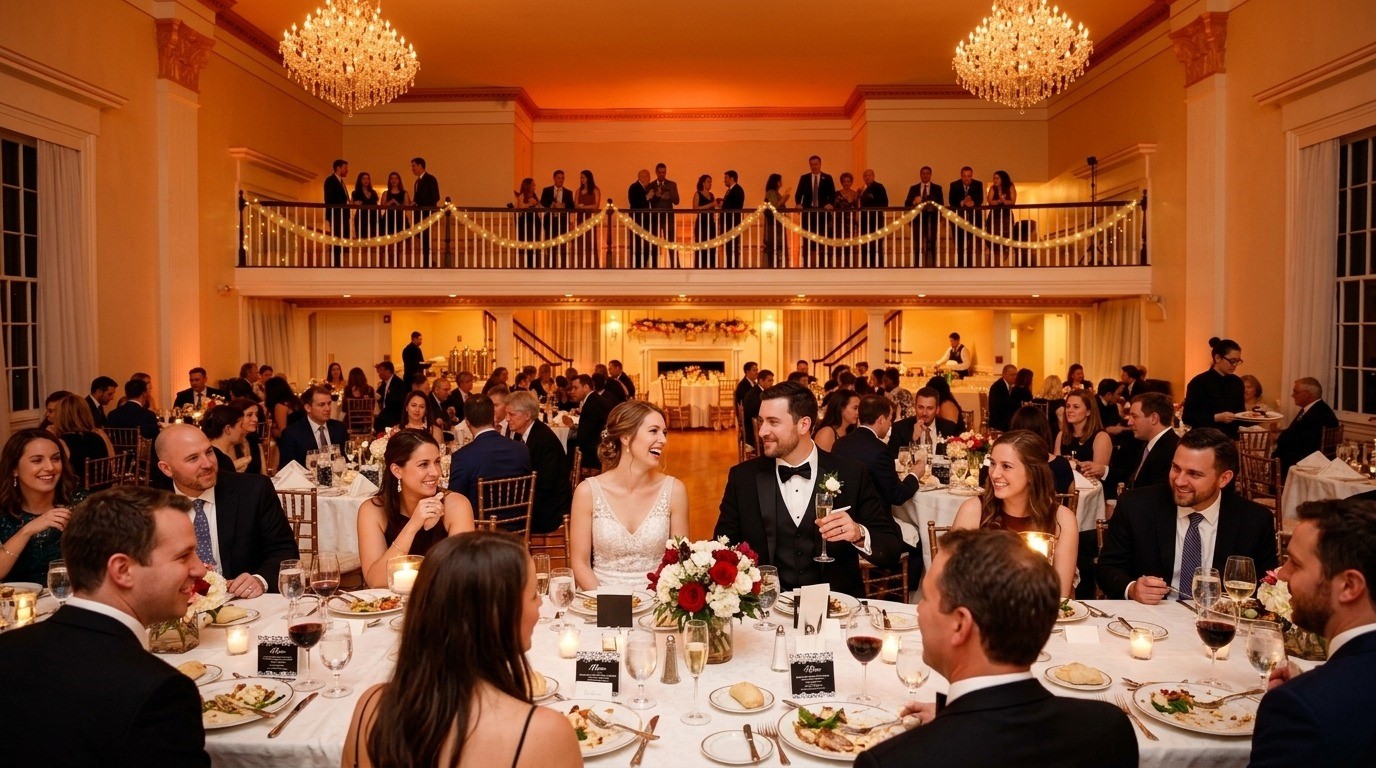
A former town meeting hall where abolitionists once debated, now fitted with Swarovski chandeliers and a four-sided mezzanine balcony built for dramatic entrances.
Topsfield is a small North Shore town — famous agricultural fair, quiet residential streets — and the building catches most people off guard. From outside, The Commons 1854 reads as a handsome but modest historic structure. Walk through the door and someone’s bold decisions become immediately apparent. Swarovski crystal chandeliers hang from restored ceilings. A neoclassical ballroom opens with proportions that feel European — clean lines, high walls, balanced geometry. Then there’s the balcony: a four-sided mezzanine wrapping the entire perimeter, creating a gallery-level vantage that transforms how you experience the space.
The balcony makes the room. Couples enter from above, appearing on the mezzanine and descending into the room while 200 guests look up. Photographers use it for a bird’s-eye angle on the first dance. Verticality and drama in a building that, from the street, promises neither.
Outdoor ceremonies happen in the private garden, and climate-controlled interiors mean the ballroom works year-round. In-house catering and bar are required. Pricing is straightforward: $2,000 to $3,000 reception fee, $1,500 ceremony fee, with bridal suite, groom’s room, and on-site parking included. For a boutique ballroom on the North Shore, The Commons delivers a surprising amount of architectural personality per dollar.
Capacity: 200 guests Spaces: Grand Ballroom with four-sided mezzanine balcony, private garden, bridal suite, groom’s room Price Range: $2,000–$3,000 reception fee; $1,500 ceremony fee Peak Season: June and September (best for outdoor garden ceremonies) Best For: Couples who want boutique ballroom drama on a North Shore budget Pet-Friendly: Conditional — pets allowed for outdoor ceremonies only
That mezzanine entrance is both a performer’s challenge and an opportunity. When the couple appears above, the room’s attention goes vertical — every head tilts up, conversations stop, energy shifts. MC and music have to be precisely synchronized with that descent. Start the entrance song too early and the moment deflates. Too late, and you’ve got an awkward pause with 200 people staring in silence. The ballroom itself — contained, climate-controlled, hard walls, moderate ceiling height — holds sound well. No bleed, no wind, no ambient noise competing with your setup. That’s a gift. A well-balanced PA with live instruments fills this room cleanly. For couples doing outdoor ceremonies, cocktail music bridges the garden-to-ballroom transition while guests move inside. Keep it simple, keep it playing, and let the room do its work once they arrive.
For over a century after its construction in 1854, this building served as the cultural and civic heart of Topsfield. Town meetings, public lectures, and — most notably — abolitionist gatherings took place in these rooms in the years leading up to the Civil War. The intricate woodwork contains hidden maritime symbols carved into the molding, a nod to the New England coastal craftsmanship tradition that defined the region’s architecture. Look closely at the trim work near the stage area and you’ll find them — anchors, rope patterns, and wave motifs tucked into the neoclassical detailing.
Official website: https://thecommons1854.com/
Boston Public Library (Boston)
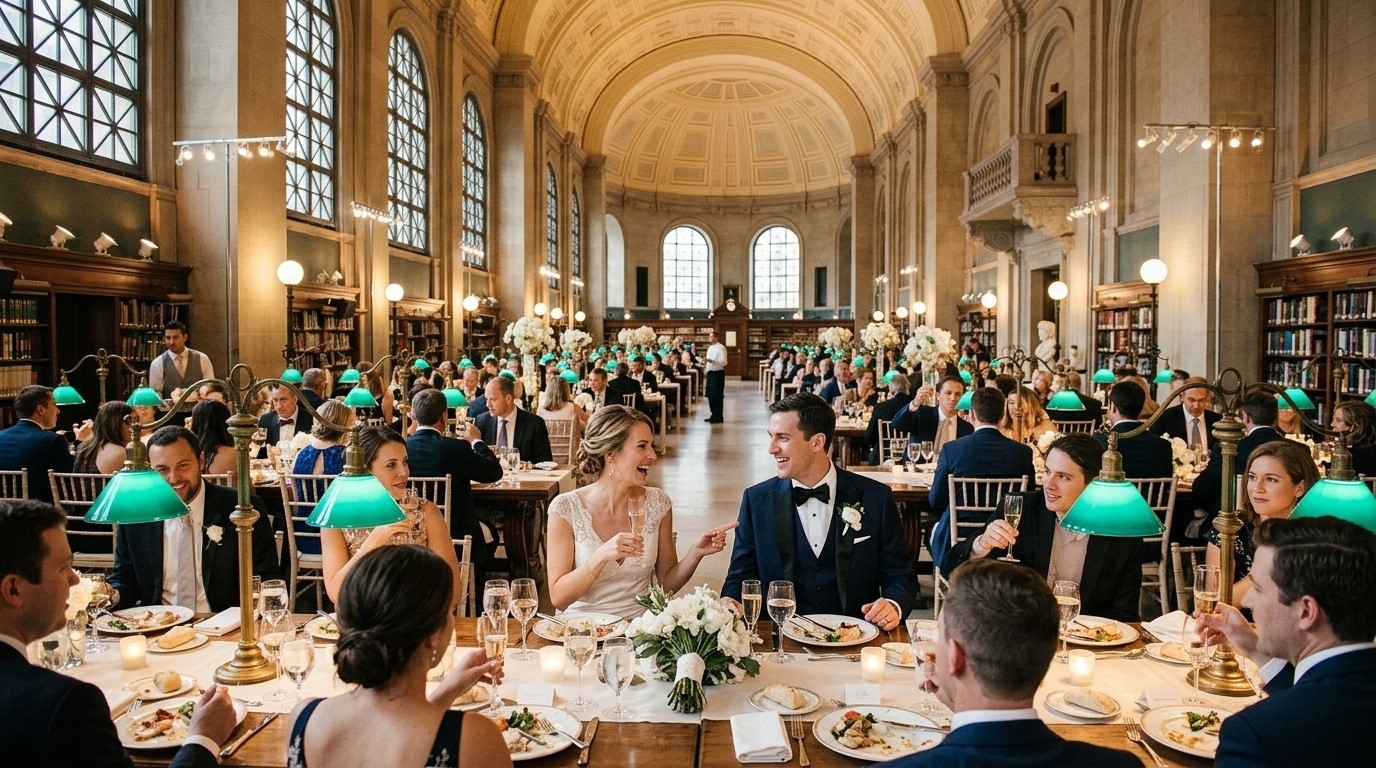
The first large free municipal library in the United States, designed by Charles Follen McKim in 1895 — where the Holy Grail murals eliminate your need for a florist.
Push through the bronze doors on Dartmouth Street and you’re standing inside a building designed as a public palace. McKim built a Renaissance Revival monument to the idea that knowledge should be free — Siena marble, travertine walls, vaulted ceilings painted by John Singer Sargent. The central courtyard, modeled after the Palazzo della Cancelleria in Rome, wraps an arcaded colonnade around a fountain where couples hold ceremonies for up to 200. In June and September, evening light drops into that courtyard and turns the stone a warm amber that looks planned — and with McKim, it probably was.
Bates Hall is the main event space — named for Joshua Bates, the library’s first benefactor who insisted the institution be “free to all,” a phrase carved into the facade. The hall seats 330 under a barrel-vaulted ceiling with massive arched windows. It runs 218 feet long. You don’t decorate a room like that. For something more intimate, the Abbey Room seats 100 surrounded by a wall-length mural cycle by Edwin Austin Abbey depicting the “Quest of the Holy Grail.” Museum-quality paintings at your dinner guests’ elbows, requiring zero additional decor — the kind of venue feature money can’t buy, because it was built for the public and you’re borrowing it for a night.
Venue fees range from $8,700 to $21,500-plus depending on rooms booked. Exclusive catering by The Catered Affair is required. No on-site parking (valet or public garage needed), and setup/teardown windows are strict — this is an active public institution, not a dedicated event space.
Capacity: 330 seated (Bates Hall); 200 ceremony (Courtyard); 100 seated (Abbey Room) Spaces: Bates Hall, Courtyard with fountain, Abbey Room (Holy Grail murals), Sargent Gallery Price Range: $8,700–$21,500+ (varies by rooms booked); exclusive catering by The Catered Affair Peak Season: June and September (courtyard evening light) Best For: Literary-minded couples who want a cultural landmark, not a hotel Pet-Friendly: No (service animals only)
A barrel-vaulted ceiling stretched across 218 feet creates an acoustic environment unlike any other wedding venue in Boston. The vault channels sound along the room’s length — position your PA incorrectly and half your guests hear echoed mush while the other half get crisp audio. Distributed sound solves this: multiple smaller speakers along the hall rather than two large stacks at one end. Live instruments thrive under that vault, the natural amplification adding body to strings and vocals that electronic playback can’t replicate. Keep in mind the library’s strict setup windows — your team can’t arrive hours early to experiment. Come with a plan, execute it, and respect the building.
McKim conceived the library as a “Palace for the People,” and it remains one of the finest Renaissance Revival buildings in the country. Upstairs, the Sargent Gallery — often explored by wedding guests between courses — contains John Singer Sargent’s mural cycle on the history of religion, a work so ambitious it consumed 30 years of his life. Joshua Bates, the London-based banker who funded the library, never actually lived in Boston. His $50,000 donation (roughly $1.8 million today) came with a single condition: that the building remain free and open to every citizen. That insistence is carved into stone above the entrance.
Official website: https://www.bpl.org/host-an-event/
How to Choose Between These Venues
Five historic mansion wedding venues in Massachusetts, and they couldn’t be more different from each other. The right one depends on guest count, budget, personality, and logistics.
Guest list over 300? The Fairmont Copley Plaza is your only realistic option here — the Grand Ballroom seats 600, and the Oval Room handles 320. Castle Hill’s Great House tent tops out at 250, and the Boston Public Library’s Bates Hall maxes at 330. On the other end, intimate celebrations under 130 find their natural home at the Lyman Estate mansion interior (125 seated) or The Commons 1854 (200 max, but its boutique proportions make it feel smaller and warmer than the number suggests).
Budget is where these venues diverge most sharply. Lyman Estate’s off-peak rental of $2,800 with BYOB occupies a different financial universe than the Copley Plaza’s $200-plus per person meal packages or the BPL’s $21,500 venue fee ceiling. The Commons 1854 sits in approachable middle territory — $2,000 to $3,000 reception, $1,500 ceremony. Castle Hill runs $8,500 to $11,500 for the venue alone, plus $18,000 to $25,000 in F&B minimums. Know your number before you tour.
When architectural drama is the priority, the Copley Plaza’s Grand Ballroom and Bates Hall deliver it through pure scale and ornamentation. The Commons 1854 achieves something equally striking by different means — the surprise of a mezzanine balcony entrance in a building no one expected to contain that kind of space.
Airport logistics matter for out-of-town guests. Boston venues (Copley Plaza, BPL, Lyman Estate in Waltham) sit within 30 to 45 minutes of Logan International. Castle Hill in Ipswich is about an hour north, with shuttles often necessary on-site. The Commons 1854 in Topsfield falls 30 to 45 minutes from Logan.
And if the story matters as much as the setting — Lyman Estate’s waltz scandal, Castle Hill’s Hollywood film pedigree, the BPL’s “free to all” democratic mission — each venue carries a narrative guests will remember long after the last dance.
Why Entertainment Matters More Than You Think at Historic Mansions
Old buildings have opinions about music. They were built before amplified sound existed — architects thinking about voices, footsteps, chamber orchestras. Bring a modern entertainment setup into one of these rooms and you’re joining a conversation that started a century or two before you arrived.
Reverb is the central variable. High ceilings and hard surfaces — marble, plaster, stone, gilded wood — reflect sound instead of absorbing it. In the Copley Plaza’s Grand Ballroom, a sustained bass note bounces off six surfaces before it decays. Push sub-bass at nightclub levels and the room dissolves into a soup of overlapping frequencies. A live saxophone in that same room, though? The reverb adds warmth and dimension that a studio recording can’t touch. The room becomes the instrument’s partner rather than its enemy.
Bates Hall at the Boston Public Library presents a different puzzle entirely. That barrel-vaulted ceiling functions like a sound tunnel — audio travels the 218-foot length with surprising efficiency, a speaker at one end sending a delayed version to the other. Distributed speaker placement solves this, but only if your team understands the physics before they show up. Meanwhile, the Lyman Estate’s low-ceilinged Federal rooms flip the problem: intimate enough that over-amplification becomes physically uncomfortable in seconds.
Equipment protection also matters more here than at any modern venue. Original hardwood at Lyman Estate, marble thresholds at the Copley Plaza, priceless murals at the BPL — your entertainment team needs to route cables without damaging surfaces, set speaker stands on protective pads, and load in through doors that haven’t been widened since the 18th century. The couples who get this right hire entertainment that respects the architecture as much as they do.
Why DLE Event Group
Massachusetts’ historic mansions don’t need more sound. They need the right sound, placed by people who’ve learned what these rooms want.
Our hybrid DJ band model was built for exactly this kind of challenge. Live musicians — saxophone, guitar, keys, percussion, vocals — produce organic sound that resonates naturally in high-ceiling plaster and marble rooms. A live horn section in the Copley Plaza’s Grand Ballroom, or a vocalist under the barrel vault in Bates Hall, creates presence that a purely electronic setup simply cannot replicate in these acoustic environments. The DJ component gives us the song library, the seamless transitions, and the precise energy control that keep a dance floor packed past midnight. Not one or the other — the combination of live instruments for rooms that reward them and DJ precision for moments that demand it is what makes historic venues come alive.
Backup equipment comes to every event. Duplicates of everything critical. When the architecture is irreplaceable and the floor beneath your speakers is older than your grandparents, redundancy isn’t optional — it’s standard procedure. Our team arrives with a plan specific to that room: speaker placement mapped to the ceiling geometry, cable routing designed to protect historic surfaces, volume calibrated to the space’s natural reverb.
DLE Event Group has performed at 100-plus weddings and events across New York City’s most prestigious historic venues — The Plaza Hotel (all eight event spaces), The Pierre, Gotham Hall, Guastavino’s — and throughout the broader region. We’ve earned The Knot Best of Weddings Hall of Fame 11 consecutive times (2013-2023). Planning starts 5 to 10 Zoom sessions before your wedding, covering music, timeline, and your venue’s specific acoustic requirements. We learn custom songs for first dances and build pronunciation guides for MC introductions. Massachusetts is well within our service area.
Frequently Asked Questions
Ready to Plan Your Massachusetts Mansion Wedding?
Five venues. Three centuries of combined architectural history. Five completely different ways to get married in a building that carries weight.
The mansion sets the stage. The entertainment is what fills the room with energy, holds guests on the dance floor, and turns architectural grandeur into a celebration people talk about for years.
DLE Event Group specializes in making old rooms feel electric without fighting the acoustics that make them special. If you’re exploring Massachusetts wedding venues for the 2025-2026 season, we’d like to hear what you’re planning.
QUESTIONNAIRE
Need Assistance? Directly reach us at contact@dleeventgroup.com or 877.534.2424