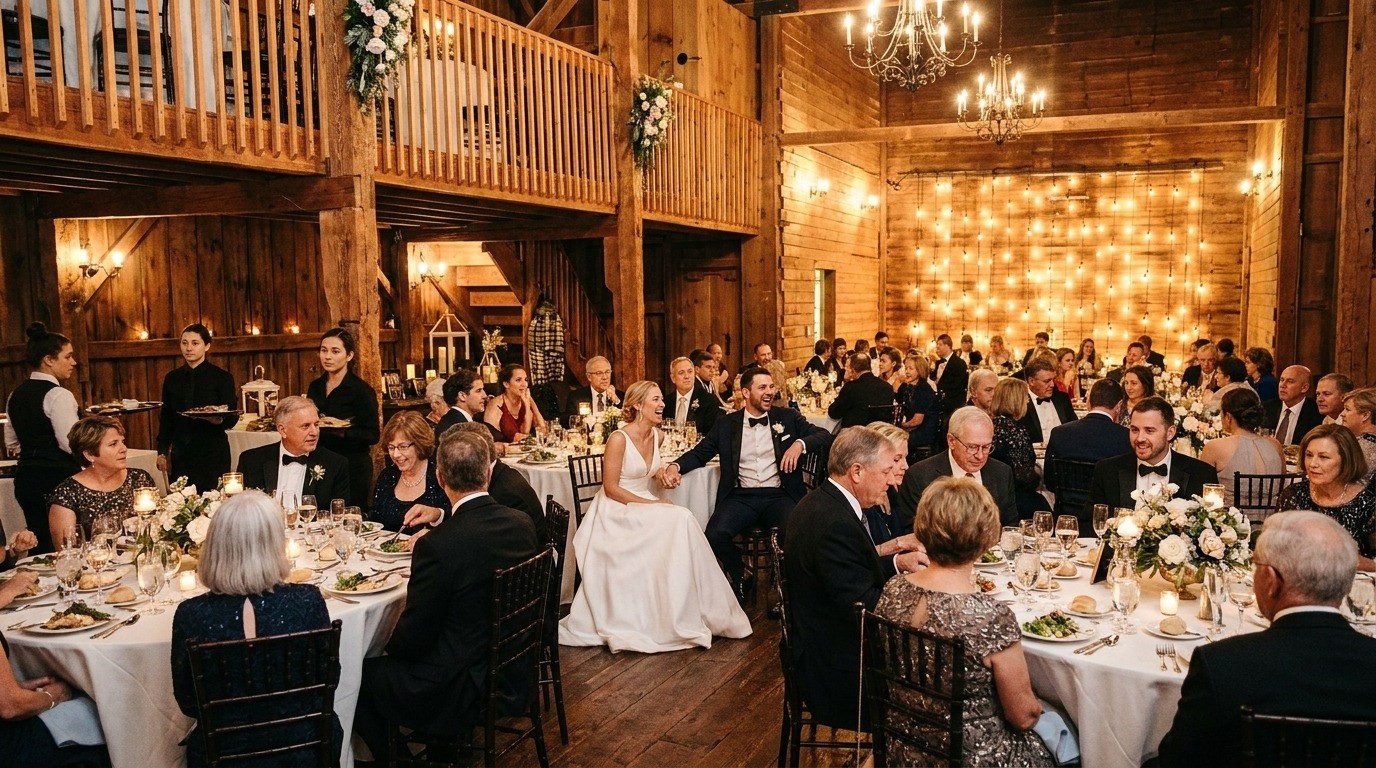
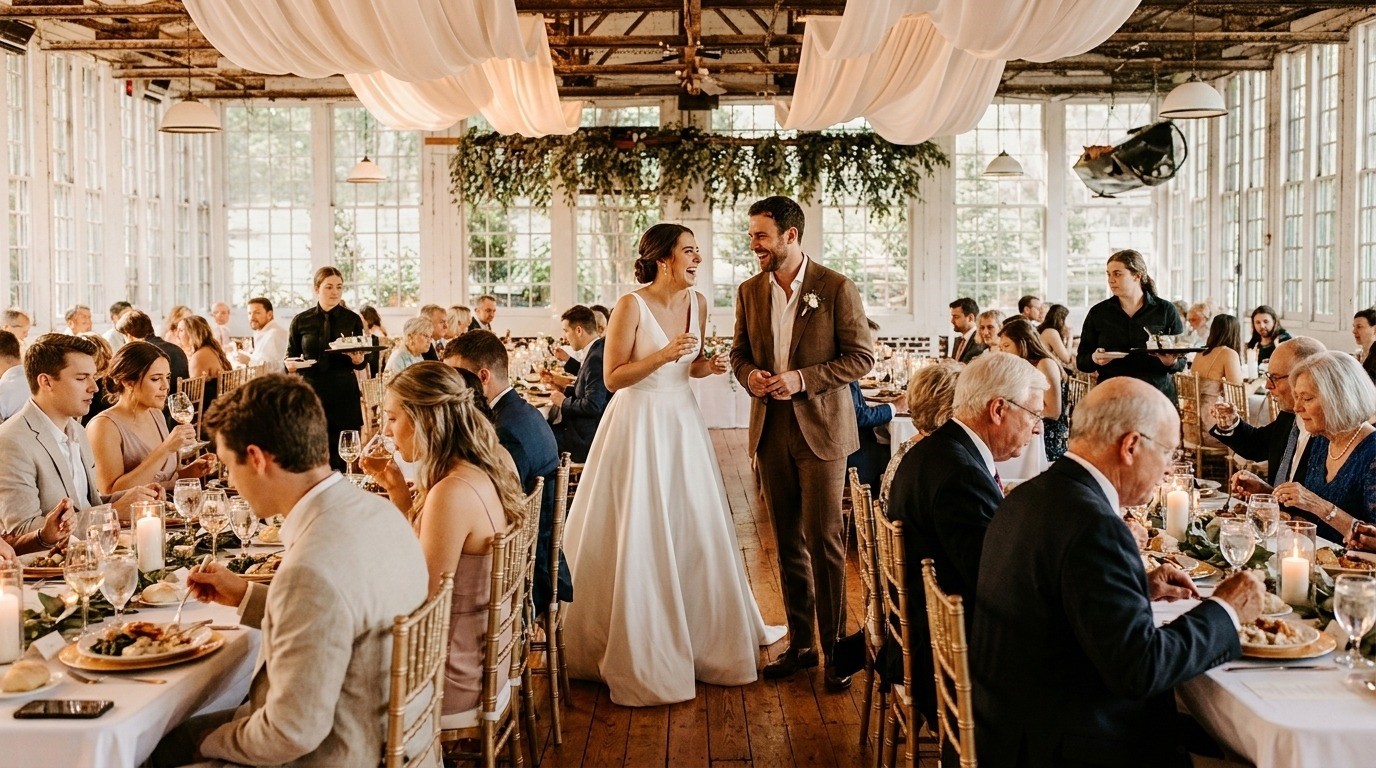
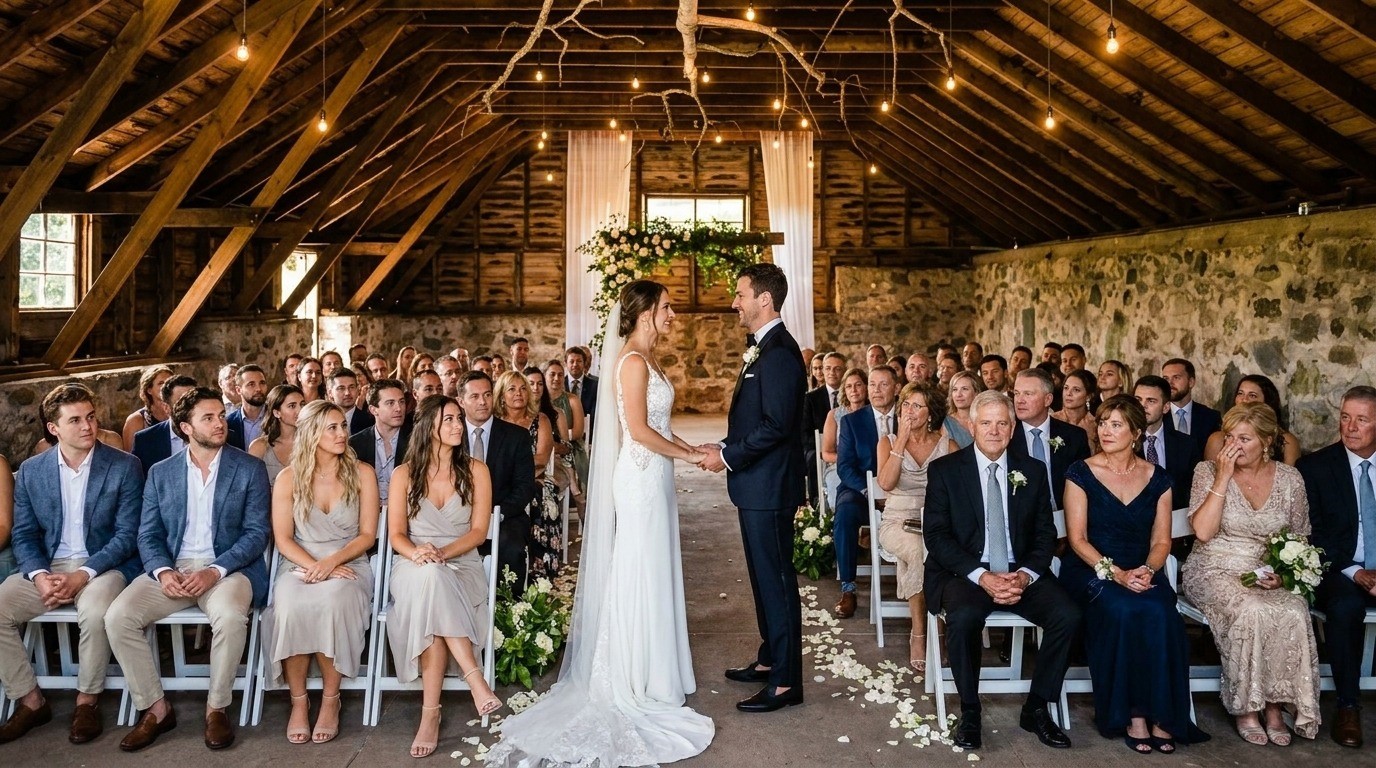
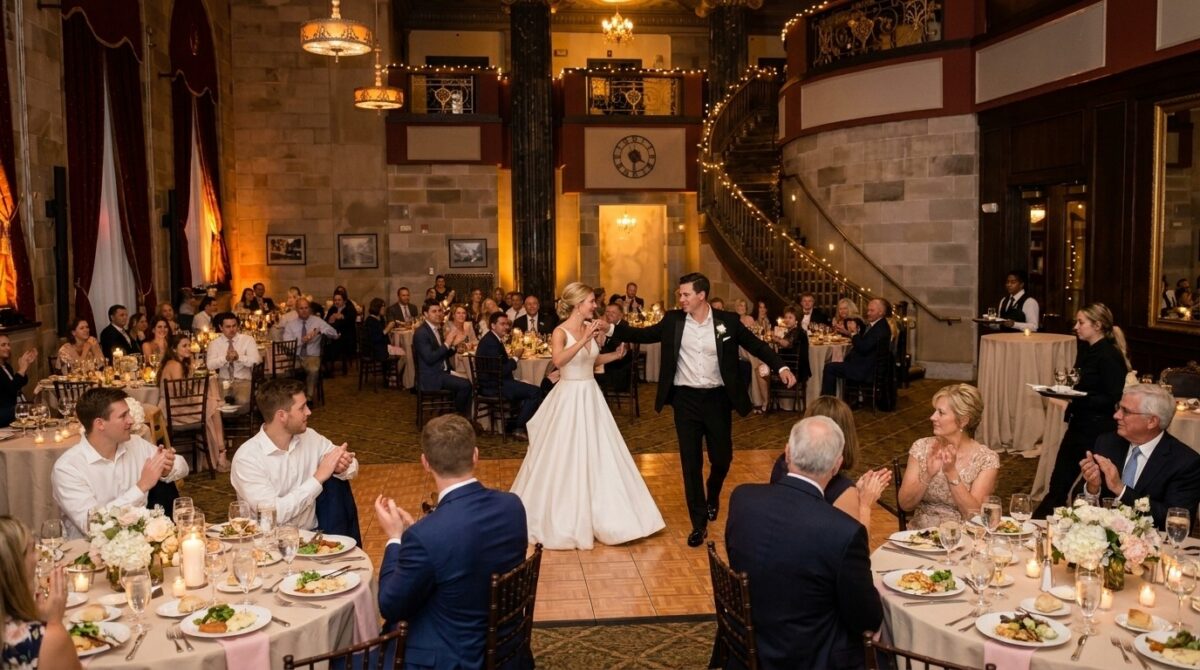
Top 5 Waterfront Wedding Venues in Massachusetts: An Entertainer’s Insider Guide

Top 5 Waterfront Wedding Venues in Massachusetts: An Entertainer’s Insider Guide

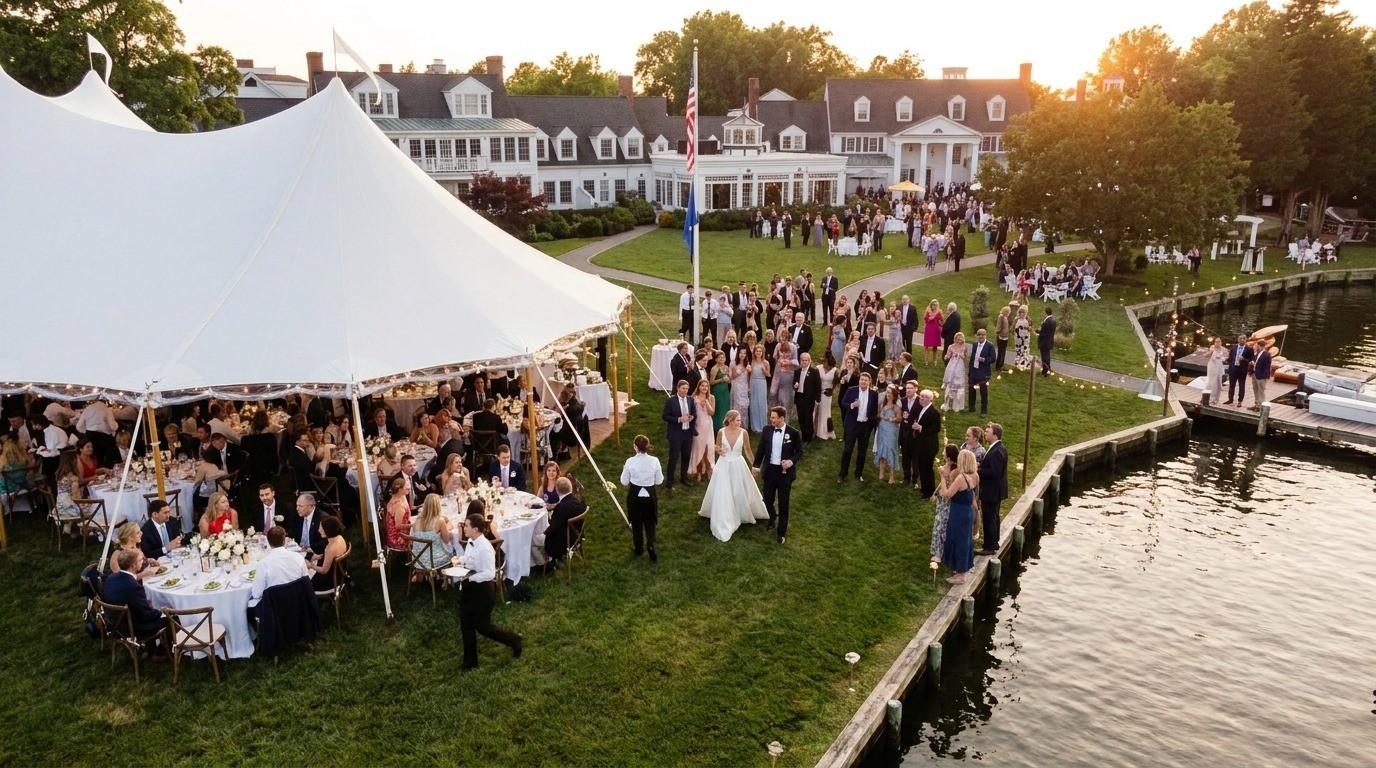
The bass player was tuning up on a deck in Harwich Port when the harbor pilot boat cut across the water, trailing a wake that caught the last of the sun and threw gold light across every surface — the tables, the glassware, the faces of a hundred and fifty people who had just stopped talking mid-sentence. Cape Cod does this to you. You plan a wedding around flowers and timelines and seating charts, and then the Atlantic hands you a moment no florist could have manufactured. I watched the couple look at each other and I watched their guests look at the water and I thought, for maybe the four hundredth time in my career: this is why people get married on the coast.

Massachusetts has 1,519 miles of tidal shoreline, and the character shifts radically depending on where you are. Cape Cod’s soft sand and salt-bleached shingle cottages feel nothing like the granite cliffs of the North Shore, which feel nothing like Boston Harbor’s brick-and-steel waterfront. I’ve loaded speakers through marina service entrances, calibrated sound systems in ballrooms where floor-to-ceiling windows turned the ocean into a wall of moving light, and learned which waterfront wedding venues Massachusetts couples should have on their radar for the 2025-2026 season. These five are as varied as that coastline — from a family-owned peninsula in the smallest town in the state to a Forbes Five-Star hotel with a colonial fort beneath its foundation.

Not because they’re the most advertised, but because they’re the ones that work — for the couple, for the guests, and for the entertainment team trying to give you the night of your life.

Why Waterfront Venues Work for Massachusetts Weddings

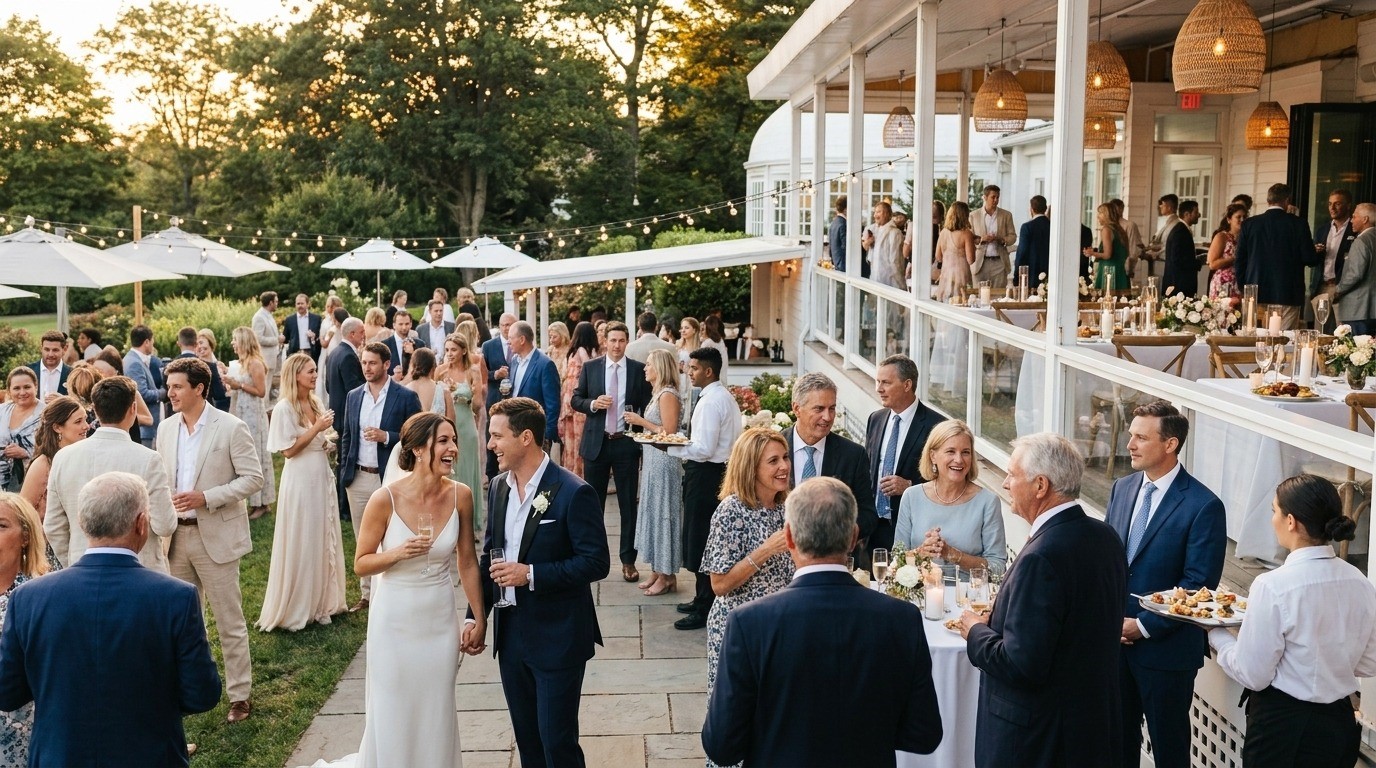
The views sell it. What actually makes a waterfront wedding different is how the water reshapes behavior. Put a hundred and fifty people on a coastal terrace during cocktail hour and watch what happens — nobody huddles in the corners. They drift toward the railing, the deck edge, the stretch of sand. Everyone orients in the same direction, watching the same light shift over the water, and conversation opens up on its own. Ceremony to cocktails to reception — that progression runs smoother at a waterfront property because the landscape is doing half the choreography for you.

For someone running the entertainment, Massachusetts coastal venues have a structural gift that inland properties can’t offer: nearly all of them separate the outdoor ceremony space from the indoor reception room. Sunset vows on a beach or cliffside, then guests move into a ballroom where the sound system is already dialed in and the dance floor is waiting. Open air to contained energy — that’s a momentum build you can’t manufacture in a single-room venue. Time it right and your guests walk into the reception feeling like the evening just shifted into a higher gear, without anyone having to announce it.

Then there are the logistics that only matter once you’ve committed to the coast. Sound carries over open water — gorgeous when it’s a solo guitarist during vows, less gorgeous when your amplified reception bleeds across the harbor at 9 PM. Wind along the Massachusetts coast is a constant from May through September, predictable enough that experienced vendors plan for it, inconsistent enough that it still humbles the ones who don’t. And a practical bonus: most of these waterfront wedding venues Massachusetts has to offer include on-site lodging or sit minutes from it, which means your guests aren’t mapping Ubers at midnight.

The Venues

Wychmere Beach Club (Harwich Port)
img41

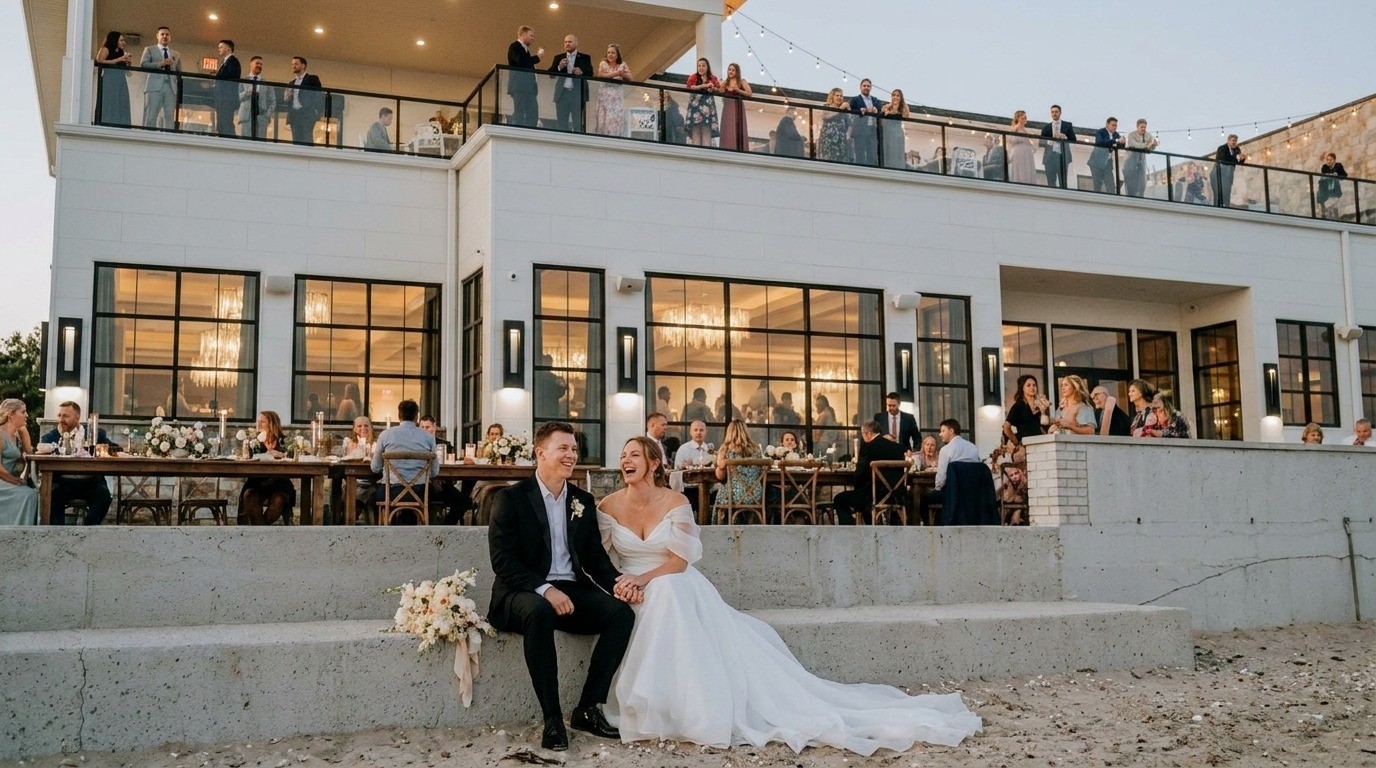
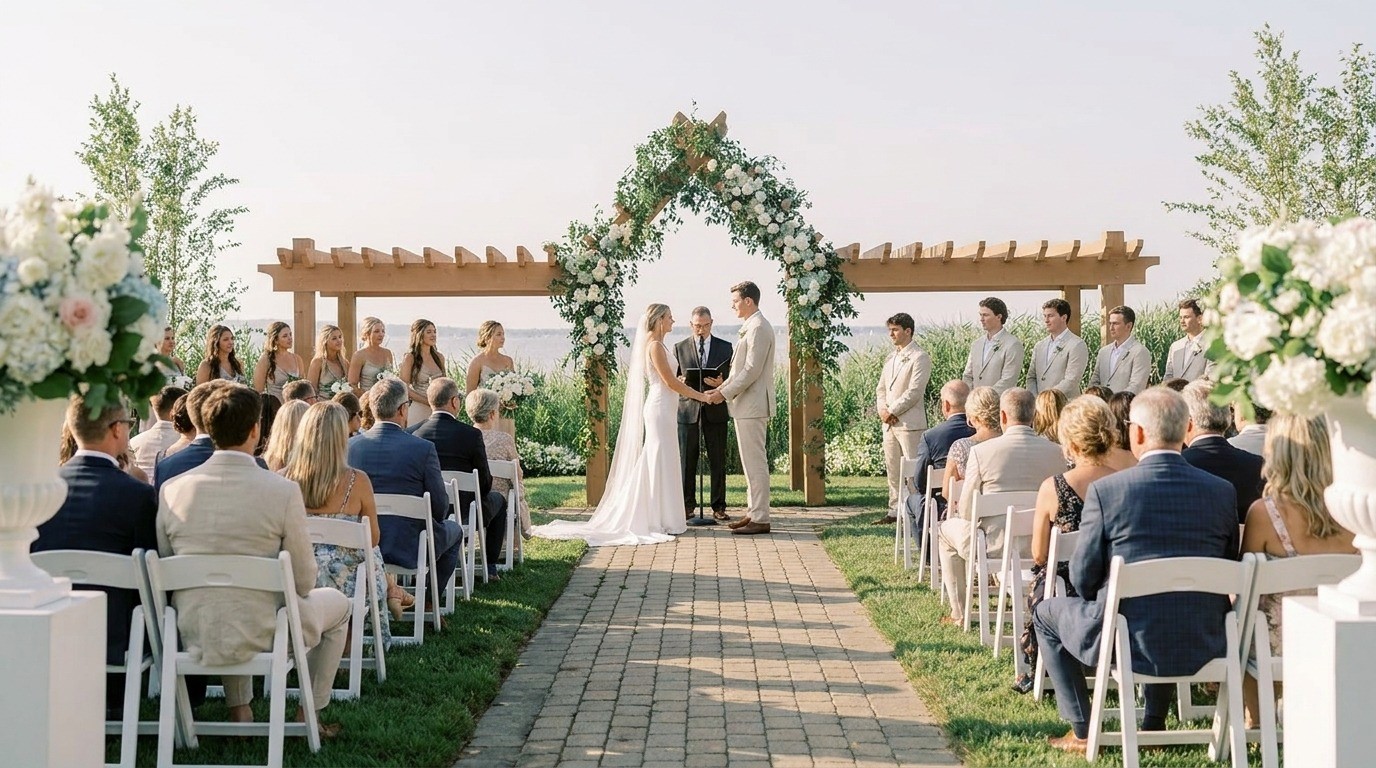
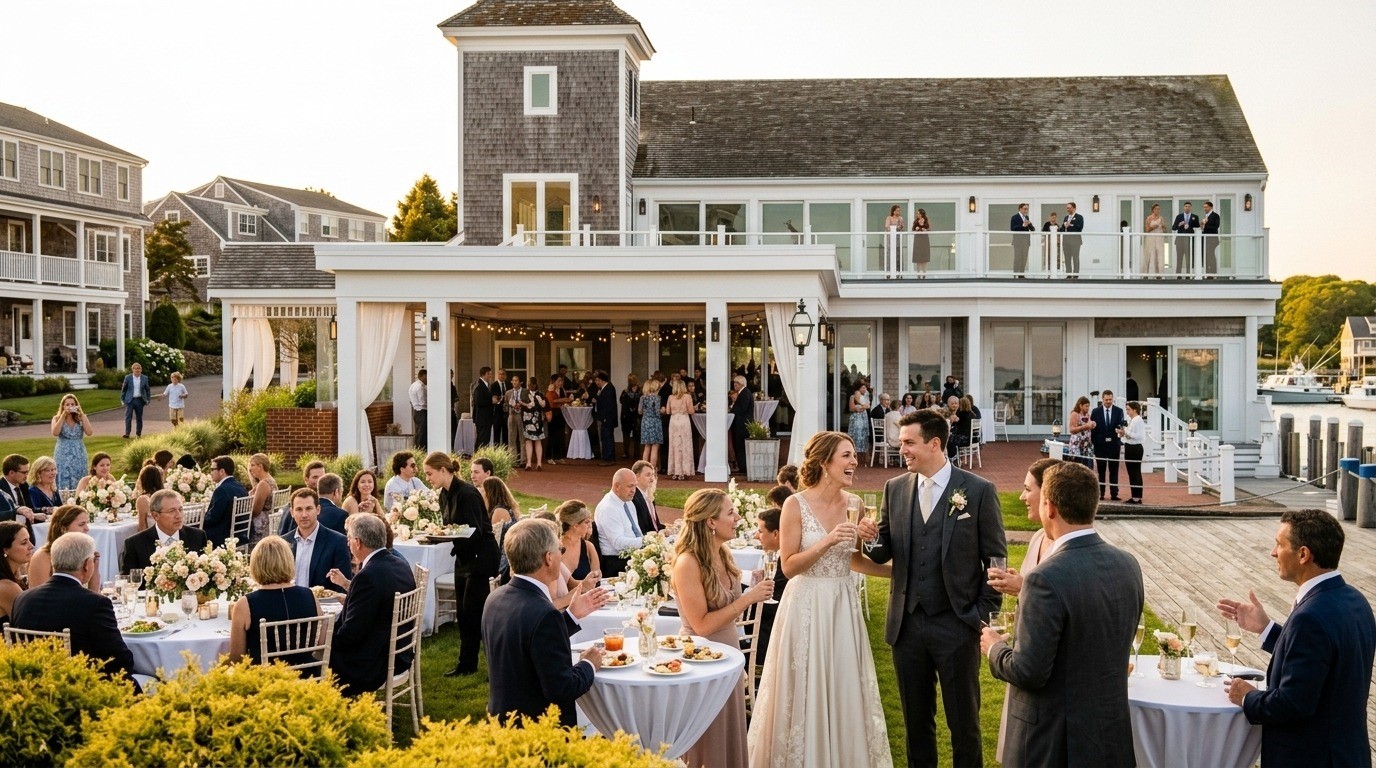
Twenty-eight oceanfront acres on Cape Cod, three distinct event rooms, and a private beach where the sand is warm enough to stand on barefoot through September.

Wychmere isn’t a cramped beachside restaurant with a function room tacked on — it’s a full coastal compound spread across nearly thirty acres of Harwich Port oceanfront, with manicured grounds, private beach access, and a white-on-white aesthetic that manages to feel luxurious without being cold. The venue traces its roots to 1892, when it opened as the Snow Inn, a Victorian-era lodging that served Harwich Port’s shipping families. By mid-century, the property had become Thompson’s Clam Bar — a Cape Cod institution — before its transformation into the modern beach club that now hosts some of the most sought-after weddings on the Cape.

Three reception spaces give you options that genuinely differ: the Harbor Room handles up to 320 seated guests with harbor and marina views; the Ocean Room accommodates 240 with a more open feel; and the Dune Room — the one I’d steer couples toward for 160 or fewer — features a private deck where your ceremony happens with feet in the sand, followed by a reception overlooking the Atlantic. Rooftop cocktail hours are a Wychmere signature: the elevation gives guests a panoramic sweep of Nantucket Sound that earns audible reactions, and it separates cocktails from the reception space in a way that makes the ballroom reveal feel intentional.

Capacity: Harbor Room (320 seated), Ocean Room (240 seated), Dune Room (160 seated) Spaces: Harbor Room, Ocean Room, Dune Room with private deck, private beach, rooftop cocktail area Price Range: Venue fees $4,000-$18,000; F&B minimums $36,000-$125,000 depending on space and date Peak Season: June-September Best For: Cape Cod luxury seekers who want beach access and options for 150-300 guests Pet-Friendly: No (service animals only)

Three reception rooms mean three different acoustic environments, which is unusual for a single property. The Harbor Room — 320 seats — requires deliberate speaker placement to keep sound present without bouncing off all that glass. The Dune Room is the performer’s favorite: intimate enough that a band fills it without fighting the space, and the indoor-to-deck flow lets you run an acoustic set outside during sunset before pulling energy inside for dancing. The five-hour event window keeps your timeline honest — not a limitation, but a forcing function that prevents the night from losing shape.

The Dune Room’s private deck is the detail that stays with you. Your ceremony happens on sand — not a symbolic beach, but actual Cape Cod shoreline — and then you walk your guests up to a reception with the Atlantic framed in every window. Thompson’s Clam Bar, the mid-century institution that once occupied this land, was famous enough that “Thompson’s by the Sea” became a local catchphrase. The venue’s architectural evolution from Victorian inn to clam bar to luxury beach club is a compressed history of Cape Cod tourism itself — and that story is visible in the property’s bones if you know where to look.

Official website: https://www.wychmere.com/

Beauport Hotel Gloucester (Gloucester)

img42

Samuel de Champlain named this harbor “Le Beau Port” in 1606, and four centuries later, the floor-to-ceiling windows in the ballroom prove he wasn’t exaggerating.

Gloucester has been a working fishing port since before the Pilgrims landed at Plymouth, and the Beauport Hotel sits on that heritage without sanitizing it. Lobster boats share the harbor with sailboats, the seagulls are aggressive and unapologetic, and the light off the water hits the ballroom windows with a quality photographers describe in terms usually reserved for the Italian coast. The hotel is modern boutique construction — built on the site of a former birdseed factory — but the name reaches back to Champlain’s 1606 expedition, when the French explorer designated this harbor “Beautiful Port.”

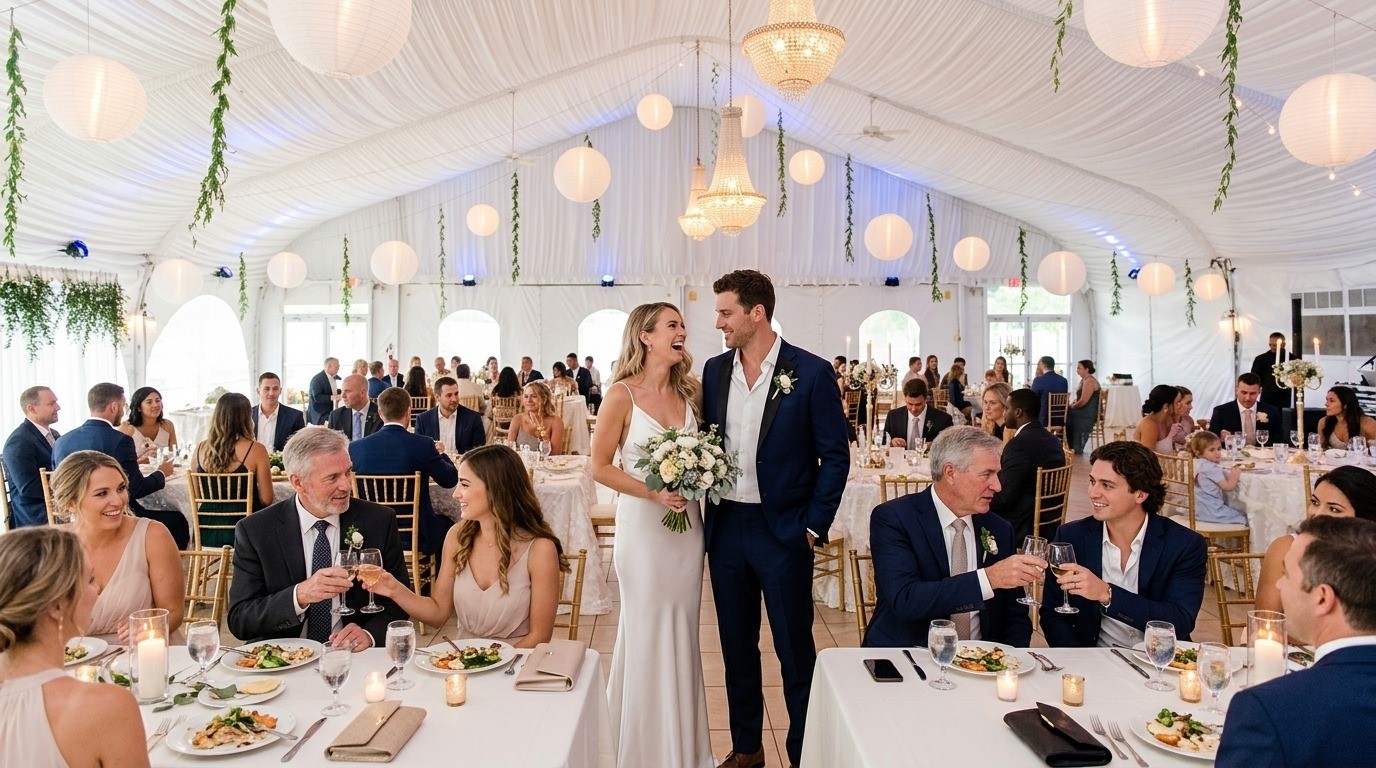
The Beauport Ballroom seats 230 and earns that number without feeling overstuffed. Floor-to-ceiling windows along the harbor side turn the water into something more than a backdrop — it shifts color as the sun tracks across the sky, a living element in the room that no decorator could have planned. Soft blues, weathered grays, driftwood accents: the design reads coastal upscale without trying too hard. Ceremonies happen on the Rooftop Terrace, which may offer the most commanding harbor perspective on the entire North Shore — an elevated, open-air platform where your vows unfold above the waterline, Gloucester’s working harbor stretched out below. Ninety-four luxury guest rooms and a complimentary bridal suite turn the hotel into a self-contained wedding weekend. Guests check in Friday, attend Saturday, brunch overlooking the harbor Sunday. Nobody is searching for a hotel at 11 PM.

Capacity: 230 seated in the Beauport Ballroom; Rooftop Terrace and Oceanside Terrace for ceremonies Spaces: Beauport Ballroom (reception), Rooftop Terrace (ceremony/cocktails), Oceanside Terrace, 94 guest rooms Price Range: Venue fees $6,500-$9,500; ceremony fee $1,500; F&B minimums vary by season Peak Season: May-October Best For: North Shore couples who want a boutique hotel wedding with harbor views and on-site lodging Pet-Friendly: No (service animals only in event spaces)

Late afternoon sun reflecting off the harbor bathes the room in warm ambient light — but it also means your lighting plan has to account for the transition from daylight to artificial as evening sets in. The ballroom’s proportions work well for 230: ceilings high enough to avoid that compressed feeling, enough soft furnishings to keep sound reflections in check. Moving guests from the Rooftop Terrace ceremony through cocktails and into the ballroom is a clean sequence — the reception room gets its final touches while everyone is occupied upstairs, and that separation builds genuine anticipation for the reveal. Ninety-four on-site rooms is the kind of number that keeps a dance floor packed past 10. When the elevator ride to bed is sixty seconds, nobody starts calculating drive times at 9:30.

Up on the rooftop pool and bar area — available for pre- or post-wedding events — your guests get a “ship-deck” vantage of the harbor that has become one of the North Shore’s most photographed wedding weekend moments. From that height, Gloucester’s fishing fleet is visible coming and going in the channel below. This is an operating harbor, not a decorative one, and that authenticity lends the venue a texture no manicured resort can replicate. Ask anyone who’s attended a Beauport wedding what they remember, and the answer is almost always the harbor — its sound, its smell, the constant working life visible through every window.

Official website: https://www.beauporthotel.com/

The Oceanview of Nahant (Nahant)
img43

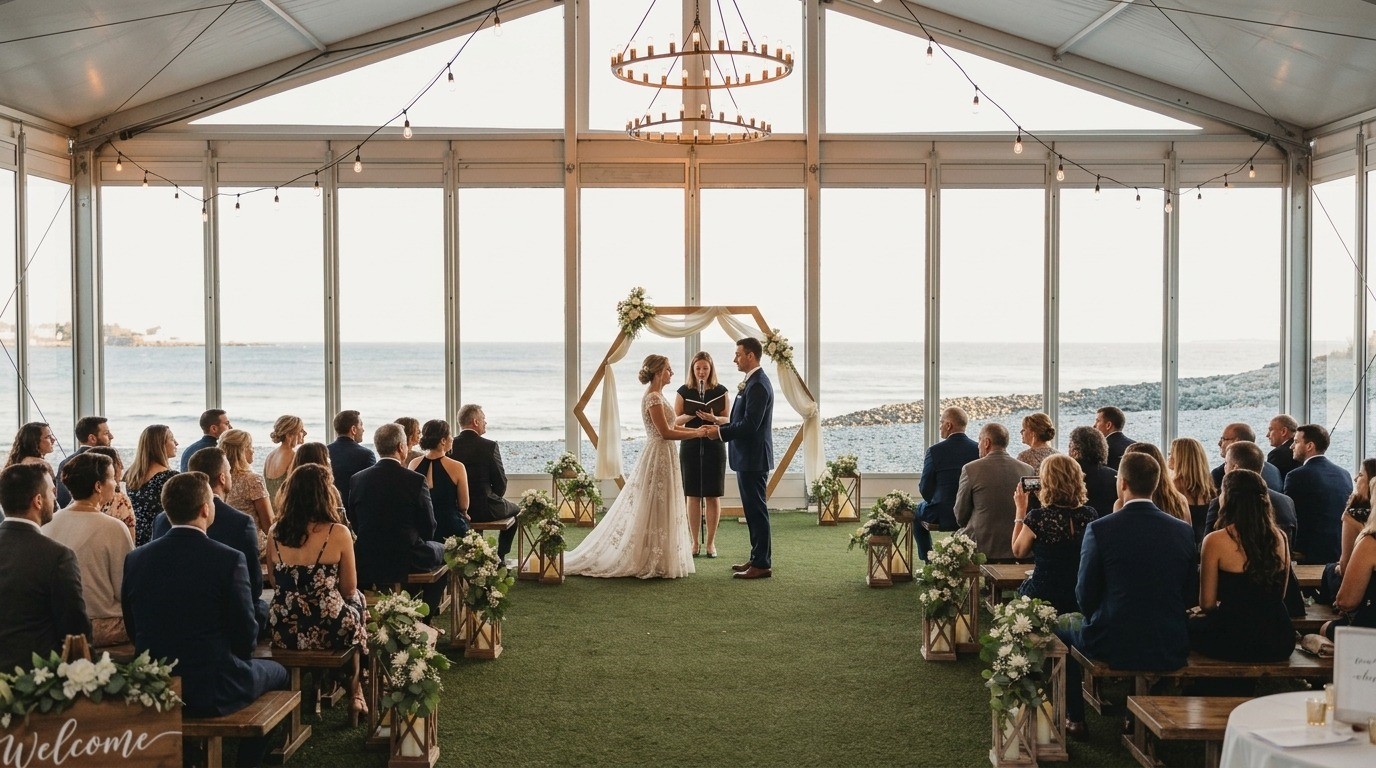
A family-owned venue on a private rocky peninsula in the smallest town in Massachusetts, where 360-degree ocean views come standard and the last dance happens on the beach.

Nahant is a peculiar place. Technically a town — the smallest by area in the entire Commonwealth — it’s really a mile-long peninsula connected to the mainland by a causeway, with the Atlantic on all sides. The Oceanview sits on a private rocky point where the ocean views aren’t “on one side” — they’re everywhere, 360 degrees of unobstructed water. On a clear day, the Boston skyline hovers in the distance, giving photographs a dramatic urban-coastal layering unique to this location.

Family ownership shows up in ways you notice immediately. This isn’t a corporate hotel that bolted on an events division — the people running your wedding know every quirk of the space, every way the light shifts across seasons, which corner of the deck catches the wind at 6 PM in July. The Grand Ballroom’s panoramic windows let the ocean into the room without the weather. Outside, a private beach serves as the ceremony site — rocky New England coastline where the waves supply your processional soundtrack. Between the two, a tented cocktail lounge gives guests a sheltered transition with the sea air still in play. Fourteen Knot Best of Weddings wins and Hall of Fame status confirm what the repeat bookings already told you: this consistency is not a coincidence.

Capacity: 220 guests Spaces: Grand Ballroom (panoramic windows), private beach (ceremony), tented cocktail lounge Price Range: ~$168-$210+ per person; venue rental $3,500-$6,500 Peak Season: July-September Best For: Couples who want a private, intimate coastal feel with all-inclusive simplicity Pet-Friendly: Conditional — pets allowed for outdoor ceremonies only (restricted from indoor spaces)

Wind is a constant on this peninsula — not a dealbreaker, but the single fastest way to tell experienced coastal entertainers from rookies. Beach ceremonies demand weighted mic stands, secured music stands, and backup plans for gusts that arrive without warning. Inside the Grand Ballroom, the proportions are right for 220 — sound fills the space without needing to overpower it. The real timeline constraint is the 11 PM music curfew: your reception has to build energy efficiently, which means no meandering first hour followed by a frantic ninety-minute sprint. A smart entertainment team structures the set list to front-load the peaks and make every minute land.

What the Oceanview is known for — and what keeps drawing couples back — is the “Last Dance on the Beach.” After the reception, the couple walks onto the private beach for a final dance on sand under a spotlight, guests lined up along the deck above. Sentimental? Absolutely. But it gives the evening a cinematic close instead of the usual slow dissolve toward the parking lot. Nahant’s own lore adds an unexpected layer: the waters just off the venue’s rocks were the site of the famous “Nahant Sea Serpent” sightings of 1819, reported by local fishermen and taken seriously enough to make the Boston newspapers. Guests who know the story tend to watch the dark water a little differently during that final beach moment.

Official website: https://www.oceanviewofnahant.com/

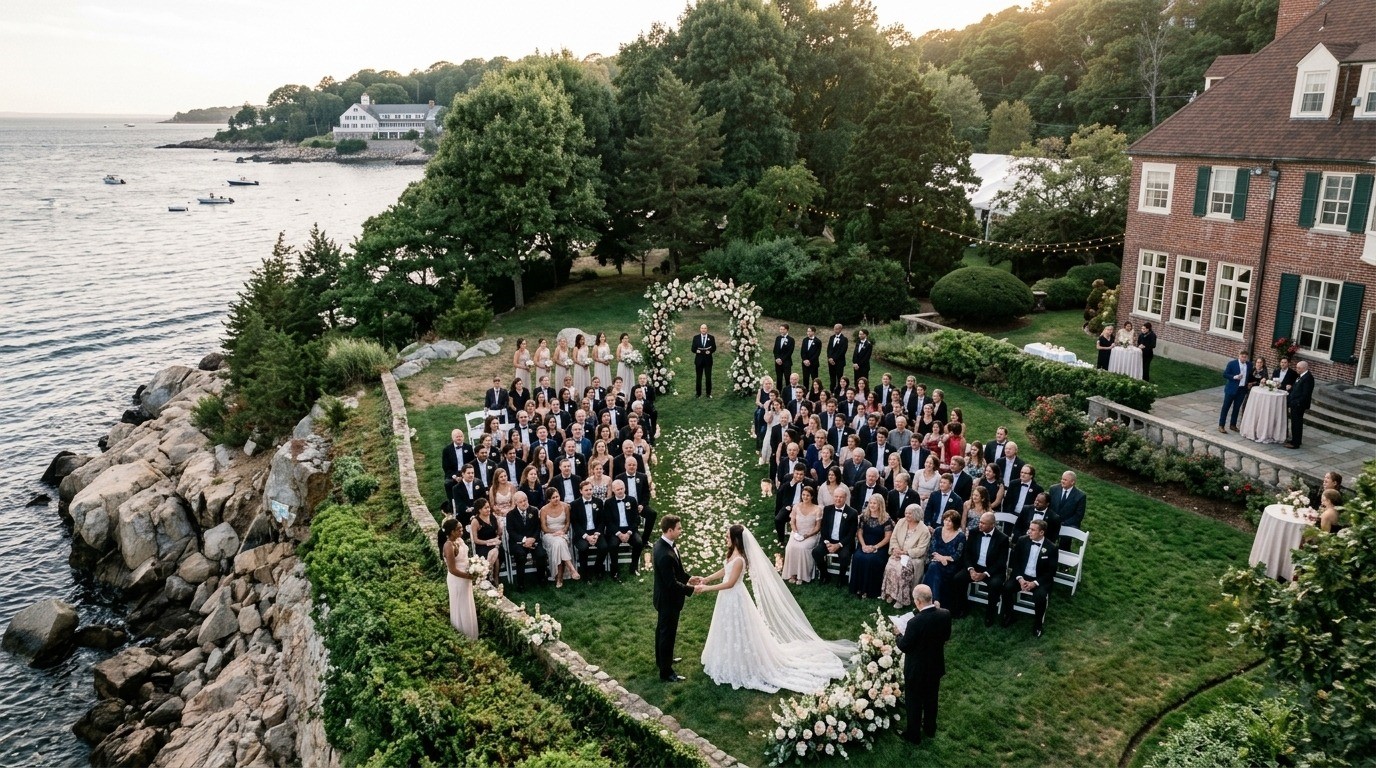
Misselwood Estate at Endicott College (Beverly)
img44

A French chateau on a North Shore cliff, where the ceremony site literally sits at the edge of the continent and the seasonal tent glows with chandeliers after dark.

You drive onto the Endicott College campus in Beverly, past academic buildings and student parking lots, and then the landscape opens into something that belongs on the Normandy coast — a French-style chateau on cliffs above the Atlantic, manicured grounds running to the rock’s edge. The estate was originally part of a property called “Bon Jour,” built in 1845 by the Loring family. The current structure was designed to mimic French countryside architecture after the original cottage was demolished in 1926. Misselwood eventually became part of the college campus — you’re technically getting married at a university property, though nothing about the setting says “campus.”

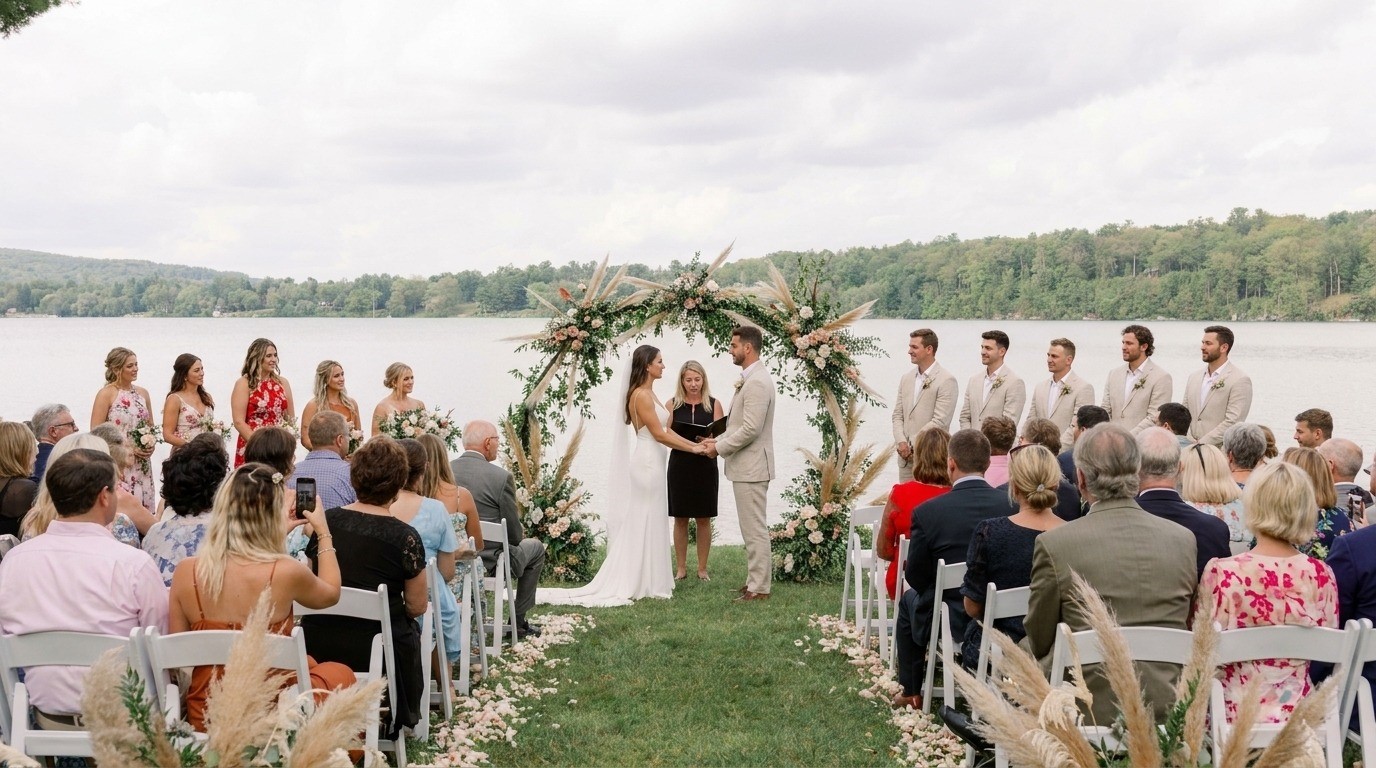
The ceremony site is the headliner: positioned on the cliff’s edge, the Atlantic crashing against the rocks below. “Edge-of-the-world” is the phrase that gets used, and for once, it’s not hyperbole. Behind you, the estate. In front of you, open ocean. After vows, the reception moves to the seasonal tent — available Memorial Day through mid-October — which is not a pop-up canopy but a climate-controlled structure with a brick foundation and chandeliers. When it’s lit at night, it glows against the dark water in a way that looks staged but isn’t. Couples who’ve attended a Misselwood wedding (Knot Best of Weddings Hall of Fame) tend to remember the contrast: raw cliffside ceremony followed by chandelier-lit warmth.

Capacity: 200 seated guests Spaces: Misselwood House, seasonal tent (Memorial Day-mid-October), oceanfront cliffside ceremony site Price Range: Venue fees $5,000-$7,500; ceremony fee $1,000 Peak Season: June-September Best For: Couples drawn to dramatic coastal landscapes with an intimate 200-guest cap Pet-Friendly: No (service animals only)

That cliffside ceremony is exposed — wind off the ocean means planning for microphones, speaker positioning, and how much projection your officiant can actually deliver into a headwind. But that exposure is also the source of the moment’s power, and no one who’s stood on that cliff wants to trade it for shelter. Once guests move to the tent, the acoustic environment changes completely: enclosed, climate-controlled, fabric walls and chandeliers producing a warm, even sound profile that’s forgiving to work with. The short walk between spaces buys your entertainment team enough time to reset from ceremony mode to reception energy. Two hundred guests fills the tent at a sweet spot — enough bodies for real dance floor momentum, few enough that every table still feels connected to the center of the room. One scheduling note worth flagging early: the tent operates Memorial Day through mid-October. Indoor options exist outside that window, but the cliffside-to-tent sequence is what makes Misselwood unmistakable.

Why this particular stretch of Beverly coastline? The Loring family chose it in 1845 because it faces east — morning light floods the estate in a way that reminded them of the French coast they loved. That eastward orientation means sunset doesn’t happen over the water (it falls behind you), but what you get instead is the twilight afterglow — that deep blue hour when the sky is still lit and the sun has already dropped — which creates a photographic quality arguably more nuanced than a straight sunset shot. Photographers who’ve worked Misselwood know this and build their shot lists around it.

Official website: https://www.misselwood.com/

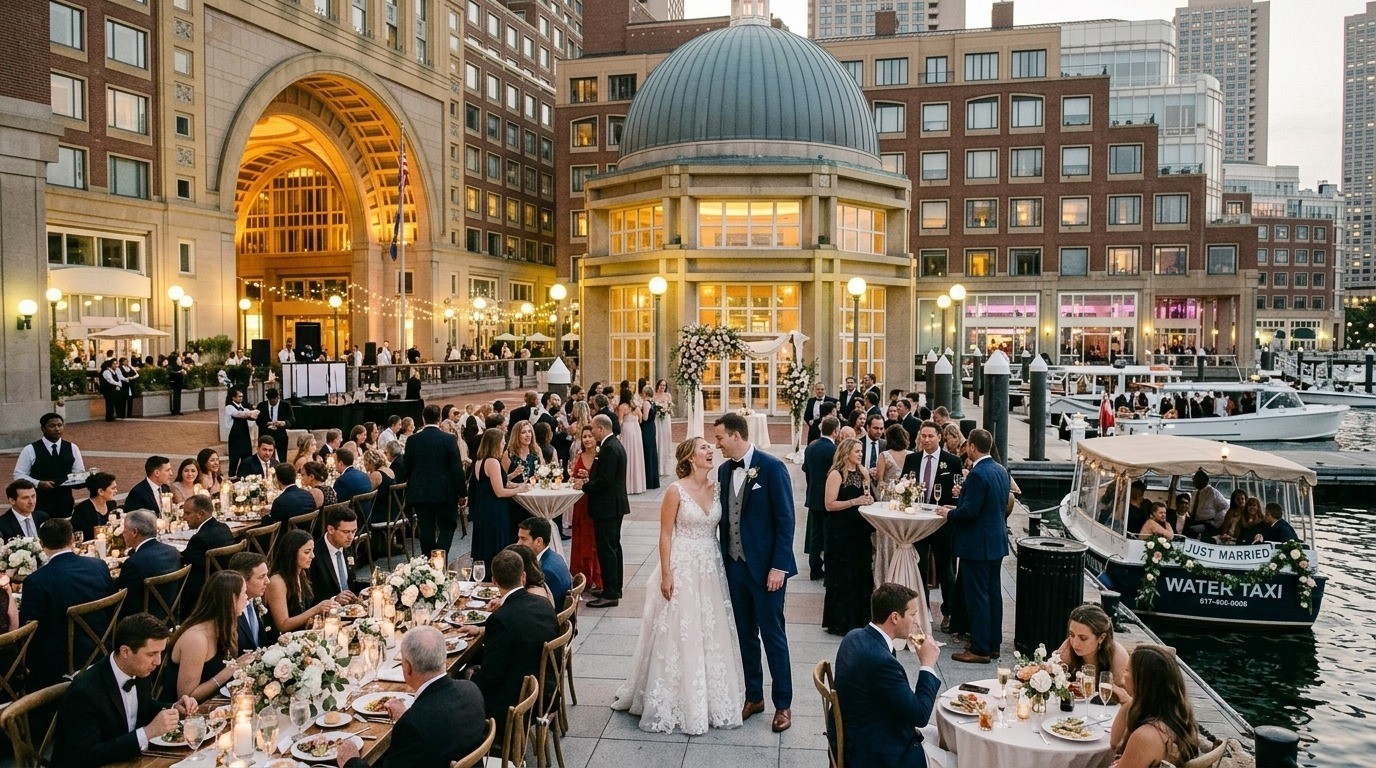
Boston Harbor Hotel (Boston)
img45

A 60-foot archway frames the harbor, a colonial fort lies beneath the foundation, and couples can arrive by boat to a reception where the city skyline and the waterfront share the same window.

This is a Forbes Five-Star, AAA Five-Diamond property on Rowes Wharf — one of Boston’s most historic waterfront addresses — where the iconic 60-foot archway functions as a gateway between the financial district and the harbor. That archway isn’t decorative. It was designed as a “Window to the Harbor,” a symbolic link between the city’s commercial identity and its maritime roots. When your guests walk through it, they’re passing through deliberate urban architecture that still earns its reputation after millions of photographs.

The Wharf Room seats 250 with floor-to-ceiling windows that keep the working harbor in your peripheral vision through every course. For larger celebrations, the Atlantic Room handles 300. Both rooms carry traditional Boston formality — dark wood, polished surfaces, a palette that reads “old money” — but the water views through the glass keep reminding you this isn’t some landlocked hotel ballroom downtown. Ceremonies can happen in the Pavilion for something more intimate, or there’s the option no other Boston venue can match: arriving by boat at the hotel’s private dock. Per-person pricing runs $220 to $320 and up, which is Forbes Five-Star territory and priced accordingly. Couples trimming costs should look elsewhere. Couples who want the highest level of city waterfront wedding Boston has ever offered should not.

Capacity: Wharf Room (250 seated), Atlantic Room (300 seated), Pavilion (smaller ceremonies) Spaces: Wharf Room, Atlantic Room, Pavilion, private dock for boat arrivals/departures Price Range: $220-$320+ per person; minimums typically start at $25,000 Peak Season: June and October Best For: High-end urban couples who want city skyline and harbor in the same frame Pet-Friendly: Yes — up to 2 pets, $100 non-refundable fee

Harbor-facing windows in the Wharf Room mean your entertainment is sharing the stage with a living backdrop — harbor lights, passing boats, the city skyline shifting from golden to electric as the night progresses. High ceilings keep the sound open and breathing, none of the compressed feeling you fight in low-ceiling hotel ballrooms. The event infrastructure here is built for professionals: clean power, proper load-in access, staff who understand vendor coordination at a level that matches the price tag. What makes this room a particular challenge is its formality. A Forbes Five-Star space demands entertainment that reads as polished from the first note — cocktail elegance into dinner ambiance into a dance floor that earns its intensity through deliberate escalation. No shortcuts, no faking it.

Beneath the hotel’s foundation lies the 17th-century South Battery, a colonial fort built to defend Boston Harbor from naval invasion. A military fortification under a luxury hotel — that duality is Boston’s waterfront identity compressed into a single address: always functional, always aspirational. The “Boat Grand Entrance” has become one of the most distinctive arrival moments at any New England wedding venue. Couples pull up to the private dock while guests watch from the Wharf Room windows above. It requires more coordination than a limousine, but the visual of approaching your own wedding across the harbor — the skyline behind you, the archway growing larger as you close the distance — is the kind of detail that rewrites how people remember the entire night.

Official website: https://www.bostonharborhotel.com/weddings

How to Choose Between These Venues

Five waterfront venues, five fundamentally different weddings. The right choice depends less on which one photographs best on your Pinterest board and more on what actually fits — your guest count, your budget, and your honest tolerance for sand in your shoes.

If your guest count is pushing 300, Boston Harbor Hotel’s Atlantic Room is your play — the only venue here that handles that scale on the waterfront. But you’re paying for it: $220 to $320 per person before a single vendor is booked. At 250, the Wharf Room delivers the same city-meets-harbor energy.

Cape Cod couples — or anyone drawn to the beach club atmosphere — should look hard at Wychmere Beach Club. Three reception rooms mean you can match your space to your guest count (160 to 320) rather than paying for room you don’t need. The food and beverage minimums ($36,000 to $125,000) reflect peak Cape Cod pricing, but the private beach ceremony and rooftop cocktail hour are genuinely difficult to replicate elsewhere on the Cape.

On the North Shore, Beauport and Misselwood sit thirty minutes apart but deliver very different weddings. Beauport is the boutique hotel route: 94 rooms, rooftop terrace, a working harbor visible through every window. Misselwood is the dramatic estate route: cliffside ceremony, chandelier tent, 200-guest cap. If on-site lodging is your deciding factor, Beauport wins. If the ceremony setting is what matters most, Misselwood’s cliff has no competition on this list.

And then there’s the Oceanview of Nahant — the wildcard pick for couples who want a private, almost secluded coastal experience that somehow still sits fifteen minutes from downtown Boston. A 220-guest cap, all-inclusive pricing ($168-$210 per person), and a family-ownership model make it the most personally run venue on this list. The “Last Dance on the Beach” tradition alone draws couples who want their wedding to end with something guests bring up for years.

Seasonality governs everything at waterfront wedding venues in Massachusetts. Peak season runs June through September. October — now the most requested wedding month in the state thanks to foliage — fills faster than summer at many venues, particularly along the North Shore. Winter bookings between January and March can shave up to 40% off venue fees, but you’re giving up the outdoor waterfront ceremony for an indoor plan. Whether that tradeoff makes sense depends entirely on how central the ocean-air ceremony is to your vision.

Why Entertainment Matters More Than You Think at Waterfront Venues

Waterfront wedding venues in Massachusetts introduce entertainment variables that simply don’t exist at inland properties — and by the time most couples realize it, the planning timeline is too compressed to adjust.

Start with wind, because it’s the one everyone underestimates. “It might be breezy” doesn’t begin to cover what happens on an exposed North Shore point in July. Gloucester, Nahant, Beverly — each gets consistent onshore winds from May through September that affect microphone quality, guest audibility during vows, and whether your sheet music stays on the stand. Cape Cod’s prevailing southwesterlies off Nantucket Sound behave differently than what you encounter in Boston Harbor, where the buildings funnel and redirect gusts along the waterfront. An entertainment team that has logged hours at Massachusetts coastal venues knows the wind direction at each property before they arrive. One that hasn’t will spend your ceremony learning it the hard way.

Then there’s the indoor-outdoor transition, which is where good waterfront weddings and great ones diverge. Nearly every venue on this list runs the ceremony outside and the reception in. Your entertainment has to handle two completely different acoustic environments in a single evening — an open-air setting where sound scatters in every direction, then an enclosed ballroom where it ricochets off walls, windows, and chandeliers. EQ settings change. Speaker placement changes. Volume balance changes. When an entertainment team has mapped that transition in advance — dialed in both setups during the site visit — guests don’t notice the shift at all. When it’s improvised on the day, you get a jarring audio gear-change that breaks the spell right when the evening should be accelerating.

Sunset timing is the third variable, and it’s the one unique to coastal weddings. Massachusetts summer sunsets range from about 8:25 PM in late June to 6:00 PM by late October — a two-and-a-half-hour swing that reshapes your entire timeline depending on the month. The strongest waterfront weddings are choreographed around that moment: ceremony timed so golden hour aligns with cocktails, the acoustic set calibrated to match the light as the sky shifts, the high-energy reception launching precisely as darkness takes over. An entertainment team worth hiring builds the set list around the sun’s schedule, not just the clock on the wall. It sounds like a small distinction. It changes the entire feel of the evening.

Why DLE Event Group

Massachusetts waterfront venues ask your entertainment to do something most setups aren’t built for: shift between an exposed outdoor ceremony, a sheltered cocktail terrace, and an enclosed ballroom — sometimes all three in a single evening — while sustaining an energy arc that builds from first note to last dance. A solo DJ can play the right songs. A band can bring the live energy. When you need both, plus the technical adaptability to handle salt air, wind, and three distinct acoustic environments before midnight, you need a format designed for exactly that kind of range. That’s DLE Event Group.

Our hybrid DJ band pairs live musicians — saxophone, guitar, keys, percussion, vocals — with a professional DJ and MC. On a cliffside ceremony at Misselwood, live instruments carry warmth and emotion without fighting the wind the way a full PA system does. During cocktail hour on a Gloucester rooftop, an acoustic configuration fits the scale and the setting. When reception doors open and the ballroom dance floor is waiting, the DJ capability lets us escalate without a gap — no break, no awkward pause where your guests reach for their phones. The live and electronic elements blend because they were engineered to work together, not bolted on after the fact.

Every event gets backup equipment — duplicates of everything critical. On the Massachusetts coast, salt air and humidity punish electronics in ways a climate-controlled Manhattan ballroom never would. Redundancy at a waterfront venue isn’t overkill; it’s the baseline of professional preparation. Over 10 years and 100+ events, we’ve earned The Knot Best of Weddings Hall of Fame 11 times because that level of preparation is audible in the performance. Our planning process starts six months before your date — 5 to 10 Zoom sessions where we learn your must-play list, your cultural traditions, your timeline, and the specific quirks of your venue.

DLE serves couples throughout the Northeast and beyond. Massachusetts is well within our range, and we’ll arrive knowing the room.

Frequently Asked Questions

Peak season (June through September) at the most competitive venues requires 12 to 18 months of lead time. October — now the most requested wedding month in the state because of foliage — often fills faster than summer, particularly on the North Shore and Cape Cod. Off-peak dates between January and March can sometimes be secured with 6 months’ notice, often at significantly reduced venue fees. Your entertainment should be locked in on the same timeline; premier waterfront dates disappear quickly on both sides of the equation.
Per-person rates on this list range from ~$168 at The Oceanview of Nahant to $320+ at Boston Harbor Hotel. Total spend for 150 guests typically falls between $50,000 and $100,000+ depending on the venue, day of the week, and season. Cape Cod venues like Wychmere carry food and beverage minimums ($36,000-$125,000) that set the floor before you add vendors. Friday and Sunday bookings often reduce costs by 20-30% at most properties. Massachusetts has a 6.25% sales tax on meals, and most venues add a 20% service charge — factor both in before comparing quotes.
At all five venues on this list, it’s the default. Each property offers a distinct outdoor ceremony space — beach, cliffside, terrace, or rooftop — paired with a separate indoor reception room, and cocktail hour bridges the gap. That outdoor-to-indoor progression is actually one of the strongest practical arguments for choosing a waterfront venue in the first place: the natural energy build from open-air vows to an enclosed dance floor is nearly impossible to replicate when everything happens in one room.
Every venue here has an indoor backup plan — no reputable coastal venue operates without one. That said, be honest with yourself about the gap: a cliffside ceremony with crashing waves and the same ceremony relocated to a ballroom are two different experiences. During your site visit, ask each venue to walk you through the rain plan in detail. Some transitions are nearly seamless (Boston Harbor Hotel simply moves everything to the Pavilion). Others involve more adjustment. One reassurance: Massachusetts coastal weather in peak season tends toward afternoon clearing, so morning clouds don’t automatically translate to a rained-out ceremony.
No. Massachusetts allows you to apply for a marriage license at any city or town clerk’s office in the state, regardless of where the ceremony takes place. Both partners must appear in person. There’s a mandatory 3-day waiting period from application to pickup, the license is valid for 60 days, and — unlike many states — Massachusetts does not require witnesses to sign the license. Plan the clerk’s office visit early in your wedding week to avoid last-minute logistics.
Boston Logan International Airport (BOS) is the primary hub for all five venues. North Shore properties (Beauport, Misselwood, Oceanview) are 30-45 minutes from Logan. For Cape Cod venues like Wychmere, guests can drive from Logan (about 90 minutes) or take the seasonal CapeFlyer train from Boston’s South Station directly to the Cape. Boston Harbor Hotel is the easiest — it’s a 10-minute cab from the airport, with a water taxi option that delivers guests directly to the hotel’s dock. Block room rates at on-site hotels or nearby lodging are worth arranging early, especially during peak season.

Start Planning Your Massachusetts Waterfront Wedding

The Massachusetts coast gives you something no inland ballroom can manufacture: a wedding where the Atlantic is in the room with you — reflected in the windows, audible through the terrace doors, visible from every seat. Cape Cod beach club, North Shore cliff, Boston Harbor archway — the specific setting varies, but the effect is the same. The water makes a hundred ordinary moments feel significant without anyone having to try.

The right entertainment makes sure the rest of the evening matches that standard. DLE Event Group’s hybrid DJ band experience was built for exactly these rooms — live instruments for the intimate moments, DJ versatility for the dance floor, and the technical preparation to handle whatever the Massachusetts coast decides to throw at you on the day.

Ready to talk?

QUESTIONNAIRE

Need Assistance? Directly reach us at contact@dleeventgroup.com or 877.534.2424
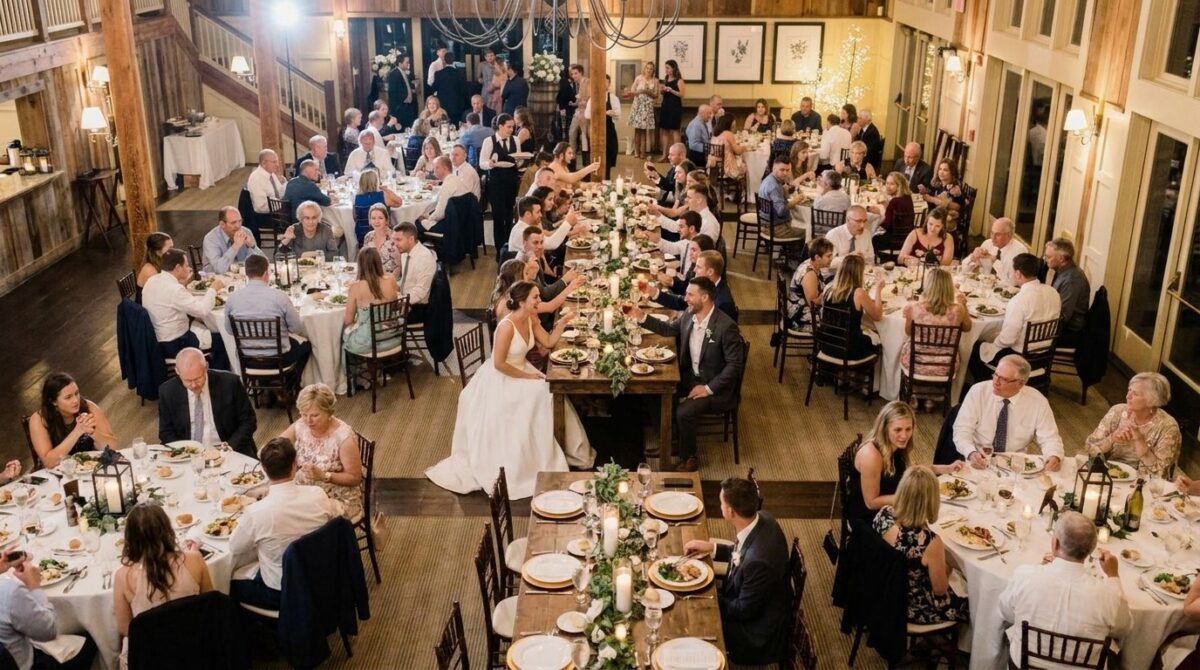
Top 5 Rustic Barn Wedding Venues in Massachusetts: An Insider’s Guide

Top 5 Rustic Barn Wedding Venues in Massachusetts: An Insider’s Guide

The first time I set up in a Massachusetts barn, I expected to fight the room. Every entertainer who’s worked a converted agricultural building knows the gamble — metal roofs that turn a snare hit into a ricochet, concrete pads that swallow bass, wind drafts that rattle mic stands. So I walked into a 200-year-old dairy barn in the hill towns west of Boston, braced for acoustic disaster, and instead heard… nothing. No echo. No ring. Just the soft creak of old timber overhead and the hum of a space that had been absorbing sound — cattle, weather, a century of New England seasons — long before anyone thought to put a dance floor in it.

That quiet sets rustic barn wedding venues in Massachusetts apart. Nothing here was shipped in on a flatbed. You’re looking at working farms in the Wachusett foothills, century-old dairy operations in the Nashoba Valley, former vaudeville theaters in old leather-tanning towns north of Boston. The buildings have calluses. You can see where ropes wore grooves into beams, where generations of farmers notched the doorframes, where the original hand-forged hardware still holds. None of it is decorative — it shapes how the room feels, how the light falls, and most importantly for someone in my line of work, how the music fills the space.

What gives Massachusetts a particular edge in this category is range. Within ninety minutes, you can go from a LEED Platinum art gallery in Boston’s Seaport to a 1763 farmhouse on Mount Wachusett’s slopes, from a 40-foot-ceiling concrete warehouse on the North Shore to a campus barn where a celebrated author helped design the renovation. Five venues, five entirely different takes on what “rustic” means in the Commonwealth.

Why Rustic and Barn Venues Work for Massachusetts Weddings

Couples rarely consider this when browsing venue photos: rustic barn wedding venues in Massachusetts solve the biggest problem in wedding entertainment before you even hire a band. The room cooperates. In a Marriott ballroom, you’re spending your first hour compensating — killing fluorescent buzz, masking HVAC drone, fighting parallel walls that turn every snare crack into a ping-pong match. In a timber-frame barn, the wood does half the mixing for you. Irregular surfaces scatter sound, exposed beams break up standing waves, and the whole room breathes.

Practically, the Massachusetts rustic category splits into two distinct lanes: the actual farms (Gibbet Hill, Harrington Farm, The Red Barn at Hampshire College) and the industrial conversions (Olio Peabody, Artists For Humanity EpiCenter). Farms give you pastoral warmth, outdoor ceremony options, and the kind of golden-hour light that makes photographers emotional. Industrial spaces give you scale, blank-canvas flexibility, and year-round climate control. Both work brilliantly for live music, but they work differently — and understanding that difference before you book entertainment is worth more than any Pinterest mood board.

But October unites the whole category. It has overtaken June as the most requested wedding month in Massachusetts because the foliage in Pioneer Valley and the Wachusett hills is that good. Plan accordingly — the best Massachusetts wedding venues in this category book 12 to 18 months out for fall dates.

The Venues

The Barn at Gibbet Hill (Groton)

img36

A rainstorm accidentally created this venue — and twenty-plus years later, it’s still the standard every other Massachusetts barn wedding is measured against.

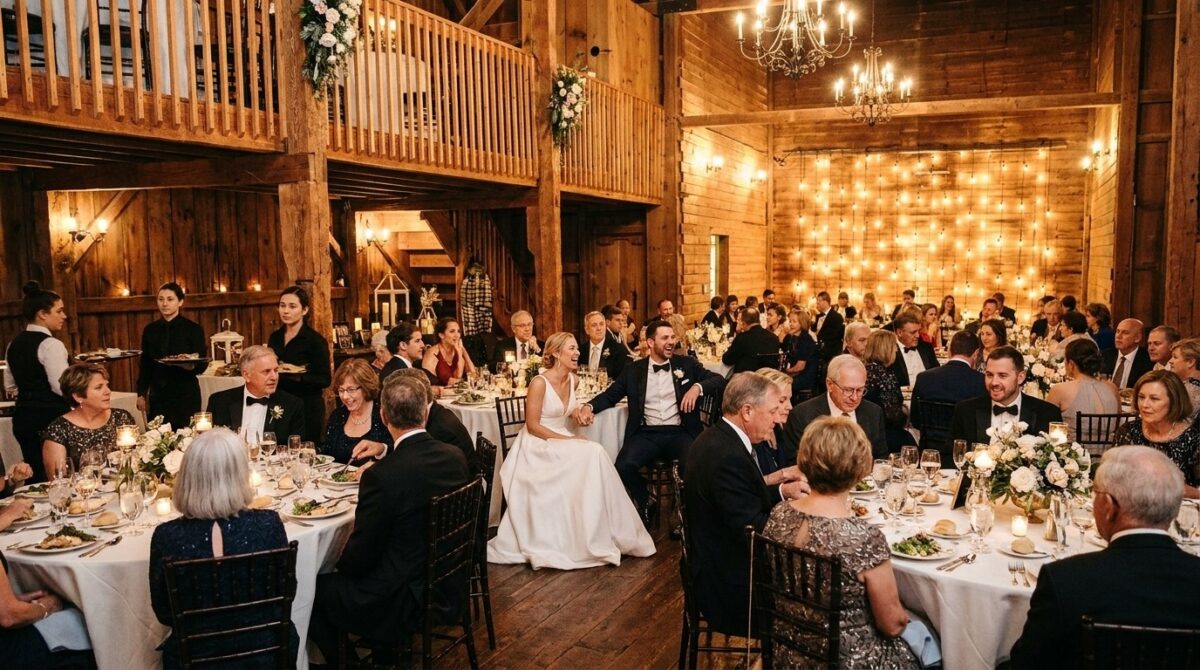
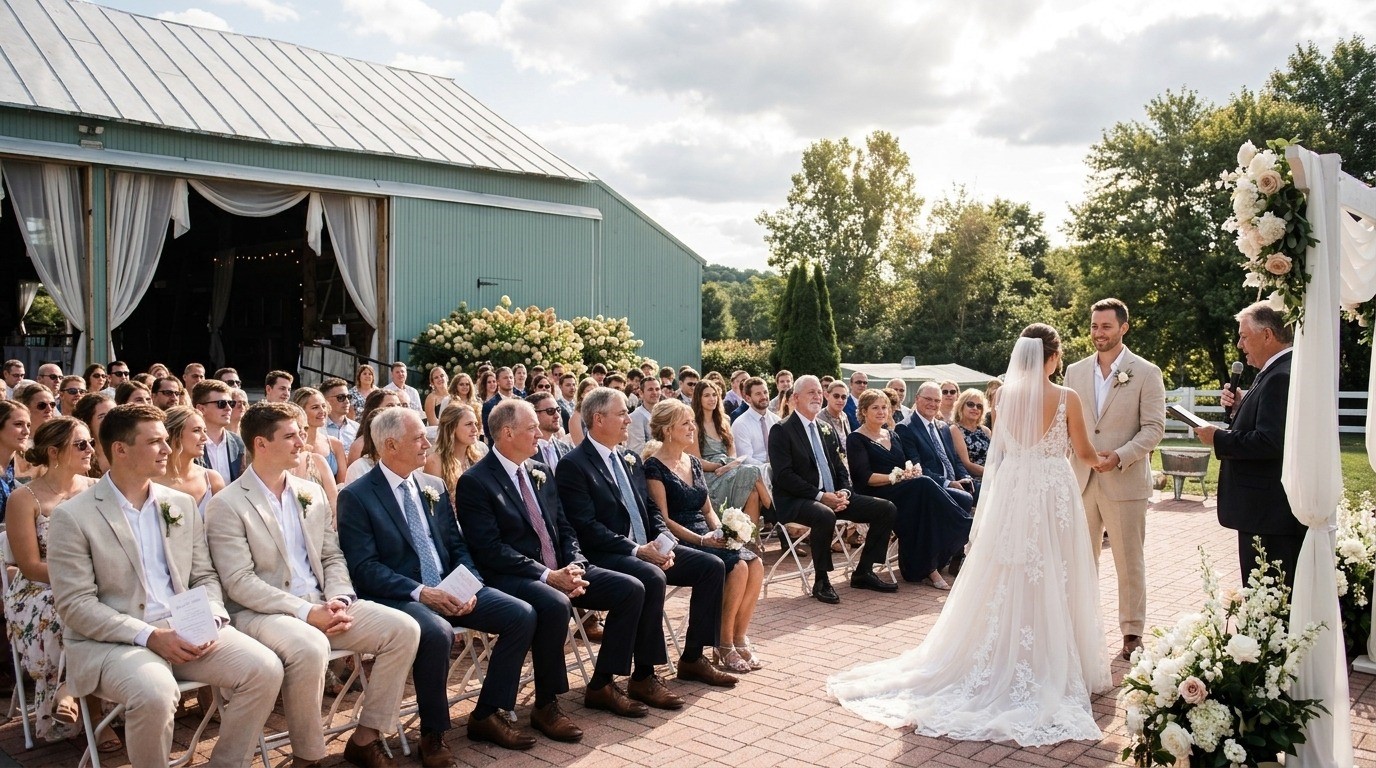
Groton is about 45 minutes northwest of Boston, and when you pull onto the property, the first thing that registers isn’t the building — it’s the land. Rolling pasture, working cattle on the hillside, stone walls cutting across fields farmed since the colonial period. Then you step inside the 100-year-old dairy barn, and the rough-hewn beams and wrought-iron chandeliers confirm what the landscape promised: you’re standing in the real thing.

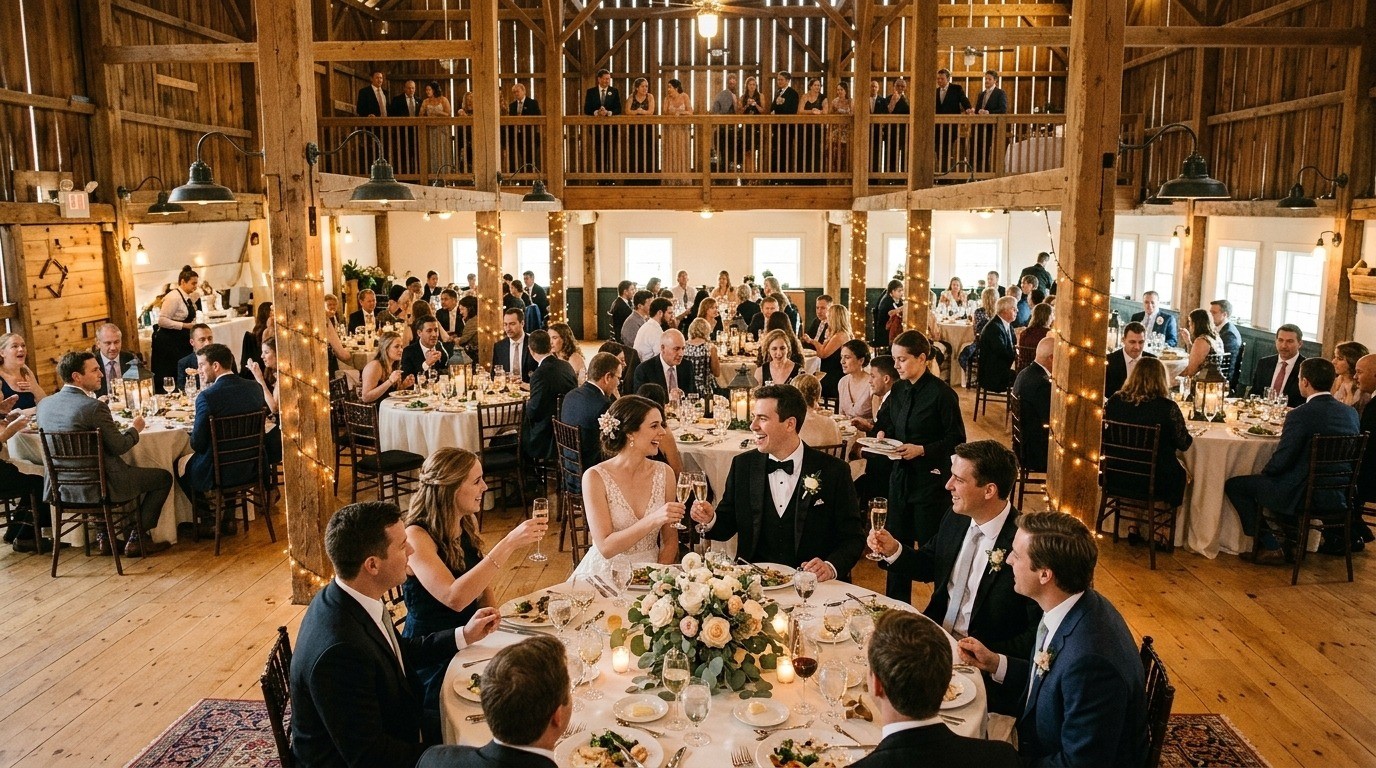
Inside, the space walks a careful line between authentic and refined. Original structural timbers frame the ceiling while iron chandeliers cast warm light that blends with ambient glow from the barn doors. Finishes are deliberately understated — the architecture does the heavy lifting, so nobody piled on decor to force a mood. Your florist works with the room rather than against it, and the natural palette of aged wood and iron means virtually any color scheme fits.

Outside, the property stretches up the hill to what might be Gibbet Hill’s greatest asset. A golf cart takes couples to the summit for portraits among the ruins of Bancroft’s Castle — a 1906 stone sanitarium that burned down, leaving a gothic shell that looks like the Scottish Highlands transplanted into central Massachusetts.

Capacity: 224 seated Spaces: Main Barn (reception), outdoor deck, hilltop ceremony area with castle ruins Price Range: Rental fees $500–$9,000; F&B minimums $3,000–$26,000 Peak Season: October (Nashoba Valley foliage at its peak) Best For: Farm-to-table couples who want a genuine agricultural setting Pet-Friendly: Yes — pets welcome for outdoor ceremonies and photos

Proportions matter here. At 224 capacity, the Barn is large enough for a substantial wedding but contained enough that the energy doesn’t dissipate into dead zones. Those rough-hewn beams overhead scatter sound in unpredictable, musical ways — high-frequency reflections get absorbed by the wood grain instead of bouncing back as harshness. Live acoustic instruments during dinner sound rich and present without amplification doing much work. When you switch to full-band dance sets, the room compresses the energy beautifully. Guests don’t drift to corners because the space naturally draws everyone toward the center. And the outdoor deck gives you a cocktail-hour staging area that’s acoustically separate from the reception — crucial for a clean sound check.

The origin story tells you everything about this place. Until 2002, this was a functional dairy farm — nothing more. Then a scheduled outdoor wedding got hit by a sudden rainstorm, and the couple moved the whole event into the unrenovated barn. Guests loved the raw atmosphere so much that the owners — the Webber Restaurant Group — pivoted from farming to events. Every restoration decision since then has been guided by that accident: keep the honesty of the original structure, don’t over-polish it, let the barn be a barn.

Official website: https://www.gibbethill.com/the-barn-at-gibbet-hill/

Harrington Farm (Princeton)

img37

Sixty acres on the slopes of Mount Wachusett, where the sunset views from the patio sit at some of the highest elevation in Central Massachusetts.

Princeton isn’t on most couples’ radar. It’s a small town in the Wachusett range, about an hour west of Boston, where the road narrows past apple orchards and cell signal gets spotty. That remoteness is Harrington Farm’s greatest asset. Once your guests turn onto the property — a 1763 farmhouse flanked by stone walls and mature maples — the outside world genuinely disappears. No ballroom can replicate that threshold.

A 1763 farmhouse anchors the property, still functional, its original architectural bones visible beneath thoughtful updates. Getting-ready rooms are inside — a space with 260 years of patina rather than a sterile bridal suite off a hotel corridor. The barn connects to the farmhouse and opens onto the Sunset Patio, which earns its name honestly: the patio faces due west at elevation, and during cocktail hour on a clear evening, you’re watching the sun drop below the ridgeline with nothing between you and the horizon but farmland and forest.

Inside the barn, a massive field-stone fireplace dominates one wall. The stonework is original — each piece fitted without mortar, held together by weight and geometry and 260 years of gravity doing its job. Nobody builds like this anymore.

Capacity: 220 guests Spaces: Farmhouse (getting ready), Barn (reception), Sunset Patio (cocktails/ceremony), garden area Price Range: Starting packages ~$15,000; per-person costs $135–$215 Peak Season: September–October (peak foliage on Wachusett Mountain) Best For: Couples who want mountaintop views with genuine New England history Pet-Friendly: Yes — dogs welcome for ceremonies and patio use

Elevation changes everything acoustically. With the patio open to the valley, sound carries outward instead of bouncing back — you get a clean throw from ceremony speakers without the reflections you’d fight at a valley-floor venue. Inside the barn, the field-stone fireplace wall acts as a massive diffuser, scattering low-frequency energy in a way that keeps bass warm without getting muddy. Patio cocktail hour to indoor reception is a short, natural transition — guests flow inside without a logistical gap. In-house catering simplifies coordination for performers, too, since there’s one team managing the timeline rather than three competing vendors. At 220 guests, the barn fills to the point where the energy is tangible but not claustrophobic — the sweet spot for getting a dance floor to ignite early.

During the late 19th century, Harrington Farm operated as a boarding house where city dwellers came for what was called “mountain therapy” — essentially an early wellness retreat on the Wachusett slopes. The original owners hosted an annual Fourth of July feast where salmon was boiled in cloth bags, a local culinary tradition so specific to Princeton that town historians still write about it. The thread of hospitality — this land as a place people came to feel better — runs unbroken from the 1800s through every wedding held here today.

Official website: https://www.harringtonfarm.com/

The Red Barn at Hampshire College (Amherst)

img38

An 1820s barn on a college campus where a children’s literature legend helped design the renovation, and a centuries-old oak tree provides the ceremony canopy.

Amherst sits in the Pioneer Valley — the five-college corridor of Western Massachusetts where intellectualism is the local industry and the landscape is almost aggressively beautiful. The Red Barn fits that character. It’s an honest-to-God 1820s barn that happens to be on one of the most progressive college campuses in the country, with wide-plank original floors, natural light from high windows, and a style that splits the difference between academic and pastoral. Nobody here is trying to be a luxury event space.

But the ceremony site is what pulls people in. A centuries-old oak tree — referred to simply as “the Wedding Oak” — stands on the lawn adjacent to the barn, and its canopy is so massive that it shades the entire ceremony guest list. You don’t need a tent or a structure. Just the tree. In June, the leaves filter sunlight into shifting green patterns across the ceremony space. In October, the Pioneer Valley foliage turns the entire backdrop into something that looks art-directed but is just Massachusetts being Massachusetts. This tree has been hosting gatherings since before Hampshire College existed, and you can feel it.

Inside, the barn is compact and warm. Wide-plank floors show their age — unevenly worn, with the kind of character that comes from two centuries of use rather than a distressing tool at a lumber yard. Seating 140 for plated service and 130 for buffet, it’s one of the more intimate barn venues in the state. Consider that a feature: every guest is close to the action, close to each other, and close to whatever is happening on the dance floor.

Capacity: 140 seated (plated); 130 seated (buffet) Spaces: Red Barn (reception), Oak Tree Lawn (ceremony), adjacent campus grounds Price Range: Rental fees $1,800–$5,000; total starting costs $8,000–$15,000 Peak Season: June (lush fields) and October (Pioneer Valley foliage) Best For: Intimate, creative weddings with an academic sensibility Pet-Friendly: Service animals only (restricted from barn interior)

Being the smallest barn on this list turns out to be an acoustic gift. You don’t need to push volume to fill the room — the proportions do the work. Those wide-plank floors have a slight flex that absorbs impact, which means even with a packed dance floor, the bass doesn’t transfer into structural vibration the way it does on concrete or stone. A hybrid setup thrives here because the barn rewards the live-instrument side of the equation: acoustic guitar, sax, light percussion during dinner fill the room naturally, and when you bring the DJ element up for dancing, the space is compact enough that moderate volume feels like a full concert. The walk from oak-tree ceremony to indoor reception takes only a few minutes, so you can pre-set the barn during the ceremony without any audience hearing the sound check. Out-of-state guests should know that Bradley International Airport in Hartford, Connecticut, is often a quicker route than flying into Boston and driving west.

Students led the barn’s 1971 renovation, and the faculty advisor who helped shape its design was Norton Juster — the Hampshire College professor who wrote The Phantom Tollbooth. Juster envisioned the space as a center for “creative community gatherings,” and that DNA is still evident in the barn’s unpretentious, flexible layout. A literary-minded couple will love that detail. And it’s the kind of provenance you genuinely can’t manufacture.

Official website: https://www.hampshire.edu/offices/event-services/red-barn

Olio Peabody (Peabody)

img39

Forty-foot ceilings, raw concrete walls, and a creative license that extends to driving a food truck through the front door.

Peabody doesn’t get mentioned alongside Nantucket or the Berkshires, and that’s part of what makes Olio work. This is the North Shore’s leather-tanning belt — a working-class industrial corridor 25 minutes north of Boston — and the venue doesn’t pretend otherwise. Built in 1912 as the Peabody Theater, one of the first entirely concrete structures in the United States, the building is raw: 40-foot ceilings, industrial-scale windows, a single massive room. It doesn’t whisper “wedding.” It shouts “do whatever you want.”

Olio’s defining feature is the total blank slate. Bring your own caterer (any licensed vendor), your own rentals, your own vision — there’s no in-house catering, no furniture package, no suggested layout nudging you toward someone else’s taste. Want a food truck parked inside the building? The doors are big enough. Want massive art installations hanging from the structural beams? The building can take it. Industrial chic in the literal sense — a structure engineered for heavy industry that now serves as a canvas for creative ambition.

No two Olio weddings look alike. The same room can host a moody, candlelit affair with draped fabric or a wide-open party with string lights, communal tables, and a DJ booth on a riser at center floor. A 10-hour rental window gives couples time to build out elaborate designs without rushing — and starting from zero means every aesthetic choice is yours.

Capacity: 300 seated; 500 cocktail-style Spaces: One massive open-concept room Price Range: Rental fees $2,500–$8,400; no F&B minimum Peak Season: Year-round (indoor venue); May/June most popular Best For: Creative couples who want total design control and industrial scale Pet-Friendly: Yes — leashed dogs welcome throughout

Forty-foot ceilings change the acoustic equation dramatically. Sound doesn’t just bounce in a room this tall — it disperses vertically, which means you lose energy upward unless your speakers are positioned to contain it. Concrete walls compound the challenge by reflecting rather than absorbing, and in a room this size, unmanaged reflections create a washy, indistinct sound that muddies vocals and kills punch. The fix is directional speaker arrays aimed at the guest area rather than the walls, plus strategic use of draping or rental soft goods to tame the worst reflection points. Performers who’ve worked industrial lofts before will know this intuitively; those who haven’t will discover it during sound check — and by then, it’s late. Worth noting: the open catering policy means no in-house team is managing the timeline, so your entertainment provider and caterer need to communicate directly. Build that into your planning.

The name has a story worth telling. “Olio” comes from the “Olio Curtain” — a miscellaneous variety act in vaudeville, performed in front of a painted curtain to keep audiences entertained while stagehands changed sets behind it. Basically the theatrical equivalent of a DJ set between band changeovers, which makes the name oddly fitting for a wedding entertainment article. The building itself, constructed in 1912 as one of America’s first all-concrete structures, has the kind of material integrity that makes architects stop and stare — poured concrete with aggregate visible in the walls, zero cosmetic finish, a building that looks exactly like what it’s made of.

Official website: https://www.oliopeabody.com/

Artists For Humanity EpiCenter (Boston)

img40

A LEED Platinum building in the Seaport that generates more energy than it consumes, with a garage-door wall that turns your reception into an open-air courtyard in seconds.

Boston’s Seaport has transformed from industrial waterfront to one of the most expensive zip codes in New England, and the Artists For Humanity EpiCenter sits right in the middle of that evolution. But unlike the glass-and-steel developments surrounding it, this building has a mission: it’s home to a nonprofit employing inner-city youth in the arts. The art on the gallery walls was created by those students. A portion of every rental fee (including a mandatory $1,000 tax-deductible membership) goes directly back to the program — your reception actively funds youth development in Boston.

Inside: 18-foot ceilings, polished concrete floors, clean white walls doubling as gallery space and blank canvas for lighting design. At 250 seated with a dance floor or 500-plus cocktail, it’s one of the larger venues in Boston proper. The defining feature, though, is the garage-door wall — a full-width retractable panel on the courtyard side. Open it, and the reception extends into outdoor space. Close it when the temperature drops or the energy needs to consolidate. That kind of flexibility is rare in urban venues and impossible to replicate.

Solar panels on the roof generate more energy than the building consumes, earning LEED Platinum certification and a designation as one of the greenest buildings in Boston. Eco-conscious couples planning in 2026 should take note: this venue walks the sustainability talk without sacrificing function.

Capacity: 250 seated with dance floor; 500+ cocktail Spaces: Main gallery/event space, outdoor courtyard (via retractable garage-door wall) Price Range: Rental fees $4,000–$6,500 plus mandatory $1,000 tax-deductible membership Peak Season: May and September (best for indoor/outdoor garage-door flow) Best For: Eco-conscious urban couples who want art, purpose, and a Seaport address Pet-Friendly: Yes — case-by-case basis; confirm gallery rules with venue

For performers, the retractable garage-door wall is the key variable. Open, your sound bleeds into the courtyard — great for cocktail ambiance, problematic if you need volume containment for a dance set. Closed, the room tightens acoustically: 18-foot ceilings with hard surfaces (concrete floor, gallery walls) create a live, reflective environment that rewards careful EQ and speaker placement. You have to treat these as two different rooms with two different sound profiles, and plan your set transitions around when that wall moves. Limited on-site parking means most guests arrive via rideshare or the MBTA Silver Line, so coordinate load-in logistics with the venue’s staff early — the Seaport isn’t the kind of neighborhood where you can double-park a gear van without consequences. An exclusive catering list simplifies vendor coordination compared to Olio’s open policy, but confirm AV and sound restrictions in advance. Gallery events sometimes carry decibel limits.

Designed from the ground up to be the “greenest” in Boston, the building delivers — solar panels on the roof produce a net energy surplus, giving back more power to the grid than it draws. But the detail that sticks with wedding guests isn’t the engineering. It’s the art. Every piece on the walls was created by a young person from Boston’s underserved communities, and the work rotates regularly. Your wedding photos won’t feature generic gallery backdrops — they’ll feature specific, original art by identifiable local artists. Knowing that your rental fee helped fund a paycheck for a young person learning their craft adds a layer of meaning most venues simply can’t offer.

Official website: https://afhboston.org/events

How to Choose Between These Venues

Five venues, five completely different experiences — and the right one depends on decisions that have nothing to do with how the photos look online..

Guest list past 250? Olio Peabody is your only option here — 300 seated, 500 cocktail. Under 150? The Red Barn at Hampshire College’s 140-capacity intimacy is hard to beat. Gibbet Hill, Harrington Farm, and Artists For Humanity fall in the 200-to-250 range, which covers most Massachusetts weddings comfortably..

Budget reality: The Red Barn starts as low as $8,000 total, and Olio’s rental begins at $2,500 (though you’re building everything from scratch — add caterer, rentals, and bar). Harrington Farm’s all-inclusive packages start at $15,000, simplifying vendor coordination. Artists For Humanity sits mid-range for Boston at $5,000–$7,500. Gibbet Hill’s pricing is variable — rental from $500 to $9,000 plus separate F&B minimums means your final number depends on date and headcount..

Pastoral, real-farm experience? Gibbet Hill or Harrington Farm. Industrial edge and creative freedom? Olio gives you the most control of any venue in the state. Sustainability and urban access? Artists For Humanity combines the Seaport with genuine environmental credentials. And if “intimate” and “literary” are your keywords, the Red Barn’s Norton Juster connection tells a story no other venue can.

For October foliage — now the most booked month in Massachusetts — Harrington Farm’s Wachusett elevation and The Red Barn’s Pioneer Valley location deliver the most saturated color. Book 12 to 18 months ahead for fall Saturdays.

Why Entertainment Matters More Than You Think at Rustic Barn Venues

Most couples book a rustic barn wedding venue in Massachusetts for the visuals. The beams, the warm wood, the string lights, the golden-hour glow through barn doors — all valid reasons. But what no venue walkthrough will show you is how profoundly the entertainment experience changes depending on whether you’re in a timber-frame barn, a concrete warehouse, or an art gallery with a retractable wall.

Barn acoustics and industrial acoustics are fundamentally different animals. At Gibbet Hill and Harrington Farm, timber absorbs high-frequency harshness and warms the mid-range — live instruments sound natural without pushing volume. At Olio, those 40-foot concrete ceilings disperse energy upward and reflect sideways, demanding precise speaker placement. At Artists For Humanity, the acoustic profile shifts mid-evening depending on whether the garage-door wall is open or closed. These differences aren’t subtle. They determine whether your dance floor feels electric or muddy.

The practical layer matters just as much. Power supply in historic structures can be limited — you can’t assume every outlet handles concert-grade draw. Some venues carry noise curfews or decibel restrictions tied to permits. Multi-space layouts at Harrington and Gibbet Hill mean your entertainment setup needs to function independently in each location — ceremony musicians in the field, full rig pre-set in the barn — with no quick-move option.

And the multi-space flow at these venues — ceremony under an oak tree, cocktails on a sunset patio, dinner and dancing inside the barn — means you’re not playing one room all night. You’re scoring a progression where each transition resets the energy. It demands a team that reads rooms in real time, not one that shows up with a preset playlist and hopes for the best.

Why DLE Event Group

We built the hybrid DJ band model for rooms exactly like these. Live musicians — sax, guitar, keys, percussion, vocals — deliver the warmth and presence that timber-frame barns amplify naturally, while the DJ component provides unlimited range: acoustic ceremony sets under the Wedding Oak at Hampshire College, a patio cocktail hour with laid-back grooves at Harrington Farm, then a packed dance floor at full energy by 10 PM. One team, one setup, one sound engineer who calibrates to the room — not the room they worked last weekend.

That calibration is never generic. Every barn sounds different. Gibbet Hill’s rough-hewn beams scatter mid-range beautifully, making it ideal for vocal-forward sets. Harrington Farm’s field-stone fireplace wall diffuses low frequencies in a way that keeps bass musical instead of boomy. Olio’s concrete canyon demands directional speaker arrays and careful volume staging. Over a decade of working venues across the Northeast has taught us these distinctions, and that venue-specific knowledge informs every pre-event planning session.

Where couples feel the difference most is in the planning process. Starting about six months before your wedding, we run 5 to 10 Zoom sessions to map every musical moment — custom song learning for your first dance, tailored edits for parent dances, pronunciation coaching for MC introductions, and timeline coordination built around your venue’s specific requirements and curfews. For venues with hard stops or noise restrictions, that timeline work is critical. No wasted minutes, no energy dips — every transition is intentional.

DLE Event Group has earned The Knot Best of Weddings Hall of Fame 11 times (2013–2023) and performed over 100 events at premier venues across New York, New England, and beyond. Our service area covers Massachusetts fully — Boston, the North Shore, the Pioneer Valley, the Wachusett region. We bring backup equipment to every event: duplicates of everything critical. When the architecture has survived centuries, the entertainment can’t be the thing that fails.

Frequently Asked Questions

Peak season (May through October) requires 12 to 18 months of lead time. October has overtaken June as the most requested month, driven by foliage demand, so fall Saturdays book fastest. Off-peak dates (January through March) can sometimes be secured with 6 months’ notice — and winter booking can save up to 40% on venue fees. Book entertainment on a similar timeline.
Wide. The Red Barn at Hampshire College starts at roughly $8,000 total. Olio Peabody’s rental begins at $2,500 (add catering, bar, and furniture rentals). Harrington Farm’s all-inclusive packages start around $15,000. Gibbet Hill varies by date and headcount — rental $500 to $9,000, F&B minimums up to $26,000. Artists For Humanity runs $5,000 to $7,500 including membership. Entertainment, photography, and florals are typically separate.
All five accommodate both. Gibbet Hill has an outdoor deck and hilltop ceremony area near Bancroft’s Castle; Harrington Farm offers the Sunset Patio; the Red Barn has the Wedding Oak. Olio’s open-concept room flexes for both, and Artists For Humanity’s retractable garage-door wall creates a natural ceremony-to-reception flow. One property means no shuttles and no timing gaps.
They’re among the best environments for live music, actually. Timber-frame construction absorbs harsh frequencies and warms sound, so acoustic instruments and vocals carry with a richness hotel ballrooms struggle to match. A hybrid setup — live musicians paired with a DJ — delivers that warmth during ceremony and dinner, then brings the DJ’s range when the dance floor opens. Industrial spaces like Olio require more careful speaker placement, but a sound engineer who knows the room makes them sing.
None offer extensive on-site lodging, so hotel blocks are essential. For Gibbet Hill and Harrington Farm, look at Leominster, Fitchburg, and Worcester-area hotels within 20 to 30 minutes. Amherst’s five-college-town options cover the Red Barn nicely. Olio is 25 minutes from Logan Airport with North Shore hotels nearby, and Artists For Humanity is in the Seaport, steps from dozens of hotels. For out-of-state guests, Logan (BOS) serves eastern venues; Bradley International (BDL) in Hartford is often more convenient for Western MA.
A few. “Telling the Bees” is an old New England custom where families decorate hives with white ribbons and whisper wedding news to the bees — fail to do so, and the insects leave, taking the family’s luck with them. Coastal couples incorporate an anchor motif for stability, and literary-minded pairs often include readings from the letters of John and Abigail Adams. On the legal side: Massachusetts has a mandatory 3-day waiting period, the license is valid for 60 days, both partners must appear in person, and no witnesses are required to sign.

Ready to Talk About Your Massachusetts Barn Wedding?

A working cattle farm in Groton, a LEED Platinum gallery in the Seaport, a 1763 farmhouse on a mountainside, a 1912 concrete theater on the North Shore — these five venues cover the full spectrum of what rustic barn wedding venues in Massachusetts offer. Each one sounds different, flows differently, and rewards a different kind of celebration

If you’re planning a wedding at any of these venues — or still deciding which direction to go — we’d welcome the conversation. DLE Event Group’s hybrid DJ band experience is built for spaces with character, and we’d love to help you figure out what the music should feel like in the room you choose.

QUESTIONNAIRE

Need Assistance? Directly reach us at contact@dleeventgroup.com or 877.534.2424

Top 5 Historic Mansion Wedding Venues in Massachusetts: An Insider’s Guide

Top 5 Historic Mansion Wedding Venues in Massachusetts: An Insider’s Guide

The first thing I noticed wasn’t the chandelier. It was the floor. I was wheeling a road case through the lobby of a Back Bay hotel that had been hosting Presidents since William Howard Taft, and the marble under my wheels had a polish so deep you could see your own reflection six feet down. A surface like that doesn’t happen by accident — it takes a century of footsteps, bellhops, diplomats, debutantes, brides, all wearing the stone smooth until it develops its own light. I stopped and just listened. Two in the afternoon on a Thursday, the room empty, but not quiet. Marble and gilded plaster carry their own hum, an ambient resonance that tells you the ceiling is high and the walls are hard before you even look up.

Over the years I’ve run cables past plaster moldings hand-carved in the 1790s, loaded gear through doors hung before the Civil War, and done sound checks in ballrooms where the gilding went up the same year the Titanic launched. The architects behind these rooms have other commissions in the Smithsonian. Every one of these spaces has an opinion about how music should sound inside it. The smart move is to listen before you play.

What makes Massachusetts almost unfair is the density. A 59-room Stuart-style estate overlooking the Atlantic. A Copley Square grand dame with a canine ambassador. A Renaissance Revival library where the murals alone are worth the trip. A small-town meeting hall hiding Swarovski chandeliers and a four-sided balcony. They all qualify as “historic.” Beyond that label, they share almost nothing — not in scale, not in sound, not in how they shape a wedding. That’s what this guide is for.

Why Historic Mansions and Estates Work for Weddings in Massachusetts

Among the best wedding venues in Massachusetts, historic mansions do half the decorating before you arrive. Thirty-foot gilded ceilings and crystal chandeliers that have been hanging since 1912 don’t need a florist to generate drama. The drama was poured into the plaster a hundred years ago.

For a performer, these spaces are the most interesting — and the most demanding — rooms to work. High ceilings and hard surfaces (marble, plaster, stone, original hardwood) create natural reverb that makes live instruments sound extraordinary. A saxophone in a ballroom with 30-foot ceilings carries a warmth and presence you cannot fake with studio effects. But that same reverb will wreck a bass-heavy DJ mix, turning low-end frequencies into an indistinct wall of noise that swallows the vocals. Understanding which setup fits which room — and dialing it in before the first guest arrives — separates a good night from a mediocre one.

Then there’s flow. Historic Massachusetts estates were designed for entertaining — parlors, courtyards, terraces, gardens, each one a separate space that naturally guides guests from ceremony to cocktails to dinner to dancing. That built-in progression keeps energy moving. Nobody sits at the same table for five hours wondering when something’s going to happen. Each room change is a small reveal, and when the music leads the transition instead of chasing it, the whole evening builds momentum. These buildings already know how to host a party. Your job is to work with the blueprint they laid down a century ago.

The Venues

Castle Hill on the Crane Estate (Ipswich)

img31

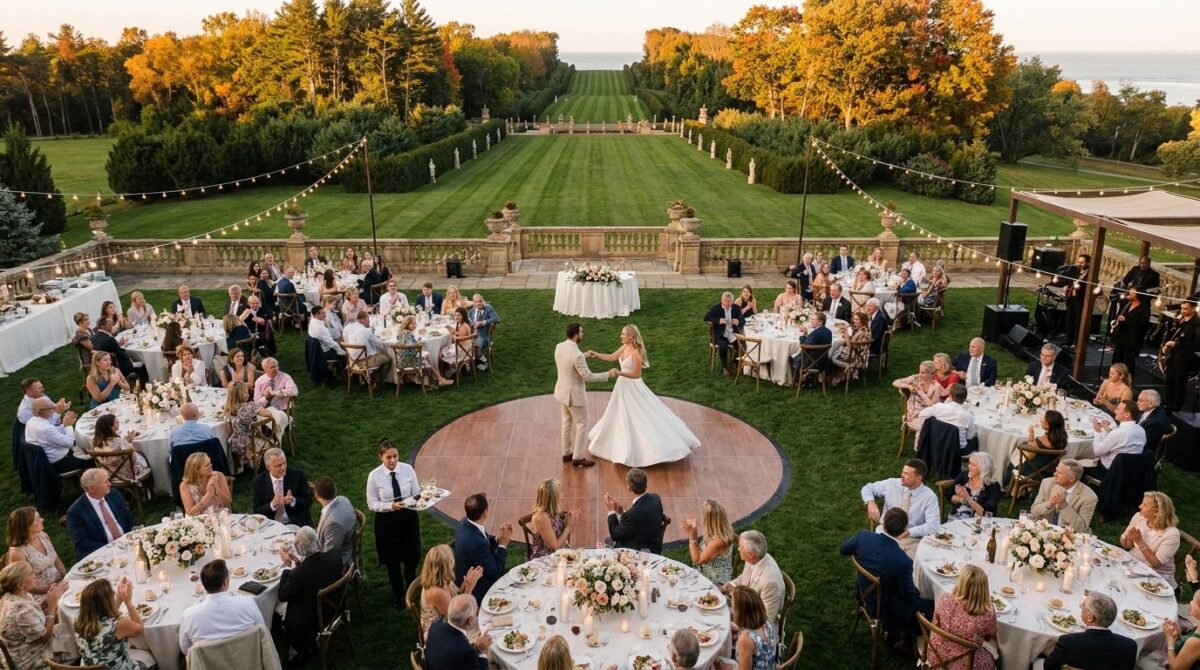
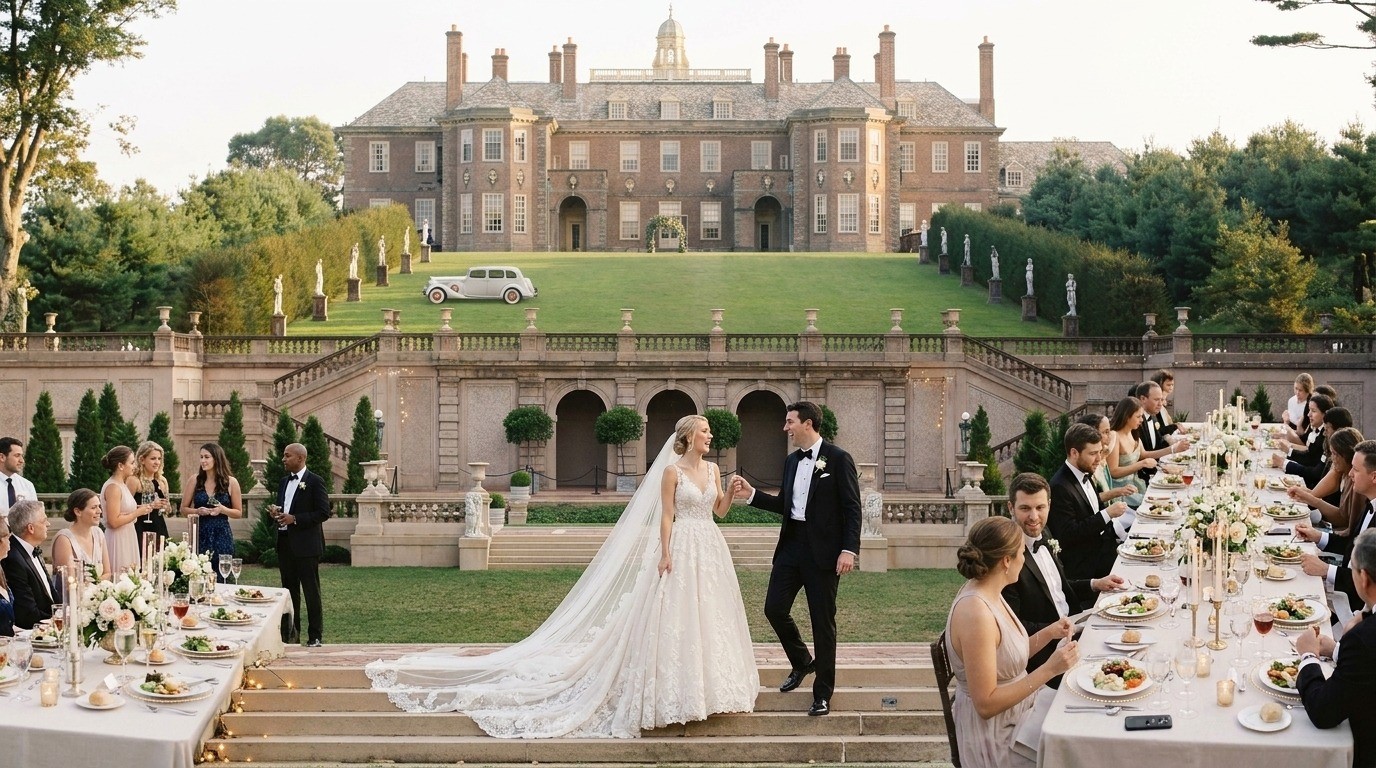
A 59-room mansion on 2,100 acres with a half-mile grass allée that ends at the Atlantic Ocean — and yes, it looks exactly like it did in the movies..

The approach alone tells you something. Protected marshland gives way to old-growth canopy before the Great House finally reveals itself — a Stuart-style mansion designed by Chicago architect David Adler in 1928 for plumbing magnate Richard T. Crane Jr. Adler’s commission was specific: build something that matched the scale of the landscape. On 2,100 acres of North Shore coastline, that meant going big. Fifty-nine rooms. A library paneled in English oak. An Italian-inspired loggia. And the Grand Allée — that manicured lawn flanked by statuary and hedgerows, stretching from the mansion’s rear terrace a full half-mile down to Crane Beach and the Atlantic..

The Trustees of Reservations manage the estate, which means preservation standards are serious. Receptions at the Great House happen under a sailcloth tent for up to 250 seated. The Barn handles 130 for couples who want the estate address without the mansion formality, and Steep Hill Beach accommodates 600-plus for truly large-scale gatherings. Venue fees for the Great House run $8,500 to $11,500, with food and beverage minimums of $18,000 to $25,000 and catering drawn from an exclusive approved list..

Capacity: 250 seated (Great House tent); 130 seated (The Barn); 600+ (Steep Hill Beach) Spaces: Great House sailcloth tent, The Barn, Steep Hill Beach, Grand Allée, Italian Garden Price Range: $8,500–$11,500 venue fee (Great House); $18,000–$25,000 F&B minimums Peak Season: June–September Best For: Couples who want Gilded Age grandeur on a cinematic North Shore estate Pet-Friendly: No (strict Trustees of Reservations policy).

Acoustically, a sailcloth tent is nothing like a ballroom. Fabric absorbs highs, open sides bleed sound, and wind off the ocean is constant on that exposed hilltop. A horn or a vocalist projects where a speaker loses clarity to wind, which is why live instruments cut through this environment far better than a purely electronic setup. The five-hour event window is tight — your entertainment team arrives with a plan built for this specific site, no on-the-fly adjustments. And shuttle logistics between parking and venue eat into your timeline more than the schedule suggests on paper..

Hollywood has used Castle Hill as a location for decades — you might recognize it from The Witches of Eastwick or Greta Gerwig’s 2019 Little Women. The grounds where the Agawam tribe once lived are now one of the most photographed landscapes in North America. And the current mansion is technically the second attempt: Crane’s wife, Florence, rejected the original 1912 Italian Renaissance version because she preferred something more “English.” Adler demolished the first house entirely and built the Stuart-style mansion you see today in 1928.

Official website: https://theinnatcastlehill.com/the-crane-estate

Lyman Estate (Waltham)

img32

The ballroom where Boston first scandalously danced the waltz — and where the oldest surviving greenhouse in the United States still grows rare camellias.

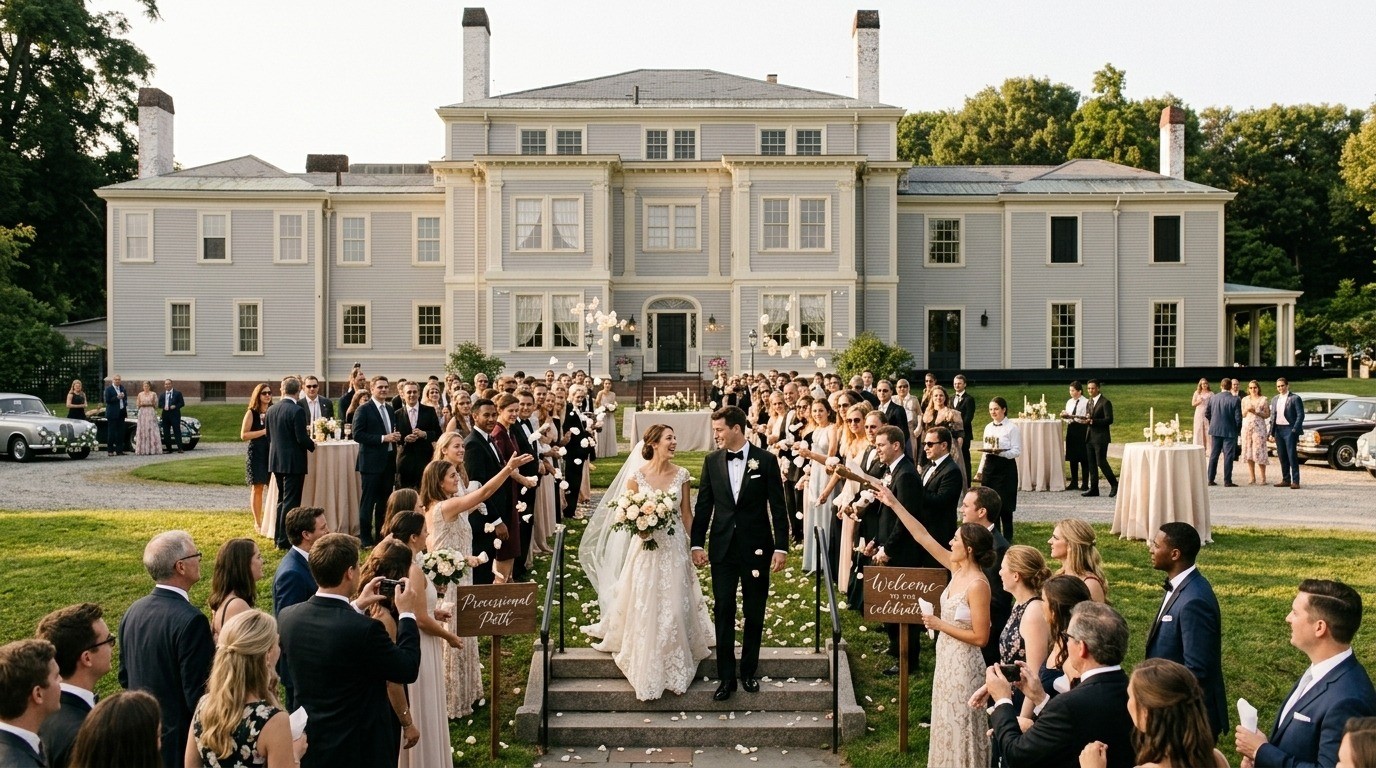
From the street, the Lyman Estate barely registers. A Federal-style mansion, restrained, almost austere — the kind of building you’d walk past without a second glance. Then you step through the door into rooms that have been hosting social events since George Washington was President. Built in 1793 and known as “The Vale,” the architectural details are original — not restored, not reproduced, but the actual moldings and mantels crafted when the Federal style was brand new.

But the grounds are where Lyman Estate earns its devotion. Greenhouses dating to 1804 — among the oldest surviving in the country — hold rare camellias, grapevines that have been producing for generations, and the kind of botanical density that makes a skeptic stop and stare. Couples use them for portraits: warm light filtering through century-old glass onto plants that were growing before the War of 1812. The lawns accommodate tented events for up to 200, while the mansion interior seats 125 for a more intimate dinner.

Pricing is remarkably approachable for an estate of this caliber — peak Saturday rentals at $6,200, off-peak Saturdays dropping to $2,800. Couples bring their own alcohol through a licensed bar service and choose from an approved vendor list for catering. Historic New England, which manages the property, earned a Preservation Award for its stewardship. This is not a building that’s been gutted and rebuilt for events.

Capacity: 125 seated (mansion interior); 200 (tented lawn events) Spaces: Federal-era ballroom, mansion parlors, century-old greenhouses, tented lawn Price Range: $2,800–$6,200 (venue rental varies by date); approved vendor catering; BYOB with licensed service Peak Season: May (wisteria and greenhouse blooms) and October (foliage) Best For: Garden-loving couples on a realistic budget who want genuine history Pet-Friendly: Yes — pets allowed for outdoor ceremonies and cocktail hours (restricted from mansion interior)

Intimate rooms mean every sonic choice is magnified. Low ceilings relative to the larger estates on this list, original plaster walls, and compact dimensions create an acoustic environment where live instruments breathe beautifully but amplified sound needs a careful hand. A three-piece acoustic ensemble — violin, guitar, vocals — fills the ballroom with exactly the right presence. Crank a PA to standard wedding volume and the room pushes back inside thirty seconds, every surface bouncing sound into mush. The tented lawn flips the problem entirely: open air, no walls, ambient noise from the surrounding neighborhood. Out there, directional speakers and a performer who can project energy without relying on the room’s help are essential. Plan the transition between indoor and outdoor spaces carefully — the walk from the greenhouse to the tent is not a quick pivot.

In the early 1800s, the Lyman Estate ballroom hosted one of Boston’s most delicious social scandals. The waltz — that close-contact, face-to-face dance European society had already embraced — was introduced to Boston here for the first time. Local elders were so scandalized by the “indecent” proximity of the dance partners that they temporarily banned the waltz from other Boston venues. Two centuries later, the room where polite society clutched its pearls over a dance is the same room where couples now have their first dance as newlyweds.

Official website: https://www.historicnewengland.org/property/lyman-estate/

The Fairmont Copley Plaza (Boston)

img33

Every U.S. President since Taft has walked through this lobby — and the hotel’s Labrador retriever might be the most popular wedding guest in Boston.

Nothing about the Copley Plaza is understated. Step in from Copley Square — Trinity Church on one side, the Boston Public Library on the other — and the lobby delivers the full Beaux-Arts treatment: soaring ceilings, gilded mirrors, marble everywhere. This hotel has been the center of Boston’s social life since it opened in 1912, standing on the original site of the Museum of Fine Arts.

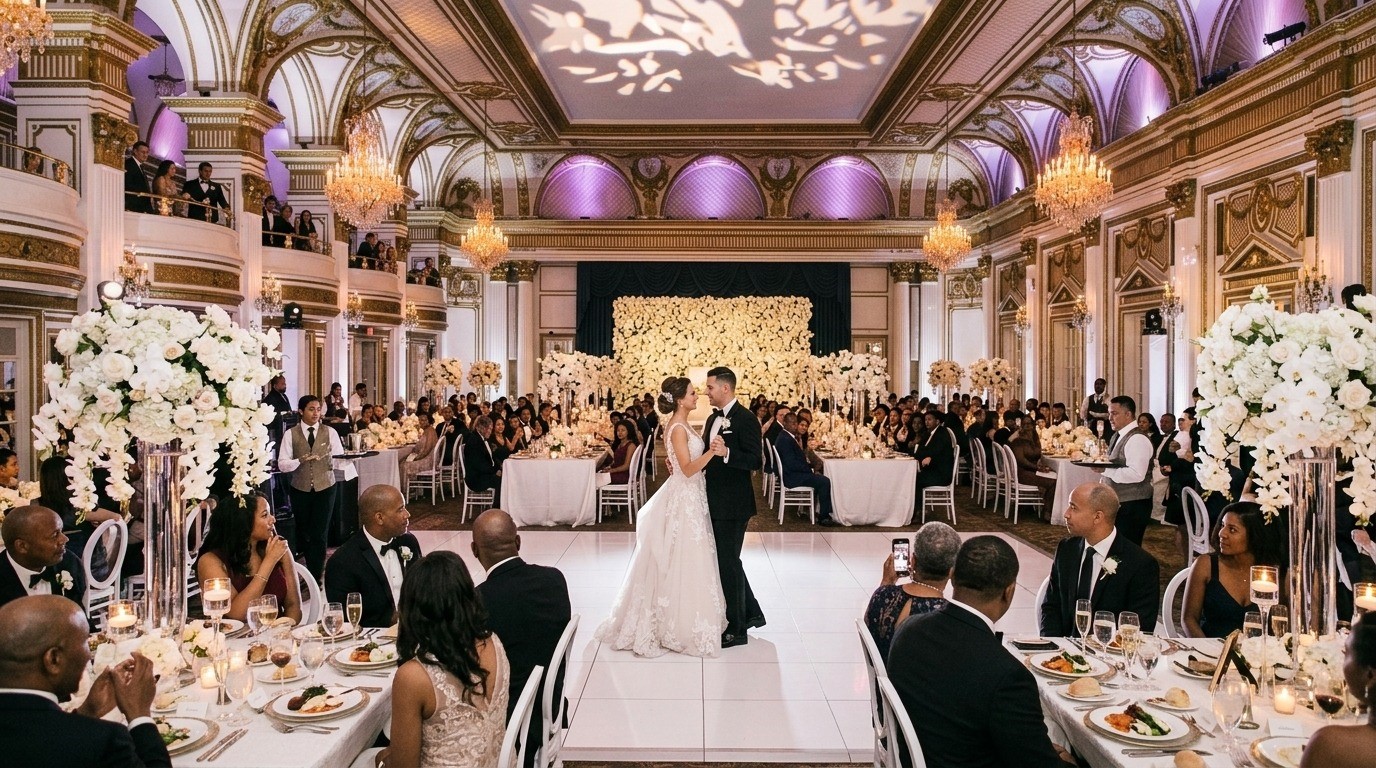
The Grand Ballroom anchors everything. Thirty-foot ceilings. Crystal chandeliers. Gilded mirrors lining the walls. Capacity for 600 seated — one of the few rooms in Massachusetts that can absorb a truly large-scale celebration without feeling like a convention center. The Oval Room (320 seated) and Venetian Room (230 seated) offer the Copley address at a more intimate scale, while “Peacock Alley” — the long gilded corridor named for the early 1900s socialites who used to parade there — remains one of the most popular bridal portrait locations in the city.

Where the Copley Plaza breaks from the grand-hotel template is its aggressively pet-friendly policy. Pets are welcome in all event spaces for a $50 fee, and the hotel’s resident “Canine Ambassador” — a Labrador named Cori Copley — has been known to appear at weddings in a bow tie. Venue fees start at $3,000; meal packages begin at $200-plus per person, with valet parking, luxury lodging, and full-service wedding planning included.

Capacity: 600 seated (Grand Ballroom); 320 seated (Oval Room); 230 seated (Venetian Room) Spaces: Grand Ballroom, Oval Room, Venetian Room, Peacock Alley, lobby Price Range: Venue fees from $3,000; meal packages $200+ per person Peak Season: December (legendary holiday decor) and May/June Best For: Black-tie couples who want a grand urban ballroom with full-service support Pet-Friendly: Yes — all event spaces ($50 fee); resident Canine Ambassador on staff

Gorgeous ceilings, consequential acoustics. Gilded plaster and marble create substantial reverb — a saxophone solo or vocal performance feels cinematic in here. But muddy bass pools and turns your dance music into a sonic blur. The key is high-frequency clarity: crisp vocals, sharp percussion, controlled low end. A hybrid setup — live musicians for presence, DJ for precision — is purpose-built for a room like this. Keep in mind the Grand Ballroom’s sheer scale: a three-piece acoustic combo that works beautifully in the Venetian Room will feel lost in the 600-seat main hall. Match the configuration to the room you’re actually using.

Every sitting U.S. President from Taft onward has passed through these doors. The building occupies the former site of the Museum of Fine Arts, which relocated to the Fenway in 1909 — meaning the ground beneath the Grand Ballroom once held masterworks by Monet and Sargent. The art moved; the grandeur stayed. Cori Copley, the current resident Labrador, has her own social media following and has appeared in more wedding photos than most human guests at this point.

Official website: https://www.fairmont-copley-plaza.com/weddings/

The Commons 1854 (Topsfield)

img34

A former town meeting hall where abolitionists once debated, now fitted with Swarovski chandeliers and a four-sided mezzanine balcony built for dramatic entrances.

Topsfield is a small North Shore town — famous agricultural fair, quiet residential streets — and the building catches most people off guard. From outside, The Commons 1854 reads as a handsome but modest historic structure. Walk through the door and someone’s bold decisions become immediately apparent. Swarovski crystal chandeliers hang from restored ceilings. A neoclassical ballroom opens with proportions that feel European — clean lines, high walls, balanced geometry. Then there’s the balcony: a four-sided mezzanine wrapping the entire perimeter, creating a gallery-level vantage that transforms how you experience the space.

The balcony makes the room. Couples enter from above, appearing on the mezzanine and descending into the room while 200 guests look up. Photographers use it for a bird’s-eye angle on the first dance. Verticality and drama in a building that, from the street, promises neither.

Outdoor ceremonies happen in the private garden, and climate-controlled interiors mean the ballroom works year-round. In-house catering and bar are required. Pricing is straightforward: $2,000 to $3,000 reception fee, $1,500 ceremony fee, with bridal suite, groom’s room, and on-site parking included. For a boutique ballroom on the North Shore, The Commons delivers a surprising amount of architectural personality per dollar.

Capacity: 200 guests Spaces: Grand Ballroom with four-sided mezzanine balcony, private garden, bridal suite, groom’s room Price Range: $2,000–$3,000 reception fee; $1,500 ceremony fee Peak Season: June and September (best for outdoor garden ceremonies) Best For: Couples who want boutique ballroom drama on a North Shore budget Pet-Friendly: Conditional — pets allowed for outdoor ceremonies only

That mezzanine entrance is both a performer’s challenge and an opportunity. When the couple appears above, the room’s attention goes vertical — every head tilts up, conversations stop, energy shifts. MC and music have to be precisely synchronized with that descent. Start the entrance song too early and the moment deflates. Too late, and you’ve got an awkward pause with 200 people staring in silence. The ballroom itself — contained, climate-controlled, hard walls, moderate ceiling height — holds sound well. No bleed, no wind, no ambient noise competing with your setup. That’s a gift. A well-balanced PA with live instruments fills this room cleanly. For couples doing outdoor ceremonies, cocktail music bridges the garden-to-ballroom transition while guests move inside. Keep it simple, keep it playing, and let the room do its work once they arrive.

For over a century after its construction in 1854, this building served as the cultural and civic heart of Topsfield. Town meetings, public lectures, and — most notably — abolitionist gatherings took place in these rooms in the years leading up to the Civil War. The intricate woodwork contains hidden maritime symbols carved into the molding, a nod to the New England coastal craftsmanship tradition that defined the region’s architecture. Look closely at the trim work near the stage area and you’ll find them — anchors, rope patterns, and wave motifs tucked into the neoclassical detailing.

Official website: https://thecommons1854.com/

Boston Public Library (Boston)

img35

The first large free municipal library in the United States, designed by Charles Follen McKim in 1895 — where the Holy Grail murals eliminate your need for a florist.

Push through the bronze doors on Dartmouth Street and you’re standing inside a building designed as a public palace. McKim built a Renaissance Revival monument to the idea that knowledge should be free — Siena marble, travertine walls, vaulted ceilings painted by John Singer Sargent. The central courtyard, modeled after the Palazzo della Cancelleria in Rome, wraps an arcaded colonnade around a fountain where couples hold ceremonies for up to 200. In June and September, evening light drops into that courtyard and turns the stone a warm amber that looks planned — and with McKim, it probably was.

Bates Hall is the main event space — named for Joshua Bates, the library’s first benefactor who insisted the institution be “free to all,” a phrase carved into the facade. The hall seats 330 under a barrel-vaulted ceiling with massive arched windows. It runs 218 feet long. You don’t decorate a room like that. For something more intimate, the Abbey Room seats 100 surrounded by a wall-length mural cycle by Edwin Austin Abbey depicting the “Quest of the Holy Grail.” Museum-quality paintings at your dinner guests’ elbows, requiring zero additional decor — the kind of venue feature money can’t buy, because it was built for the public and you’re borrowing it for a night.

Venue fees range from $8,700 to $21,500-plus depending on rooms booked. Exclusive catering by The Catered Affair is required. No on-site parking (valet or public garage needed), and setup/teardown windows are strict — this is an active public institution, not a dedicated event space.

Capacity: 330 seated (Bates Hall); 200 ceremony (Courtyard); 100 seated (Abbey Room) Spaces: Bates Hall, Courtyard with fountain, Abbey Room (Holy Grail murals), Sargent Gallery Price Range: $8,700–$21,500+ (varies by rooms booked); exclusive catering by The Catered Affair Peak Season: June and September (courtyard evening light) Best For: Literary-minded couples who want a cultural landmark, not a hotel Pet-Friendly: No (service animals only)

A barrel-vaulted ceiling stretched across 218 feet creates an acoustic environment unlike any other wedding venue in Boston. The vault channels sound along the room’s length — position your PA incorrectly and half your guests hear echoed mush while the other half get crisp audio. Distributed sound solves this: multiple smaller speakers along the hall rather than two large stacks at one end. Live instruments thrive under that vault, the natural amplification adding body to strings and vocals that electronic playback can’t replicate. Keep in mind the library’s strict setup windows — your team can’t arrive hours early to experiment. Come with a plan, execute it, and respect the building.

McKim conceived the library as a “Palace for the People,” and it remains one of the finest Renaissance Revival buildings in the country. Upstairs, the Sargent Gallery — often explored by wedding guests between courses — contains John Singer Sargent’s mural cycle on the history of religion, a work so ambitious it consumed 30 years of his life. Joshua Bates, the London-based banker who funded the library, never actually lived in Boston. His $50,000 donation (roughly $1.8 million today) came with a single condition: that the building remain free and open to every citizen. That insistence is carved into stone above the entrance.

Official website: https://www.bpl.org/host-an-event/

How to Choose Between These Venues

Five historic mansion wedding venues in Massachusetts, and they couldn’t be more different from each other. The right one depends on guest count, budget, personality, and logistics.

Guest list over 300? The Fairmont Copley Plaza is your only realistic option here — the Grand Ballroom seats 600, and the Oval Room handles 320. Castle Hill’s Great House tent tops out at 250, and the Boston Public Library’s Bates Hall maxes at 330. On the other end, intimate celebrations under 130 find their natural home at the Lyman Estate mansion interior (125 seated) or The Commons 1854 (200 max, but its boutique proportions make it feel smaller and warmer than the number suggests).

Budget is where these venues diverge most sharply. Lyman Estate’s off-peak rental of $2,800 with BYOB occupies a different financial universe than the Copley Plaza’s $200-plus per person meal packages or the BPL’s $21,500 venue fee ceiling. The Commons 1854 sits in approachable middle territory — $2,000 to $3,000 reception, $1,500 ceremony. Castle Hill runs $8,500 to $11,500 for the venue alone, plus $18,000 to $25,000 in F&B minimums. Know your number before you tour.

When architectural drama is the priority, the Copley Plaza’s Grand Ballroom and Bates Hall deliver it through pure scale and ornamentation. The Commons 1854 achieves something equally striking by different means — the surprise of a mezzanine balcony entrance in a building no one expected to contain that kind of space.

Airport logistics matter for out-of-town guests. Boston venues (Copley Plaza, BPL, Lyman Estate in Waltham) sit within 30 to 45 minutes of Logan International. Castle Hill in Ipswich is about an hour north, with shuttles often necessary on-site. The Commons 1854 in Topsfield falls 30 to 45 minutes from Logan.

And if the story matters as much as the setting — Lyman Estate’s waltz scandal, Castle Hill’s Hollywood film pedigree, the BPL’s “free to all” democratic mission — each venue carries a narrative guests will remember long after the last dance.

Why Entertainment Matters More Than You Think at Historic Mansions

Old buildings have opinions about music. They were built before amplified sound existed — architects thinking about voices, footsteps, chamber orchestras. Bring a modern entertainment setup into one of these rooms and you’re joining a conversation that started a century or two before you arrived.

Reverb is the central variable. High ceilings and hard surfaces — marble, plaster, stone, gilded wood — reflect sound instead of absorbing it. In the Copley Plaza’s Grand Ballroom, a sustained bass note bounces off six surfaces before it decays. Push sub-bass at nightclub levels and the room dissolves into a soup of overlapping frequencies. A live saxophone in that same room, though? The reverb adds warmth and dimension that a studio recording can’t touch. The room becomes the instrument’s partner rather than its enemy.

Bates Hall at the Boston Public Library presents a different puzzle entirely. That barrel-vaulted ceiling functions like a sound tunnel — audio travels the 218-foot length with surprising efficiency, a speaker at one end sending a delayed version to the other. Distributed speaker placement solves this, but only if your team understands the physics before they show up. Meanwhile, the Lyman Estate’s low-ceilinged Federal rooms flip the problem: intimate enough that over-amplification becomes physically uncomfortable in seconds.

Equipment protection also matters more here than at any modern venue. Original hardwood at Lyman Estate, marble thresholds at the Copley Plaza, priceless murals at the BPL — your entertainment team needs to route cables without damaging surfaces, set speaker stands on protective pads, and load in through doors that haven’t been widened since the 18th century. The couples who get this right hire entertainment that respects the architecture as much as they do.

Why DLE Event Group

Massachusetts’ historic mansions don’t need more sound. They need the right sound, placed by people who’ve learned what these rooms want.

Our hybrid DJ band model was built for exactly this kind of challenge. Live musicians — saxophone, guitar, keys, percussion, vocals — produce organic sound that resonates naturally in high-ceiling plaster and marble rooms. A live horn section in the Copley Plaza’s Grand Ballroom, or a vocalist under the barrel vault in Bates Hall, creates presence that a purely electronic setup simply cannot replicate in these acoustic environments. The DJ component gives us the song library, the seamless transitions, and the precise energy control that keep a dance floor packed past midnight. Not one or the other — the combination of live instruments for rooms that reward them and DJ precision for moments that demand it is what makes historic venues come alive.

Backup equipment comes to every event. Duplicates of everything critical. When the architecture is irreplaceable and the floor beneath your speakers is older than your grandparents, redundancy isn’t optional — it’s standard procedure. Our team arrives with a plan specific to that room: speaker placement mapped to the ceiling geometry, cable routing designed to protect historic surfaces, volume calibrated to the space’s natural reverb.

DLE Event Group has performed at 100-plus weddings and events across New York City’s most prestigious historic venues — The Plaza Hotel (all eight event spaces), The Pierre, Gotham Hall, Guastavino’s — and throughout the broader region. We’ve earned The Knot Best of Weddings Hall of Fame 11 consecutive times (2013-2023). Planning starts 5 to 10 Zoom sessions before your wedding, covering music, timeline, and your venue’s specific acoustic requirements. We learn custom songs for first dances and build pronunciation guides for MC introductions. Massachusetts is well within our service area.

Frequently Asked Questions

Peak season dates — particularly October, which now books faster than June thanks to New England foliage demand — require 12 to 18 months of lead time at the most popular venues. Boston venues and North Shore estates fill earliest due to metro-area demand. Booking between January and March (the off-peak window) can save up to 40% on venue fees, and Friday or Sunday dates at most Massachusetts venues come with significantly lower rates and reduced F&B minimums.
It varies enormously depending on the model. Lyman Estate’s off-peak rental of $2,800 with BYOB means you could build a 125-person wedding for $25,000-$40,000. The Commons 1854 runs $3,500-$4,500 for venue and ceremony, plus in-house catering. Castle Hill’s all-in for 200 guests typically reaches $50,000-$75,000. The Copley Plaza, at $200-plus per person, scales with your guest count — 150 guests could run $35,000-$55,000. Understand the pricing model (rental-only vs. all-inclusive) before you start comparing.
All five venues in this guide support it. Castle Hill uses the Grand Allée for ceremonies and the sailcloth tent for receptions. Lyman Estate offers the greenhouse or lawn for ceremonies and the ballroom or tent for dinner. The Copley Plaza runs ceremonies in one event room and receptions in another. The Commons 1854 pairs its private garden outdoors with the ballroom indoors. The BPL handles courtyard ceremonies and Bates Hall receptions. In every case, the transition between spaces is where entertainment planning matters most — cocktail music needs to fill the gap while rooms flip.
In these rooms, live instruments consistently outperform DJ-only setups. High ceilings and hard surfaces — marble, plaster, stone, original hardwood — create natural reverb that flatters acoustic sound and punishes over-amplified bass. A hybrid setup (live musicians plus DJ) gives you the warmth these buildings reward during ceremonies and dinner, plus the range and energy to fill a dance floor later. The specific configuration should match the room — a saxophone trio in the Copley Plaza’s Grand Ballroom is a different calculation than a guitarist in the Lyman Estate’s Federal parlor. Work with an entertainment team that asks about your venue’s acoustics before they quote you a price.
There’s a mandatory 3-day waiting period from the date you apply until you can pick up the license. It’s valid for 60 days. Both partners must appear in person at any city or town clerk’s office in the state — residency is not required. Unlike many states, Massachusetts does not require witnesses to sign the marriage license. Plan ahead for that 3-day gap, especially if you’re coming from out of state.
A few worth knowing. “Telling the Bees” is an old New England tradition where families decorated hives with white ribbons and whispered news of the wedding — offend the bees, and they’ll abandon the hive, taking the farm’s luck with them. Coastal couples sometimes incorporate an anchor motif, a maritime superstition symbolizing stability in a “stormy” world. In Boston, there’s a tradition of working North End molasses into the menu (often via ginger snaps) to “sweeten” the couple’s future — a nod to the Great Molasses Flood of 1919.

Ready to Plan Your Massachusetts Mansion Wedding?

Five venues. Three centuries of combined architectural history. Five completely different ways to get married in a building that carries weight.

The mansion sets the stage. The entertainment is what fills the room with energy, holds guests on the dance floor, and turns architectural grandeur into a celebration people talk about for years.

DLE Event Group specializes in making old rooms feel electric without fighting the acoustics that make them special. If you’re exploring Massachusetts wedding venues for the 2025-2026 season, we’d like to hear what you’re planning.

QUESTIONNAIRE

Need Assistance? Directly reach us at contact@dleeventgroup.com or 877.534.2424

Top 5 Waterfront Wedding Venues in Connecticut: An Entertainer’s Insider Guide

Top 5 Waterfront Wedding Venues in Connecticut: An Entertainer’s Insider Guide

The wind off Long Island Sound does something to a saxophone line that no concert hall can replicate. I figured this out mid-performance at a shoreline reception a few years back — watching the notes carry over salt water, past the docked boats, across a terrace full of people who had kicked off their shoes and were dancing on flagstone still warm from the afternoon sun. Behind them, the Connecticut coastline was doing that thing it does in late June: the sky goes copper, then rose, then this deep violet that makes the Sound look like hammered metal. Nobody was checking their phone. Nobody was ready to leave.

That’s the pull of a waterfront wedding in Connecticut. It’s not the tropics — you won’t get turquoise water or palm trees, and anyone who promises you that is selling you a fantasy. What you get instead is something with more texture. Rocky points and tidal marshes. Lighthouses that actually function. Harbors where lobster boats tie up next to sailboats. The Connecticut shoreline runs about 96 miles along the Sound, but the character shifts every few towns — from the Gold Coast glamour of Fairfield County to the quieter, salt-worn fishing villages east of New Haven to the river-mouth history of Old Saybrook. And tucked into the Litchfield Hills, two hours from the coast, you’ll find a lake-country retreat that belongs on this list for reasons I’ll get to.

I’ve loaded equipment through marina side doors, run cables across resort terraces with the tide rising below, and learned exactly which waterfront wedding venues Connecticut couples should have on their radar for the 2025-2026 season. These five are the ones I’d recommend over a beer. No brochure language. Just what I’ve seen.

Why Waterfront Venues Work for Connecticut Weddings

Most couples pick a waterfront venue for the photos. What surprises them is how much the water changes the entire event flow. Water draws people outward. Cocktail hour on a terrace overlooking the Sound isn’t something your guests have to be coaxed into; they gravitate to the railing, drink in hand, and the conversations happen naturally. That transition from ceremony to cocktails to reception? It’s smoother at a waterfront property because the landscape itself guides people through the evening.

From an entertainment perspective, Connecticut’s coastal venues offer a specific advantage: most of them have both indoor and outdoor spaces, which means you can run a sunset ceremony on a lawn or terrace and then move guests inside for dinner and dancing without losing momentum. The shift in atmosphere — from open sky and sea breeze to a climate-controlled ballroom with a proper sound system — actually creates a natural energy build that’s hard to manufacture in a single-room venue.

The practical stuff matters too. Sound behaves differently near water — it carries, which is gorgeous for a string trio during the ceremony and something you need to plan around for amplified reception music. Wind is a factor from May through October along the Sound. And Connecticut’s waterfront venues tend to come with built-in lodging, which means your guests aren’t scrambling for hotels at midnight — a genuine relief when half your list drove up from New York and the other half flew down from Boston.

The Venues

Saybrook Point Resort & Marina (Old Saybrook)

img26

Frank Sinatra used to drink here — and the sunsets haven’t gotten any less dramatic since the Rat Pack left.

Saybrook Point sits at the exact spot where the Connecticut River empties into Long Island Sound, and that confluence gives you water views in nearly every direction — a rare thing even among shoreline venues. The resort has been a social anchor in Old Saybrook since 1871, when the original Pease House stood on this land. By the 1950s, it had become the Terra Mar, a celebrity haunt where Sinatra and his crew held court. The Tagliatela family transformed it into the current resort, and they did something quietly significant in the process — they made it Connecticut’s first “Certified Green” hotel. The farm-to-table kitchen isn’t a marketing buzzword here; it’s baked into how they operate.

For ceremony spaces, you have options. The Compass Rose terrace puts your guests directly on the waterfront with the marina and lighthouse as your backdrop, while the garden Pergola offers something more enclosed and intimate. For the reception, the Lighthouse Gallery seats 200 and delivers panoramic water views from every angle — floor-to-ceiling windows that turn the Sound into a living mural that changes color throughout the evening. The aesthetic walks a line between coastal chic and a kind of Victorian elegance that feels earned rather than forced.

Beneath all of it is genuinely historic ground — Saybrook Point was the site of Connecticut’s first military fort, built in 1635 — and that gives the place a weight you feel even if you can’t name it.

Capacity: Up to 200 seated in the Lighthouse Gallery; outdoor ceremonies for 200 Spaces: Lighthouse Gallery (reception), Compass Rose Terrace (outdoor ceremony), Garden Pergola (intimate ceremony) Price Range: $179-$230+ per person; site fees $2,500-$7,000; average total spend ~$50,000 Peak Season: May-November Best For: Couples who want maritime luxury with an eco-conscious edge Pet-Friendly: Yes — up to 2 dogs, max 60 lbs; $50 daily fee

Inside the Lighthouse Gallery, the water does half your lighting work. Late afternoon sun bounces off the Sound and fills the space with a warm, shifting glow that changes as the evening progresses. A 200-person cap keeps the room proportional — you’re not fighting a cavernous ballroom with a modest guest list. Sound stays contained and present. The five-hour event window means you plan your timeline tightly, but that constraint keeps the energy focused. With 82 on-site guest rooms and literary-themed guesthouses, your guests aren’t driving anywhere after the last dance — and when there’s an open bar and a waterfront, nobody wants to.

After the reception winds down, couples staying in the Lighthouse Suite get something no other venue in the state can match: a private honeymoon suite inside an actual, functioning lighthouse at the end of the resort’s dock. You walk down the pier, the marina quiet around you, and you’re sleeping in a lighthouse. It sounds like a brochure fabrication, but it’s real, and it’s been drawing couples to this property for years.

Official website: https://www.saybrook.com/

Water's Edge Resort and Spa (Westbrook)

img27

The Great Lawn slopes from the resort to a private white-sand beach, and when 300 guests are watching a ceremony on that grade, the Sound becomes the largest backdrop money can’t buy.

Water’s Edge earns its reputation on sheer scale. Twenty-five acres of gardens, a private beach, a full-service spa, and ballrooms with crystal chandeliers — this is the Connecticut shoreline venue for couples who want a resort wedding without flying to the Caribbean. The property started in the 1920s as a private summer cottage for a menswear tycoon. By the mid-century, it had become a hotel under Bill Hahn — locally known as the “Host with the Most” — and a discreet getaway for Hollywood names like Katharine Hepburn and Barbra Streisand.

That “Golden Age” charm is still present in the bones of the place, but it’s been updated with modern shoreline luxury. The Westbrook Ballroom handles up to 300 seated guests, making it one of the largest waterfront reception spaces on the Connecticut coast. For a more contained feel, the Royal Ballroom offers a 220-person option with private balconies overlooking the water. Both rooms deliver a crystal-and-linen treatment that reads as classic New England formal without tipping into stuffy.

But the real draw is outdoors. The Great Lawn — a massive, manicured slope that runs from the resort directly to the ocean — provides what is arguably the most dramatic unobstructed ceremony backdrop in the state. Your guests sit on the grade, the lawn frames the couple, and the Sound stretches out behind them. No arch or altar competes with that view. Photographers will tell you it’s the single best natural-light ceremony angle on the Connecticut coast.

Capacity: Up to 300 guests; Royal Ballroom (220 seated), Westbrook Ballroom (300 seated) Spaces: Great Lawn (outdoor ceremony), Royal Ballroom, Westbrook Ballroom, full-service spa and salon Price Range: ~$154-$194+ per person; ceremony fee $895-$1,100; 20% service charge + 7.35% tax Peak Season: June-September Best For: Large-scale beachfront resort weddings with full guest amenities Pet-Friendly: No — ADA service animals only

A 300-person room near the ocean is a specific set of challenges I enjoy solving. The Westbrook Ballroom has the height and hard surfaces to carry sound properly, but crystal chandeliers and large windows create reflection points that can muddy a mix if you’re not deliberate about speaker placement. On the other hand, the transition from Great Lawn ceremony to indoor reception is clean. Guests move through cocktails in an adjacent space while the ballroom gets its final setup. When they walk into the reception room — fully lit, fully dressed, band warming up — that reveal hits harder because they haven’t been watching chairs get rearranged. With 150+ on-site rooms, your late-night crowd doesn’t thin out early. People stay. The dance floor stays full.

Water’s Edge is a Historic Hotels of America member, and that designation isn’t handed out casually — it requires documented architectural significance and a commitment to preservation. What guests notice is something subtler: the resort’s award-winning New England clam chowder, served alongside in-house catering that leans into the region’s maritime kitchen. When your rehearsal dinner ends with a Connecticut coastal lobster bake — clams, corn, drawn butter, feet practically in the sand — you’re participating in a New England tradition that predates the venue itself.<br.
Official website: https://watersedgeresortandspa.com/

The Inn at Longshore (Westport)

img28

The Rockefellers partied here. The Roosevelts partied here. Marilyn Monroe partied here. Now your guests will — and the view over the Saugatuck River still earns every one of those comparisons.

Westport is Gold Coast Connecticut, and The Inn at Longshore is the property that defines that phrase. Built in 1890 for the Bedford family, the estate spent decades as an ultra-exclusive country club before the Town of Westport purchased the 52-acre park in 1960 to preserve its heritage for the public. That decision means you’re getting married on land that carries genuine Fairfield County aristocratic history — not a reproduction of it, not an imitation, but the actual estate where the old-money families of the early 20th century gathered.

A sprawling lawn runs down to the water along the Saugatuck River — photographers will tell you it offers the most unobstructed sunset views in Fairfield County. Inside, the Grand Ballroom handles 300 seated guests, and the outdoor lawn can accommodate the same number for a ceremony with the water as your backdrop. OntheMarc Events manages the property, and their catering — from-scratch seasonal menus produced by the on-site restaurant La Plage — operates at a level that matches the setting. This isn’t banquet food. It’s restaurant food served at a wedding.

The venue hosts only one wedding at a time — the entire 52-acre estate is yours for the day. No shared parking lots, no competing cocktail hours through the wall.

Important planning note: The Inn at Longshore is currently closed for an $8 million renovation and is expected to reopen in Fall 2026. Couples targeting late-2026, 2027, and 2028 dates are in the right window, but in-person site visits and tours are on hold until the reopening. If the Inn is your top choice, watch for the venue’s reopening announcements and plan your timeline accordingly. If you need a Fairfield County waterfront venue before Fall 2026, the other properties on this list remain fully operational.

Capacity: Up to 300 seated in the Grand Ballroom; outdoor lawn ceremonies for 300+ Spaces: Grand Ballroom, waterfront lawn (ceremony), 12 on-site guest rooms Price Range: Average spend $40,000-$50,000+; F&B minimums $5,000-$34,000 depending on date Peak Season: May-October Best For: Gold Coast couples who want historic estate elegance with a waterfront edge Pet-Friendly: Yes — 2 dogs max, 50 lbs; $35 per night fee

Acoustically, the Grand Ballroom has good bones — high enough ceilings to let music breathe, a layout that creates a natural dance floor center rather than pushing it to a corner. OntheMarc’s professional event operation means vendor coordination runs without the friction you encounter at committee-managed properties. The outdoor-to-indoor transition is seamless: ceremony on the lawn, cocktails on the terrace, then the ballroom opens. Each phase has its own space and atmosphere. For a performer, that’s ideal — you calibrate the energy for each moment instead of making one room do everything. With 12 on-site guest rooms and Westport’s hotels within minutes, guest logistics are clean.

Local Westport lore holds that F. Scott Fitzgerald based the extravagant parties in The Great Gatsby on events he attended at this estate. Whether or not literary historians can verify the connection to the letter, the spirit of it is undeniable — there’s a reason people call this the “Gatsby venue.” The 52-acre property along the Saugatuck River, the sweeping lawn, the mix of old-money elegance and waterfront ease — it’s a setting that feels like it was written into a novel because, in a sense, it might have been.

Official website: https://westfaironline.com/

Tyde at Walnut Beach (Milford)

img29

Opened in March 2024, this is Connecticut’s newest waterfront venue — and the rooftop terrace overlooking Charles Island already feels like it’s been part of Milford’s coastline for decades.

Tyde is a different animal from the historic resorts on this list. It’s a $5 million ground-up build — a complete reconstruction of the beloved Costa Azzurra restaurant that was a local landmark for the Milford shoreline community for decades. The Landino family, who owned Costa Azzurra, oversaw every architectural detail of the new venue, and their Italian heritage shows in choices you wouldn’t expect from a “modern coastal” space: custom chandeliers where each design represents a specific flower (the Madonna Lily among them), materials selected by hand, a kitchen built around their family’s culinary traditions.

What you walk into reads as crisp and contemporary — clean lines, a “blank canvas” interior — but has a warmth underneath that comes from being a family project rather than a developer’s calculation. The panoramic ballroom seats up to 220 (190 when you add a live band, which is a detail I appreciate them being upfront about), and the design maximizes the coastline views. But the signature space is above: a rooftop terrace with fire pits where guests step out of an elevator into open air, the Sound stretching before them, Charles Island sitting in the middle distance like a painting someone hung on the horizon. Between the ballroom, the outdoor courtyard, and the rooftop, you have three distinct spaces that each carry a different energy.

Capacity: Up to 220 guests (190 with a live band); panoramic ballroom, outdoor courtyard, rooftop terrace Spaces: Panoramic ballroom, outdoor courtyard, rooftop terrace with fire pits, bridal/groom suites Price Range: Sat ~$200/pp, Fri ~$180/pp, Sun ~$140/pp; ceremony fee $1,500-$2,000; $3,000 deposit Peak Season: May-October Best For: Modern couples who want new construction with ocean views and rooftop cocktails Pet-Friendly: Yes — for ceremonies and outdoor photos

That 190-person cap with a live band tells me the venue did the math on floor space rather than quoting a maximum and hoping for the best. Your dance floor won’t be an afterthought squeezed between dinner tables. Panoramic windows give the room natural side-lighting during golden hour that makes everything look cinematic. From a performer’s standpoint, new construction is a gift: modern electrical systems that handle full band power draws without tripping breakers, purpose-built acoustics, and a layout designed for event flow rather than retrofitted. The rooftop-to-ballroom transition gives you a natural energy escalation — mellow cocktails above, then down to the main event. And the large on-site parking lot eliminates the shuttle logistics that plague other shoreline properties.

Charles Island, visible from the rooftop terrace, carries one of Connecticut’s most persistent legends: Captain Kidd allegedly buried treasure there in 1699 before his arrest and execution in London. A causeway from Walnut Beach allows you to walk to the island at low tide, though the treasure — if it was ever there — has never been found. The Landino family’s “Cannoli Guy” — a signature guest experience where fresh cannoli are filled to order during the reception — has already become the thing guests bring up at brunch the next morning. New venues rarely develop a signature that fast.

Official website: https://tyde-walnutbeach.com/

Interlaken Inn (Lakeville)

img30

Two lakes, 30 acres, and a bonfire pit where the last hour of your wedding happens under stars that you actually forgot existed.

Interlaken is on this list because waterfront doesn’t always mean saltwater. Tucked into the Litchfield Hills — Connecticut’s northwestern corner, two hours from the coast and a world apart from it — this lakefront resort sits on 30 acres between Lake Wononscopomuc and Lake Wononpakook. The setting is closer to the Adirondacks than to Long Island Sound, and that’s exactly the point. Where the shoreline venues offer maritime polish, Interlaken offers something looser: kayaks pulled up on the shore, bonfires at the water’s edge, hiking trails that guests wander before the ceremony, a destination-weekend energy that starts Friday afternoon and doesn’t let go until Sunday brunch.

Originally established in 1892 as a farmhouse, the property was destroyed by a catastrophic fire in 1971 and rebuilt as the contemporary inn in 1973. The Reisman family has owned it since 1982, and their approach leans into “summer camp for adults” — except with farm-to-table catering and a 4.5-hour open bar. The Lakeside Tented Pavilion handles up to 220 guests right on the water, so your reception backdrop is lake and treeline rather than a wall. For intimate gatherings, indoor rooms accommodate groups of 30 to 80.

June brings wisteria in bloom across the property. October delivers peak Litchfield Hills foliage — and this corner of Connecticut produces some of the most intense fall color in New England. Either season gives you a setting that photographs like it was staged, except it wasn’t.

Capacity: Up to 220 in the Lakeside Tented Pavilion; intimate rooms for 30-80 Spaces: Lakeside Tented Pavilion, indoor reception rooms, waterfront ceremony area, bonfire pit Price Range: $139-$159++ per person; site fees $500-$2,000; total weekend spend ~$40,000 Peak Season: June (wisteria) and October (peak foliage) Best For: Weekend destination weddings with a “summer camp for adults” vibe Pet-Friendly: Yes — in the Woodside Building; $25 per pet, per night

A tented pavilion on a lake is an acoustically interesting environment. The open sides mean sound dissipates faster than in a walled room, so you need to bring more horsepower to fill the space — but the flip side is that you don’t get the harsh reflections you’d fight in a hard-walled banquet hall. The result, when the system is dialed in properly, is a warm, enveloping sound that feels live and present without being punishing. What makes Interlaken structurally unusual is the outdoor-to-outdoor flow — ceremony at the waterfront, cocktails on the grounds, reception in the pavilion, bonfire to close — unlike any other venue on this list. Instead of moving guests inside, you keep them in the landscape all evening. The energy stays relaxed and communal, which is what you want for a weekend wedding where half the guest list has been kayaking together since Friday. With 80+ on-site rooms across five buildings and a guaranteed one-wedding-per-day policy, Interlaken hands you total ownership of the property and a guest list that doesn’t scatter at 10 PM — a combination the coastal resorts simply can’t match.

Interlaken is located near Lime Rock Park, one of the country’s most storied motorsport circuits, and during summer months the inn frequently hosts racing legends alongside wedding guests. That proximity creates a uniquely Lakeville weekend: your rehearsal dinner guests might be sharing the restaurant with a Formula Atlantic driver who just set a lap record that afternoon. The lakeside bonfire — the inn’s signature tradition — is where the wedding’s final chapter plays out: s’mores, drinks, the last conversations of the night happening around the fire with the lake going still in the dark. It’s not the traditional “last dance” ending. It’s better.

Official website: https://www.interlakeninn.com/

How to Choose Between These Venues

Five waterfront venues, five distinct experiences. The decision comes down to who you are and what kind of wedding you’re building.

Guest list pushing 300? Water’s Edge in Westbrook is built for that scale. It’s the largest venue on this list, and the Great Lawn ceremony-to-ballroom flow is hard to match. Closer to 200 guests and drawn to the eco-luxury route with a lighthouse honeymoon suite? Saybrook Point wraps the waterfront experience in a tighter, more boutique package.

Gold Coast pedigree matters to some couples — and if you want a venue where the history is real, not curated, The Inn at Longshore delivers a Fairfield County estate wedding with genuine roots. The $40,000-$50,000 average spend reflects the location and the OntheMarc catering standard. Budget-conscious? It’s not. Worth it? For the right couple, absolutely — just keep in mind the Inn is closed for its $8 million renovation through Fall 2026, so this option is on the table for late-2026 dates and beyond only.

Couples who lean modern — clean architecture, rooftop fire pits, no outdated wiring — should look at Tyde at Walnut Beach. Barely two years old, it’s already operating at a level that earns its spot here. The Sunday rate of ~$140 per person makes it the most accessible premium option, and that rooftop terrace is genuinely one of the best cocktail hour spaces on the Connecticut coast.

Then there’s the wildcard: if your idea of waterfront is mountain lakes rather than ocean waves, Interlaken Inn in Lakeville is your answer. The ~$40,000 total weekend spend includes a destination-wedding experience in the Litchfield Hills with on-site lodging for your entire guest list. October foliage weekends book fast — 18 months out isn’t too early.

For all five, the seasonality matters. Peak season along the Sound is May through October. Interlaken peaks in June and October specifically. Winter dates at several of these venues come with significant discounts, but you’re trading the outdoor waterfront ceremony for an indoor affair. For some couples, that tradeoff is worth tens of thousands in savings.

Why Entertainment Matters More Than You Think at Waterfront Venues

Waterfront venues in Connecticut present a set of entertainment variables that don’t exist at inland properties, and most couples don’t think about them until they’re three months out and it’s too late to plan around them.

Wind is the first one. Long Island Sound generates consistent onshore breezes from May through October — pleasant for guests in cocktail attire, complicated for a string trio on an exposed terrace. Sheet music becomes a projectile. Microphone stands need weighted bases. An entertainment team that has worked shoreline venues knows all of this and plans for it. One that hasn’t will be learning in real time at your ceremony.

Acoustics shift dramatically between outdoor and indoor spaces, and most of these venues use both in a single evening. Your ceremony happens on a lawn where sound dissipates in every direction — you need more amplification than you think, positioned so your vows carry to the back row without blasting the front. Then you move inside to a ballroom where sound bounces off hard walls and crystal fixtures. The EQ, the speaker placement, the volume — everything changes. That transition needs to be anticipated, not improvised.

Timing is the variable unique to waterfront weddings. Sunset over Long Island Sound doesn’t wait for your cocktail hour to finish. In June, you’re looking at 8:15-8:30 PM. By October, it’s 6:15. The best waterfront weddings are built around that moment — the ceremony timed so golden hour hits during photos, the cocktails positioned so guests are at the railing when the sky goes copper. An entertainment team that understands this coordinates with your planner to match the music to the moment. The acoustic set during sunset cocktails should feel different from the high-energy band set that launches the reception after dark. Getting that pacing right is what separates a good waterfront wedding from one that happened to be near water.

Why DLE Event Group

Connecticut’s waterfront venues demand entertainment that can handle the shift — outdoor ceremony to rooftop cocktails to ballroom reception, the Sound in every window, the energy building from sunset to midnight. That’s not a one-note DJ setup. It’s not a band that plays the same set regardless of the room. It’s a hybrid approach, and it’s what DLE Event Group was built to deliver.

Our hybrid DJ band experience pairs live musicians — sax, guitar, keys, percussion, vocals — with a professional DJ and MC. Live instruments fill a waterfront terrace with warmth during cocktail hour. The DJ capability lets us pivot from acoustic ceremony music to a packed dance floor at midnight without a gap or a break in momentum. For venues where you’re moving between distinct spaces with different acoustics across a single evening, that flexibility isn’t a luxury. It’s a necessity.

We bring backup equipment to every event — duplicates of everything critical. At a venue on the water, where salt air and humidity stress electronic equipment, redundancy matters. Over 10 years and 100+ events, we’ve earned The Knot Best of Weddings Hall of Fame 11 times because that preparation shows up in the performance. Our planning process — 5 to 10 Zoom sessions starting six months before your wedding — means we’ll know your timeline, your must-play songs, your cultural traditions, and your venue’s quirks long before we load in.

DLE serves couples throughout the tri-state area and beyond, and Connecticut’s shoreline is well within our range. Whether you’re booking Saybrook Point or Interlaken, we’ll arrive knowing the room.

Frequently Asked Questions

For peak season (May through October), expect to book 18 to 24 months ahead. Fairfield County venues influenced by the NYC wedding market tend to fill fastest — and with The Inn at Longshore closed for an $8 million renovation through Fall 2026, expect heightened demand at the remaining Fairfield County waterfront properties in the interim. Off-peak dates — January through March — can sometimes be secured with as little as 6 months’ notice. Book your entertainment on a similar timeline; premier dates for both venues and performers go fast in this market.
It varies widely. Per-person rates range from ~$139 at Interlaken Inn to ~$230 at Saybrook Point. Total spend for 150 guests typically falls between $40,000 and $60,000 depending on the venue, season, and day of the week. Friday and Sunday dates save 10-20% at most properties. Service charges of 20-22% and Connecticut sales tax (Water’s Edge charges 7.35%) apply on top of per-person pricing. Factor those in before you compare numbers.
Yes, and at all five of these venues it’s the norm. Most offer a dedicated outdoor ceremony space and a separate indoor reception space, with cocktail hour serving as the transition window. This is one of the strongest arguments for a waterfront venue: the outdoor ceremony-to-indoor reception flow creates a natural energy progression that single-room venues can’t replicate.
Every venue on this list has an indoor backup plan. Rain plans are standard along the Connecticut coast — no reputable venue books outdoor ceremonies without one. That said, the aesthetic shift from a Great Lawn ceremony to an indoor ballroom ceremony is real, so ask each venue exactly what their rain backup looks like during your site visit. Some are seamless. Some require more adjustment.
Yes. Connecticut requires you to apply for a marriage license in the town where the ceremony will take place. The good news: there’s no waiting period — you can get married the same day the license is issued. No witnesses are required, the license is valid for 65 days, and the fee is $50. If you’re coming from out of state, plan to visit the town clerk’s office during business hours before the wedding.
It depends on the venue location. For Fairfield County venues (Longshore, Tyde), Westchester County Airport (HPN) is the easiest option, with JFK and LaGuardia as alternatives. For shoreline venues east of New Haven (Saybrook Point, Water’s Edge), Tweed-New Haven Airport (HVN) offers direct East Coast flights. For Interlaken Inn in the Litchfield Hills, Bradley International (BDL) near Hartford is your best bet. Metro-North also runs along the coast, and several venues are a short cab ride from a train station.

Start Planning Your Connecticut Waterfront Wedding

Connecticut’s shoreline offers what the tropics can’t: a waterfront wedding with substance — real history, real architecture, real New England character, and a sunset over Long Island Sound that makes 200 people go quiet at the same time.

Pair a penny in the bride’s left shoe (a New England tradition for financial luck) with a first dance by a lakeside bonfire, or a Walnut Beach rooftop cocktail hour followed by fresh cannoli at midnight — these venues give you a wedding that is unmistakably, specifically Connecticut. The entertainment should match.

DLE Event Group would love to talk about how our hybrid DJ band experience works at the venue you’re considering. We’ll bring the live instruments, the DJ versatility, the backup gear, and a planning process that starts months before your wedding day.

Ready to talk?

QUESTIONNAIRE

Need Assistance? Directly reach us at contact@dleeventgroup.com or 877.534.2424
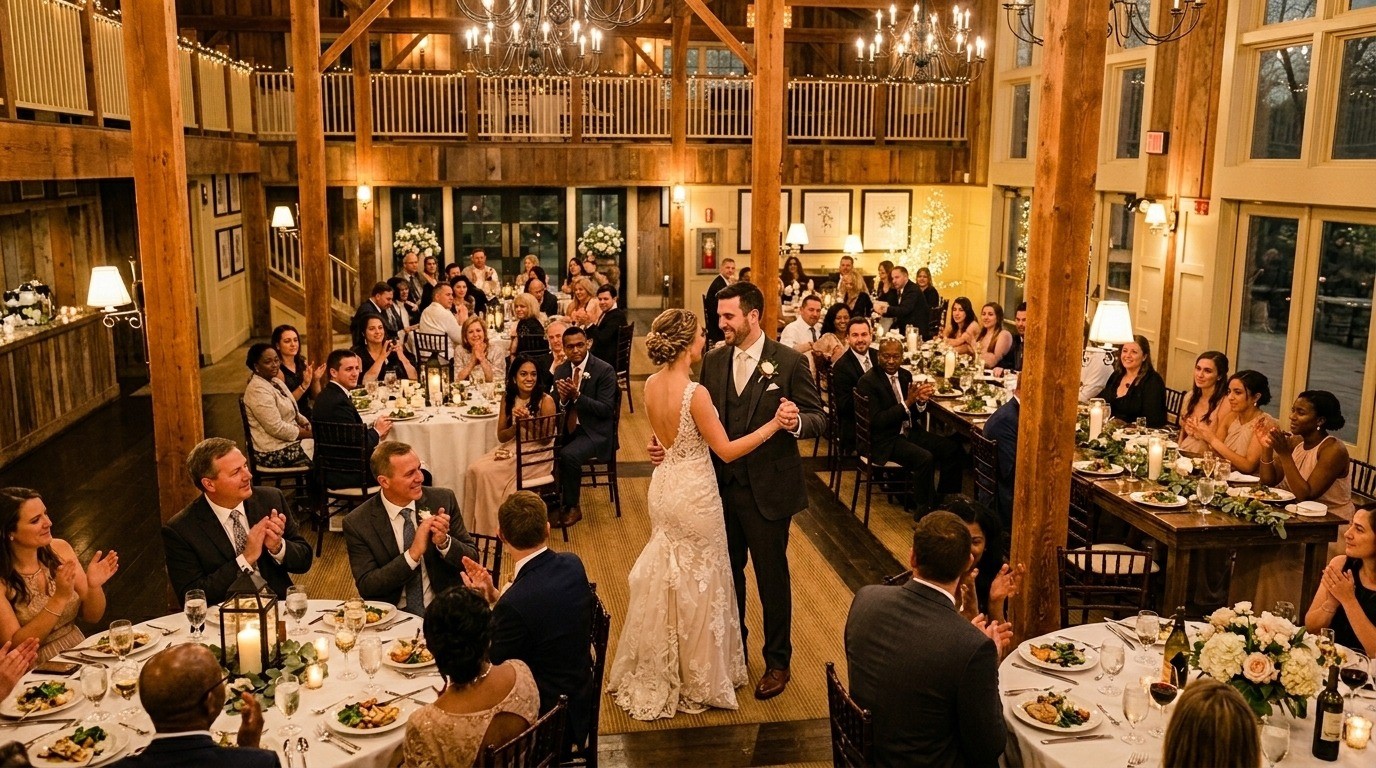
Top 5 Rustic Barn Wedding Venues in Connecticut: An Insider’s Guide

Top 5 Rustic Barn Wedding Venues in Connecticut: An Insider’s Guide

The doors on old barns are heavy. Not heavy like a hotel ballroom — those glide on hydraulics and whisper shut behind you. Barn doors are solid timber on iron rails, and when you slide one open for the first time at a venue walkthrough, it takes your whole arm. That weight is the first thing you notice. The second thing is the air. In a 150-year-old Connecticut dairy barn, the air smells like old wood and open sky, and it hits you before your eyes even adjust to the light.

I’ve loaded amplifiers through these doors in Middletown, run cable past stone walls in Canterbury, and watched a couple’s first dance under exposed post-and-beam framing in the Litchfield Hills while the October foliage burned orange through every window. Rustic barn wedding venues in Connecticut aren’t what most people picture when they hear “barn wedding.” These aren’t purpose-built event barns with fake distressing and a coat of paint. These are functional structures — dairy barns, factories, working farms — with histories measured in centuries, not marketing cycles. And the thing that keeps surprising me, after performing at dozens of them across New England, is how well they work for live music. Timber-frame construction absorbs and distributes sound in ways that drywall and drop ceilings can only dream about. The bass doesn’t boom. The vocals don’t bounce. The room just… takes what you give it and warms it up.

Connecticut has five of the best rustic and industrial chic venues I’ve encountered anywhere in the Northeast — each one authentically different, each one with a story that predates anyone’s wedding Pinterest board by about two hundred years.

Why Rustic and Barn Venues Work for Connecticut Weddings

Most couples overlook something fundamental about this category: rustic barn wedding venues in Connecticut solve a problem that most traditional ballrooms create. In a hotel, you’re fighting the space. You’re draping fabric over ceiling tiles, bringing in your own lighting to kill the fluorescents, and hoping the room doesn’t feel like last weekend’s corporate retreat. In a real barn, the bones are the decor. The timber beams, the weathered siding, the market string lights strung between posts — all of that is already doing the work.

From an entertainment perspective, these spaces offer something specific: intimacy without smallness. A 200-person wedding in a converted barn feels closer, warmer, more connected than the same headcount in a 5,000-square-foot ballroom. The lower ceilings (relative to grand hotels) keep the energy contained. Guests don’t scatter — they stay near the music because the room’s proportions naturally draw them inward. And the exposed wood construction? It acts like a giant acoustic panel. I’ve played sets in Connecticut barns where the sound was better than venues charging three times the price.

The practical side matters too. Most of these venues are all-inclusive or semi-inclusive, which means fewer vendor headaches. Several are climate-controlled year-round — a detail that separates genuinely functional event spaces from scenic photo ops that leave your grandmother shivering in November.

The Venues

The Barns at Wesleyan Hills (Middletown)

img21

A 150-year-old dairy barn where the architecture won awards not for being old, but for how intelligently it was modernized.

The Big Barn is the main event. Soaring post-and-beam ceilings rise above you, the original structural timbers left fully exposed, while the exterior wears a contemporary light gray shingle-style cladding that earned the renovation local architectural preservation awards. It’s a space that respects what it was without pretending it’s still a working dairy. The palette is neutral — warm wood, soft grays, natural light from oversized windows — so your florist and lighting designer are working with a blank canvas, not fighting someone else’s color scheme.

Most barn venues give you one room. This property gives you three buildings. The Big Barn handles your reception (up to 225 seated). The Middle Barn — smaller, more contained — works perfectly for cocktail hour, giving guests a distinct space to settle in before the main event reveals itself. And then there’s the Little Barn, which is essentially a private clubhouse for the wedding party: its own building with a kitchen, safe, and climate control. No cramming the bridal party into a repurposed office with a full-length mirror and calling it a “suite.”

Outside, massive weeping willow trees — among the largest in the state, according to locals — create a living canopy for ceremonies. They’ve been here longer than anyone can pin down, and they frame the property in a way that no landscape architect could replicate on a deadline.

Capacity: Up to 225 seated Spaces: Big Barn (reception), Middle Barn (cocktails), Little Barn (wedding party suite), outdoor ceremony lawn Price Range: $25,000–$35,000+ all-inclusive; per-person rates ~$110–$180+; $995 ceremony fee Peak Season: May–October Best For: Couples who want polished rustic without sacrificing modern comfort Pet-Friendly: Yes — dogs welcome for ceremonies and photos; must be crated in suite otherwise

From an entertainment standpoint, the three-barn flow is a rare gift. You set up in the Big Barn while cocktails happen next door in the Middle Barn, and neither space bleeds into the other acoustically. That means a full sound check with no audience, which is rare and valuable. The post-and-beam ceiling in the reception barn gives you enough height for sound to develop without the reverb problems you get in taller industrial spaces. Energy builds fast in this room — the proportions keep guests close to the dance floor, and by the time you’re three songs into the reception set, the whole space is moving. Climate control year-round means you never have to worry about outdoor noise bleed or equipment sweating in August humidity.


One more thing about this property: the willow trees. The barn’s renovation earned recognition for its “shingle-style” approach — updating the exterior to contemporary standards while preserving the original 1800s post-and-beam skeleton inside. It’s the rare venue where the architecture holds up in conversation, not just in photographs. The property has been in the Hubbard family for generations, and the willows have become an unofficial landmark — couples who married here years ago still refer to the venue as “the one with the willows.”

Official website: https://www.ctweddinggroup.com/connecticut-wedding-venues/the-barns-at-wesleyan-hills

The Lace Factory (Deep River)

img22

Where else can your guests arrive by steam train and walk into a 19th-century warehouse with 10-foot windows overlooking the Connecticut River?

You walk in and the scale hits you immediately. Six thousand square feet of open floor plan, exposed brick on every wall, original wood floors that creak in the right places, and those windows — tall, arched, flooding the space with natural light from the river side. Call it what it is: a factory floor. That distinction matters, because the energy in a warehouse space moves differently. It’s wider, more open, less “cozy cabin” and more “downtown loft transplanted to the Connecticut shoreline.”

The building dates to 1875, and its resume reads like a condensed history of the Connecticut River Valley economy. It started as a shipyard. Then it served as a dock for ivory deliveries during Deep River’s run as the “Ivory Capital” of America — the town once supplied the piano key industry. Eventually it became a cornerstone lace factory, the name that stuck. All of that industrial DNA is visible in the bones of the space: the brick, the timber, the proportions built for machinery and production rather than aesthetics. The fact that it’s gorgeous is almost accidental.

For intimate events, the Riverview Room handles up to 49 guests — a separate space within the building that offers river views without the scale of the main warehouse. But the main room at 225 capacity is where this venue earns its reputation.

Capacity: Up to 225 in the main warehouse; Riverview Room for 49 guests Spaces: Main warehouse floor, Riverview Room, outdoor landing area Price Range: Saturday rental ~$6,500–$8,500; catering (Cloud Nine) ~$135–$155 per person Peak Season: September–November (peak foliage for the adjacent steam train ride) Best For: Industrial-chic couples who want raw character with river views Pet-Friendly: Often permitted for outdoor ceremonies at the Landing; confirm indoor policy with venue

Here’s what nobody mentions on the venue tour: exposed brick is beautiful, but it’s also reflective — sound bounces off masonry harder than wood. In the Lace Factory’s main room, the 10-foot windows and original wood floors balance out the brick walls nicely, but you need a sound engineer who understands the space. The ceilings are lower than a typical barn, which concentrates energy on the dance floor but demands careful volume management so the room doesn’t get harsh. The 10:00 PM curfew is real and enforced, so every minute of your five-hour event window counts. You plan your set with a hard stop in mind, and you front-load the dance-floor bangers accordingly. No slow build here — you light it up early.


And then there’s the Essex Steam Train — the detail nobody believes until they see it. Guests can ride a historic locomotive — actual coal-fired steam engine, restored 19th-century passenger cars — directly to the venue’s entrance at the Deep River Landing. During September and October, that train ride cuts through peak New England foliage along the Connecticut River Valley. This isn’t a gimmick — it’s an actual logistical option that doubles as one of the most memorable arrival experiences at any wedding venue in the state. The Lace Factory is the only venue in Connecticut where the wedding party can depart via a 19th-century locomotive.

Official website: https://thelacefactory.com/

Wrights Mill Farm (Canterbury)

img23

Two hundred acres of working farmland, a waterfall ceremony site hidden in the woods, and a horse-drawn carriage to get you there.

Canterbury is quiet corner Connecticut — eastern part of the state, away from the Fairfield County bustle, closer to the Rhode Island border than to Hartford. Wrights Mill Farm sits on land that’s been farmed since the early 1700s, and that continuity shows in everything from the stone walls lining the property to the functional water-powered grist mill that still operates on site. This isn’t a “farmhouse aesthetic” venue. Cows live here. The mill grinds. The waterfall that serves as your ceremony backdrop has been carving through these rocks for centuries.

The ceremony site itself is something you have to see to believe — a secluded clearing in the woods where a natural waterfall provides the backdrop. Couples arrive via a traditional white horse-drawn carriage along a path through the property, which sounds like a fairy tale cliche until you’re standing in the New England woods watching it happen in real time. It works because it’s not staged. The carriage follows actual farm paths. The waterfall is actual geography, not a water feature installed by a landscape company.

The reception moves to the barn — rebuilt in 2020 after a devastating fire in 2016 destroyed the original lodge. The local community rallied to help the owners, and the new structure incorporates stone and wood salvaged from the property’s original colonial buildings. It’s climate-controlled, modern where it needs to be, and seats 210. The 200-acre property also includes an 8-bedroom house available for guest rental, which turns the whole weekend into an immersive experience rather than a drive-in, drive-out event.

Capacity: Up to 210 seated Spaces: Waterfall ceremony site, climate-controlled barn (reception), 8-bedroom guest house Price Range: Reception fee starts at ~$5,500; packages $85–$130+ per person; 10% off for January–March weddings Peak Season: October (200 acres of private foliage) Best For: Couples who want a full fairy-tale farm experience with genuine rural character Pet-Friendly: Yes — dogs encouraged in ceremonies

Plan for distance. The walk from waterfall ceremony to barn reception covers real ground across the property, so your entertainment setup needs to be completely independent in both locations. Ceremony musicians at the waterfall, full band and DJ rig pre-set in the barn. There’s no “quick move” option here — the spaces are too far apart. But that distance is also an advantage: cocktail hour on the farmland between ceremony and reception gives guests time to absorb the setting, and by the time they walk into the barn, the energy shift feels earned. The rebuilt barn has good acoustics — new construction with deliberate sound design, not the echoey metal-roof situation you find at some newer farm venues. The all-inclusive packages include a DJ, which means couples looking for a hybrid experience should coordinate early to integrate live musicians into the existing framework.

Most guests remember the waterfall. I remember the grist mill. It’s not decorative — the water-powered mechanism still functions, and it’s been on this property since the colonial era. After the 2016 fire destroyed the original lodge, the rebuilding effort became a community project, with the new barn incorporating salvaged stone and timber from structures that had stood on the land for over two hundred years. That kind of material continuity — where the walls of your reception space contain stone from the 1700s — can’t be faked. It’s just there, and your guests will feel it even if they can’t name why.

Official website: https://www.wrightsmillfarm.com/

The Pavilion on Crystal Lake (Middletown)

img24

A wood-paneled barn on a pine-ringed lake where the glow stick exit has become its own tradition.

Crystal Lake is the kind of setting that feels impossible to find in a state ninety minutes from Manhattan. Towering pine trees — rumored to have been planted by a single local family over 80 years ago — surround a tranquil lake, and the pavilion sits right on the water. The building itself is wood-paneled with market lighting strung throughout, giving the interior a warm amber glow that works equally well for afternoon ceremonies and late-night dancing. It’s rustic without being rough. The finishes are intentional, the layout is clean, and the lake views through the windows give the space a depth that most barn venues lack.

Ceremonies happen outdoors at the gazebo, set among the pines with the lake as your backdrop. The transition from outdoor ceremony to indoor reception is short and natural — guests walk a few hundred feet and they’re in the room, drink in hand. No shuttles, no twenty-minute gaps where everyone’s wondering what to do next. The property offers exclusive use — no other events competing for attention — and the Lake Cottage — a full house available for rental five hours before the wedding — gives the entire party a comfortable staging area without the cramped bridal suite shuffle.

This is a Middletown venue, the same town as The Barns at Wesleyan Hills and close to the Wadsworth Mansion, which means your hotel block situation is straightforward. Guests get one area to navigate, and the venue’s fully ADA-accessible layout means nobody’s getting left out.

Capacity: Up to 210 seated Spaces: Outdoor gazebo (ceremony), indoor lake-view reception hall, Lake Cottage (pre-wedding party house) Price Range: Full packages typically start at $20,000; $750 ceremony fee; bar service starts at $19/pp Peak Season: April–November Best For: Couples who want lakeside intimacy with all-inclusive simplicity Pet-Friendly: Yes — dogs allowed for ceremonies and photos

Performers love this room. Wood absorbs high frequencies and reduces harsh reflections, which means you get warmth out of the room without cranking the volume. The market lighting doubles as a visual rhythm — the glow creates an intimacy that pairs naturally with live acoustic sets during dinner and amplified dance sets later in the evening. The midnight curfew on Saturdays gives you more runway than the Lace Factory’s 10 PM stop, and that extra two hours makes a real difference when you’re building toward a peak dance floor moment. The lake proximity means outdoor cocktail hour music carries beautifully across the water, giving guests a sound experience that’s unique to this venue. Layout-wise, the single-room reception keeps everyone in one space — no stragglers in side rooms, no energy leaks.

Nobody plans a glow stick exit. It just happens here. Because the pavilion’s historic wooden construction prohibits sparklers (for obvious reasons), couples and guests have adopted glow sticks as the send-off tradition — lines of color arcing over the couple as they exit toward the lake. It started as a practical workaround and became something guests talk about the next morning. The pine grove surrounding the ceremony gazebo, planted by that single local family decades ago, has matured into a natural cathedral — tall, straight trunks with a canopy that filters light the way stained glass does. You can’t build that. You can only find it.

Official website: https://www.ctweddinggroup.com/venues/the-pavilion-on-crystal-lake/

South Farms (Morris)

img25

A fourth-generation working cattle farm where the White Barn is on the State Registry of Historic Buildings and the beef on your plate was raised on the property.

Morris is deep in the Litchfield Hills — Connecticut’s quietest, most rural corner, the part of the state that looks like Vermont forgot its borders. South Farms has been in the Paletsky family for over 160 years, and it’s still a working cattle operation producing grass-fed beef. That’s not a historical footnote. That beef is often what’s served at your reception dinner. Farm-to-table is an overused phrase, but when the farm and the table are literally the same address, the term earns its keep.

The White Barn is the centerpiece: 20,000 square feet of event space with corrugated tin ceilings, reclaimed wood walls, and designer chandeliers that split the difference between rustic and refined. It’s listed on the State Registry of Historic Buildings and is a featured stop on the Connecticut Historic Barn Trail. The original “Sam Paletsky” signage is still intact — the preservation effort that converted this from a working dairy barn to an event space in 2015 won an AIA Design Award for Historic Preservation, and you can see why. Nothing was stripped. Nothing was replaced with a shinier version. They just made the existing structure safe, comfortable, and beautiful for guests while keeping the bones honest.

Indoor capacity is 150 seated, with larger groups possible through adjacent tenting on the property. The Stone Barn and Hayloft offer additional spaces for cocktails and smaller gatherings. And unlike many barn venues that close up for winter, South Farms is fully heated and air-conditioned — a rarity in this category that extends the wedding season well beyond the typical May-through-October window.

Capacity: Up to 150 seated indoors; larger groups via adjacent tenting Spaces: White Barn (reception), Stone Barn, Hayloft, outdoor ceremony areas Price Range: Venue rental $5,000–$12,500; total spend ~$35,000–$50,000; catering ~$150/pp; bar ~$50/pp Peak Season: October (heart of the Litchfield Hills foliage belt) Best For: Architecture lovers who want a luxury farm experience with genuine provenance Pet-Friendly: Yes — dogs allowed for ceremonies and outdoor cocktails

Acoustically, the corrugated tin ceiling in the White Barn is the variable to plan around. Tin reflects sound more than wood, which means you need to think about speaker placement carefully to avoid harsh reflections during amplified sets. The good news: the reclaimed wood walls absorb a lot of that bounce, and the designer chandeliers break up the ceiling plane enough to scatter reflections. At 150-person capacity, the room is intimate enough that you don’t need to push volume to fill it — and that’s where a hybrid setup really shines. Live instruments at moderate volume sound gorgeous in this space. The DJ component handles the dynamic range when the dance floor heats up. The multi-space layout (White Barn, Stone Barn, Hayloft) lets you design a progression through the evening — cocktails in the Stone Barn, dinner under the tin ceiling, dancing in the main space — that keeps guests moving and keeps the energy fresh.

The “Sam Paletsky” signage might be the most photographed detail at any barn wedding venue in Connecticut. It’s original — not a reproduction, not a prop — and it connects the venue directly to the family that’s worked this land since the 1860s. The current owner’s transformation of a working dairy barn into a preservation-award-winning event space was less a renovation than a careful act of translation: same structure, same materials, same identity, just a new purpose. South Farms is the most photographed landmark in Morris, and when you see the White Barn in October with the Litchfield Hills burning red and gold behind it, you understand why.

Official website: https://www.southfarms.org/

How to Choose Between These Venues

Five venues, five distinct experiences. Here’s how to narrow it down.

If your guest list runs past 200, The Barns at Wesleyan Hills and The Lace Factory both seat 225 with all-inclusive catering that takes vendor coordination off your plate. If budget matters most, Wrights Mill Farm is the value leader — packages from $85 per person, plus a 10% winter discount.

If you want industrial edge over barn warmth, the Lace Factory is your only pick on this list — exposed brick, factory floors, and the steam train. Everything else leans pastoral. If intimate matters more than grand, South Farms at 150 seated is the smallest of the group, and deep in the Litchfield Hills, your guests are truly away from everything.

Fall weddings: all five are strong, but South Farms sits at the epicenter of the Litchfield Hills foliage belt — the best October color in the state. The Lace Factory pairs peak foliage with the Essex Steam Train ride, which is its own level of spectacle.

On-site lodging matters more than couples expect. Wrights Mill Farm’s 8-bedroom guest house and the Pavilion’s Lake Cottage give your closest people a place on the property. The other three venues rely on nearby hotels, which in Middletown and Deep River means options within a short drive.

Why Entertainment Matters More Than You Think at Rustic Barn Venues

Most couples choose rustic barn wedding venues in Connecticut for the look. The beams, the warm wood, the string lights. That’s valid — these spaces photograph beautifully. But what the venue tour won’t tell you is how much the entertainment experience changes depending on the room.

Barn acoustics are fundamentally different from hotel acoustics. Timber-frame construction absorbs and diffuses sound instead of reflecting it back at the audience. Live music — actual instruments, actual voices — sounds natural in these spaces because the room is amplifying warmth rather than creating harshness. A generic playlist through rental speakers will fill the space, sure. But you’ll be leaving most of the room’s acoustic potential on the table.

Then there’s the practical side. Historic barns have specific power supply constraints — you can’t plug in a full concert rig and assume the circuits will hold. Some venues have noise curfews (the Lace Factory’s 10 PM stop is the strictest in this group). Some restrict where you can place equipment to protect original floors. These aren’t problems — they’re variables an experienced entertainment team plans around. An inexperienced one discovers them at load-in.

The multi-space flow at venues like Wesleyan Hills, South Farms, and Wrights Mill Farm demands entertainment that adapts. You’re not playing one room all night. You’re scoring a journey — ceremony in a field, cocktails in a stone barn, dinner and dancing in the main space. Each transition shifts the energy. That takes planning, and musicians who can read the room in real time.

Why DLE Event Group

We built our hybrid DJ band model for exactly these kinds of spaces. Live musicians — sax, guitar, keys, percussion, vocals — create the warmth and presence that timber-frame rooms amplify naturally. The DJ component gives us unlimited range, from acoustic ceremony pieces to a packed dance floor at 11 PM. It’s one team, one setup, one sound engineer who understands how the room behaves and calibrates accordingly.

At rustic barn wedding venues in Connecticut, that calibration matters more than at most venue types. Every barn sounds different. The Barns at Wesleyan Hills, with its post-and-beam ceiling, absorbs mid-range frequencies beautifully — ideal for vocals and acoustic instruments. South Farms’ corrugated tin ceiling requires a different approach: careful speaker angles, strategic volume management, leaning into the live instruments during dinner when the room rewards subtlety. We’ve spent over a decade learning these distinctions at venues across the Northeast, and that knowledge is baked into every pre-event planning session.

The planning process itself is a differentiator. Starting roughly six months before your wedding, we run 5 to 10 Zoom sessions to build out every musical moment — custom song learning, tailored edits for your first dance, pronunciation guides for your MC introductions, timeline coordination with your venue’s specific requirements. For a venue with a hard curfew like the Lace Factory, that timeline work is especially critical. Every transition, every song choice, every energy shift is mapped with intention.

DLE Event Group has earned The Knot Best of Weddings Hall of Fame 11 times (2013–2023) and performed 100+ events at premier venues across New York, the tri-state area, and beyond. Our service area extends well into Connecticut. We bring backup equipment to every event — duplicates of everything critical — because at venues where the architecture is irreplaceable, so is the moment.

Frequently Asked Questions

For peak season (May through October), the most popular barn venues require 18 to 24 months of lead time. Fairfield County-adjacent venues and the Litchfield Hills book fastest, driven by NYC-area demand. Off-peak dates (January through March) can sometimes be secured with 6 months’ notice, and several venues offer 10% to 50% winter discounts. Book entertainment on a similar timeline.
It varies significantly by venue. At the budget-friendly end, Wrights Mill Farm starts at roughly $85 per person with reception fees from $5,500. Mid-range, The Pavilion on Crystal Lake offers full packages starting at $20,000. At the higher end, South Farms runs $35,000 to $50,000 total with catering around $150 per person. The Barns at Wesleyan Hills falls in the $25,000 to $35,000+ range for all-inclusive packages. These numbers typically include catering, bar, and basic coordination — but entertainment, photography, and florals are usually separate line items.
All five venues on this list accommodate both ceremony and reception on site. The Barns at Wesleyan Hills has a willow-lined ceremony lawn. The Lace Factory offers an outdoor Landing area. Wrights Mill Farm has the secluded waterfall site. The Pavilion on Crystal Lake has its pine-surrounded gazebo. South Farms provides multiple outdoor ceremony locations. The ceremony fee ranges from $750 (Pavilion) to $995 (Wesleyan Hills), and having everything on one property eliminates transit logistics entirely.
Barn settings are actually ideal for live music. Timber-frame construction naturally absorbs and warms sound, so acoustic instruments and vocals have a richness that you rarely get in hotel ballrooms or industrial lofts. A hybrid setup — live musicians paired with a DJ — gives you that acoustic warmth during ceremony and dinner, then the DJ’s range and volume control when the dance floor opens up. The key is working with a team that understands the specific acoustics of your chosen venue, since every barn sounds different.
Wrights Mill Farm offers the most on-site lodging with an 8-bedroom guest house available for rental. The Pavilion on Crystal Lake has the Lake Cottage for the wedding party. The three Middletown-area venues (Wesleyan Hills, Pavilion, and nearby Wadsworth Mansion) share access to Middletown’s hotel inventory. Deep River (Lace Factory) and Morris (South Farms) are smaller towns — plan on blocking rooms at nearby inns. For out-of-state guests flying in, central Connecticut venues are best served by Bradley International Airport (BDL), while eastern Connecticut venues like Wrights Mill Farm are closer to Providence (PVD), a 45-minute drive.
A few worth knowing. The “Penny in the Shoe” is a New England tradition — brides place a vintage copper penny in their left shoe for financial luck. Along the shoreline, the Coastal Lobster Bake is the signature Connecticut rehearsal dinner format. And if you’re in the Litchfield Hills, the West Cornwall Covered Bridge (built 1864) is nearby — historically called a “kissing bridge” for the privacy it offered courting couples. On the legal side: Connecticut has no waiting period for marriage licenses, no witness requirement, and the license costs $50, valid for 65 days. Apply in the town where your ceremony takes place.

Ready to Talk About Your Connecticut Barn Wedding?

These five venues represent the best of what rustic barn wedding venues in Connecticut have to offer — real structures with real histories, not set pieces. Each one sounds different, flows different, and rewards a different kind of celebration. What they share is this: they all deserve entertainment that matches their character.

If you’re planning a wedding at any of these venues — or still narrowing down your list — we’d welcome the conversation. DLE Event Group’s hybrid DJ band experience is built for spaces like these, and we’d love to help you figure out what the music should feel like in the room you choose.

QUESTIONNAIRE

Need Assistance? Directly reach us at contact@dleeventgroup.com or 877.534.2424
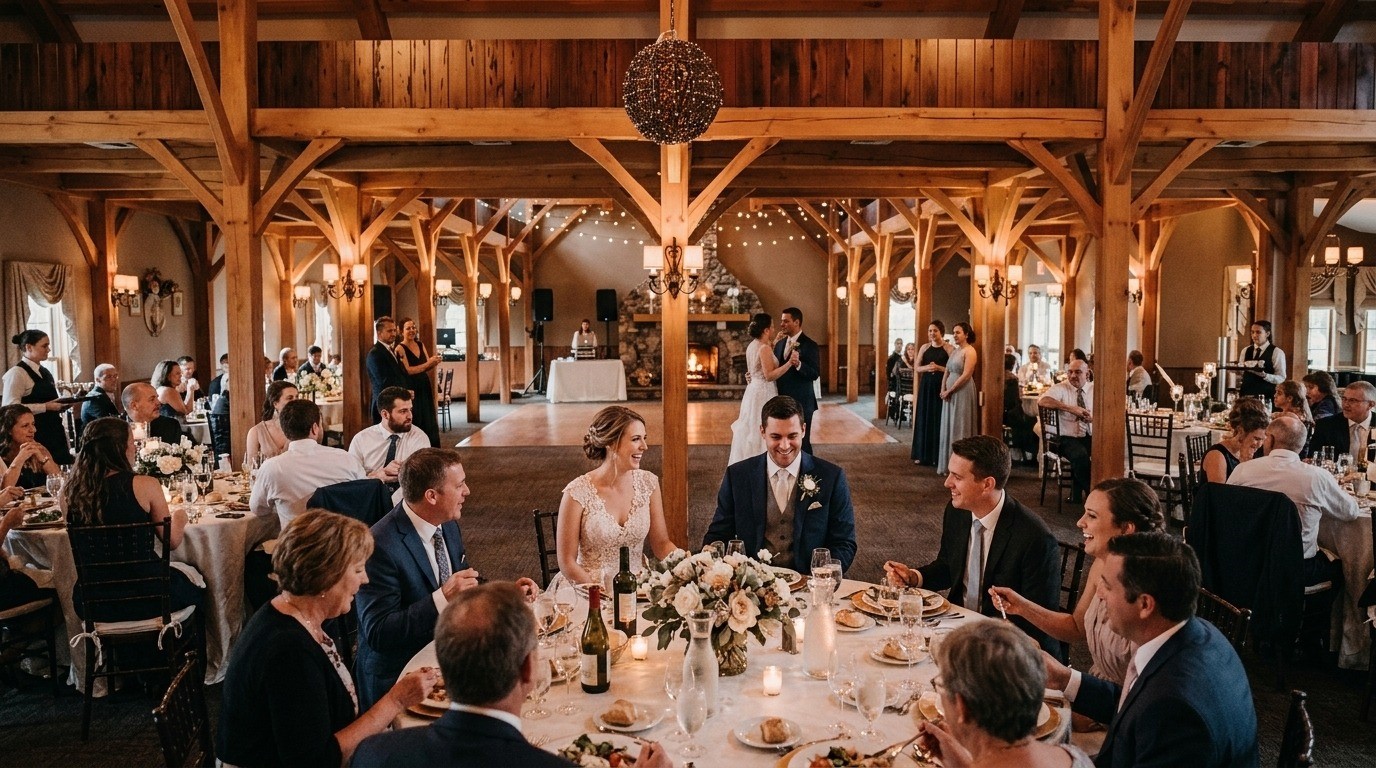
Top 5 Historic Mansion Wedding Venues in Connecticut: An Insider’s Guide

Top 5 Historic Mansion Wedding Venues in Connecticut: An Insider’s Guide

The brass doors weigh more than you’d think. I remember the first time I pushed through the entrance of a Connecticut estate with a road case in each hand—one wheel caught on a marble threshold that had been worn smooth by two centuries of foot traffic—and the room that opened up behind it stopped me mid-step. Thirty-five-foot ceilings covered in gold leaf. Stone walls that had absorbed the conversations of industrialists, governors, soldiers. The kind of space where your voice changes before you even realize it, because the architecture demands a certain gravity.

That’s what historic mansion wedding venues in Connecticut do to you. They don’t just provide a backdrop. They rewrite the atmosphere of your entire event. I’ve performed at estates where the floorboards were older than the Constitution and castles where granite blocks were hauled by oxen. I’ve run sound checks in conservatories designed by the same firm that landscaped Central Park and loaded gear through doors that Revolutionary War generals walked through. Every one of these buildings carries a weight that no amount of draping or uplighting can manufacture. It’s either in the walls or it isn’t.

Connecticut packs an unusual density of architectural periods into a small state—Art Deco bank vaults, Norman castles, English country manors, Federal-era mansions, Beaux-Arts estates. For couples who want a wedding that feels rooted in something real, something with a story older and larger than their own, this is the state to look at. And for someone in my line of work, these rooms are endlessly interesting to perform in, because no two of them handle sound, light, or energy the same way.

Why Historic Mansions and Estates Work for Weddings

Most couples underestimate how much work the building itself does. When your guests walk into a room with original marble fireplaces, hand-carved moldings, or a ceiling that took three years to gild, you don’t need to spend $40,000 on decor to create a mood. The mood was built into the walls a century ago.

From an entertainment perspective, these spaces are fascinating. High ceilings and stone or plaster walls create natural reverb—live instruments sound fuller, richer, more present than in a hotel ballroom with drop-tile ceilings and carpeted floors. But that same reverb can work against you if you don’t understand the room. A bass-heavy DJ setup in a marble hall will turn to mud. Acoustic instruments in a timber-frame conservatory will ring out beautifully. Knowing which approach fits which room is the difference between a dance floor that fills at 8:30 and one that stays half-empty all night.

And then there’s flow. Historic estates were designed for entertaining. They have parlors, galleries, terraces, gardens—distinct spaces that naturally move guests from one moment to the next. Ceremony in the garden. Cocktails on the terrace. Dinner in the ballroom. That built-in progression creates energy shifts that keep people engaged instead of planted at the same table for five hours. When the architecture choreographs the evening for you, everything—including the music—hits differently.

The Venues

The Society Room of Hartford (Hartford)

img16

Imagine getting married inside a bank vault the size of a cathedral—because that’s essentially what this is.

The Society Room doesn’t ease you in. You enter through massive brass doors, and then you’re standing under 35-foot ceilings covered in gold leaf, surrounded by Renaissance Revival architecture that was built in 1834 to announce Hartford’s status as an insurance and industrial powerhouse. This was the Society for Savings bank, and whoever designed it wanted every depositor to feel like they were entrusting their money to something permanent. Two centuries later, that sense of permanence hasn’t faded.

The main floor is one enormous open room with a wrap-around mezzanine above it—and this is where the signature moment happens. Couples appear on the mezzanine and descend a sweeping staircase into the ballroom below. Locals call it the “Society Room Entrance,” and it’s earned the name. The room’s proportions are dramatic enough that the descent actually feels cinematic. Gold leaf catches the light from every angle. The original steel bank vault—still intact, still functional—sits off to the side, and it’s become the most distinctive portrait backdrop in the state.

Outside, Bushnell Park (the oldest public park in America) gives you green space in the middle of downtown Hartford. The venue’s exclusive caterer, Riverhouse Hospitality, runs the food program, and they’ve built in a detail I love: an “Irish Pub” lounge tucked away for the wedding party. After hours of portraits and receiving lines, having a private space with a drink that isn’t in a champagne flute matters more than you’d expect.

Capacity: Up to 300 seated (main floor and mezzanine); 400 for cocktail-style receptions Spaces: Grand ballroom with mezzanine, bank vault portrait room, Irish Pub lounge, Pratt Street access for outdoor portraits Price Range: $109–$179 per person (seasonal); ceremony fee $650–$795; 22% service fee Peak Season: September–December (holiday lighting and urban winter atmosphere) Best For: Couples who want Gatsby-era drama in a city setting Pet-Friendly: No (indoor historic facility)

The acoustics in this room are a performer’s puzzle—and a rewarding one. Those 35-foot gold-leaf ceilings create generous reverb—live instruments sound spectacular, but an overpowered subwoofer will blur everything into mush. The mezzanine entrance adds a logistical wrinkle: you need your MC and your music timed precisely to that staircase descent, because the room goes silent when every guest looks up. That pause is golden. You don’t fill it with music—you let it build, then hit the first dance or the welcome with something that matches the scale. The ballroom’s open floor plan means your dance floor can be massive, and because there are no pillars breaking sightlines, everyone in the room sees the energy when it peaks.

The original bank vault is one of those details you don’t believe until you see it. It’s not decorative—it’s the actual steel vault from the 1830s, complete with the locking mechanism. Couples use it for portraits, but some have turned it into a cigar lounge or late-night cocktail bar. The door alone weighs several tons. That vault has outlasted every financial crisis in American history, which—if you think about it—isn’t a bad metaphor for a marriage.

Official website: https://hartfordsocietyroom.com/

Saint Clements Castle & Marina (Portland)

img17

A Norman-style castle with five-story towers, 90 acres, and a marina where you can arrive by boat—on the Connecticut River, not the Loire Valley.

Arrival matters here. You come up a long drive through the grounds, and the castle reveals itself in stages—granite walls, turrets, formal gardens sloping down toward the river. Guests stop mid-conversation and just look. Howard and Gertrude Taylor broke ground in 1898, and they didn’t build a mansion. They built a deliberate replica of French nobility, modeling the Art Gallery after the Great Hall of the Chateau de Langeais. The granite blocks were moved into place by oxen. You don’t move granite by oxen unless you’re making a point.

Three distinct event spaces give you real flexibility. The Prince Edward Ballroom seats 260, the Waterford Room handles 210 for something more intimate, and the River’s Edge Marina accommodates 140 with the Connecticut River as your backdrop. That marina option is the standout—couples can make their grand entrance or exit by private boat, and the river at sunset in this stretch of Portland is genuinely beautiful. The grounds are vast enough that ceremony, cocktails, and reception can each occupy their own world without anyone doubling back through the same hallway.

Saint Clements has an unusual backstory for a luxury venue: in 1993, the estate was gifted to a foundation, and today, wedding proceeds support local charities. You’re celebrating in a castle and funding community programs. That fact doesn’t show up in most venue guides, but it changes the character of the place in a way that’s hard to articulate. The staff cares about this building differently when they’re stewards, not employees.

Capacity: Prince Edward Ballroom (260 seated), Waterford Room (210 seated), River’s Edge Marina (140 seated) Spaces: Prince Edward Ballroom, Waterford Room, River’s Edge Marina, formal gardens, castle grounds (90 acres) Price Range: $120–$155+ per person; $2,000 deposit; $550 preservation fee Peak Season: May–October (river views and formal gardens in peak bloom) Best For: Couples who want castle grandeur with waterfront access Pet-Friendly: Conditional—dogs allowed outdoors for ceremonies and photos only

Granite walls and high stone ceilings in the Prince Edward Ballroom give you a live, resonant room—fantastic for a string quartet or a saxophone, challenging if you over-amplify low frequencies. The space between the three event areas means transitions need advance planning; you can’t just walk guests down a hallway. But that distance is also an advantage—each move feels like a new act in the evening. The Marina space is essentially an outdoor-to-indoor hybrid, so wind and weather factor into your sound setup. I’d always bring a backup plan for speaker placement there. The castle’s back-to-back booking schedule means no on-site rehearsals, so your entertainment team needs to arrive with a plan, not figure one out on the fly.

One detail that catches people off guard: the castle is one of the only luxury wedding venues in Connecticut that operates as a non-profit. Every dollar spent on your celebration supports local charitable programs. The $550 preservation fee isn’t a surcharge—it’s a direct investment in maintaining a building that’s been standing since 1898. Fifteen WeddingWire Couples’ Choice awards and a Knot Hall of Fame nod suggest the charitable mission hasn’t come at the expense of quality. If anything, it seems to sharpen the focus.

Official website: https://www.saintclementscastle.com/

Lord Thompson Manor (Thompson)

img18

Forty acres of Olmsted-designed grounds, a James Beard-recognized kitchen, and a weekend takeover model that turns your wedding into a private estate retreat.

Lord Thompson Manor doesn’t do Saturday-afternoon-and-out weddings. The entire model is built around the weekend: your guests arrive Friday, settle into the manor or the adjacent Cottage House, and the celebration unfolds across two or three days. Built in 1917 as a summer home for John R. Gladding, the estate was later landscaped by the Olmsted Brothers—the same firm behind Central Park and the grounds of the U.S. Capitol. You can feel that pedigree in the Sunken Garden, which has the kind of deliberate, layered beauty that only comes from designers who thought in decades, not seasons.

The interior runs through distinct rooms, and the owners have leaned into that. They call it the “Party Flow”—toasts on the balcony, dinner in the dining rooms, dancing in the conservatory. Each transition moves guests into a new environment with a different energy. It’s not a gimmick. It’s how these houses were designed to entertain, and when you work with the architecture instead of fighting it, the evening has a natural rhythm that keeps people on their feet.

And the food deserves its own paragraph. The in-house chefs hold James Beard Foundation Celebrated Chef status, which is not a credential you encounter often at wedding venues. The Silverstone family, who currently own the manor, have built a reputation around culinary experiences that rival destination restaurants. The on-site KISS Spa is the quiet luxury detail—available to guests staying on the property, and yes, your bridal party will use it.

Capacity: Up to 220 seated Spaces: Garden Terrace, Conservatory, Sunken Garden, multiple dining rooms, balcony Price Range: 125-person weekend averages $22,300–$30,000; facility fee ~$4,750; catering ~$110/pp; alcohol ~$37/pp Peak Season: May–October (full use of the Sunken Garden and outdoor spaces) Best For: Food-obsessed couples who want a multi-day estate experience Pet-Friendly: Conditional—private estate, contact owners for specific requests (often flexible for ceremonies)

The “Party Flow” model is a performer’s dream if you plan for it—and a mess if you don’t. Each room has different dimensions, different ceiling heights, different acoustic properties. The conservatory, where most dancing happens, has glass walls and a moderate ceiling that create a bright, contained sound—great for energy. But the transition from dinner means you need to rebuild momentum when guests physically relocate. The trick is to have music already playing in the conservatory before they arrive—let the sound draw them in. With the entire property exclusively yours and a cap around 220, your entertainment needs to fill a living room with your closest people. That’s a different skill than commanding a ballroom, and honestly, a more demanding one.

Having the Olmsted Brothers involved elevates this property from “nice estate” to historically significant landscape. Frederick Law Olmsted Jr. and John Charles Olmsted designed grounds for the White House, the National Mall, and some of the most important public parks in America. Their Sunken Garden at Lord Thompson reflects the same philosophy: create spaces that feel inevitable, as if the land chose that arrangement. In the 1930s, the manor served as a Marian Fathers monastery and novitiate—an unexpected spiritual layer for a building that now hosts celebrations.

Official website: https://www.lordthompsonmanor.com/

Burr Mansion (Fairfield)

img19

John Hancock got married here in 1775. George Washington and John Adams were guests. That’s not a marketing embellishment—it’s a documented historical fact.

The Burr Mansion sits on 4 acres in Fairfield with a weight of history that most venues can only dream about. The original 1732 structure was burned by the British during the 1779 raid on Fairfield—one of the most destructive acts of the Revolutionary War in Connecticut. When it was rebuilt in 1790, Hancock himself offered to provide the timber and glass, and the new structure was designed as a replica of his Boston mansion. Federal and Greek Revival details remain throughout, and the 15 separate event rooms give the building a maze-like quality that rewards exploration.

Beyond the history, Burr Mansion runs on an open vendor model you almost never see at estate-level properties. You bring your own everything. Full caterer’s kitchen, renovated in 2019. BYOB allowed. Your choice of florist, DJ, band, photographer. For couples who want creative control (or who want to save thousands on alcohol by buying it wholesale), this flexibility is significant. The outdoor tent accommodates 200-plus guests when the weather cooperates; the indoor spaces max out around 95 seated, which gives the mansion an intimate, house-party feel.

The town of Fairfield owns the property, which keeps rental fees remarkably reasonable compared to privately operated estates. A furnished bridal suite on the second floor provides a quiet retreat, and parking happens at the adjacent Town Hall. It’s not a full-service luxury venue. It’s an extraordinary historic building that hands you the keys and lets you build the wedding you actually want.

Capacity: Indoor (95 seated), outdoor tent (200+ seated); 15 event rooms in the mansion Spaces: Indoor parlors and event rooms, outdoor tent, manicured gardens, bridal suite Price Range: Rental fee $2,000–$5,000 (8-hour block); tent fee ~$2,800; $1,500 security deposit Peak Season: May–October (when the 200-guest garden tent is available) Best For: History lovers and DIY planners who want full vendor freedom Pet-Friendly: Conditional—dogs permitted for outdoor ceremonies and garden photos

With no house sound system to fall back on, your entertainment choice matters more here than at an all-inclusive estate. You’re bringing everything. The indoor spaces max at 95 seated across small, segmented rooms, and intimate means every sonic detail is magnified. Live acoustic instruments—guitar, violin, a vocalist—breathe in these rooms. A full PA cranked to standard wedding volume will overwhelm them. The outdoor tent is a different calculation: open sides, ambient noise, no walls to contain energy. You need directional speakers and a performer who can read the crowd without the room doing the work.

The Revolutionary War connection at Burr Mansion isn’t decoration—it’s the building’s identity. John Hancock and Dorothy Quincy’s 1775 wedding here is a documented event, with Washington and Adams in attendance. When the British burned Fairfield four years later, the original structure was lost entirely. The rebuilt mansion carries a local legend about a “spirit of liberty” that draws historical reenactors and families with deep New England roots. Getting married in the same building where a Founding Father said his vows adds a layer of significance that no amount of venue styling can replicate.

Official website: https://www.fairfieldrecreation.com/burr_mansion.php

Wadsworth Mansion at Long Hill Estate (Middletown)

img20

A 103-acre Beaux-Arts estate designed by the same architects who built Edith Wharton’s home—and a 700-foot ceremony lawn that functions as the longest aisle you’ve ever seen.

You drive through 103 acres of wooded estate before the mansion appears—Neoclassical columns, a loggia with arched openings, marble fireplaces visible through tall windows. Hoppin & Koen designed it between 1908 and 1911 for Colonel Clarence S. Wadsworth, a conservationist who eventually gifted the property to the public. Those same architects designed The Mount, Edith Wharton’s famous home in Lenox, Massachusetts—a literary and artistic pedigree that architecture buffs immediately recognize.

But the 700-foot Vista is what stops every conversation. It’s a manicured lawn that stretches from the mansion’s rear loggia straight out toward a tree-lined horizon—wider and longer than a football field, framed by wilderness on both sides. Couples use it as a ceremony aisle, and the visual effect is extraordinary: guests seated along this expanse, the wedding party approaching from what feels like a quarter mile away, the mansion rising behind the officiant. As a performer, I can tell you that the emotional build during a processional that long is completely different from walking 30 feet down a hotel ballroom.

Inside, the mansion holds 200 seated with marble fireplaces, original millwork, and proportions generous enough to make even a mid-sized wedding feel grand. The approved caterer model gives you more flexibility than a fully exclusive kitchen, though outside caterers pay a $1,000 fee. Wadsworth Mansion runs one event per day across a 9-hour rental period, so the entire estate is yours.

Capacity: 200 seated indoors; 275+ for cocktail events or tented patio receptions Spaces: Grand interior rooms, loggia, 700-foot Vista lawn, tented patio, 103-acre grounds Price Range: Peak venue fee $6,000–$7,000; all-in spend typically $45,000–$65,000; NYE fee $10,000 Peak Season: May–October (the 700-foot Vista at its most dramatic) Best For: Couples who want Gilded Age architecture on a Newport-level estate Pet-Friendly: Yes—for ceremonies and outdoor portions of the day

The loggia is one of the most interesting performance spaces in Connecticut. It’s a semi-outdoor room—arched openings on one side, the mansion’s stone wall on the other—which creates a natural acoustic environment that splits the difference between indoor resonance and open-air clarity. Live instruments sound warm without the echo you get in a fully enclosed stone room. For the Vista ceremony, you’re working with open-air acoustics across 700 feet, which means your ceremony sound system needs to project without a single wall to help. Wireless microphones are non-negotiable, and speaker placement along the aisle’s length (not just at the altar) keeps the officiant audible for guests in the back rows. The transition from outdoor ceremony to indoor reception requires a clear plan—the walk from the Vista to the mansion takes a few minutes, and your cocktail music should already be playing when guests arrive inside. One event per day means your load-in and sound check can happen without rushing, which is a luxury that venues with back-to-back bookings can’t offer.

A $5.8 million restoration in 1999 saved a building that had spent decades as a convent for the Religious of Our Lady of the Cenacle. Colonel Wadsworth eventually donated the property to ensure it would remain public—he was an early advocate for land preservation in Connecticut. The architectural connection to Edith Wharton’s The Mount is more than trivia; Hoppin & Koen brought the same Beaux-Arts principles to both buildings, and visitors who’ve been to Lenox will notice echoes in the proportions, the loggia design, and the relationship between house and grounds.

Official website: https://www.wadsworthmansion.com/

How to Choose Between These Venues

Five historic mansion wedding venues in Connecticut, and they couldn’t be more different from each other. The right one depends on who you are, who’s coming, and what kind of evening you’re trying to create. If your guest list runs north of 250, The Society Room of Hartford and Saint Clements Castle are your realistic options. The Society Room handles 300 seated in one open room with no pillars, which means every guest has a clear sightline to the dance floor. Saint Clements gives you three distinct spaces, so you can scale to the room that fits your number—260, 210, or 140. Budget flexibility points straight to Burr Mansion. A rental fee of $2,000–$5,000 with BYOB and open vendor selection puts this in a completely different financial category than the all-inclusive estates. You’ll do more planning legwork, but you’ll control every dollar. On the other end, Wadsworth Mansion’s all-in spend of $45,000–$65,000 and Lord Thompson Manor’s weekend packages reflect a full-service experience where the venue handles more of the logistics.

Couples planning a multi-day celebration—Friday welcome dinner, Saturday wedding, Sunday brunch—should start with Lord Thompson Manor, which was built for exactly that. Thirteen guest rooms on-site, an Olmsted-designed estate, and a culinary team with James Beard credentials make it a destination weekend, not just an event. The intimate cap of 220 guests keeps it personal.

When the architecture itself is the point—when you want your guests gasping as they walk in—The Society Room’s gold-leaf ceilings and Wadsworth Mansion’s 700-foot Vista deliver that reaction through entirely different means but with equal force. One is urban drama; the other is pastoral grandeur.

For out-of-town guests flying in, airport proximity matters. Hartford venues are closest to Bradley International. Fairfield County (Burr Mansion) works best with Westchester County Airport or the New York airports. Lord Thompson Manor in eastern Connecticut is actually closest to Providence’s T.F. Green.

And if the historical story matters as much as the physical space, Burr Mansion’s Revolutionary War pedigree—a documented Hancock wedding in 1775—is simply impossible to match.

Why Entertainment Matters More Than You Think at Historic Mansions

Historic buildings are not neutral containers. Every one of them has an acoustic personality, and ignoring it is one of the most common mistakes couples make when booking an estate or mansion wedding.

High ceilings are the main variable. The Society Room’s 35-foot gold-leaf ceiling creates a natural reverb that flatters live instruments—a saxophone solo in that room has a warmth and depth you won’t get in a standard event space. But that same reverb smears a bass-heavy DJ mix into an indistinguishable wall of sound. The room rewards you when you work with its properties and punishes you when you don’t. Saint Clements Castle, built from granite, has similar resonance characteristics. Lord Thompson Manor’s conservatory, with its glass walls and moderate ceiling, is a completely different acoustic environment—bright and contained, great for building dance floor energy.

Flow is the other variable. These aren’t hotel ballrooms where everything happens in one room. Historic estates move guests through spaces—gardens to terraces to dining rooms to ballrooms. That means your entertainment can’t stay static. You need musicians who can perform in a garden during cocktails, transition to a ballroom for dinner, and shift energy again when the dancing starts. Each room change is a potential momentum killer if the music doesn’t bridge the gap. It’s also an opportunity—when the entertainment leads that transition intentionally, each new space feels like a reveal.

Equipment protection is a bigger deal here than at modern venues. Original hardwood floors, marble thresholds, plaster walls—these buildings have preservation requirements. Your entertainment team needs to know how to protect surfaces during load-in, run cables without damaging century-old millwork, and set up without leaving a trace. It sounds minor until you’re the couple getting an invoice for floor refinishing because a speaker stand scratched a 200-year-old board.

Why DLE Event Group

Connecticut’s historic mansions demand entertainment that understands old rooms. Not just how to play in them—how to listen to them first. Our hybrid DJ band model was designed for exactly this kind of challenge. Live musicians—saxophone, guitar, keys, percussion, vocals—produce sound that resonates naturally in high-ceiling stone and plaster rooms. The warmth of live instruments fills a space like the Society Room’s gold-leaf ballroom without the sonic problems that come from over-amplified low-end frequencies. The DJ component gives us the range to shift from a string-accompanied ceremony to a packed dance floor without missing a beat or changing setups. It’s the combination of both—live presence for the rooms that reward it, DJ precision for the moments that need it—that makes historic venues come alive.

We bring backup equipment to every event. Duplicates of everything critical. At a venue where the architecture is irreplaceable and the evening has no do-over, redundancy is standard operating procedure. Our team arrives with a plan for that specific room—speaker placement, stage positioning, cable routing that protects historic surfaces—because we’ve spent over a decade learning what these spaces require.

DLE Event Group has performed at 100+ weddings and events across New York City’s most prestigious venues—The Plaza Hotel, The Pierre, Gotham Hall, Guastavino’s—and throughout the tri-state area. We’ve earned The Knot Best of Weddings Hall of Fame 11 consecutive times. Our planning process starts with 5 to 10 Zoom sessions approximately six months before your wedding, covering your music, your timeline, and your venue’s specific requirements. We learn custom songs for first dances and coordinate pronunciation guides for MC introductions. Connecticut is well within our service area, and we bring the same specificity to every estate here that we bring to a Plaza Hotel ballroom.

Let’s discuss our packages, with configurations ranging from a DJ-led hybrid with two to seven live musicians up to our Celebrity Hybrid DJ Band for full-scale production.

Frequently Asked Questions

For peak season (May through October), the most popular estates require 18 to 24 months of lead time. Fairfield County venues book the fastest because of proximity to the New York City market. Off-peak dates—January through March—can often be secured with as little as 6 months’ notice, and many venues offer significant discounts for winter weddings, including waived site fees or 50% off per-person minimums.
It varies enormously depending on the model. Burr Mansion’s rental-only approach means you could build a full wedding for $20,000–$35,000 by bringing your own caterer and BYOB. Lord Thompson Manor’s weekend packages run $22,300–$30,000 for 125 guests. Wadsworth Mansion’s all-in spend typically lands between $45,000 and $65,000. The Society Room, at $109–$179 per person with a 22% service fee, will run roughly $40,000–$70,000 depending on guest count and season. Know which model fits your planning style before you start touring.
Yes, and all five venues in this guide support it. Most couples use a garden, terrace, or dedicated space for the ceremony and then move guests to the ballroom or tent for the reception. The transition is where entertainment planning matters most—you need cocktail music filling the gap while the ceremony space flips, and the timing has to account for the physical distance between spaces (which, on a 103-acre estate like Wadsworth, is more than a quick stroll).
Connecticut makes it straightforward. Apply for the license in the town where the ceremony will occur. There’s no waiting period—you can marry the same day the license is issued. The state doesn’t require witnesses, the license is valid for 65 days, and the fee is $50. Compared to states with waiting periods and residency requirements, Connecticut is refreshingly simple.
Live instruments almost always outperform a DJ-only setup in these rooms. High ceilings and hard surfaces (stone, plaster, marble, wood) create natural resonance that flatters acoustic and amplified live sound. A hybrid approach—live musicians paired with a DJ—gives you the warmth and presence these buildings reward during dinner and slow dances, plus the range and energy for a packed dance floor later. The key is working with the room’s acoustics, not against them.
A few good ones. The Coastal Lobster Bake is Connecticut’s signature rehearsal dinner tradition—steamed clams, lobster, and chowder, often served beachside. The “Penny in the Shoe” is a New England superstition where the bride places a vintage copper penny in her left shoe for financial luck. And the historic covered bridges of the Litchfield Hills—like the West Cornwall Covered Bridge, built in 1864—were originally called “kissing bridges” because they gave courting couples a rare moment of privacy in horse-drawn carriages. Some couples still stop for photos on these bridges between ceremony and reception.

Ready to Plan Your Connecticut Mansion Wedding?

Five estates. Five centuries of combined history. Five completely different ways to get married in a building that means something.

The venue sets the tone—but the entertainment is what brings the room to life.

DLE Event Group specializes in making historic spaces feel electric. If you’re exploring any of these Connecticut venues for the 2025–2026 wedding season, we’d like to hear about what you’re planning.

QUESTIONNAIRE

Need Assistance? Directly reach us at contact@dleeventgroup.com or 877.534.2424
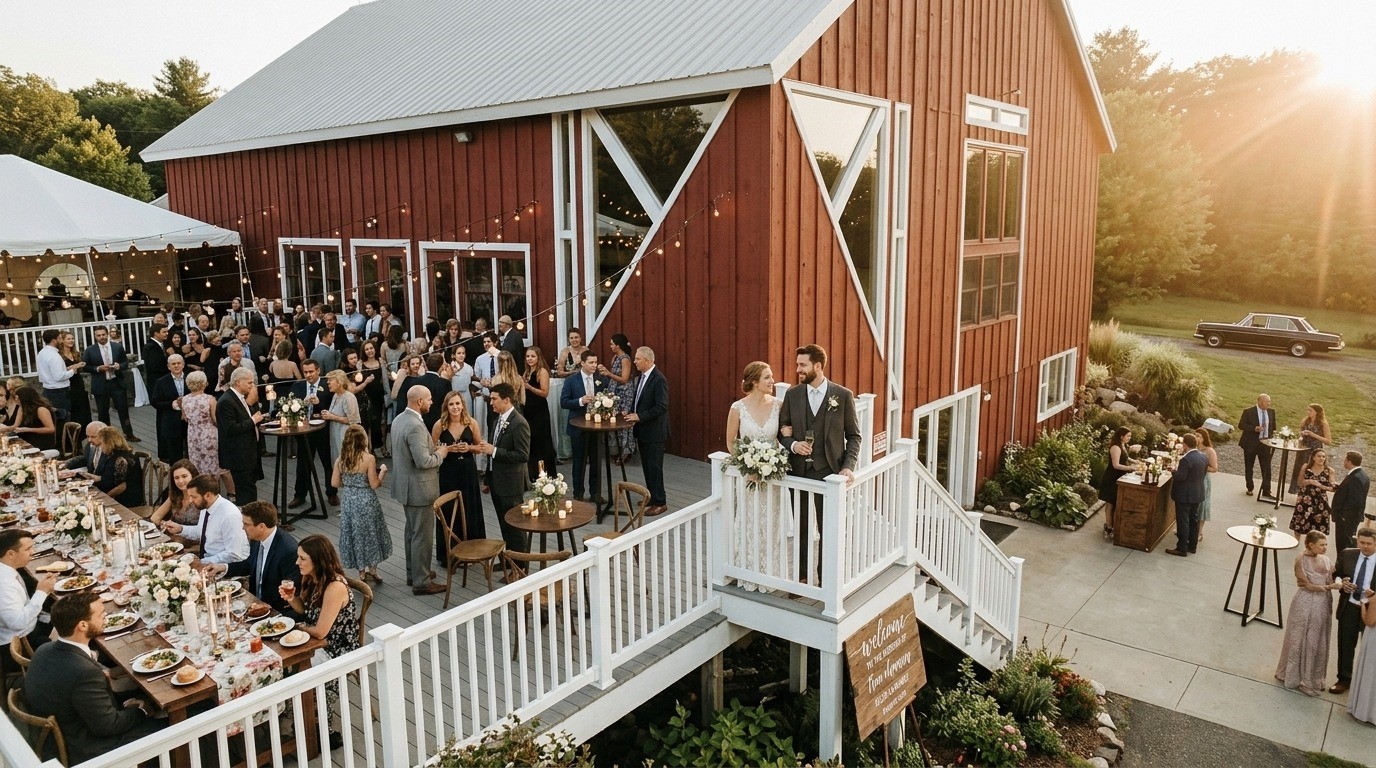
Top 5 Waterfront Wedding Venues in Maryland: An Entertainer’s Guide to the Chesapeake Bay

Top 5 Waterfront Wedding Venues in Maryland: An Entertainer’s Guide to the Chesapeake Bay

The wind picks up right around 5:30 PM. Every time. I’ll be running cable along the edge of an outdoor ceremony space, and there it is — that shift off the Chesapeake that smells like salt marsh and warm wood pilings. It tugs at the bunting, lifts the hair of guests finding their seats, and it means the sun is about two hours from doing something ridiculous to the sky over the Bay.

I’ve loaded equipment into waterfront wedding venues in Maryland more times than I can count, and the thing that still gets me is how the water changes everything — not just the view, but the feel of the event. Sound carries differently when there’s open water on one side. The energy of a cocktail hour with a bay breeze running through it is fundamentally different from cocktail hour in an enclosed ballroom. Guests loosen up faster. Conversations get louder. By the time the sun drops behind the Bay Bridge and the whole horizon turns copper, people are already in the mood to celebrate. You haven’t even started dinner yet.

Maryland’s Chesapeake coastline offers some of the best waterfront wedding venues in the country — not because they’re flashy, but because they’re genuine. This is tidal water, working harbors, ospreys diving fifty yards from your ceremony. The Chesapeake Bay is the largest estuary in the United States, and when you put a wedding next to it, the scale reminds everyone that the moment is bigger than the guest list.

Here are five waterfront wedding venues Maryland couples should know — from a performer who has watched the sun set over this water more times than most people get to.

Why Waterfront Venues Work (And What Most Couples Miss)

From an entertainment professional’s perspective, waterfront wedding venues in Maryland offer something that indoor-only spaces can’t replicate: a natural energy arc that builds throughout the evening. Outdoor ceremonies by the water tend to start soft — the bay is doing most of the atmospheric work. Then cocktail hour brings movement, conversation, and that golden-hour light. By the time guests move inside for the reception, they’ve already had an experience. They arrive at the dance floor warmed up, not cold.

But there are things couples overlook. Wind is real. Every outdoor waterfront setup needs a plan for microphone management — lapel mics over handhelds, wind screens on everything, and a sound tech who knows how to adjust EQ on the fly when a gust rolls through during the vows.

Sunset timing matters more than you’d think: if your ceremony runs long, you miss the golden hour entirely, and your photographer will remind you of that for years. And the transition from outdoor ceremony to indoor reception is its own logistical puzzle — how far apart are the spaces? Is there a covered path? What happens when it rains?

These are the details that separate a good waterfront wedding from a great one. The venues below handle most of them for you — but knowing what to ask about makes all the difference.

The Venues

Chesapeake Bay Beach Club (Stevensville)

img11

Four ballrooms, one campus, and a sunset that faces directly west over the Bay — this is the venue that put Maryland’s Eastern Shore on the national wedding map.

Your first glimpse of the property catches you off guard: the Bay Bridge is right there, impossibly close, its span catching light in a way that makes it look less like infrastructure and more like sculpture. The Chesapeake Bay Beach Club occupies a 7-acre parcel that founder John Wilson chose specifically for its rare westward-facing shoreline — a detail that matters more than it sounds, because it means the sun sets over the water, not behind trees or buildings. That “Sunset Guarantee” isn’t marketing. It’s geography.

Nothing about the campus feels like a wedding factory. Four ballrooms — Sunset (up to 310 guests), Beach House (230), Tavern (160), and Inn (100) — each have dedicated ceremony, cocktail, and rain-backup spaces. The Sunset Ballroom is the flagship, and the second-story ceremony site with wall-to-wall windows overlooking the Bay Bridge makes guests go quiet when they walk in. You feel like you’re floating on the water. The 77-room Inn means your family can stay on-site, and there’s a spa, so the morning-of getting-ready routine doesn’t require anyone leaving the property.

In-house catering runs farm-to-table with coastal influences. Many couples swap the champagne toast for an oyster shooter, honoring the local watermen tradition — the kind of regional detail that gives the evening a sense of place imported decor never achieves.<br.
Capacity: 100–310 seated (varies by ballroom) Spaces: Sunset Ballroom, Beach House Ballroom, Tavern Ballroom, Inn Ballroom; each with dedicated ceremony, cocktail, and inclement weather backup spaces Price Range: Peak Saturday rental $7,500–$10,500; all-inclusive for 150 guests typically $55,000–$75,000 (includes 21% gratuity and 6% sales tax) Peak Season: May–October Best For: Resort-style celebrations with sunset views and on-site lodging Pet-Friendly: Yes for outdoor ceremonies; not permitted in indoor reception areas

Running sound here means thinking about four very different rooms. Each ballroom has its own dimensions and acoustic personality — the Sunset Ballroom, with its tall windows and open sightlines, lets sound breathe in a way that rewards live instruments, while the more intimate Inn space works better with a contained setup. The real win is that ceremony, cocktails, and reception all happen on the same campus, so transitions stay smooth and you never lose energy shuttling guests between locations. We can keep music flowing through every phase without a dead-air gap.

The venue gained national attention in 2005 when it hosted the Today Show’s “Hometown Wedding” broadcast. Worth knowing, sure. But the piece of history I find more compelling is its connection to the old “Honeysuckle Route” of the Chesapeake Beach Railway — the historic rail line that brought Washingtonians to the Bay shore for summer escapes. That sense of arrival, of leaving the city behind and stepping into something slower and more beautiful, still defines the experience of getting to this venue. It’s a trip, in the best way.

Official website: https://www.baybeachclub.com/

Kent Island Resort (Stevensville)

img12

The driveway alone is worth the venue fee. A long, tree-lined approach through open countryside, 220 acres unfolding around you — by the time you reach the Manor House, you’ve already started forgetting about the office.

This land holds one of the most remarkable origin stories in Maryland. It’s the site of the first permanent English settlement in the state, dating to 1631. The Manor House at the center of the property was built in 1820, fell into ruin by 1911, and was painstakingly restored in the 1980s. Walking through it now, you’d never guess it had been abandoned — the bones of the building carry a weight that new construction can’t fake.

Scale is what makes Kent Island Resort different from most Chesapeake Bay wedding venues. Three primary event spaces — The Farmstead (300 guests), The Pavilion (300 guests), and the more intimate Garden House (80 guests) — spread across grounds that include a private dock, expansive countryside views, and that famous tree-lined driveway. The Farmstead has a modern farmhouse-style ballroom that balances polish with the surrounding agricultural landscape, while the Garden House suits smaller weddings that want the estate’s grandeur without the large-format production.

Chef-curated menus lean into Eastern Shore specialties, premium open bar packages come standard, and the luxury lodging in the Manor House means your closest family can literally sleep inside a piece of Maryland history.

Capacity: 80–300 seated (varies by space) Spaces: The Farmstead, The Pavilion, The Garden House; getting-ready suites, private dock Price Range: Venue rental $3,000–$12,000; all-inclusive packages from $149–$160+ per person (23% service charge applies) Peak Season: May–October Best For: Grand estate weddings with dramatic arrival moments Pet-Friendly: No (service animals only)

Most larger receptions end up in the Farmstead ballroom, and it’s a space that responds well to hybrid entertainment — the modern construction gives you predictable acoustics without the echo problems you sometimes fight in older venues. What really helps from a logistics standpoint is the sheer size of the property: ceremony on the grounds, cocktails near the dock or garden, reception in the ballroom, all without leaving the estate. That continuity matters for energy. When guests walk between spaces rather than driving, the evening builds instead of resetting. One thing to plan for: 220 acres mean sound carries far before it hits a wall, so outdoor ceremony sound design needs to account for all that openness.

Behind the Farmstead, there’s a spot the venue calls the “Golden Field” — an open expanse that photographers know about but most couples discover only during their site visit. Schedule a 15-minute “sunset escape” during the reception, slip away with your photographer, and the images you get in that field at golden hour will be the ones you frame. It’s the property’s secret weapon, and it costs nothing extra.

Official website: https://www.kentislandresort.com/

Inn at Perry Cabin (St. Michaels)

img13

“Arrive at your wedding by yacht” sounds like something from a movie tagline. At Perry Cabin, it’s a Tuesday conversation with the events team — and yes, the 55-foot Hinckley is as gorgeous as it sounds.

History is inseparable from atmosphere here. Samuel Hambleton built the Inn in 1816 — he’d served as aide to Commodore Oliver Hazard Perry of War of 1812 fame — and designed the manor’s north wing to replicate the Commodore’s flagship cabin. The town itself, St. Michaels, carries the nickname “the Town That Fooled the British,” after residents famously hung lanterns in the treetops during a nighttime bombardment, causing the British fleet to overshoot entirely. That kind of lore isn’t background decoration. It’s woven into the fabric of the place.

As a Forbes Five-Star resort, the service standard operates on a different tier. Seventy-eight rooms and suites on-site. Chef-driven Chesapeake Bay farm-to-table catering with plated dinners starting at $160–$175 per person. Lush gardens, a permanent tent called The Cove for weather backup, and the Commodore Ballroom for indoor receptions. Most outdoor ceremonies happen on the Linden Lawn, with the harbor and Eastern Shore landscape as your backdrop. Maximum capacity runs to 250 for tented events or 300 for a full property buyout.

Then there’s the entrance. Couples can arrive by sea aboard the Inn’s 55-foot Hinckley yacht, The Star Light. At a lesser venue, this might feel gimmicky. Here — where the entire property faces the water and the maritime heritage runs back two centuries — it feels exactly right.

Capacity: 250 tented; 300 full buyout Spaces: Commodore Ballroom, Linden Lawn, The Cove (permanent tent), harbor grounds Price Range: Minimum spend from ~$65,500–$68,000 for weekend events; estimated ~$723 per guest inclusive Peak Season: Late April–October Best For: Luxury couples who want Forbes Five-Star service and nautical character Pet-Friendly: Yes — dogs up to 75 lbs welcome ($200 fee); includes pet room service menu and pet beds

Every entertainment professional needs to know one thing about Perry Cabin before planning anything else: there’s a strict 10:00 PM curfew for amplified music. Non-negotiable. Your entire reception timeline needs to be tighter and more intentional than at venues that let you play until midnight. The upside? It forces a disciplined event flow — earlier first dance, efficient toasts, and a dance set that starts at its peak rather than building slowly. I actually prefer working within constraints like this; it eliminates the late-evening energy lull that plagues receptions dragging past 11 PM. The Commodore Ballroom’s acoustics are forgiving for both live instruments and DJ setups, and the walk from outdoor ceremony on the lawn to indoor reception is short enough to keep music going through the cocktail bridge.

This is the primary filming location for the 2005 movie Wedding Crashers. The Pointe lawn where Vince Vaughn and Owen Wilson crashed the reception? It’s a real place, and you can stand on it. The Inn also has a few friendly ghost stories connected to Room 39, which staff will share if you ask — the kind of detail that adds character without spookiness. But honestly, the fact that your guests can say “we were at the Wedding Crashers venue” at brunch the next day is worth more than any centerpiece.

Official website: https://www.innatperrycabin.com/

Herrington on the Bay (North Beach)

img14

Palm trees on the Chesapeake. That’s the first thing that throws you.

Actual palm trees, lining the walkways of a property on Maryland’s western shore, about 30 miles southeast of D.C. Locals have been calling Herrington on the Bay the “Maryland Caribbean” for years, and the name fits. Polynesian-style lawns, waterfalls, a private beach — it reads like a resort brochure for somewhere tropical, except you drove here from Annapolis in 40 minutes.

Two distinct event spaces anchor the property: the Herrington Yacht Club (up to 160 guests) for more intimate celebrations, and the Paradise Ballroom (up to 350) for larger weddings. Both sit directly on the water. The Yacht Club has a nautical intimacy to it — sunset views from every angle and a private beach for cocktail hour. The Paradise Ballroom is built for big-production energy, with capacity for a dance floor that actually accommodates 350 people moving. Inclement weather backup options exist for both, plus ready suites for the wedding party.

Where Herrington diverges from other Chesapeake Bay wedding venues is its identity as Maryland’s first “Eco-Lifestyle” venue. The sustainable philosophy shows up in the farm-to-fork catering, the event design approach, and the overall operations. All-inclusive packages start around $25,000, with the average spend landing between $45,000 and $55,000, and catering and bar packages running $85–$165+ per person. An Event Specialist and Day-of Coordinator come standard, and the venue partners with Perfect Pet Resort to handle dog logistics during the event — a surprisingly thoughtful touch.

Capacity: 160 (Yacht Club); 350 (Paradise Ballroom) Spaces: Herrington Yacht Club, Paradise Ballroom, private beaches, Polynesian lawns; inclement weather backup and ready suites Price Range: All-inclusive from ~$25,000; average spend $45,000–$55,000; catering/bar $85–$165+ per person Peak Season: May–October Best For: Eco-conscious couples who want a tropical atmosphere on the Chesapeake Pet-Friendly: Yes — partners with Perfect Pet Resort for day-of dog logistics

Two venues, two very different acoustic environments — and that distinction matters when you’re planning entertainment. The Yacht Club’s smaller footprint concentrates sound nicely; live acoustic sets during cocktail hour carry beautifully in that space. The Paradise Ballroom is a different animal altogether. A 350-capacity room needs real power behind the sound system, and the open layout means you want directional speakers aimed at the dance floor, not diffused audio bouncing off every surface. Between spaces, covered pathways make the outdoor-to-indoor transition seamless, so you can maintain a musical thread from ceremony through reception without the awkward silence that kills momentum at some waterfront venues.

The property sits near the site of the “Lost Town of Herrington,” a 1651 colonial settlement that’s now more archaeological footnote than visible ruin. In the 1950s, the area was developed with ambitions to become a “miniature New York Yacht Club.” That nautical DNA persists — the venue is a working marina, and couples regularly make a grand entrance or exit by boat. But ask guests what they remember the next morning, and it’s almost always the same answer: the sunset colors over the pier. Locals call them “Cotton Candy Skies,” and on a clear evening in August, that description is not an exaggeration.

Official website: https://www.herringtononthebay.com/

Celebrations at the Bay (Pasadena)

img15

Stand on Knock’s Point and turn slowly. Water on your left. Water ahead. Water on your right. That 270-degree panoramic view of the Chesapeake — no other Maryland waterfront venue offers anything close to it.

Celebrations at the Bay doesn’t announce itself with a dramatic arrival or a historic manor. The draw is that ceremony site, jutting out toward the water, where the geography does the emotional heavy lifting and all you need to do is show up and say the words. Most waterfront venues give you water on one side. This one wraps it around you.

Three distinct spaces accommodate different wedding sizes: the Tented Vista Ballroom (250–300 guests), the Chesapeake Ballroom (150 guests), and the Knollview House (50–75 guests). The Tented Vista is the flagship — a grand, clear-span tent structure directly on the water with unobstructed views that make your reception feel like it’s happening on a yacht. The Chesapeake Ballroom handles mid-size celebrations well, and the Knollview House, built around 1900, reflects Pasadena’s history as a summer retreat for Baltimore residents. For an intimate wedding that still wants waterfront character, it’s the right fit.

Catering is handled exclusively by Catering by Uptown, and they specialize in diverse cultural cuisines — a meaningful detail for couples whose wedding menu needs to reflect more than standard American banquet fare. All-inclusive pricing runs from $10,000 to $35,000+ depending on space, season, and guest count, with a 20% service charge. Wedding cake and open bar are included in most packages. A private pier offers the option for a sailboat send-off, and guaranteed indoor backup exists for every outdoor ceremony site.

Capacity: 50–300 seated (varies by space) Spaces: Tented Vista Ballroom, Chesapeake Ballroom, Knollview House; private pier, outdoor ceremony sites with guaranteed indoor backup Price Range: All-inclusive $10,000–$35,000+; 20% service charge; F&B minimums vary by season Peak Season: April–November Best For: Large-format waterfront celebrations with panoramic Chesapeake views Pet-Friendly: Yes for outdoor ceremonies

If I had to pick one room on this list to work in, it would be the Tented Vista Ballroom. Tent venues can be tricky acoustically — fabric walls absorb high frequencies while bass builds up unevenly — but a well-designed tent with open sightlines to the water gives you a natural venting effect that actually helps with sound clarity. At 250–300 capacity, you need a setup that can fill the room without overwhelming quieter moments like toasts and first dances. The transition from Knock’s Point ceremony to tented reception is short and direct, which keeps the energy continuous. One planning note: the venue runs 4.5 to 6-hour reception packages, so your entertainment timeline needs to be efficient. Front-load the formalities and get to dancing sooner rather than later.

Couples at Celebrations have a signature exit available to them that sparklers and vintage cars can’t touch: a sailboat send-off from the private pier, James Bond-style, while guests wave from the waterfront. It’s genuinely cinematic. But the more quotable detail might be the local tradition of serving the Orange Crush — Maryland’s signature cocktail, born at a bar in Ocean City — during cocktail hour. A small, regional touch, but it roots the evening in this specific place, and guests who aren’t from Maryland always remember it.

Official website: https://www.celebrationsatthebay.com/

How to Choose Between These Venues

Five waterfront venues, five different experiences. The right one depends on your priorities more than your Pinterest board.

If your guest list runs above 250, Kent Island Resort (300 in The Farmstead or Pavilion), Chesapeake Bay Beach Club (310 in the Sunset Ballroom), Celebrations at the Bay (300 in the Tented Vista), and Herrington’s Paradise Ballroom (350) all handle large weddings without feeling overcrowded. Closer to 100? Look at the Inn at Perry Cabin, Chesapeake Bay Beach Club’s Inn Ballroom (100), or the Knollview House at Celebrations (50–75).

If budget is the primary driver, Celebrations at the Bay offers all-inclusive packages starting at $10,000 — significantly below the other venues on this list. Kent Island Resort’s per-person pricing starting at $149 also offers strong value for the estate experience. Chesapeake Bay Beach Club and Inn at Perry Cabin sit at the premium end, with all-in costs for 150 guests reaching $55,000–$75,000 and $65,500+ respectively.

If on-site lodging matters (and for a waterfront wedding weekend, it should), Chesapeake Bay Beach Club has 77 rooms, Inn at Perry Cabin has 78, and Kent Island Resort offers Manor House lodging. Herrington and Celebrations don’t have comparable on-site hotel inventory, so you’ll need a shuttle plan for guests staying off-property.

If you want the most resort-like experience, Chesapeake Bay Beach Club is the clear answer — spa, lodging, dining, all on one campus. For the highest luxury tier with Forbes Five-Star service, that’s Perry Cabin. If sustainability and a tropical aesthetic matter more than traditional elegance, Herrington is in a category of its own. And for the most dramatic ceremony setting — that 270-degree water panorama — Knock’s Point at Celebrations is unmatched.

For 2026 season planning, all five venues book peak Saturday dates 12–18 months out. Start conversations now for fall 2026 or spring 2027.

Why Entertainment Matters More Than You Think at Waterfront Venues

After years of performing at Maryland waterfront venues, one challenge stands out that most couples don’t anticipate: the energy gap between outdoors and indoors.

Here’s what happens. Your ceremony is outside, on the water, with the breeze and the light and the natural drama of the Chesapeake. It’s gorgeous. Cocktail hour is on a patio or a lawn, maybe near a pier, and the atmosphere is effortless. Then everyone moves inside for the reception, and suddenly the room feels… flat. The natural energy source is gone. Windows help, but they’re not the same as standing in it. This is the moment where entertainment has to pick up what the water put down.

A DJ playing background tracks can’t bridge that gap. You need live presence — a saxophone playing while guests transition between spaces, a vocalist adding warmth to the first 20 minutes of dinner, the kind of organic sound that keeps the energy rising even after the doors close. Then later, when you want the dance floor packed, the DJ capability gives you range and volume that live instruments alone can’t sustain for three hours.

Wind is the other factor. Every outdoor waterfront setup in Maryland deals with it. At Chesapeake Bay Beach Club, at Herrington, at Knock’s Point — always a variable. Lapel mics over handhelds, wind screens on every stand, and a sound technician who can adjust EQ in real time are non-negotiable. I’ve seen vows disappear into a gust at venues where nobody planned for it. That’s not a risk you take at your wedding.

And then there’s the curfew question. Perry Cabin’s 10 PM hard stop, Celebrations’ 4.5–6 hour reception windows — these constraints mean your entertainment can’t be passive background for the first hour and then suddenly try to build energy at 9 PM. The timeline has to be intentional from the first note. An experienced wedding entertainment team knows how to front-load the emotional peaks so that a 10 PM ending feels like a finale, not a cutoff.

Why DLE Event Group

Waterfront weddings on the Chesapeake need entertainment that’s as adaptable as the weather and as dynamic as the setting. That’s what the hybrid DJ band model was built for.

DLE Event Group pioneered the hybrid approach — live musicians and vocalists performing alongside a professional DJ in a single, integrated experience. For a Maryland waterfront wedding, this means a string or acoustic set during a bayfront ceremony that transitions seamlessly into a full band and DJ reception without changing vendors, resetting equipment, or losing the thread. One team handles your ceremony, cocktail hour, and reception. One sound system designed for the specific acoustic profile of your venue. One MC who already knows every guest’s name because we’ve spent 5–10 Zoom sessions planning with you over the preceding six months.

Our musicians have national and international performance credits. They learn custom songs for first dances and parent dances. They know how to perform the hora, the tarantella, the dabke — whatever your celebration calls for. And they travel with backup equipment for every critical component. At a venue an hour from the nearest music store, redundancy isn’t a luxury. It’s basic professionalism.

DLE Event Group has performed at 100+ weddings and events over more than a decade. We’ve earned The Knot Best of Weddings Hall of Fame 11 times — every year from 2013 through 2023 — plus The Knot 2025 award. Our home base is New York City, but our service area extends well beyond: Maryland, the D.C. region, and destinations worldwide. We bring the same caliber of sound, the same depth of planning, and the same commitment to filling the room — whether that room overlooks Central Park or the Chesapeake Bay.

Frequently Asked Questions

For peak-season Saturday dates (May through October), plan to book 12–18 months ahead. The best waterfront wedding venues Maryland offers — especially Chesapeake Bay Beach Club and Inn at Perry Cabin — fill their premium dates fast because they’re competing with corporate events and galas, not just other weddings. If you have flexibility on the day of the week (Friday evenings and Sundays are generally more available) or the month (April and November still offer beautiful Chesapeake weather with fewer competing bookings), you’ll have more options. Book your entertainment on the same timeline — premier DLE dates go just as quickly.
It depends heavily on venue and guest count. Celebrations at the Bay starts at $10,000 all-inclusive for smaller weddings. Herrington on the Bay averages $45,000–$55,000 all-in. Chesapeake Bay Beach Club runs $55,000–$75,000 for 150 guests, and Inn at Perry Cabin’s minimum spend starts around $65,500. Those figures include catering, venue rental, and service fees — but not entertainment, photography, florals, or other vendor costs. Budget 10–15% of your total for entertainment if you want something beyond a basic DJ setup.
Yes, and I’d strongly recommend it for Maryland waterfront weddings. All five venues on this list offer dedicated ceremony and reception spaces on the same property, which means no guest transportation logistics, no “where are we going next?” confusion, and — critically — no energy gap between events. The transition from an outdoor ceremony to indoor reception stays smooth when guests can walk between spaces while cocktail music plays. Every venue here also provides inclement weather backup for outdoor ceremonies, so rain doesn’t derail the plan.
Waterfront venues have specific acoustic needs that shape your entertainment choices. Outdoor ceremonies need lapel mics and wind screens — handheld mics and open water don’t mix well. The transition between outdoor and indoor spaces benefits enormously from live musicians who can play acoustically outside and then amplify inside. And the curfew constraints at some venues (10 PM at Perry Cabin, time-limited packages at Celebrations) mean you need an entertainment team that knows how to build energy efficiently rather than slowly. A hybrid DJ band setup covers all of these needs in a single package.
Three of the five offer substantial on-site lodging: Chesapeake Bay Beach Club (77 rooms), Inn at Perry Cabin (78 rooms and suites), and Kent Island Resort (Manor House). Herrington has limited accommodations, and Celebrations does not have a hotel on-site. For venues without lodging, arrange shuttle service from nearby hotels — especially if your reception ends after dark and your guests have been enjoying the open bar.
Every venue on this list has built-in rain contingencies. Chesapeake Bay Beach Club’s second-story ceremony space with panoramic Bay Bridge views is actually one of the best rain plans in the state — some couples prefer it to the outdoor option. Inn at Perry Cabin has The Cove, a permanent tent structure. Kent Island Resort, Herrington, and Celebrations all offer guaranteed indoor backup for every outdoor ceremony site. The key is discussing the rain plan during your site visit so you’re comfortable with the backup space, not just aware it exists.

Ready to Plan Your Waterfront Wedding Entertainment?

Maryland’s Chesapeake Bay coastline offers some of the most compelling waterfront wedding settings on the East Coast — venues where the water, the light, and the history of the shore do half the work for you. What you need is entertainment that does the other half.

DLE Event Group’s hybrid DJ band experience is built for exactly this kind of celebration: live musicians who can play a bayfront ceremony as the sun sets, then fill a ballroom when it’s time to dance. We bring the planning, the equipment, the backup systems, and the experience of 100+ events to make sure the music matches the moment.

Let’s talk about your wedding.

QUESTIONNAIRE

Need Assistance? Directly reach us at contact@dleeventgroup.com or 877.534.2424
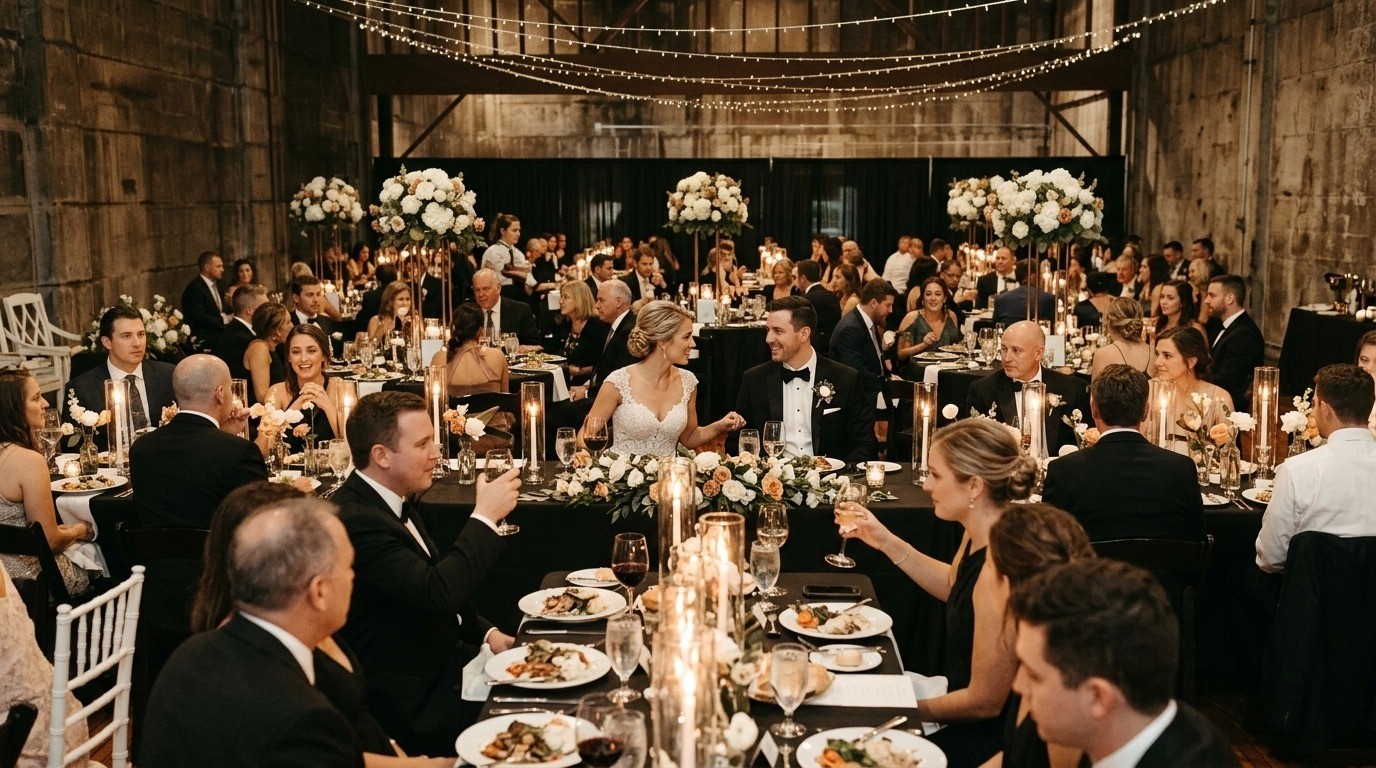
Top 5 Rustic Barn Wedding Venues Maryland: An Entertainer’s Insider Guide

Top 5 Rustic Barn Wedding Venues Maryland: An Entertainer’s Insider Guide

The bass hit the wood and the wood hit back.

That’s the only way I can describe it. I was sound-checking in a restored Maryland barn — timber-frame, hand-hewn beams, stone foundation — and when the kick drum fired, the whole room responded. Not a muddy echo bouncing off drywall and drop ceiling tiles like you get in hotel ballrooms. A warm, full resonance, the kind that wraps around the low end of a live band and gives it weight. I turned to our sound engineer and he was already grinning. We both knew: this room was going to be fun.

I’ve performed at rustic barn wedding venues Maryland couples tend to gravitate toward, and I’ve played the polished hotel ballrooms in Baltimore and DC. What most people don’t expect: the barns often sound better. Timber and stone do something to music that plaster and carpet can’t. They give it body. They let the highs ring without getting harsh and let the lows breathe without getting boomy. There’s a physics explanation for it, but honestly, you just feel it when you’re standing in the room.

The range across Maryland’s rustic and industrial venues is what gets me. Working wineries in the Catoctin foothills where lavender fields run right up to the ceremony site. A 340-year-old manor on the Eastern Shore where George Washington actually slept — and where you can still touch the brass doorknob from his room. A former Chevrolet showroom in Ellicott City with three-foot granite walls and industrial windows overlooking the Tiber River. These aren’t interchangeable “barn venues.” Each one carries a personality that shapes the entire celebration. As someone who reads a room — literally and figuratively — every single weekend, that personality matters more than most couples realize.

Why Rustic, Barn, and Industrial Venues Work for Maryland Weddings

Most couples underestimate how much work the building itself does. When your guests walk into a room with original marble fireplaces, hand-carved moldings, or a ceiling that took three years to gild, you don’t need to spend $40,000 on decor to create a mood. The mood was built into the walls a century ago. From an entertainment perspective, these spaces are fascinating. High ceilings and stone or plaster walls create natural reverb—live instruments sound fuller, richer, more present than in a hotel ballroom with drop-tile ceilings and carpeted floors. But that same reverb can work against you if you don’t understand the room. A bass-heavy DJ setup in a marble hall will turn to mud. Acoustic instruments in a timber-frame conservatory will ring out beautifully. Knowing which approach fits which room is the difference between a dance floor that fills at 8:30 and one that stays half-empty all night. And then there’s flow. Historic estates were designed for entertaining. They have parlors, galleries, terraces, gardens—distinct spaces that naturally move guests from one moment to the next. Ceremony in the garden. Cocktails on the terrace. Dinner in the ballroom. That built-in progression creates energy shifts that keep people engaged instead of planted at the same table for five hours. When the architecture choreographs the evening for you, everything—including the music—hits differently.

The reason is intimacy without compromise. Barn wedding venues Maryland couples love tend to cap between 100 and 300 guests, which is the sweet spot for keeping a dance floor alive all night. You’re not fighting a cavernous room where half the energy dissipates before it reaches the back tables. The architecture creates natural containment — stone walls, exposed beams, lower ceilings relative to a hotel — and that containment translates directly into dance floor energy. People feel the music in their chest, not just in their ears.

Practical things get overlooked, though. Power supply is a big one — older barns and industrial spaces don’t always have the electrical capacity for a full band, professional lighting, a caterer’s kitchen, and a DJ rig running simultaneously. You need a vendor who’s thought about that before load-in, not during. Weather contingency matters at any venue with an outdoor ceremony component. Sound curfews are real — rural neighbors and municipal codes both have opinions about how late the bass can thump. None of these are dealbreakers. They’re just the details that separate a smooth celebration from a stressful one.

Among the best wedding venues in Maryland, rustic and industrial chic spaces offer something polished ballrooms simply can’t: character that doesn’t need to be rented, installed, or struck at the end of the night. Exposed beams, stone, patina — all permanent. Your florist builds on it instead of creating from scratch. Your photographer captures it in every frame without posing. And your entertainment feeds off it all evening long.

The Venues

Springfield Manor (Thurmont)

img6

The lavender fields are what you’ll see on Instagram, but it’s the Catoctin Mountain backdrop behind that restored barn that anchors the whole property.

Springfield Manor sits on a historic Frederick County estate that operates simultaneously as a winery, distillery, and brewery — and this isn’t some branding gimmick. Your cocktail hour can feature estate-made wine, small-batch spirits, and craft beer, all produced on the same grounds where your guests are sipping them. That triple operation gives the venue an energy you won’t find at a standard barn rental. People wander, taste, ask questions about the distillation process. Cocktail hour basically runs itself.

Two distinct event spaces divide the property. The Ballroom handles up to 300 guests with a more polished, finished interior — elegant but with rustic bones underneath. The Barn caps at 150 and delivers the full sensory experience: intimate, textured, exactly what comes to mind when you picture a barn wedding. Both sit against the Catoctin Mountains, the same range that shelters Camp David, and the views run long enough to keep your photographer busy well past golden hour.

In June, the outdoor ceremony pergola faces those mountains and the lavender fields at peak bloom. The property transforms into something that doesn’t look like Maryland at all — more like Provence dropped into the foothills of Appalachia. Some couples infuse their signature cocktails with the lavender. Others hand out dried bundles as a natural alternative to confetti for their send-off.

Capacity: Ballroom up to 300; Barn up to 150 Spaces: Outdoor ceremony pergola, Ballroom, The Barn, on-site B&B with 8 luxury suites Price Range: Site fees from $3,550 to $4,024+; tables and Chiavari chairs included; BYO alcohol often permitted Peak Season: June (peak lavender bloom) Best For: Couples who want craft beverages and mountain views Pet-Friendly: Yes — the lavender fields make for great pet photos

Having two event spaces changes everything from an entertainment standpoint. The Barn’s timber frame and lower ceiling create exactly the kind of contained acoustic environment I described earlier — punchy, warm, naturally flattering for both live instruments and DJ playback. The Ballroom opens up considerably, so you’ll want a sound team that can scale without losing that warmth. What works equally well in both: the ceremony-to-cocktails-to-reception flow. Pergola, tasting areas, and reception space all live on the same property — no shuttles, no long walks, no momentum lost between phases. That matters more than most couples realize. A 20-minute gap while guests wander around trying to figure out where to go next will kill dance floor energy before anyone has danced a step.

Springfield Manor earned Frederick’s Best Event Venue 2024, and it’s the only Maryland wedding venue that operates as a winery, distillery, and brewery under one roof. The on-site B&B means your wedding party and closest family can stay on the property — no one needs to worry about driving home through the mountain roads after a night of tasting the estate’s own spirits.

Official website: https://www.springfieldmanor.com/

Milton Ridge (Clarksburg)

img7

A 19th-century schoolhouse turned wedding chapel, surrounded by a purpose-built venue that handles every detail so you don’t have to.

Most rustic venues in Maryland hand you a beautiful space and wish you luck finding vendors. Milton Ridge took a different approach: they built an all-inclusive model around a historic structure. At its heart sits a non-denominational chapel that started life as an 1875 schoolhouse, meticulously restored to keep its original wood-beamed ceilings and handmade character. Walk in and you’re in a different century — a room where the architecture does all the work the ceremony atmosphere needs.

Guests move from the chapel to a modern reception hall where clean, contemporary lines carry just enough warmth to feel connected to the property’s roots. An outdoor garden patio handles cocktails when the weather cooperates. And then there’s the two-story Bridal Cottage — genuinely impressive, with a full hair and makeup salon on the lower level and a groom’s retreat upstairs. That cottage alone solves a problem I encounter at half the weddings I work: bridal parties crammed into a bedroom while someone steams a dress in the bathroom down the hall. Purpose-built space makes a noticeable difference.

Where Milton Ridge really separates itself is the all-inclusive model. Packages range from essentials to their Diamond tier, which bundles DJ services, photography, and cake into the venue cost. Couples who want the rustic aesthetic without the project management burden of juggling a dozen independent vendors — this is their answer. Max capacity is 150, and they host one wedding at a time. Your celebration gets the full property, not a shared calendar.

Capacity: Up to 150 guests Spaces: Historic Chapel (1875), modern reception hall, outdoor garden patio, two-story Bridal Cottage Price Range: $3,750 to $9,950+ (Diamond package includes DJ, photography, and cake); buffet catering $65–$75 per person Peak Season: April through November Best For: Smaller weddings that want all-inclusive simplicity Pet-Friendly: Yes, for ceremonies only

Acoustically, that chapel is a gift. The wood-beam ceiling and intimate scale produce a naturally warm sound — almost a ready-made concert hall in miniature. Voice carries beautifully, which matters for readings, vows, and any live ceremony music you’re considering. The transition to the reception hall is tight and efficient, keeping guest energy up. One thing to plan around: an 11:30 PM curfew, which means your timeline needs to be locked and your entertainment team needs to be managing the clock. A skilled MC builds to a peak and lands the final song right on time — but that only works if the whole evening is paced correctly from the first welcome.

Here’s what stays with you about that 1875 schoolhouse chapel: the wood beams, the proportions, the quality of light coming through the windows — none of it was designed for weddings. Nobody planned this room for Instagram. It was built so rural Maryland kids could learn to read, and a century and a half later, it happens to be one of the most genuine ceremony spaces in the state. The WeddingWire Couples’ Choice Award (2024 and 2025) suggests couples agree.

Official website: https://www.miltonridge.com/

Montagu Meadows (Westminster)

img8

Half a mile off the main road, down a gravel drive, past a chestnut grove — and then an 1850s bank barn appears like it’s been waiting for you.

You notice the privacy before anything else at Montagu Meadows. Ten acres in Carroll County, far enough from civilization that you genuinely forget Baltimore is 45 minutes away. The property calls itself a “Hidden Valley” experience, and that’s not exaggeration — the seclusion wraps around your wedding and separates it from the ordinary Saturday everyone else is having.

Dating to the 1850s, the barn is a bank barn built into a hillside in the style Maryland and Pennsylvania German farmers perfected. Modern amenities were added during restoration (ADA compliance, proper lighting, restroom trailers), but the bones stayed intact — exposed timber framing, original stonework, the smell of old wood that no decorator on earth can fabricate. Out on the property, a chestnut grove serves as the ceremony site. Come autumn, it becomes the kind of natural canopy couples spend thousands trying to recreate with fabric and framework.

Then there’s the “Something Borrowed” room, and it’s the kind of detail that tells you everything about this venue’s character. A dedicated space filled with curated wedding decor — centerpieces, lanterns, signs, table runners — all left by previous couples and offered free of charge to future ones. The tradition started organically and became something the venue is known for. Budget-conscious couples walk in, choose from high-quality pieces, and dramatically reduce their decor costs. No marketing angle behind it. Just couples helping couples, and it keeps a certain spirit alive at this place.

Capacity: Up to 100 guests Spaces: 1850s bank barn, chestnut grove ceremony site, ready suites Price Range: “3-Day Dream Wedding” package at $6,990; elopement packages from $500; restroom trailers included Peak Season: May through October Best For: Budget-savvy couples who want seclusion and character Pet-Friendly: Yes, for outdoor ceremonies

A hundred guests max. For entertainment, that’s an asset, not a limitation. The dance floor is never more than a few steps from any table — nobody retreats to a far corner, everybody stays in it. Timber framing gives you that warm low-end response I love in barn acoustics, and the contained space means you don’t need to overpower the room to get people moving. A DJ-led hybrid setup shines here: live musicians layering sax or guitar over the DJ’s playback, sound wrapping around the room without massive amplification. And the 3-day rental model (Friday setup, Saturday wedding, Sunday cleanup) is a genuine gift for entertainment logistics. We load in Friday, sound-check at leisure, dial the system for the room’s specific acoustics. No rushing through it on the wedding morning while the florist works around our speaker stands.

Transparent pricing defines Montagu Meadows. At $6,990 for the full “3-Day Dream Wedding” package, it’s one of the most accessible barn venues in the region for couples on a real budget. The Zola “Best of” 2024 winner earned that recognition partly by proving a genuine barn wedding in Maryland doesn’t require a $30,000 venue fee. BYOB alcohol allowed, outside catering permitted — couples control costs on nearly every line item.
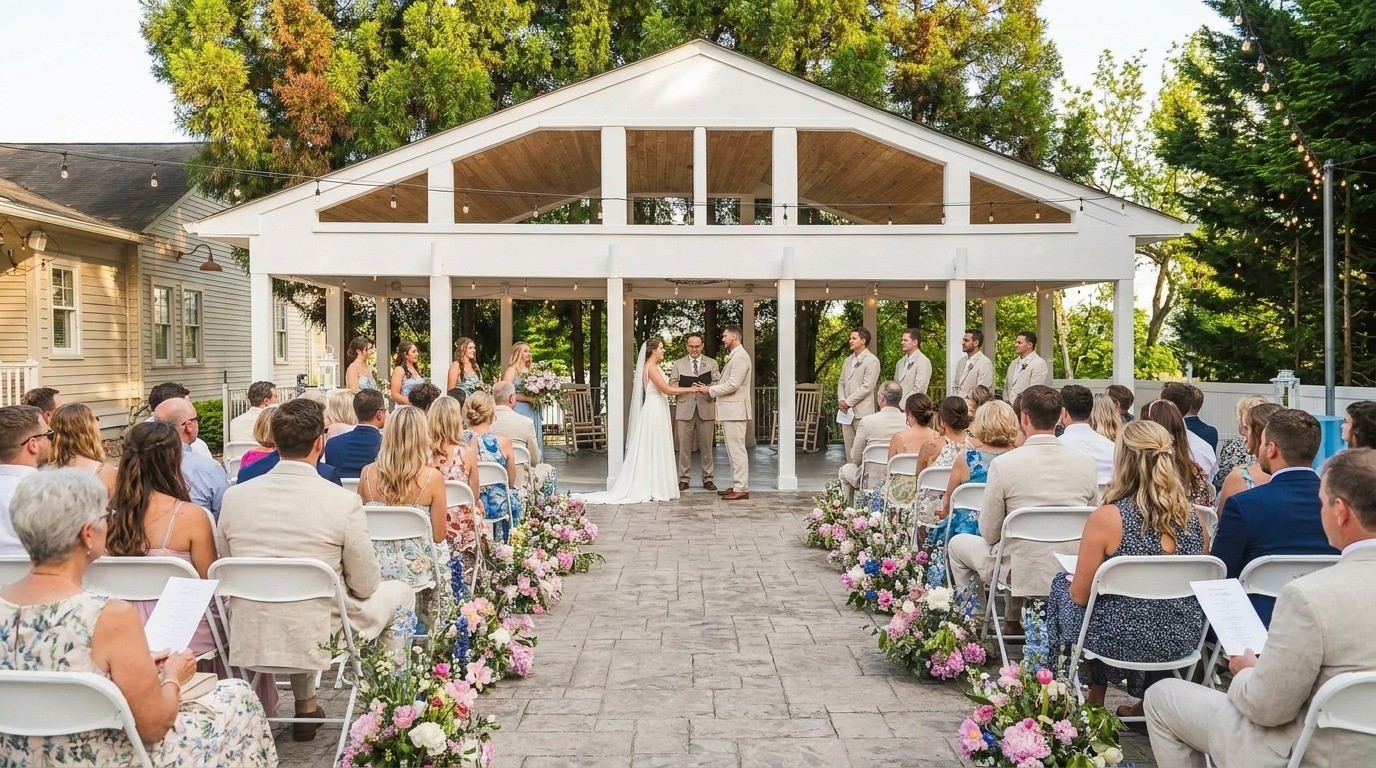
Official website: https://www.montagumeadows.com/

Worsell Manor (Warwick)

img9

George Washington slept here. Not as a saying — as a documented, journal-entry, brass-doorknob-you-can-still-touch historical fact.

Built in 1683 on Maryland’s Eastern Shore, Worsell Manor predates the country itself by nearly a century. One of the oldest properties in America. The Georgian architecture has weathered over 340 years of coastal storms, wars, and changing ownership, still standing with a structural confidence that modern construction rarely achieves. Pull up the drive and you’re looking at a building that was already 100 years old when the Declaration of Independence was signed.

Beside the historic manor and a cottage sits the wedding barn, and the contrast is part of what makes the property work — 17th-century history meeting a purpose-built event space with modern HVAC, proper lighting, and a floor engineered to host up to 225 guests depending on layout. Grounds are expansive and open, with a “secret garden” feel that rewards couples who walk the property with their photographer. The Knot’s “Best of Weddings” 2024 nod makes sense: this particular combination of deep history, genuine antique charm, and flexible event infrastructure is harder to find than you’d think.

On-site lodging in the manor and cottage (up to 23 guests) transforms a Worsell Manor wedding into a weekend affair. Your wedding party and immediate family take over Friday night, celebrate Saturday, linger over brunch Sunday. That weekend-takeover rhythm creates a togetherness that day-of venues can’t replicate — and gives everyone time to explore the property’s genuinely remarkable past.

Capacity: The Barn seats approximately 190 guests comfortably, up to 225 depending on setup Spaces: Wedding barn (with HVAC), historic manor, cottage (23 overnight guests total), gardens and grounds Price Range: $7,800 to $13,650 venue rental; bar services approximately $20 per person; $750 refundable security deposit Peak Season: April through October Best For: Weekend takeovers with history and antique character Pet-Friendly: Yes — large open spaces ideal for dogs
<br.
The barn’s volume and ceiling height can handle a full hybrid band comfortably — I’ve seen rooms this size come alive in ways that surprise even the couple who booked them. In the 190 to 225 guest range, you’re in that productive middle ground: large enough for serious dance floor energy, small enough that slower moments never feel hollow. One logistical reality to plan around: music typically ends by 10:00 PM, common for Eastern Shore venues near residential areas. That curfew doesn’t cramp the celebration if your entertainment team knows how to structure the evening so the dance floor peaks at the right moment — not twenty minutes after the last note. Pacing becomes everything. Read the room early, bring the energy up in deliberate stages, make sure that final song lands as a climax rather than a cutoff.

Washington was a regular guest at Worsell Manor and mentioned it multiple times in his personal journals. The room where he slept still has its original 18th-century brass doorknob — a literal piece of American history your guests can reach out and touch. Plenty of Maryland venues claim historical significance. Worsell Manor has the documentary evidence and the physical artifacts to back it up. That’s the kind of detail that turns a wedding venue into a story your guests retell for years.

Official website: https://www.worsellmanor.com/

Main Street Ballroom (Ellicott City)

img10

Three-foot-thick granite walls, original industrial windows, 10,000 square feet of single-level space — and not a single structural column blocking the dance floor.

Every other venue on this list draws character from farmland, timber, and pastoral landscape. Main Street Ballroom draws from Ellicott City’s industrial past, and it’s on this list intentionally. The building started life as a Chevrolet showroom and workshop in the 1920s. The bones of that era are everywhere — massive granite boulder walls, factory-scale windows, the kind of raw structural honesty that no amount of reclaimed-wood accent walls can replicate. Rustic in the truest sense: real materials, honestly aged, unapologetically industrial.

“Blank slate” gets thrown around loosely in the wedding industry. Here, the concept is real. Ten thousand square feet of open, single-level space. An open vendor policy. Couples build exactly the wedding they want from the ground up — their own food, their own alcohol (BYOB with licensed bartenders), their own entertainment, their own design vision. The venue provides the architecture and steps back. For creative couples exploring industrial chic wedding venues Maryland has to offer, this approach is liberating. For couples who prefer someone else to manage the details, it demands more planning and coordination.

Old Ellicott City itself adds a layer of character that a standalone venue can’t provide. The historic district’s Main Street — antique shops, restaurants, 19th-century stone buildings — becomes the backdrop for pre-ceremony photos. A riverside patio overlooks the Tiber River, and on-site suites handle getting-ready logistics without leaving the building. Old Ellicott City has served as the backdrop for numerous films and TV productions, and standing on that main street, it’s immediately obvious why.

Capacity: Up to 300 guests (250 seated with dancing); 10,000 sq. ft. single level Spaces: Open-plan ballroom, riverside patio, on-site suites Price Range: Full-day package $6,750 to $11,000; no 20% venue service fee; hourly rates available for smaller events Peak Season: Year-round (fully climate-controlled) Best For: Creative couples who want a blank-slate industrial canvas Pet-Friendly: Yes — extremely; easy-to-clean stone floors and open layout

This room is one of the most rewarding spaces on this list for entertainment — and one of the most demanding. Three-foot granite walls are acoustically reflective. Sound bounces hard. In the wrong hands, that becomes a harsh, echoing mess where every frequency fights for dominance. Get the speaker placement and EQ calibration right, though, and those same walls create an enveloping sound field that puts every guest inside the music. No sightline obstructions on the dance floor, no dead zones behind pillars, no awkward corners where energy dies — that column-free, single-level layout is a massive advantage. The 16-hour rental window (8 AM to midnight) is the most generous on this list, giving entertainment teams time to load in early, sound-check thoroughly, and dial the system for the room’s specific behavior. That extra time translates directly into better sound at showtime.

A 1920s Chevrolet showroom needed to be wide open — cars had to get in and out — which meant high ceilings, broad doorways, and a floor built to support serious weight. That industrial DNA gives the space its character today, and it explains how 10,000 square feet can sit on a single level with no support columns interrupting the floor plan. WeddingWire Couples’ Choice (2024 and 2025) and The Knot Best of 2024 — awards from both major platforms, which tells you the blank-slate model is working.

Official website: https://www.fetewell.com/main-street-ballroom

How to Choose Between These Five Venues

Five venues, five genuinely different experiences. Here’s how to think through the decision.

Start with headcount. Guest lists north of 200 narrow you to Springfield Manor’s Ballroom (300), Main Street Ballroom (250 seated with dancing), or Worsell Manor’s barn (up to 225, with roughly 190 seated comfortably). Under 150? Milton Ridge (150 max) and Montagu Meadows (100 max) are purpose-built for that scale, and the intimacy shows.

Budget changes the conversation quickly. Montagu Meadows at $6,990 for a three-day package with BYOB is hard to beat. Milton Ridge’s all-inclusive model ($3,750 to $9,950) takes the vendor headache off your plate. Main Street Ballroom’s $6,750 to $11,000 range with no service fee and full BYOB can save thousands compared to Worsell Manor’s $7,800 to $13,650.

Couples who want a full weekend should look at Worsell Manor’s on-site lodging for 23 guests or Springfield Manor’s 8-suite B&B. Friday through Sunday with your closest people, and the celebration breathes instead of being compressed into six hours.

Creative control is its own axis. Main Street Ballroom’s open vendor policy is the only true blank slate. Want the opposite — walk in and everything is handled? Milton Ridge’s Diamond package bundles DJ, photography, cake, and catering into one contract.

Seasonality and setting round out the picture. Montagu Meadows and Worsell Manor operate April through October only. Main Street Ballroom runs fully year-round and climate-controlled. Springfield Manor gives you Catoctin Mountain views, Worsell Manor gives you Eastern Shore countryside, and Main Street Ballroom gives you a walkable historic district.

Why Entertainment Matters More Than You Think at Rustic and Industrial Venues

After years of performing in barns, warehouses, and converted industrial spaces, I can tell you the pattern: couples choose these venues for the aesthetic and then underestimate how much the space itself shapes the entertainment experience. Exposed timber, stone walls, metal roofing, open floor plans — the features that make these venues beautiful are exactly the features that make sound behave in unpredictable ways.

Consider the physics. Timber-frame barns absorb high-frequency harshness while reinforcing warmth in the mid-range. A jazz trio in a barn sounds better than the same trio in a convention center, full stop. But that same wood can turn a poorly positioned speaker system into a muddy, booming mess. Industrial spaces like Main Street Ballroom flip the problem — granite reflects sound aggressively, and without proper acoustic management, you get a room that’s loud without being clear. The gap between “incredible sound” and “I couldn’t hear the toasts” comes down to an engineer who has worked these kinds of rooms before.

Practical realities compound the acoustic ones. Power supply in older barns can be limited. Outdoor ceremony sites mean wind and weather contingencies for microphones. Music curfews at rural venues (10:00 PM at Worsell Manor, 11:30 PM at Milton Ridge) demand an MC who can pace the evening so the celebration peaks at precisely the right moment — not after the music stops.

Couples who have the best experience at these venues book entertainment that understands the specific space. Not just “a DJ” or “a band,” but a team that has worked rustic and industrial rooms, brings the right equipment for the acoustics, and knows how to read a room where the architecture is doing half the talking.

Why DLE Event Group

Our hybrid DJ band experience was built for venues exactly like these.

The concept is straightforward: live musicians — sax, guitar, keys, percussion, vocals — performing alongside a professional DJ who also serves as your MC. Live instruments fill a timber-frame barn with warmth and presence naturally, without needing to push volume to create energy. The DJ side gives you range to play anything, from a string-quartet arrangement during your vows to the song that empties every chair at midnight. It’s a format that adapts to the room instead of fighting it — and in spaces with distinct acoustic personalities, that adaptability is everything.

Over more than a decade and 100+ weddings and events, we’ve earned The Knot Best of Weddings Hall of Fame 11 times (2013-2023) and the 2025 Knot award. Our musicians carry national and international performance credits and play premier venues every week. They understand instinctively that a 150-person barn wedding requires a different energy than a 500-person hotel ballroom, and they adjust without being told.

Much of the value lives in the planning process. Starting roughly six months before your wedding, we run 5 to 10 Zoom planning sessions. We learn your music, your timeline, your cultural traditions (Hora, Baraat, Tarantella, Dabke — we’ve done them all). We coordinate with your venue on power requirements, load-in logistics, curfew management, and sound levels. Custom songs for your first dance, tailored edits for parent dances and special moments — all prepared in advance. And we bring duplicate backup equipment to every event, because at a venue this meaningful, failure isn’t an option.

DLE serves Maryland, DC, the tri-state area, and destinations beyond. Let’s discuss our packages, with configurations ranging from DJ-led hybrid setups to full celebrity band experiences. If you’re planning a rustic, barn, or industrial chic wedding in Maryland for the 2026–2027 season — at any of these venues or others among the many Maryland wedding venues we serve — we’d love to talk about the room you’ve chosen and how we can make it sing.

Frequently Asked Questions

For peak-season Saturdays (May through October), 12 to 18 months out is standard. Venues like Montagu Meadows and Worsell Manor operate seasonally and host one wedding at a time, so their calendars fill quickly. Springfield Manor’s June lavender dates are especially competitive. Friday or Sunday dates give you more flexibility. Same goes for booking entertainment — premier dates go fast on both sides.
The range is wider than most couples expect. Montagu Meadows offers a 3-day package for $6,990 with BYOB and outside catering. Milton Ridge’s all-inclusive packages run $3,750 to $9,950. Springfield Manor’s site fees start at $3,550 but catering is exclusive. Worsell Manor ranges from $7,800 to $13,650 for the venue alone. Main Street Ballroom is $6,750 to $11,000 with no service fee surcharge. In all cases, the venue fee is just one piece — get full all-in quotes before comparing.
All five venues on this list accommodate both. Springfield Manor has a dedicated outdoor pergola. Milton Ridge has the historic chapel. Montagu Meadows uses the chestnut grove. Worsell Manor offers gardens and grounds. Main Street Ballroom handles everything in one open floor plan. Same-site ceremonies keep your timeline tight and — from an entertainment perspective — let your team manage sound and energy from beginning to end without packing up and relocating.
A hybrid approach — live musicians layered over a professional DJ — is ideal. Live instruments fill timber and stone rooms with warmth that speaker-only setups can’t match, while the DJ gives you access to any song in any genre. The key is an entertainment team that understands these acoustics. Barn rooms reward warmth and punish harshness. Industrial stone demands careful speaker placement. An experienced team adjusts for the room; a generic one uses the same setup everywhere and hopes for the best.
Springfield Manor has an on-site B&B with 8 luxury suites. Worsell Manor’s manor and cottage sleep up to 23 guests. For the other venues, you’ll need nearby hotels — Milton Ridge is close to the I-270 corridor, Montagu Meadows has Carroll County hotels within a short drive, and Main Street Ballroom sits near hotels along Route 40 and the Columbia corridor. If on-site lodging is a priority, Springfield Manor and Worsell Manor are the clear choices.
Not all of them. Montagu Meadows operates May through October only. Worsell Manor runs April through October. Springfield Manor and Milton Ridge host events April through November with some winter availability. Main Street Ballroom is the only fully year-round venue — climate-controlled and entirely indoors. If you want a December or January celebration with rustic-industrial character, that’s your answer.

Let's Talk About Your Venue

You’ve found the barn, the manor, or the warehouse. You’ve fallen for the beams, the stone, the fields, the history. Now you need entertainment that understands why that room matters — a team that reads its acoustics, respects its character, and brings an energy that makes 100 guests feel like 300 or 225 guests feel like family.

DLE Event Group has spent over a decade doing exactly that across New York, Maryland, and the mid-Atlantic. We’d love to hear about the space you’ve chosen and help you figure out how music can bring it to life.

QUESTIONNAIRE

Need Assistance? Directly reach us at contact@dleeventgroup.com or 877.534.2424