Top 5 Rustic Barn Wedding Venues in Connecticut: An Insider’s Guide

I’ve loaded amplifiers through these doors in Middletown, run cable past stone walls in Canterbury, and watched a couple’s first dance under exposed post-and-beam framing in the Litchfield Hills while the October foliage burned orange through every window. Rustic barn wedding venues in Connecticut aren’t what most people picture when they hear “barn wedding.” These aren’t purpose-built event barns with fake distressing and a coat of paint. These are functional structures — dairy barns, factories, working farms — with histories measured in centuries, not marketing cycles. And the thing that keeps surprising me, after performing at dozens of them across New England, is how well they work for live music. Timber-frame construction absorbs and distributes sound in ways that drywall and drop ceilings can only dream about. The bass doesn’t boom. The vocals don’t bounce. The room just… takes what you give it and warms it up.
Connecticut has five of the best rustic and industrial chic venues I’ve encountered anywhere in the Northeast — each one authentically different, each one with a story that predates anyone’s wedding Pinterest board by about two hundred years.
Why Rustic and Barn Venues Work for Connecticut Weddings
From an entertainment perspective, these spaces offer something specific: intimacy without smallness. A 200-person wedding in a converted barn feels closer, warmer, more connected than the same headcount in a 5,000-square-foot ballroom. The lower ceilings (relative to grand hotels) keep the energy contained. Guests don’t scatter — they stay near the music because the room’s proportions naturally draw them inward. And the exposed wood construction? It acts like a giant acoustic panel. I’ve played sets in Connecticut barns where the sound was better than venues charging three times the price.
The practical side matters too. Most of these venues are all-inclusive or semi-inclusive, which means fewer vendor headaches. Several are climate-controlled year-round — a detail that separates genuinely functional event spaces from scenic photo ops that leave your grandmother shivering in November.
The Venues
The Barns at Wesleyan Hills (Middletown)
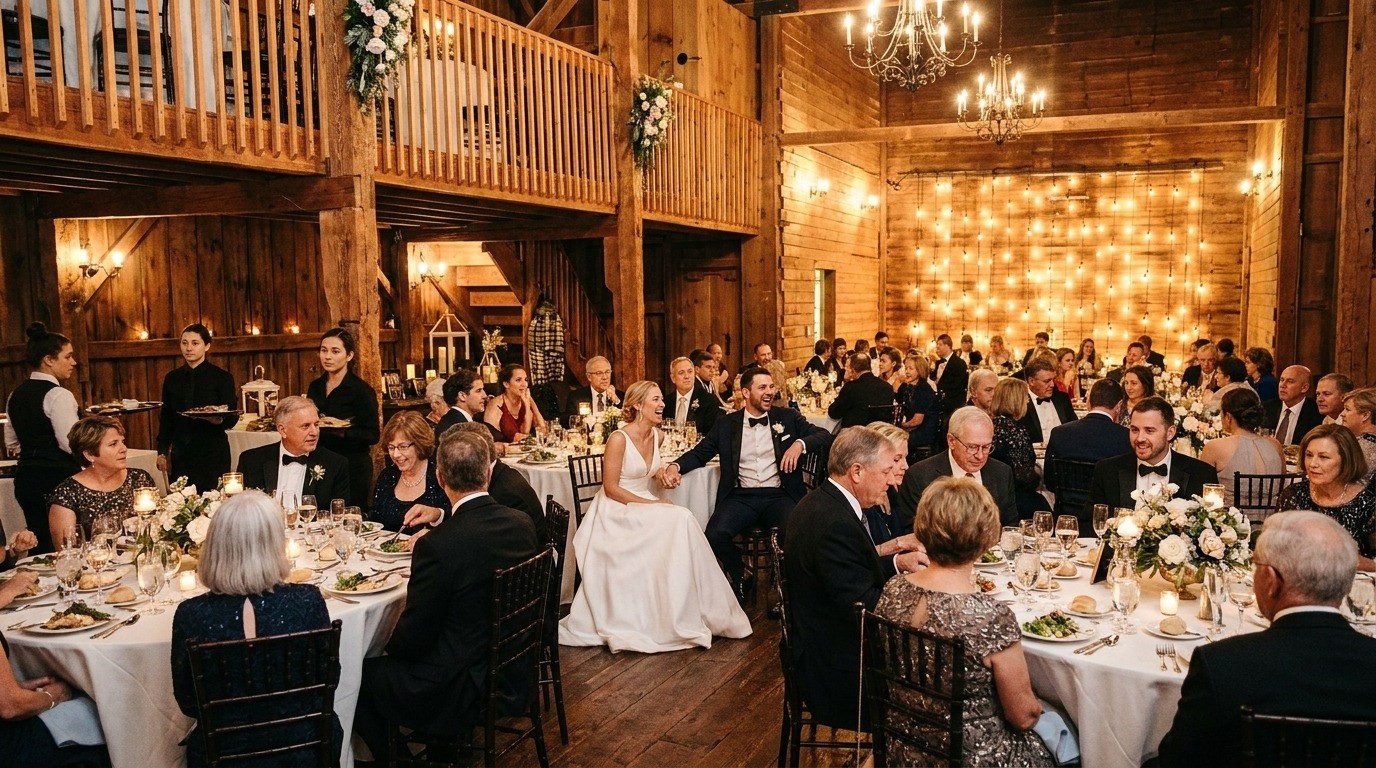
A 150-year-old dairy barn where the architecture won awards not for being old, but for how intelligently it was modernized.
The Big Barn is the main event. Soaring post-and-beam ceilings rise above you, the original structural timbers left fully exposed, while the exterior wears a contemporary light gray shingle-style cladding that earned the renovation local architectural preservation awards. It’s a space that respects what it was without pretending it’s still a working dairy. The palette is neutral — warm wood, soft grays, natural light from oversized windows — so your florist and lighting designer are working with a blank canvas, not fighting someone else’s color scheme.
Most barn venues give you one room. This property gives you three buildings. The Big Barn handles your reception (up to 225 seated). The Middle Barn — smaller, more contained — works perfectly for cocktail hour, giving guests a distinct space to settle in before the main event reveals itself. And then there’s the Little Barn, which is essentially a private clubhouse for the wedding party: its own building with a kitchen, safe, and climate control. No cramming the bridal party into a repurposed office with a full-length mirror and calling it a “suite.”
Outside, massive weeping willow trees — among the largest in the state, according to locals — create a living canopy for ceremonies. They’ve been here longer than anyone can pin down, and they frame the property in a way that no landscape architect could replicate on a deadline.
Capacity: Up to 225 seated Spaces: Big Barn (reception), Middle Barn (cocktails), Little Barn (wedding party suite), outdoor ceremony lawn Price Range: $25,000–$35,000+ all-inclusive; per-person rates ~$110–$180+; $995 ceremony fee Peak Season: May–October Best For: Couples who want polished rustic without sacrificing modern comfort Pet-Friendly: Yes — dogs welcome for ceremonies and photos; must be crated in suite otherwise
From an entertainment standpoint, the three-barn flow is a rare gift. You set up in the Big Barn while cocktails happen next door in the Middle Barn, and neither space bleeds into the other acoustically. That means a full sound check with no audience, which is rare and valuable. The post-and-beam ceiling in the reception barn gives you enough height for sound to develop without the reverb problems you get in taller industrial spaces. Energy builds fast in this room — the proportions keep guests close to the dance floor, and by the time you’re three songs into the reception set, the whole space is moving. Climate control year-round means you never have to worry about outdoor noise bleed or equipment sweating in August humidity.
One more thing about this property: the willow trees. The barn’s renovation earned recognition for its “shingle-style” approach — updating the exterior to contemporary standards while preserving the original 1800s post-and-beam skeleton inside. It’s the rare venue where the architecture holds up in conversation, not just in photographs. The property has been in the Hubbard family for generations, and the willows have become an unofficial landmark — couples who married here years ago still refer to the venue as “the one with the willows.”
Official website: https://www.ctweddinggroup.com/connecticut-wedding-venues/the-barns-at-wesleyan-hills
The Lace Factory (Deep River)
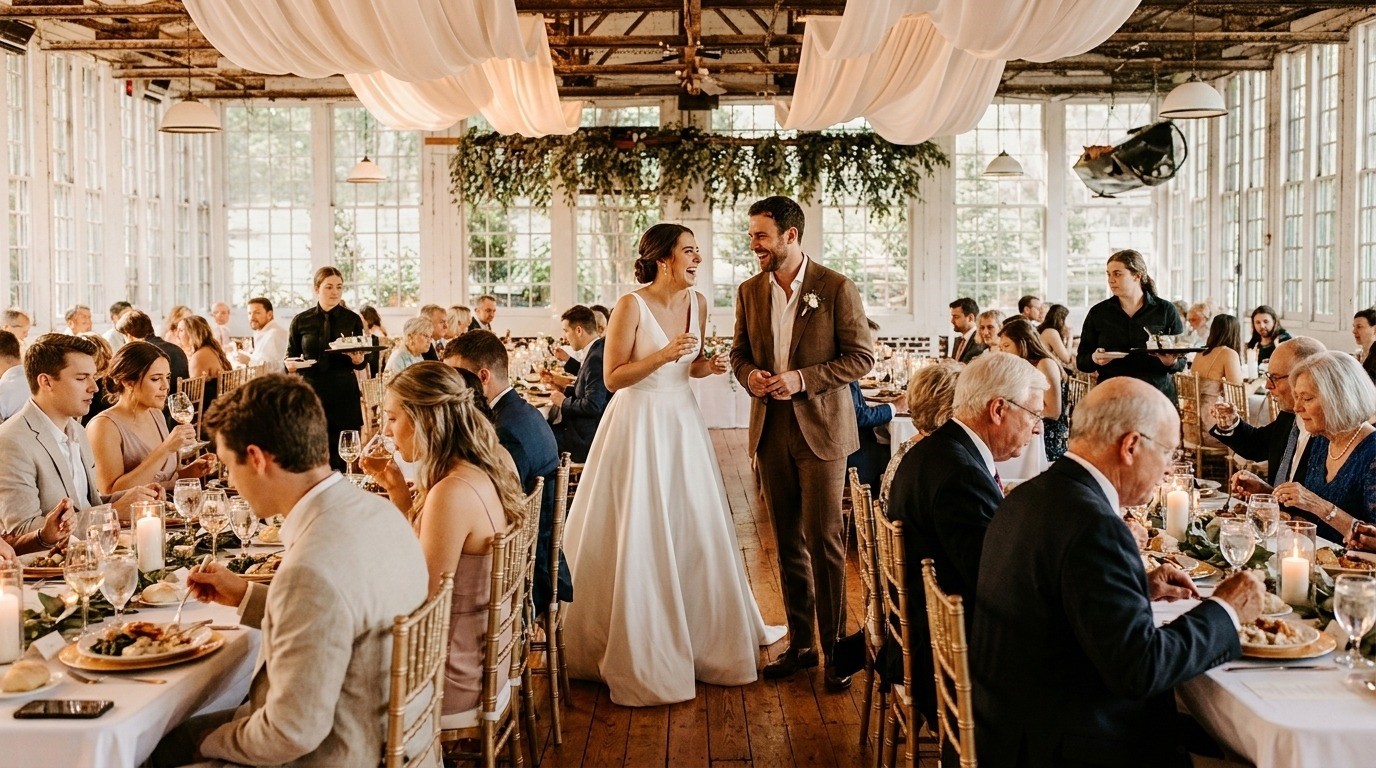
Where else can your guests arrive by steam train and walk into a 19th-century warehouse with 10-foot windows overlooking the Connecticut River?
You walk in and the scale hits you immediately. Six thousand square feet of open floor plan, exposed brick on every wall, original wood floors that creak in the right places, and those windows — tall, arched, flooding the space with natural light from the river side. Call it what it is: a factory floor. That distinction matters, because the energy in a warehouse space moves differently. It’s wider, more open, less “cozy cabin” and more “downtown loft transplanted to the Connecticut shoreline.”
The building dates to 1875, and its resume reads like a condensed history of the Connecticut River Valley economy. It started as a shipyard. Then it served as a dock for ivory deliveries during Deep River’s run as the “Ivory Capital” of America — the town once supplied the piano key industry. Eventually it became a cornerstone lace factory, the name that stuck. All of that industrial DNA is visible in the bones of the space: the brick, the timber, the proportions built for machinery and production rather than aesthetics. The fact that it’s gorgeous is almost accidental.
For intimate events, the Riverview Room handles up to 49 guests — a separate space within the building that offers river views without the scale of the main warehouse. But the main room at 225 capacity is where this venue earns its reputation.
Capacity: Up to 225 in the main warehouse; Riverview Room for 49 guests Spaces: Main warehouse floor, Riverview Room, outdoor landing area Price Range: Saturday rental ~$6,500–$8,500; catering (Cloud Nine) ~$135–$155 per person Peak Season: September–November (peak foliage for the adjacent steam train ride) Best For: Industrial-chic couples who want raw character with river views Pet-Friendly: Often permitted for outdoor ceremonies at the Landing; confirm indoor policy with venue
Here’s what nobody mentions on the venue tour: exposed brick is beautiful, but it’s also reflective — sound bounces off masonry harder than wood. In the Lace Factory’s main room, the 10-foot windows and original wood floors balance out the brick walls nicely, but you need a sound engineer who understands the space. The ceilings are lower than a typical barn, which concentrates energy on the dance floor but demands careful volume management so the room doesn’t get harsh. The 10:00 PM curfew is real and enforced, so every minute of your five-hour event window counts. You plan your set with a hard stop in mind, and you front-load the dance-floor bangers accordingly. No slow build here — you light it up early.
And then there’s the Essex Steam Train — the detail nobody believes until they see it. Guests can ride a historic locomotive — actual coal-fired steam engine, restored 19th-century passenger cars — directly to the venue’s entrance at the Deep River Landing. During September and October, that train ride cuts through peak New England foliage along the Connecticut River Valley. This isn’t a gimmick — it’s an actual logistical option that doubles as one of the most memorable arrival experiences at any wedding venue in the state. The Lace Factory is the only venue in Connecticut where the wedding party can depart via a 19th-century locomotive.
Official website: https://thelacefactory.com/
Wrights Mill Farm (Canterbury)

Two hundred acres of working farmland, a waterfall ceremony site hidden in the woods, and a horse-drawn carriage to get you there.
Canterbury is quiet corner Connecticut — eastern part of the state, away from the Fairfield County bustle, closer to the Rhode Island border than to Hartford. Wrights Mill Farm sits on land that’s been farmed since the early 1700s, and that continuity shows in everything from the stone walls lining the property to the functional water-powered grist mill that still operates on site. This isn’t a “farmhouse aesthetic” venue. Cows live here. The mill grinds. The waterfall that serves as your ceremony backdrop has been carving through these rocks for centuries.
The ceremony site itself is something you have to see to believe — a secluded clearing in the woods where a natural waterfall provides the backdrop. Couples arrive via a traditional white horse-drawn carriage along a path through the property, which sounds like a fairy tale cliche until you’re standing in the New England woods watching it happen in real time. It works because it’s not staged. The carriage follows actual farm paths. The waterfall is actual geography, not a water feature installed by a landscape company.
The reception moves to the barn — rebuilt in 2020 after a devastating fire in 2016 destroyed the original lodge. The local community rallied to help the owners, and the new structure incorporates stone and wood salvaged from the property’s original colonial buildings. It’s climate-controlled, modern where it needs to be, and seats 210. The 200-acre property also includes an 8-bedroom house available for guest rental, which turns the whole weekend into an immersive experience rather than a drive-in, drive-out event.
Capacity: Up to 210 seated Spaces: Waterfall ceremony site, climate-controlled barn (reception), 8-bedroom guest house Price Range: Reception fee starts at ~$5,500; packages $85–$130+ per person; 10% off for January–March weddings Peak Season: October (200 acres of private foliage) Best For: Couples who want a full fairy-tale farm experience with genuine rural character Pet-Friendly: Yes — dogs encouraged in ceremonies
Plan for distance. The walk from waterfall ceremony to barn reception covers real ground across the property, so your entertainment setup needs to be completely independent in both locations. Ceremony musicians at the waterfall, full band and DJ rig pre-set in the barn. There’s no “quick move” option here — the spaces are too far apart. But that distance is also an advantage: cocktail hour on the farmland between ceremony and reception gives guests time to absorb the setting, and by the time they walk into the barn, the energy shift feels earned. The rebuilt barn has good acoustics — new construction with deliberate sound design, not the echoey metal-roof situation you find at some newer farm venues. The all-inclusive packages include a DJ, which means couples looking for a hybrid experience should coordinate early to integrate live musicians into the existing framework.
Most guests remember the waterfall. I remember the grist mill. It’s not decorative — the water-powered mechanism still functions, and it’s been on this property since the colonial era. After the 2016 fire destroyed the original lodge, the rebuilding effort became a community project, with the new barn incorporating salvaged stone and timber from structures that had stood on the land for over two hundred years. That kind of material continuity — where the walls of your reception space contain stone from the 1700s — can’t be faked. It’s just there, and your guests will feel it even if they can’t name why.
Official website: https://www.wrightsmillfarm.com/
The Pavilion on Crystal Lake (Middletown)

A wood-paneled barn on a pine-ringed lake where the glow stick exit has become its own tradition.
Crystal Lake is the kind of setting that feels impossible to find in a state ninety minutes from Manhattan. Towering pine trees — rumored to have been planted by a single local family over 80 years ago — surround a tranquil lake, and the pavilion sits right on the water. The building itself is wood-paneled with market lighting strung throughout, giving the interior a warm amber glow that works equally well for afternoon ceremonies and late-night dancing. It’s rustic without being rough. The finishes are intentional, the layout is clean, and the lake views through the windows give the space a depth that most barn venues lack.
Ceremonies happen outdoors at the gazebo, set among the pines with the lake as your backdrop. The transition from outdoor ceremony to indoor reception is short and natural — guests walk a few hundred feet and they’re in the room, drink in hand. No shuttles, no twenty-minute gaps where everyone’s wondering what to do next. The property offers exclusive use — no other events competing for attention — and the Lake Cottage — a full house available for rental five hours before the wedding — gives the entire party a comfortable staging area without the cramped bridal suite shuffle.
This is a Middletown venue, the same town as The Barns at Wesleyan Hills and close to the Wadsworth Mansion, which means your hotel block situation is straightforward. Guests get one area to navigate, and the venue’s fully ADA-accessible layout means nobody’s getting left out.
Capacity: Up to 210 seated Spaces: Outdoor gazebo (ceremony), indoor lake-view reception hall, Lake Cottage (pre-wedding party house) Price Range: Full packages typically start at $20,000; $750 ceremony fee; bar service starts at $19/pp Peak Season: April–November Best For: Couples who want lakeside intimacy with all-inclusive simplicity Pet-Friendly: Yes — dogs allowed for ceremonies and photos
Performers love this room. Wood absorbs high frequencies and reduces harsh reflections, which means you get warmth out of the room without cranking the volume. The market lighting doubles as a visual rhythm — the glow creates an intimacy that pairs naturally with live acoustic sets during dinner and amplified dance sets later in the evening. The midnight curfew on Saturdays gives you more runway than the Lace Factory’s 10 PM stop, and that extra two hours makes a real difference when you’re building toward a peak dance floor moment. The lake proximity means outdoor cocktail hour music carries beautifully across the water, giving guests a sound experience that’s unique to this venue. Layout-wise, the single-room reception keeps everyone in one space — no stragglers in side rooms, no energy leaks.
Nobody plans a glow stick exit. It just happens here. Because the pavilion’s historic wooden construction prohibits sparklers (for obvious reasons), couples and guests have adopted glow sticks as the send-off tradition — lines of color arcing over the couple as they exit toward the lake. It started as a practical workaround and became something guests talk about the next morning. The pine grove surrounding the ceremony gazebo, planted by that single local family decades ago, has matured into a natural cathedral — tall, straight trunks with a canopy that filters light the way stained glass does. You can’t build that. You can only find it.
Official website: https://www.ctweddinggroup.com/venues/the-pavilion-on-crystal-lake/
South Farms (Morris)
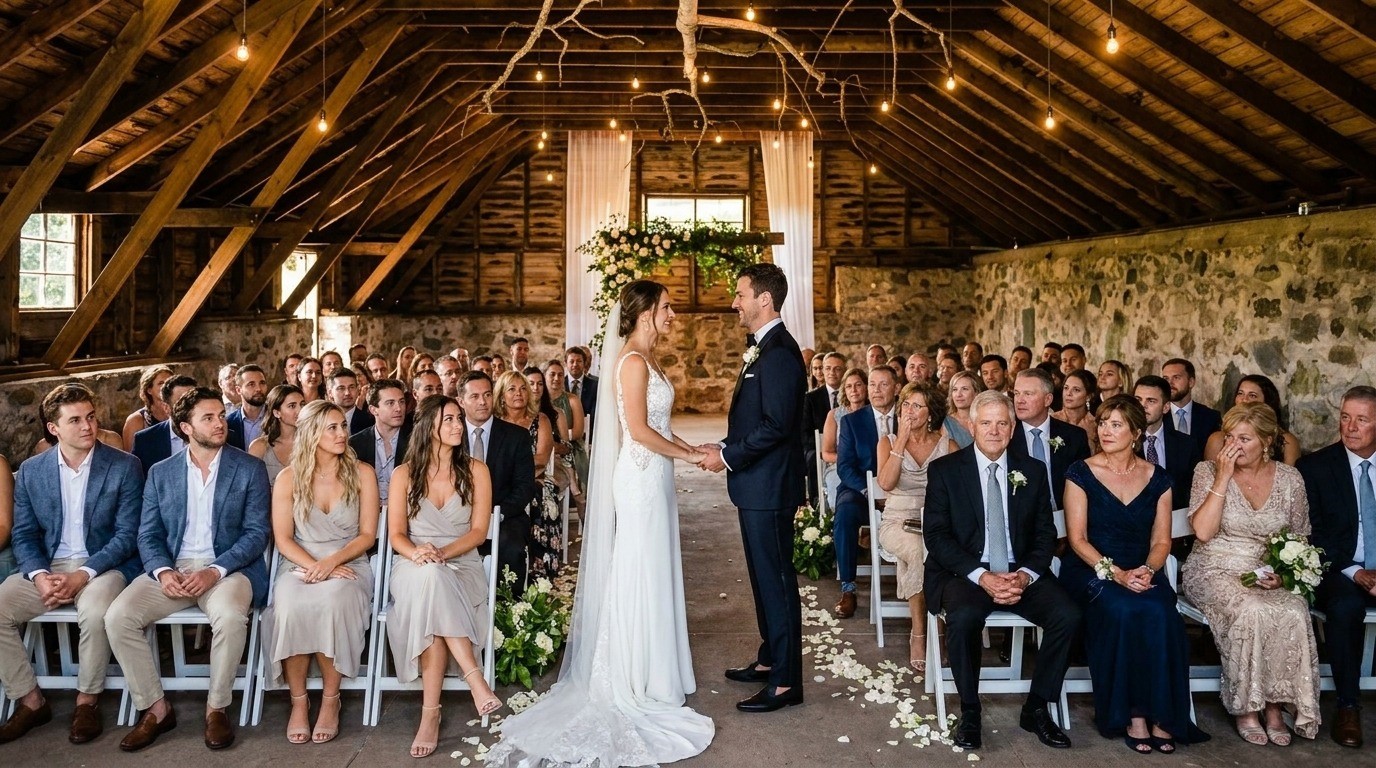
A fourth-generation working cattle farm where the White Barn is on the State Registry of Historic Buildings and the beef on your plate was raised on the property.
Morris is deep in the Litchfield Hills — Connecticut’s quietest, most rural corner, the part of the state that looks like Vermont forgot its borders. South Farms has been in the Paletsky family for over 160 years, and it’s still a working cattle operation producing grass-fed beef. That’s not a historical footnote. That beef is often what’s served at your reception dinner. Farm-to-table is an overused phrase, but when the farm and the table are literally the same address, the term earns its keep.
The White Barn is the centerpiece: 20,000 square feet of event space with corrugated tin ceilings, reclaimed wood walls, and designer chandeliers that split the difference between rustic and refined. It’s listed on the State Registry of Historic Buildings and is a featured stop on the Connecticut Historic Barn Trail. The original “Sam Paletsky” signage is still intact — the preservation effort that converted this from a working dairy barn to an event space in 2015 won an AIA Design Award for Historic Preservation, and you can see why. Nothing was stripped. Nothing was replaced with a shinier version. They just made the existing structure safe, comfortable, and beautiful for guests while keeping the bones honest.
Indoor capacity is 150 seated, with larger groups possible through adjacent tenting on the property. The Stone Barn and Hayloft offer additional spaces for cocktails and smaller gatherings. And unlike many barn venues that close up for winter, South Farms is fully heated and air-conditioned — a rarity in this category that extends the wedding season well beyond the typical May-through-October window.
Capacity: Up to 150 seated indoors; larger groups via adjacent tenting Spaces: White Barn (reception), Stone Barn, Hayloft, outdoor ceremony areas Price Range: Venue rental $5,000–$12,500; total spend ~$35,000–$50,000; catering ~$150/pp; bar ~$50/pp Peak Season: October (heart of the Litchfield Hills foliage belt) Best For: Architecture lovers who want a luxury farm experience with genuine provenance Pet-Friendly: Yes — dogs allowed for ceremonies and outdoor cocktails
Acoustically, the corrugated tin ceiling in the White Barn is the variable to plan around. Tin reflects sound more than wood, which means you need to think about speaker placement carefully to avoid harsh reflections during amplified sets. The good news: the reclaimed wood walls absorb a lot of that bounce, and the designer chandeliers break up the ceiling plane enough to scatter reflections. At 150-person capacity, the room is intimate enough that you don’t need to push volume to fill it — and that’s where a hybrid setup really shines. Live instruments at moderate volume sound gorgeous in this space. The DJ component handles the dynamic range when the dance floor heats up. The multi-space layout (White Barn, Stone Barn, Hayloft) lets you design a progression through the evening — cocktails in the Stone Barn, dinner under the tin ceiling, dancing in the main space — that keeps guests moving and keeps the energy fresh.
The “Sam Paletsky” signage might be the most photographed detail at any barn wedding venue in Connecticut. It’s original — not a reproduction, not a prop — and it connects the venue directly to the family that’s worked this land since the 1860s. The current owner’s transformation of a working dairy barn into a preservation-award-winning event space was less a renovation than a careful act of translation: same structure, same materials, same identity, just a new purpose. South Farms is the most photographed landmark in Morris, and when you see the White Barn in October with the Litchfield Hills burning red and gold behind it, you understand why.
Official website: https://www.southfarms.org/
How to Choose Between These Venues
If your guest list runs past 200, The Barns at Wesleyan Hills and The Lace Factory both seat 225 with all-inclusive catering that takes vendor coordination off your plate. If budget matters most, Wrights Mill Farm is the value leader — packages from $85 per person, plus a 10% winter discount.
If you want industrial edge over barn warmth, the Lace Factory is your only pick on this list — exposed brick, factory floors, and the steam train. Everything else leans pastoral. If intimate matters more than grand, South Farms at 150 seated is the smallest of the group, and deep in the Litchfield Hills, your guests are truly away from everything.
Fall weddings: all five are strong, but South Farms sits at the epicenter of the Litchfield Hills foliage belt — the best October color in the state. The Lace Factory pairs peak foliage with the Essex Steam Train ride, which is its own level of spectacle.
On-site lodging matters more than couples expect. Wrights Mill Farm’s 8-bedroom guest house and the Pavilion’s Lake Cottage give your closest people a place on the property. The other three venues rely on nearby hotels, which in Middletown and Deep River means options within a short drive.
Why Entertainment Matters More Than You Think at Rustic Barn Venues
Barn acoustics are fundamentally different from hotel acoustics. Timber-frame construction absorbs and diffuses sound instead of reflecting it back at the audience. Live music — actual instruments, actual voices — sounds natural in these spaces because the room is amplifying warmth rather than creating harshness. A generic playlist through rental speakers will fill the space, sure. But you’ll be leaving most of the room’s acoustic potential on the table.
Then there’s the practical side. Historic barns have specific power supply constraints — you can’t plug in a full concert rig and assume the circuits will hold. Some venues have noise curfews (the Lace Factory’s 10 PM stop is the strictest in this group). Some restrict where you can place equipment to protect original floors. These aren’t problems — they’re variables an experienced entertainment team plans around. An inexperienced one discovers them at load-in.
The multi-space flow at venues like Wesleyan Hills, South Farms, and Wrights Mill Farm demands entertainment that adapts. You’re not playing one room all night. You’re scoring a journey — ceremony in a field, cocktails in a stone barn, dinner and dancing in the main space. Each transition shifts the energy. That takes planning, and musicians who can read the room in real time.
Why DLE Event Group
At rustic barn wedding venues in Connecticut, that calibration matters more than at most venue types. Every barn sounds different. The Barns at Wesleyan Hills, with its post-and-beam ceiling, absorbs mid-range frequencies beautifully — ideal for vocals and acoustic instruments. South Farms’ corrugated tin ceiling requires a different approach: careful speaker angles, strategic volume management, leaning into the live instruments during dinner when the room rewards subtlety. We’ve spent over a decade learning these distinctions at venues across the Northeast, and that knowledge is baked into every pre-event planning session.
The planning process itself is a differentiator. Starting roughly six months before your wedding, we run 5 to 10 Zoom sessions to build out every musical moment — custom song learning, tailored edits for your first dance, pronunciation guides for your MC introductions, timeline coordination with your venue’s specific requirements. For a venue with a hard curfew like the Lace Factory, that timeline work is especially critical. Every transition, every song choice, every energy shift is mapped with intention.
DLE Event Group has earned The Knot Best of Weddings Hall of Fame 11 times (2013–2023) and performed 100+ events at premier venues across New York, the tri-state area, and beyond. Our service area extends well into Connecticut. We bring backup equipment to every event — duplicates of everything critical — because at venues where the architecture is irreplaceable, so is the moment.
Frequently Asked Questions
Ready to Talk About Your Connecticut Barn Wedding?
If you’re planning a wedding at any of these venues — or still narrowing down your list — we’d welcome the conversation. DLE Event Group’s hybrid DJ band experience is built for spaces like these, and we’d love to help you figure out what the music should feel like in the room you choose.
QUESTIONNAIRE
Need Assistance? Directly reach us at contact@dleeventgroup.com or 877.534.2424