Live Music Proposal Ideas: 6 Ways to Propose With a Band

I’ve cued a lot of “big moments” from behind a sound desk. First dances, surprise parent songs, the occasional flash-mob that the couple swore would stay secret and absolutely did not. But the one that still gets me is the proposal — because there’s no second take. The ring comes out once. The song has to land on the first downbeat, every time.
Here’s a number worth sitting with: in The Knot’s most recent proposal study, 83% of people said their proposal still felt like a surprise — and yet only about 5% of couples brought in a musician, a videographer, or a planner to pull it off. Live music at a proposal is rare. That’s exactly why it works. When a real band starts playing “your song” in a room your partner thought was just a normal Tuesday, the floor drops out from under them in the best way.
Here are six live music proposal ideas that actually deliver — setups I’ve either staged, scored, or watched go right (and occasionally watched go sideways). For each one I’ll give you the concept, the moment, the part nobody tells you about, and a ballpark on what the music costs. Because a proposal with a live band is only magic if the logistics are boring and bulletproof.

First, Why a Band Beats a Bluetooth Speaker

A phone playlist says “I planned this.” A live band says “I planned this for you, and I hired humans to feel it with us.”
Live music does something to a room that recordings can’t fake. You feel the bass in your chest. The singer makes eye contact. The tempo can stretch — a good band will slow “your song” down to a crawl as you drop to one knee, then swell back up the second your partner says yes. We call that pacing the moment, and you cannot do it with a Spotify queue.
It’s also the rarest move on the table. Most people do the scenic-overlook-and-a-speaker version. Roughly a third of proposals (34%, per The Knot) happen at a “scenic” spot — the lookout, the rooftop, the beach. Beautiful, but crowded as a category. Add real musicians and you’ve made something almost nobody in your partner’s feed has seen.
One honest caveat before we start: live music is the emotional engine of these ideas, not the whole machine. You still need a ring, a location, ideally a photographer hiding behind a planter, and a plan for what happens after the yes. The band is the half that makes the other half unforgettable.

1. The Secret Show (The Fake Album Launch)

Best for: music-obsessed couples, total-surprise lovers, anyone who’d say “we don’t do clichés.”

The concept: you invite your partner to an “exclusive listening party” for an up-and-coming band — a private set in a recording studio, an industrial loft, or a small gallery. They think they’re there as a music fan. They’re actually the only audience that matters.
The moment: the band plays two or three originals to sell the ruse. Then the singer stops mid-set. “We’ve got one special request tonight, for someone really important.” The lights find you, the band slides into an acoustic version of your song, and your partner realizes — slowly, then all at once — that the entire “show” was built around them.

The part nobody tells you: the ruse lives or dies on the venue feeling real. Hire a band that can genuinely play their own material for ten minutes, not just your one song. And brief them on a hard cue — a phrase or a hand signal — so the pivot from “concert” to “proposal” is instant. The whole effect is the gear-change.

Ballpark: a jazz or pop combo that can carry a short original set runs roughly $1,000–$3,500 in a major city, more for a polished four-or-five-piece. Add a small PA and a custom arrangement of your song.

2. The Roaming Band in the Park (Parisian Style)

Best for: outdoorsy couples, walk-and-talk romantics, daytime proposers.
The concept: you’re strolling through a park or along a pier and you “happen upon” an acoustic trio — guitar, light percussion, maybe a sax — apparently busking for whoever wanders by.
The moment: as you get close, they don’t stay put. They fall into step behind you, playing, and as the song builds they curl around into a half-circle and close you both into a little bubble of sound in the middle of a public space. Strangers stop. Phones come up. You’re suddenly the scene everyone else wishes they’d stumbled into.

The part nobody tells you — and in NYC this is the whole ballgame: keep it acoustic and keep it small. In Central Park, an unamplified group under 20 people generally needs no permit, as long as you’re not in a designated quiet zone (Strawberry Fields, Sheep Meadow, the upper Bethesda Terrace) and you’re not blocking paths. The second you add a microphone, an amp, or a Bluetooth speaker, you’ve crossed into NYPD Sound Device Permit territory (apply in person at the precinct, ~$45, at least five days ahead). A roaming acoustic trio sidesteps all of it. (Rules shift — confirm with NYC Parks before the date.)

Ballpark: a strolling acoustic duo or trio for a short, focused set is roughly $175–$1,000 depending on the players and the city.

3. The Second-Line Parade (New Orleans Energy)

Best for: extroverts, big personalities, couples who want the proposal to become the party.
The concept: straight out of New Orleans tradition — a full brass band, horns and percussion, the works.
The moment: you propose somewhere intimate, your partner says yes, and then the band comes blasting around the corner. Suddenly you’re leading a mini-parade down the block, parasols up, strangers clapping, the city itself folded into your engagement. It’s impossible to keep a straight face. That’s the point.

The part nobody tells you: this one is loud and mobile, which means in a public street you’re squarely in permit land — amplified-adjacent volume, a moving group, sometimes a street closure. New Orleans has a formal process for this (via nola.gov). In NYC, a brass second-line on a public street needs real coordination, so a lot of couples run it inside a private courtyard, a venue, or a rooftop they’ve booked, where the band can be as loud as the room allows. Also: brass bands are 6 to 10+ people. The size scales the cost fast.

Ballpark: a short 15–30 minute street/parade set is roughly $500–$1,500; a full multi-hour booking climbs to $2,000–$3,000 and up.

The real one: this isn’t theoretical. A guy named Radek planned a second-line proposal in the French Quarter from over 4,000 miles away in England — proposed, and a five-piece brass band rolled in on cue, leading the brand-new couple down the street to Café du Monde. Documented by Lady Walker Photography. If he can run that across an ocean and a six-hour time difference, you can run it across town.

4. The Candlelit Rooftop String Quartet

Best for: classic romantics, golden-hour planners, the photo-and-video crowd.
The concept: a private rooftop, a few hundred candles, flowers, and a string quartet (or a jazz quintet) already in position when the doors open.
The moment: you walk your partner up under some excuse — “the bar’s up here,” “the view’s better from the roof.” The doors open, the strings begin a lush, “Bridgerton”-style arrangement of a song that’s actually modern and actually yours, and the city skyline does the rest. Visually, nothing else on this list photographs like it.

What the rooftop won’t tell you: it fights you on two fronts — wind and cold. Wind eats string sound and flips sheet music; cold detunes instruments and stiffens players’ hands. Brief your quartet, give them a sheltered corner and music clips, and don’t make them wait outside for 40 minutes before you arrive. And confirm your “private” rooftop is genuinely private and licensed for it — a surprise rooftop with strangers in it isn’t a surprise.

Ballpark: a string quartet for a focused ceremony-length set runs roughly $600–$1,500, with premium NYC groups higher. A jazz quintet sits closer to $2,000–$4,000.

5. The Singing Waiters Takeover

Best for: theater kids at heart, restaurant-proposal couples, anyone who loves a plot twist.
The concept: a normal dinner at a nice restaurant. The “staff” are actually professional singers. Somewhere between the entrée and dessert, a waiter stages a little mishap — a dropped tray, a mock argument — and then breaks into song. One by one, other “servers” join, pulling instruments from behind the bar.
The moment: the restaurant flips from awkward to electric in about four seconds, the song crescendos, and you’re already moving toward one knee while your partner is still processing that the busboy has a Broadway belt.

The part nobody tells you: this needs the restaurant in on it weeks ahead — staffing, timing, a hidden mic rig, a sound engineer riding levels so the “surprise” isn’t a muddy mess. The slick versions (2–4 trained vocalists, choreography, real sound production) are a genuine production. A clever trick from the pros: plant the cue on the menu — a dessert named after your song — so your partner unknowingly triggers the whole thing by ordering it.

Ballpark: a single surprise singer can be a few hundred dollars; a full multi-singer, choreographed, properly-mic’d show runs roughly $1,500–$3,500+.

6. The Waterfront Serenade (The Boat Arrival)

Best for: waterfront cities, sunset-timers, couples near a lake, river, or harbor.
The concept: you’re on a pier, a bridge, or the shore. A small boat drifts in carrying a band playing warm, acoustic, folk-leaning music that rolls across the water toward you.
The moment: sound travels strangely and beautifully over open water — it arrives soft, then full, like the song is finding you on purpose. The boat, the reflection, the band: it’s a cinematographer’s dream and it photographs like a film still.

The thing that catches people: water and electronics are enemies. Keep the instruments acoustic and the boat steady, and mind the wind off the water (same enemy as the rooftop). One NYC-specific landmine: Brooklyn Bridge Park, gorgeous as it is, bans amplified sound entirely and bans decorations — no confetti, no petals, real or fake. So the boat-with-acoustic-band works there; the boat-with-a-PA-and-rose-petals doesn’t. Pick your waterfront with the rulebook open.

Ballpark: a small acoustic folk band for a short waterside set runs roughly $500–$2,000, plus whatever the boat costs.

The Logistics That Make or Break It

Six pretty ideas, and every one of them lives or dies on the unglamorous stuff. Here’s what I drill into every couple:

Nail the cue. Pick one unmistakable signal — a spoken phrase, a hand on the back, a specific word — and rehearse it with the band. The number one way these go wrong is the band starting too early or too late. Your “yes” and the song’s swell should hit together.

Mic the band, or mic nothing. If you’ve got a videographer (and you should — this is the rare thing you’ll rewatch for 50 years), get a direct feed from the band’s mixer or a lav on the singer. The sound of the live music is half the memory. Phone audio of a great live moment is heartbreakingly bad.

Acoustic vs. amplified is a legal decision, not just a taste one. In NYC public space, acoustic-and-small keeps you permit-free in most parks; the moment you amplify, you need an NYPD sound permit, and some spots (Brooklyn Bridge Park, Central Park’s quiet zones) won’t allow amplification at all. When in doubt, go acoustic — it’s more intimate anyway.

Book early. Good musicians get reserved, especially May through October and on Saturdays. Give a band three-plus weeks minimum; for a custom song arrangement or a multi-piece group, more. Last-minute is how you end up with a guy and a karaoke track.

Personalize the song. Most pros will happily rework a lyric to slip in your partner’s name or an inside reference. It’s the detail that makes people cry. (For the record: 57% of people cry at their proposal even without the customized lyric. Stack the deck.)

Budget the tip. Live musicians are tipped 15–20% of the contract, same as any vendor. Build it in.

What It Actually Costs

Let me give it to you straight, because proposal budgets are real. Here’s the directional range for the music alone — not the ring, the dinner, the boat, or the photographer.
EnsembleRough range (USA, 2026)
Solo guitarist / singer$200–$1,000
String quartet$600–$2,500
Jazz trio$1,000–$3,500
Jazz quintet$2,000–$6,000
New Orleans brass / second-line$500–$3,000+ (parade vs. full set)
Roaming acoustic band$175–$2,000
Singing waitersa few hundred (solo) to $3,500+ (full show)

Three things move these numbers: city (NYC, LA, Chicago, and Miami run 20–50% above small-market rates), season and day (peak months and Saturdays cost more), and travel (anything past a 25–50 mile radius adds a surcharge). For perspective on where this sits in the whole picture — the average engagement ring ran about $5,200 in the most recent The Knot data. A live band for the proposal is often a fraction of that, for arguably the most replayed thirty seconds of the entire engagement.

Where DLE Event Group Fits In

Worth being clear about what we do and don’t do here. We’re not a proposal-planning agency — we won’t book your restaurant or hide your ring. What we are is the live-music engine behind the moment, and for these six ideas, that’s the half that’s hardest to get right.
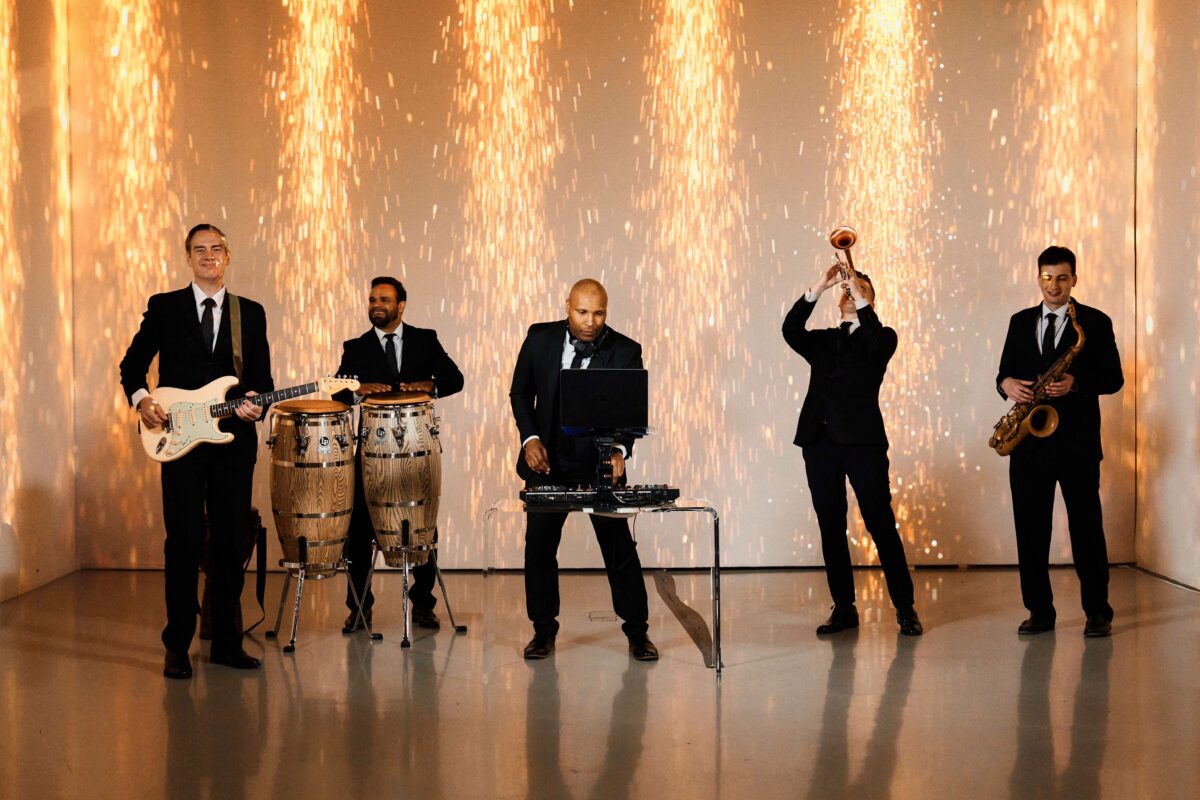
DLE Event Group has spent over a decade as NYC’s hybrid live-band-and-DJ specialists — 100+ events, eleven straight years in The Knot’s Best of Weddings Hall of Fame. Our musicians aren’t a pickup group; many of them play premier NYC rooms every week, which matters more than it sounds. A proposal serenade has zero margin for error, and seasoned players don’t flinch when a cue lands two minutes late because your partner stopped to tie a shoe.
The practical fit: we scale from a solo guitarist to a string trio (violin, viola, cello), a sax-guitar-percussion combo, a jazz group, on up to a full orchestra. Our players learn custom songs — your song, in your arrangement, with your partner’s name woven in if you want it. We bring our own best-in-class sound and duplicate backup gear, because “the mic died during the proposal” is not a sentence anyone should ever say. And after a decade in these rooms, we know how a given space behaves — where sound dies, where it soars, where the band should stand so the strings carry over the wind.
Every couple, every tradition — we work with all of them, full stop. If you’re staging the proposal as the overture to the wedding we’re already booked for, even better — we’ll thread the same song through both.
Packages start at $5,995. Travel fees apply for out-of-region events. Every quote is custom because every wedding is.

FAQs

For the music alone, plan on roughly $200 for a solo guitarist up to $3,500+ for a full brass band or a choreographed singing-waiters show, with string quartets around $600–$2,500 and jazz groups $1,000–$4,000. Major cities run 20–50% higher, peak season and Saturdays cost more, and you tip musicians 15–20% on top.
Three weeks is a bare minimum. If you want a custom song arrangement, a larger ensemble, or a date in peak season (May–October) or on a Saturday, give them a month or two. Booking early also means your first-choice players, not whoever’s left.
If it’s a small acoustic group (under 20 people, no amplification) in most Central Park areas, generally no — but stay out of quiet zones like Strawberry Fields and don’t block paths. The moment you add a speaker, mic, or amp, you need an NYPD Sound Device Permit (~$45, apply in person ≥5 days ahead). Brooklyn Bridge Park bans amplified sound entirely. Rules change, so confirm with NYC Parks before your date.
For a proposal, acoustic is usually the better call: it’s more intimate, it photographs cleaner, and in NYC public spaces it keeps you out of permit trouble. Go amplified only when the space is private (a booked rooftop, a courtyard, a venue) and the band genuinely needs the volume, like a full brass second-line.
“Your song” — the one with a story attached. Then let the band arrange it for their instruments and, if you like, rewrite a lyric to include your partner’s name or a private reference. The familiarity is what lands the emotional punch; the personalization is what makes people cry.
Yes, and have them get a clean audio feed from the band’s mixer. A proposal with live music is one of the few moments you’ll genuinely rewatch for decades, and phone audio of live performance is famously bad. The sound is half the memory.

Let's Make the Music Unforgettable

You get one take at this. The ring, the location, the timing — that’s yours to plan. The live music that turns it from “a proposal” into the proposal — that’s where we live.
Tell us which of these six you’re imagining and we’ll build the sound around it: the right ensemble, your song arranged the way it should be, and players who’ve performed the highest-stakes moments more times than they can count.

Call us at 877-534-2424 or email contact@dleeventgroup.com. DLE Event Group — 404 5th Avenue, 3rd Floor, New York, NY 10018.

QUESTIONNAIRE

Need Assistance? Directly reach us at contact@dleeventgroup.com or 877.534.2424

The 30 Best Places to Propose in NYC

You learn to spot the signs after a while. The guy who keeps patting his coat pocket. The woman who picked this exact rooftop “for no reason.” I’ve spent more than a decade playing the rooms where New York couples get married — and a fair number of the ones where they got engaged first — and I’ve watched a proposal go off behind Bethesda Terrace while we were loading in for a reception, then watched another nearly capsize because the couple’s perfect spot turned out to be packed with a tour group at golden hour.
So here’s what nobody tells you about the best places to propose in NYC: the view is the easy part. This city hands you a hundred gorgeous backdrops. What separates a proposal that lands from one that merely photographs well is the planning underneath it — the timing, the crowds, the permit you didn’t know you needed, and the moment itself.
A quick reality check before the list. Per The Knot, only about 30% of proposals are a complete surprise — 53% of people already know it’s coming, they just don’t know when or where. So the when and the where are the levers you actually control. Choose them well and you turn a question they half-saw coming into a scene that still knocks them flat. (And about a quarter of proposers now hire a photographer to catch it, The Knot found — which means picking a spot that holds up on camera matters more than it used to.)
I’ve sorted 30 of the best places to propose in NYC into four kinds of moment — gardens, water, sky, and table — across all five boroughs. For each one: where it is, why it works, and the practical catch that keeps it from going sideways.

Parks & Gardens

The classic move, and for good reason — green space gives you privacy, soft light, and a backdrop that shifts with the season. Most cost nothing. The catch is almost always the same one: crowds, and, if you’re bringing a pro photographer, permits.

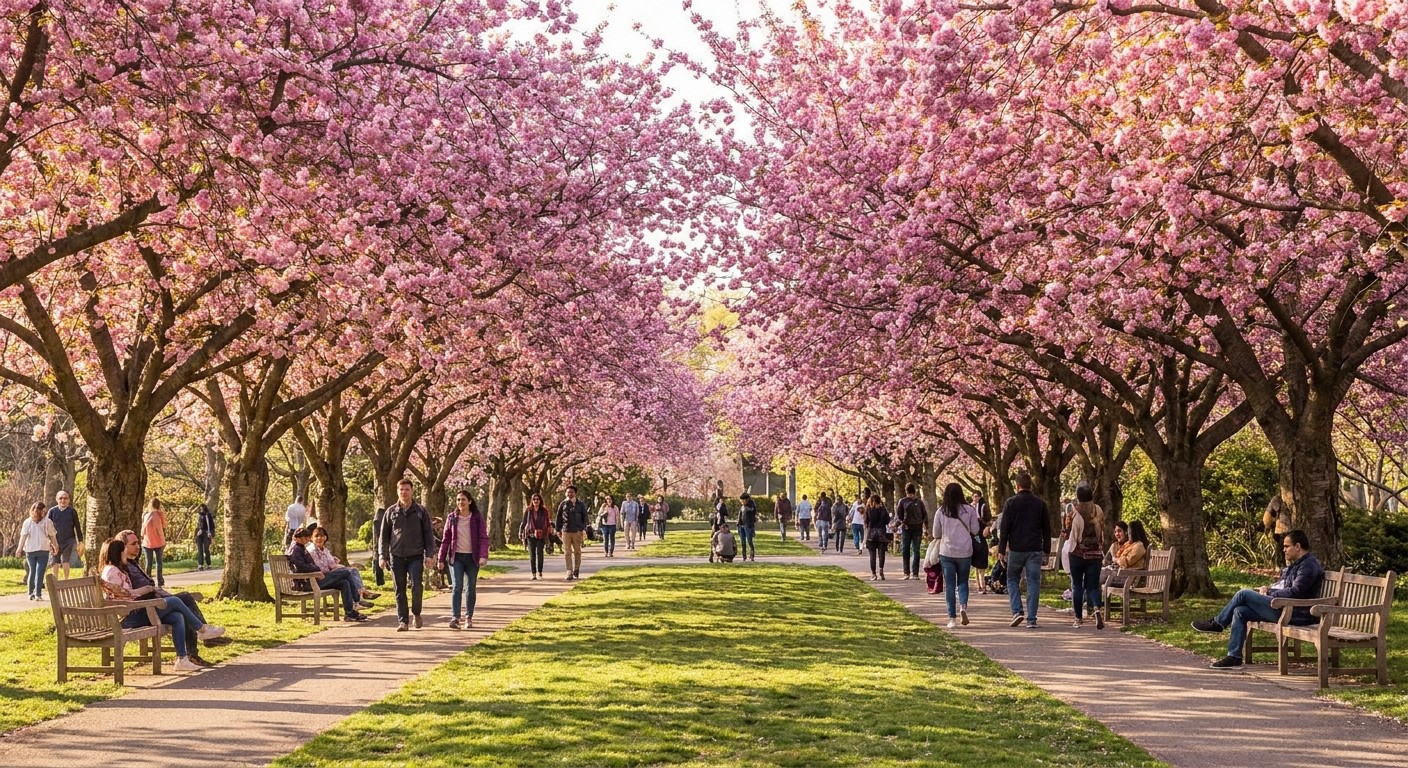
Bow Bridge — Central Park, Manhattan

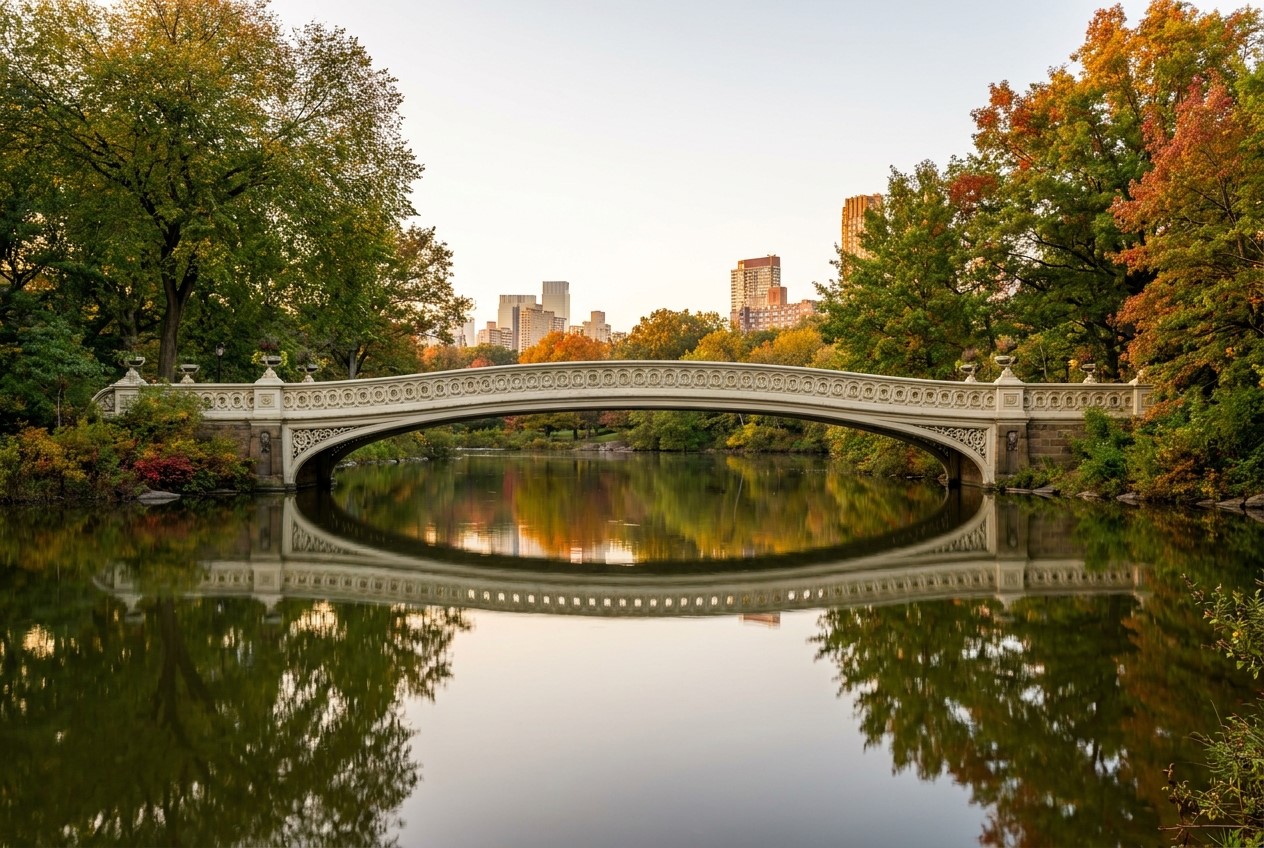
This is the NYC proposal, the one you’ve seen in a dozen movies — the Victorian cast-iron span throwing a clean reflection across the lake, Midtown stacked behind it. The bridge is narrow enough that for ten seconds it can feel like the two of you have the whole park to yourselves. It’s free and needs no permit for a quiet just-the-couple moment, but come at sunrise or you’ll be sharing the rail with thirty tourists — and honestly, the early light is the prettiest anyway.

Bethesda Terrace & Fountain — Central Park, Manhattan

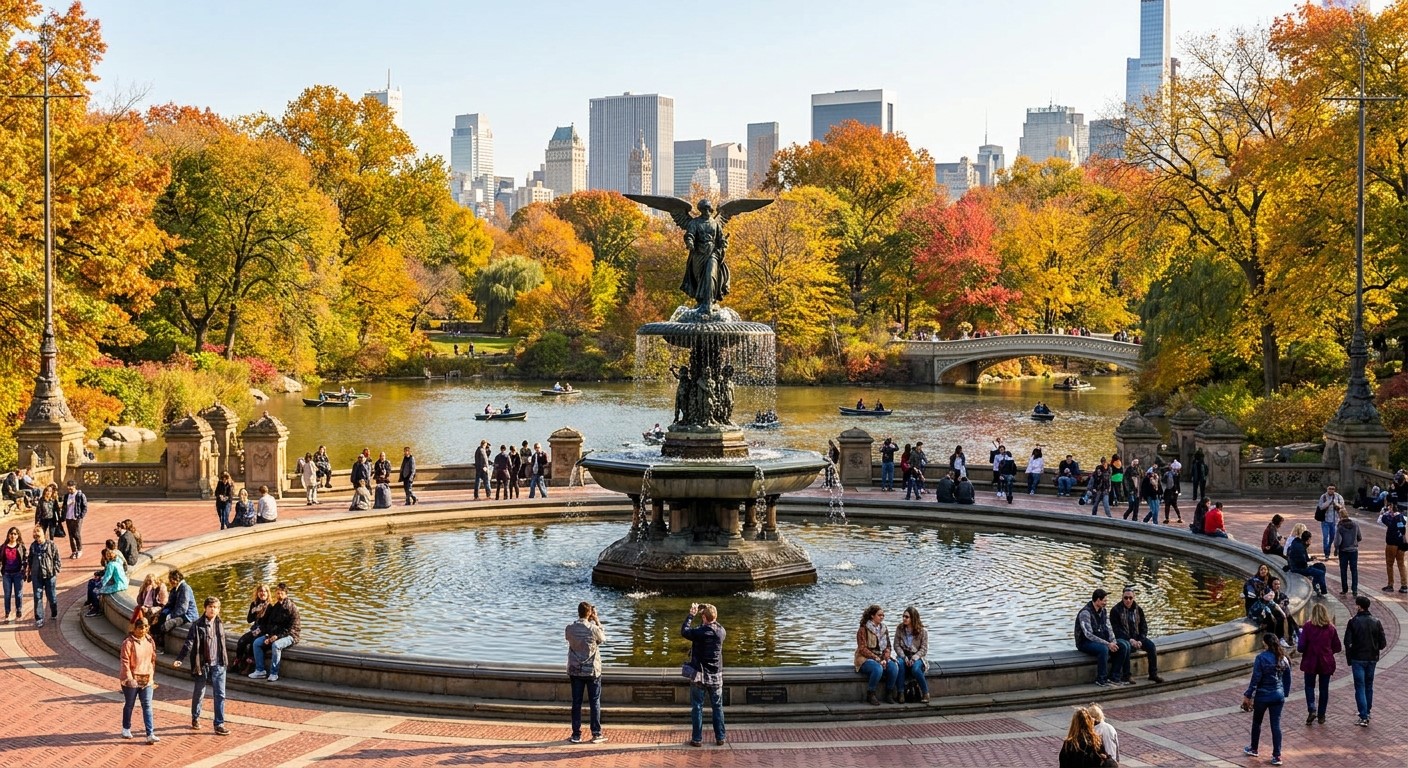
Walk a few minutes south and the scene turns grander and more theatrical: the neoclassical arcade, the tiled ceiling underneath, the angel fountain on the lake. I’ve heard string players test the acoustics under that lower passage, and it’s genuinely lovely — the architecture does so much of the work that you barely need props. Free, like Bow Bridge, but go early; by midday the performers and crowds take it over, and weekends are the worst of it.

Conservatory Garden — Central Park, Manhattan

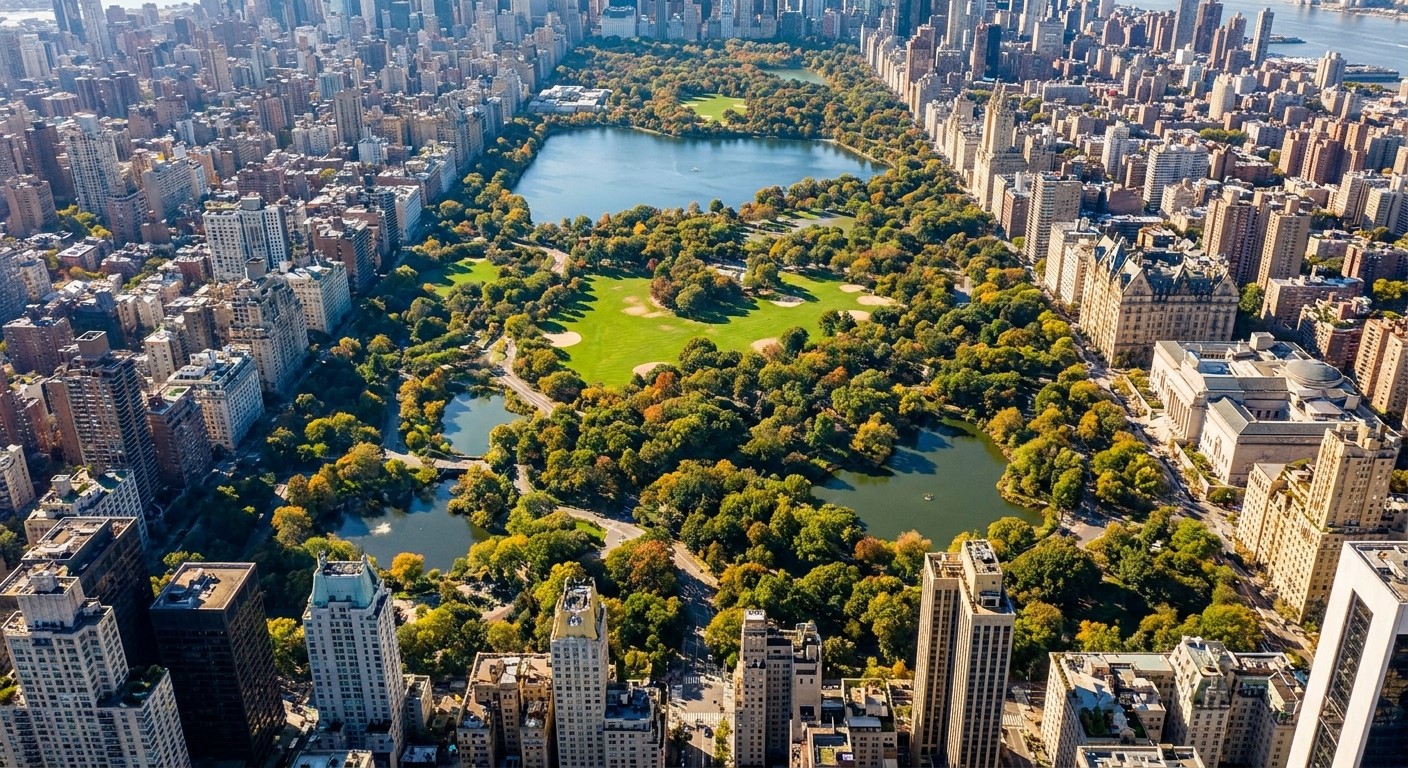
Up at 105th Street hides the quietest corner of the whole park — Central Park’s formal six-acre garden, all manicured hedges, fountains, and seasonal blooms, with almost no foot traffic. It feels like a secret, which is rare for Central Park. Walking it is free, but this garden runs by stricter rules: NYC Parks requires a permit for organized gatherings and any professional engagement photography here regardless of group size, so keep it intimate or arrange the shoot in advance.

Brooklyn Botanic Garden — Prospect Heights, Brooklyn

Cherry-blossom canopy in spring, the Cranford Rose Garden in June, fiery foliage in fall — Brooklyn Botanic hands you a different fairytale every season, and few places in the city photograph like it in bloom. Now the real numbers, straight from the Garden: a casual proposal with your phone or a consumer camera needs no permit, just admission. Bring a professional photographer, though, and BBG requires a photo-session permit that runs $366 for up to 25 people, lasts 60 minutes, comes with a security-guard escort, and has to be booked at least 14 business days ahead — with equipment capped at one camera and one tripod, and no props, lighting, or drones. This one’s a plan-ahead, not a walk-up.

Queens Botanical Garden — Flushing, Queens

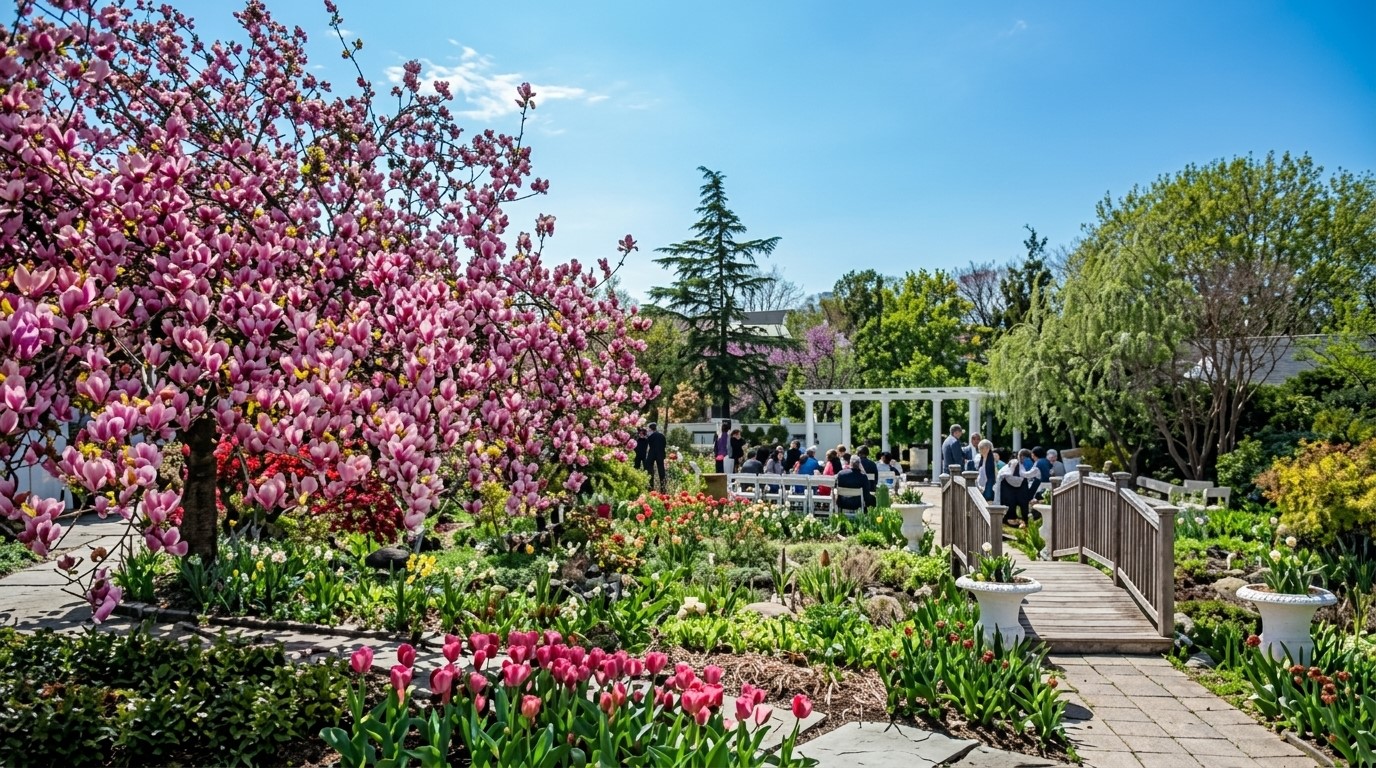
Flushing’s botanical garden is the one most New Yorkers forget exists — smaller than its Brooklyn and Bronx cousins, far less trafficked, with a dedicated wedding garden tucked inside. That’s exactly the appeal: intimacy without a crowd, and no fighting anyone for the good spot. Admission’s cheap, weekday mornings run nearly empty, and you’ll want to confirm photo rules with the garden if a shooter’s coming along.

New York Botanical Garden — Bronx Park, The Bronx

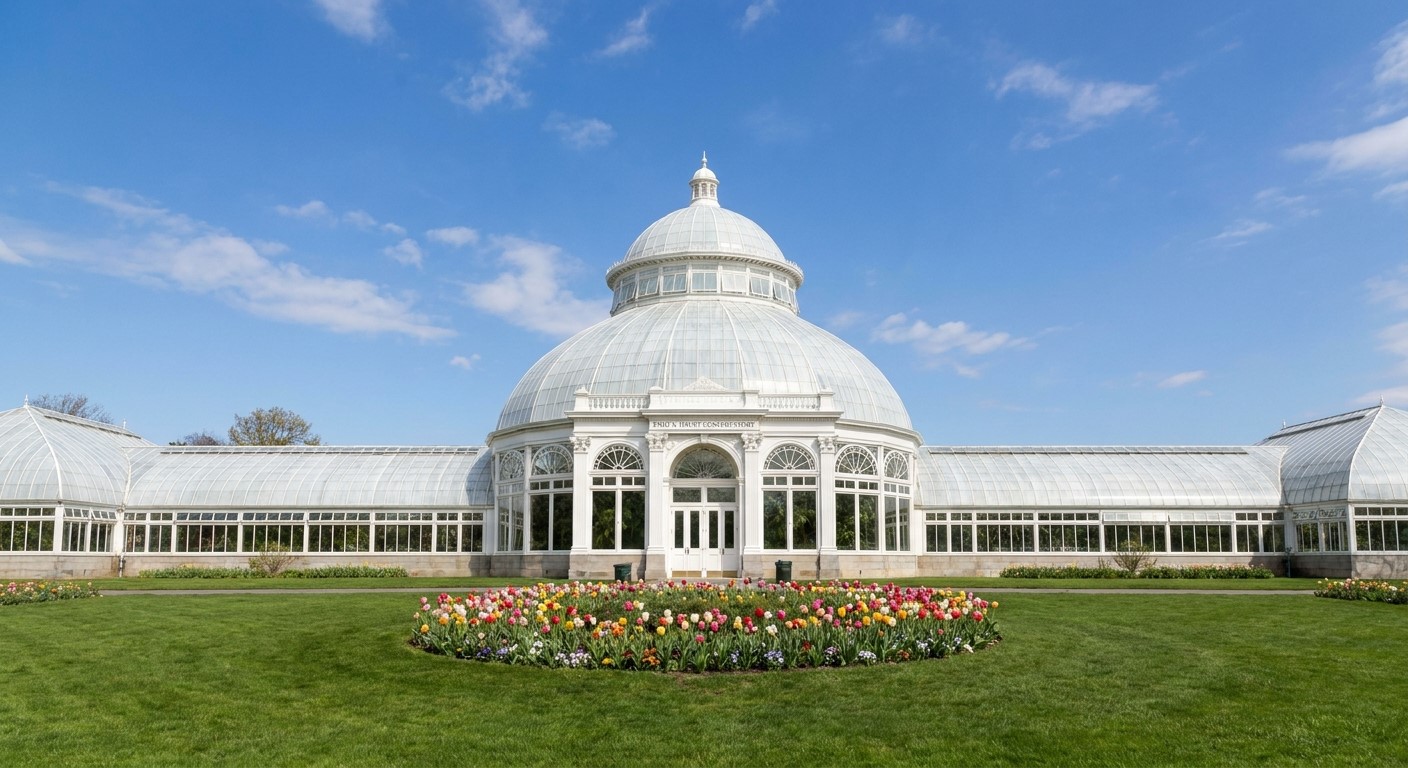
Up in the Bronx, 250 acres unfurl around the landmark Haupt Conservatory glasshouse and the Peggy Rockefeller Rose Garden — grander and wilder than the Brooklyn version. That Victorian glasshouse is a backdrop you simply won’t find anywhere else in the city. Entry’s ticketed; the conservatory and rose garden are the money spots, so aim for a weekday and check the photography policy before you book a pro.

New York Chinese Scholar's Garden — Snug Harbor, Staten Island

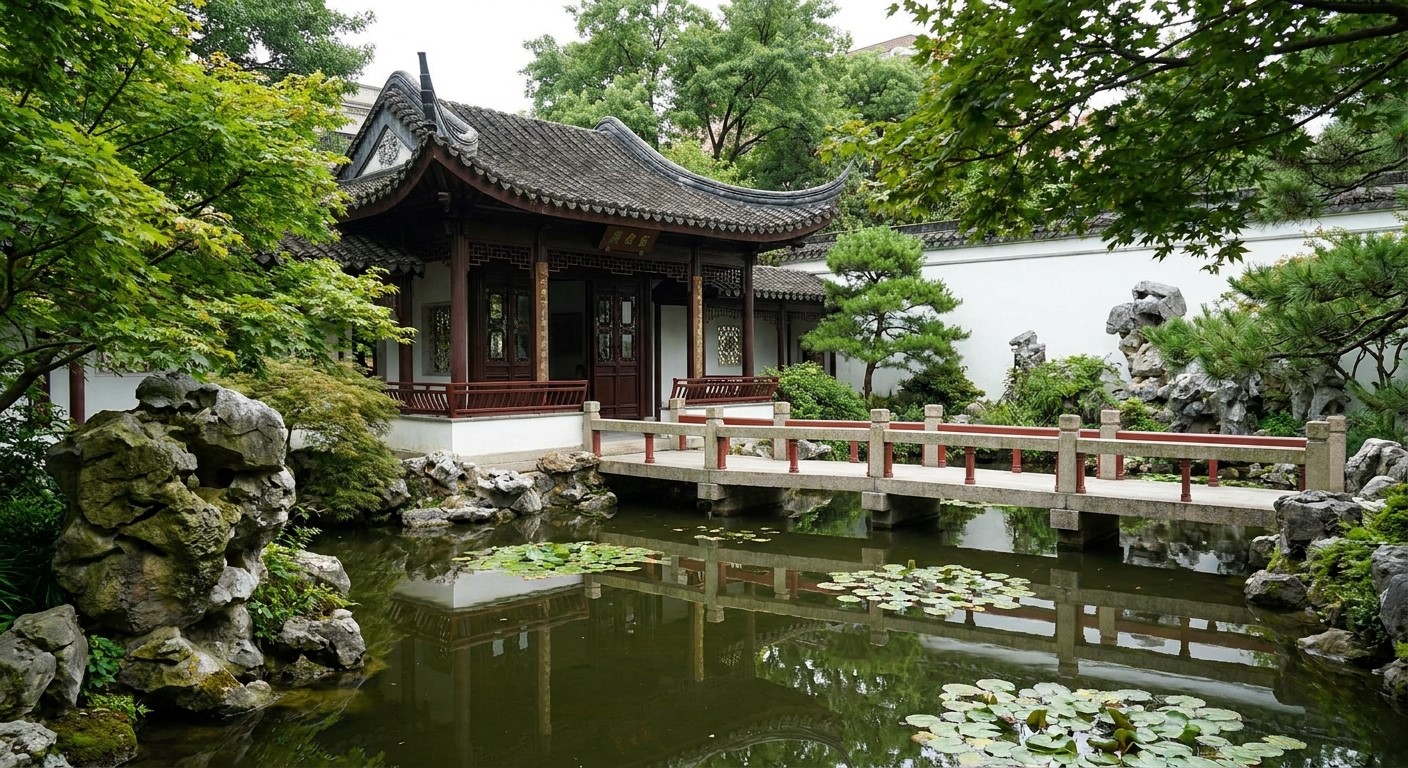
Ten minutes from the ferry terminal, hidden inside the Snug Harbor cultural center, sits a walled Ming Dynasty-style garden — pavilions, a koi pond, stone bridges, the works. Most New Yorkers have no idea it’s there, which makes stepping in feel like a complete change of world. It’s ticketed and quiet most days, and the enclosed courtyards hand you a kind of privacy no open park can.

Wave Hill — Riverdale, The Bronx

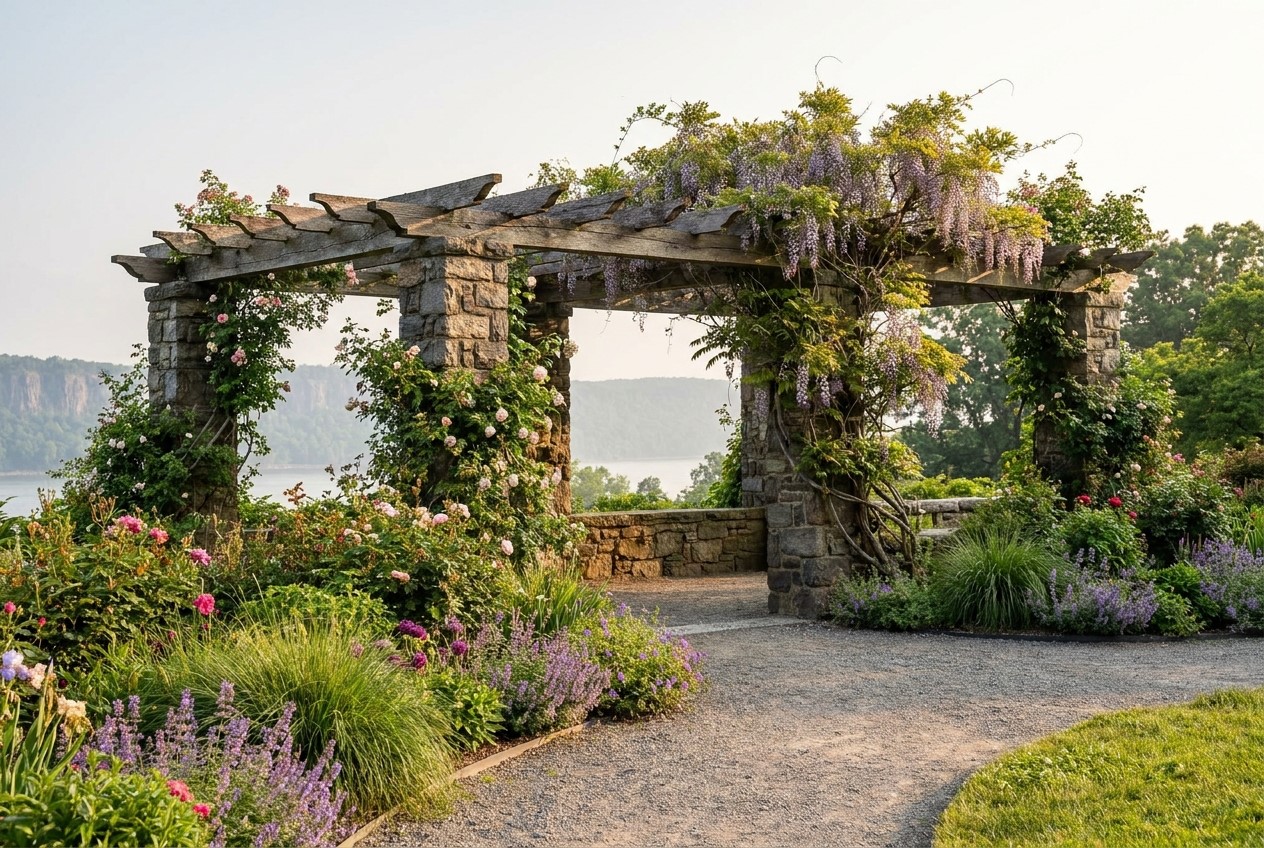
Perched on a Bronx bluff above the Hudson, Wave Hill frames the river and the Palisades cliffs through a stone pergola that practically composes the photo for you. Go late afternoon, when the light comes low across the water and everything goes gold. It’s ticketed, and the hours shift by season, so check before you commit to a date.

Jefferson Market Garden — Greenwich Village, Manhattan

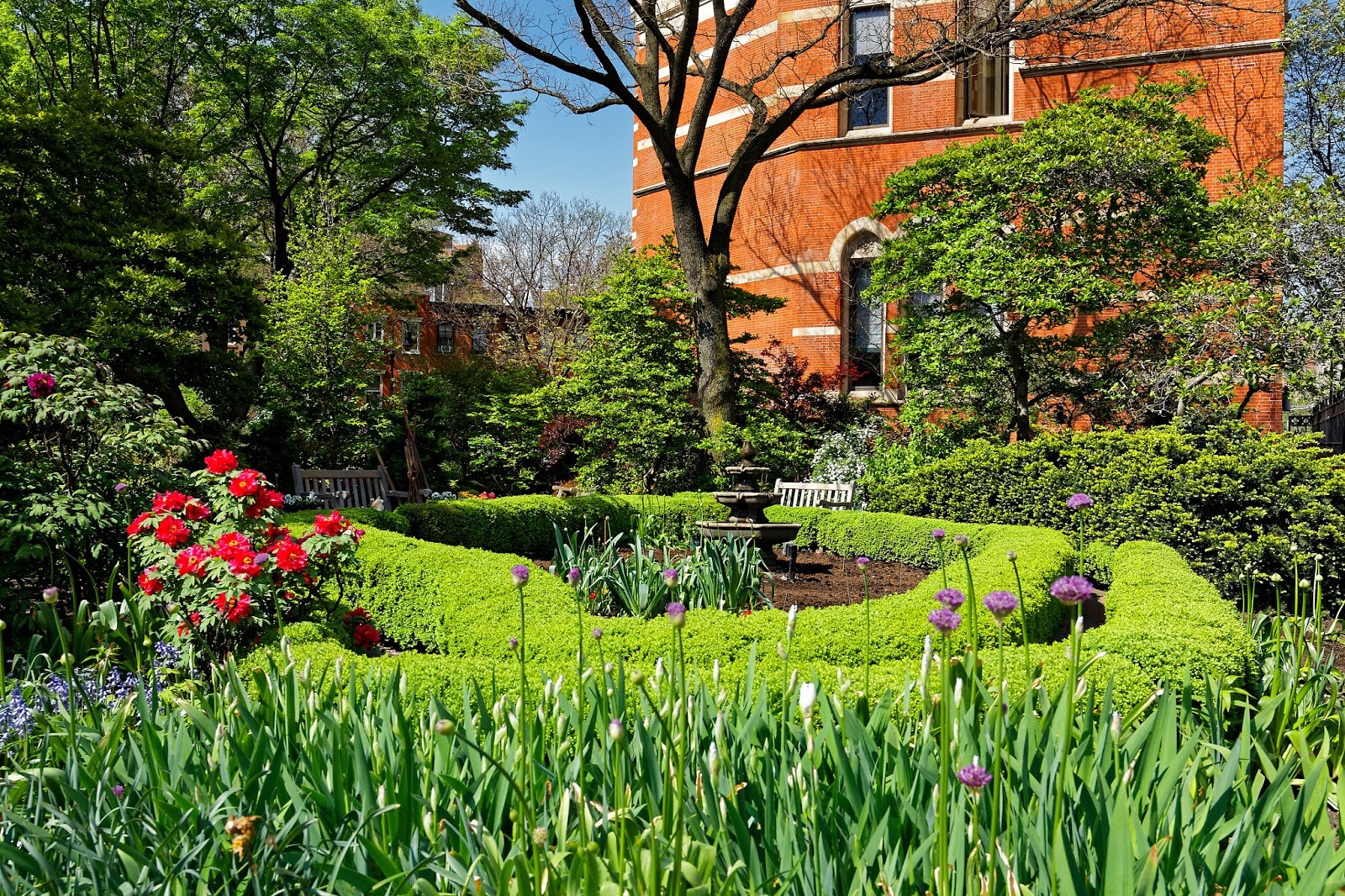
Behind the old courthouse in the West Village, a brick-walled community garden hides in plain sight — roses, a little pond, birdsong instead of traffic. It’s a pocket of quiet in the busiest part of downtown, and it reads like a place you found on purpose. Free to enter, but seasonal: open spring through fall on limited hours, and it occasionally closes for private events, so check the day before you go.

Bridges & Waterfronts

Water gives you a horizon, a sunset, and that open-sky feeling you can’t fake. It also hands you wind, and at a couple of spots, hard rules about what you’re allowed to set up. Nearly all of these cost nothing.

Brooklyn Bridge Park / Pebble Beach — DUMBO, Brooklyn

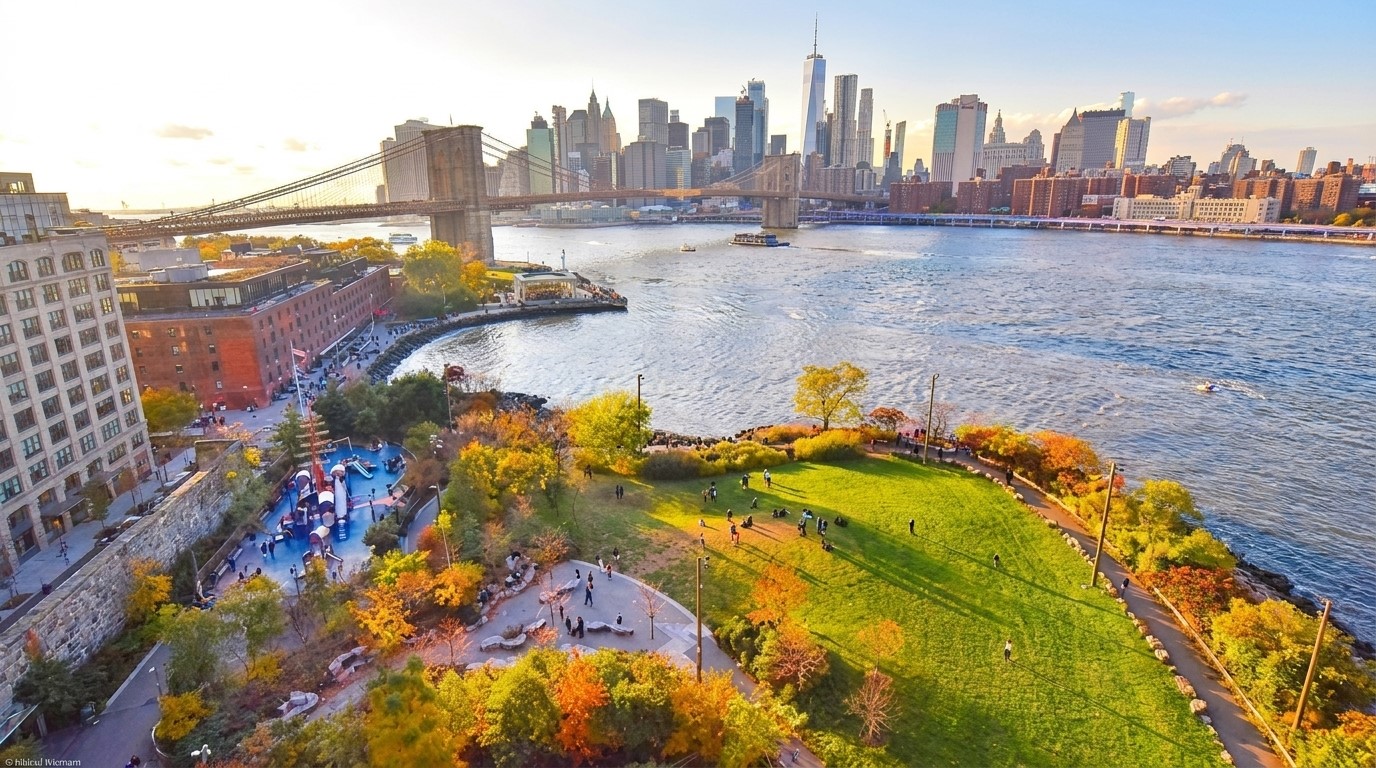
Down at the water in DUMBO, the rocky little cove called Pebble Beach puts the Brooklyn Bridge overhead and the Lower Manhattan skyline glittering across the river — bridge, skyline, and water stacking into one frame at blue hour. Romanticize it all you want, but know the rules first: Brooklyn Bridge Park bans amplified sound and bans decorations, real or fake, so no rose petals and no confetti. A quiet proposal works beautifully here; a setup with a speaker and props gets shut down. Weekday evenings dodge the worst of the sunset crowd.

Gantry Plaza State Park — Long Island City, Queens

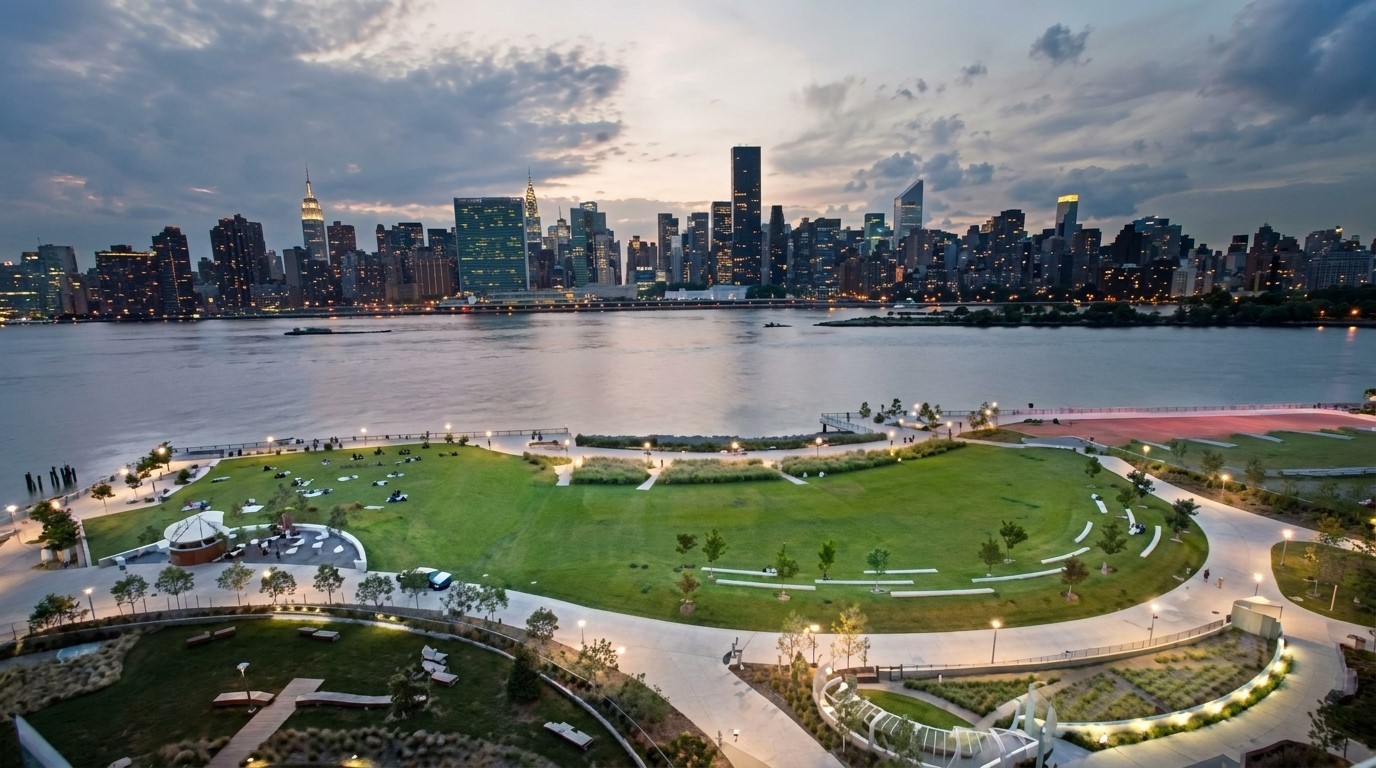
Across the East River in Long Island City, restored shipping gantries stand over a waterfront that stares straight at the Midtown skyline and the old Pepsi-Cola sign. You get the full Manhattan postcard while standing somewhere most tourists never bother to reach. The piers face west, so this is a sunset play — the skyline lights up as the sun drops behind it. Free.

Astoria Park — Astoria, Queens

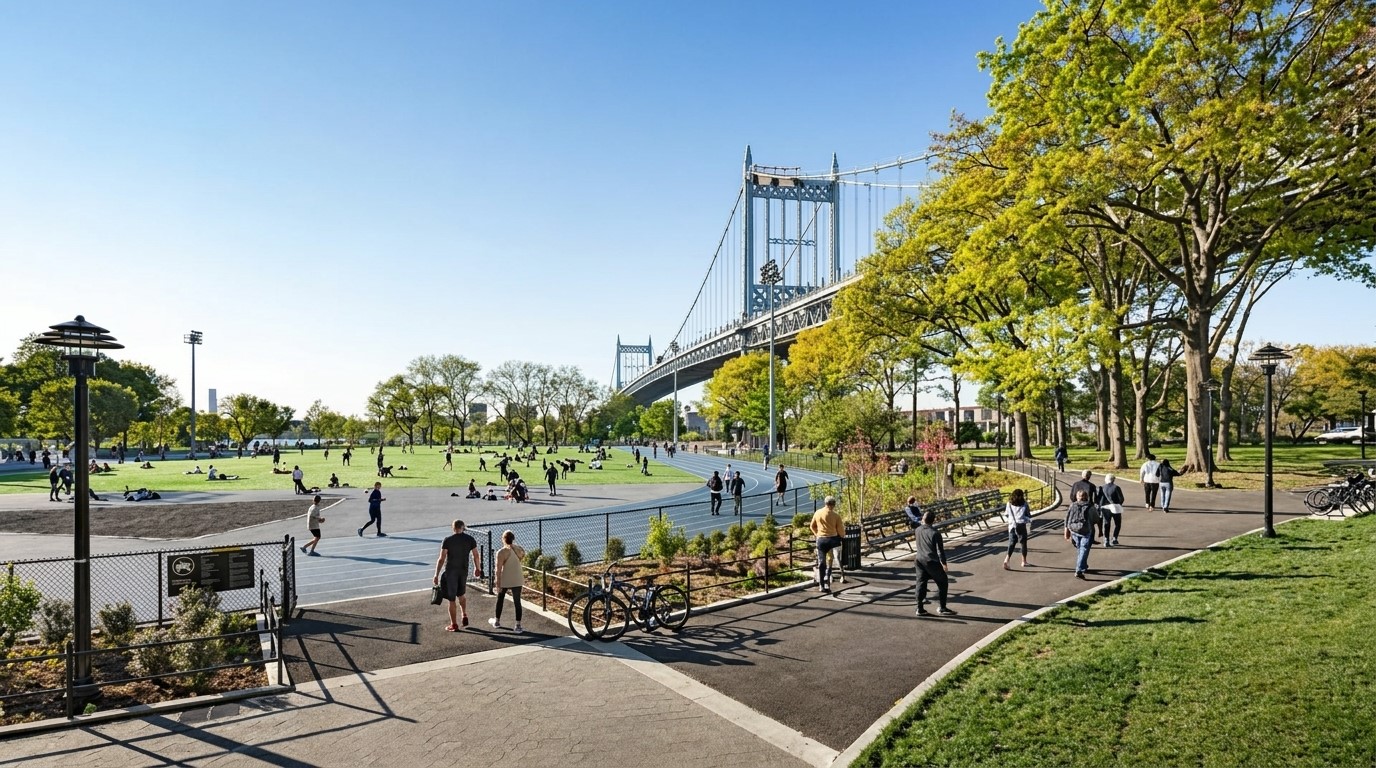
Further up the Queens shoreline, Astoria Park sits dramatically between two bridges — the Hell Gate and the RFK — whose steel gives the scene a scale and grit the polished spots don’t have. It’s grassy, local, and unfussy, quieter than the LIC waterfront, with room to find a private patch of grass. Free, and the evening light off the water is the move.

Alice Austen House Park — Rosebank, Staten Island

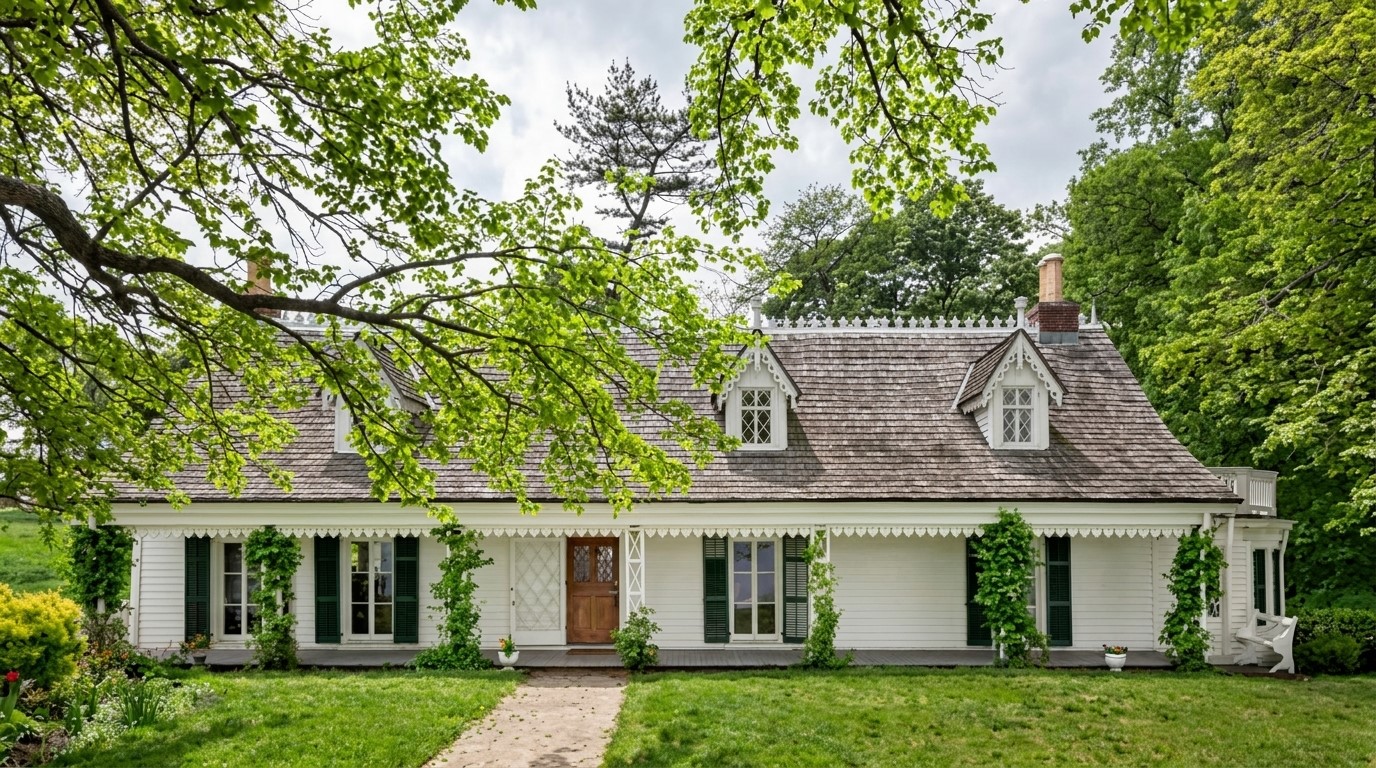
On Staten Island, the lawn of a historic Victorian cottage slopes down toward the harbor, the Verrazzano-Narrows Bridge glowing across the Narrows. Cottage and bridge land you history and grandeur in a single shot, with barely a crowd to crop out. The grounds are free, sunset over the bridge is the whole reason to come, and it pairs neatly with the ferry for a full day out.

Conference House Park — Tottenville, Staten Island

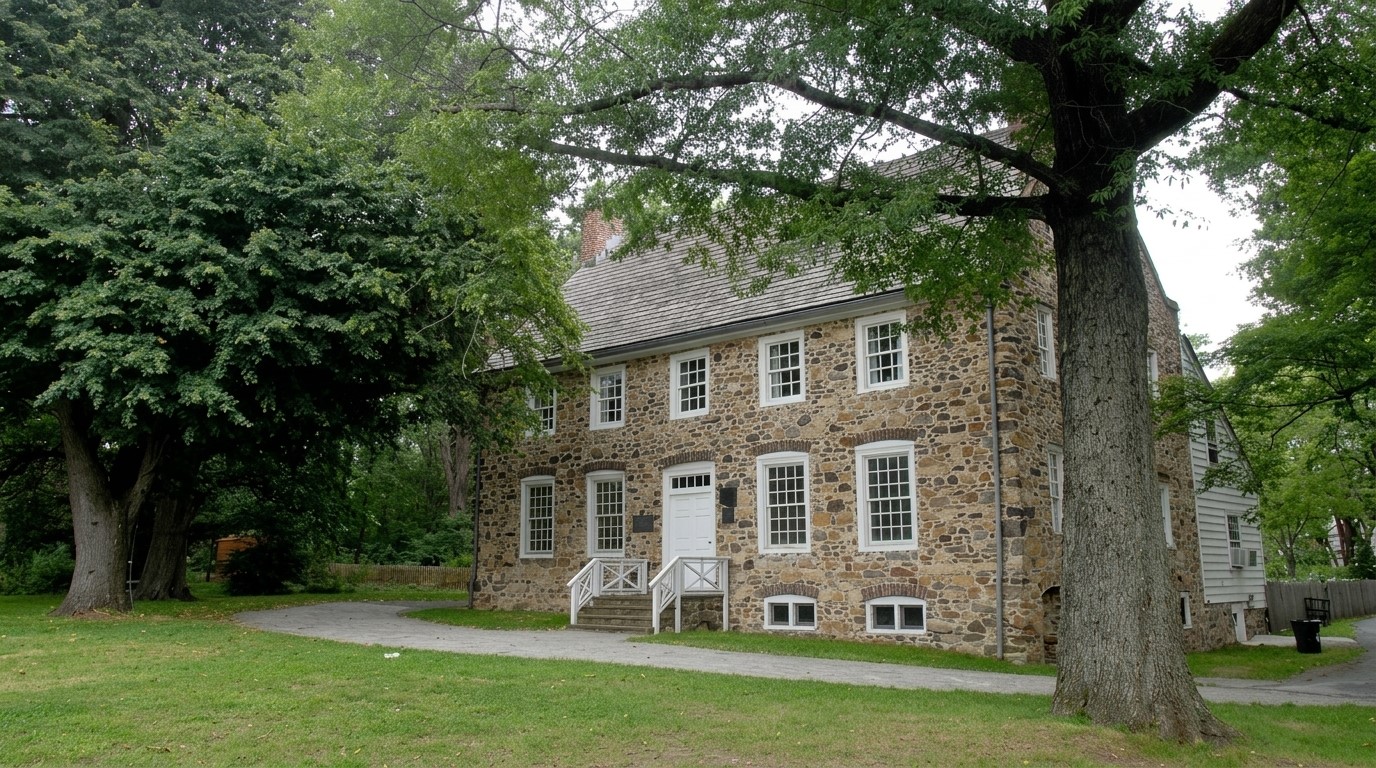
Go as far south as New York State stretches and you hit Conference House Park — the literal southernmost point, a quiet beach with wide sunset views over Raritan Bay. There’s something fitting about proposing at the very edge of the state, where it’s down to you, the sand, and the horizon. It’s free and genuinely uncrowded; it’s also a trek, so fold it into a day trip and time it for sundown.

Staten Island Ferry — Staten Island ↔ Manhattan

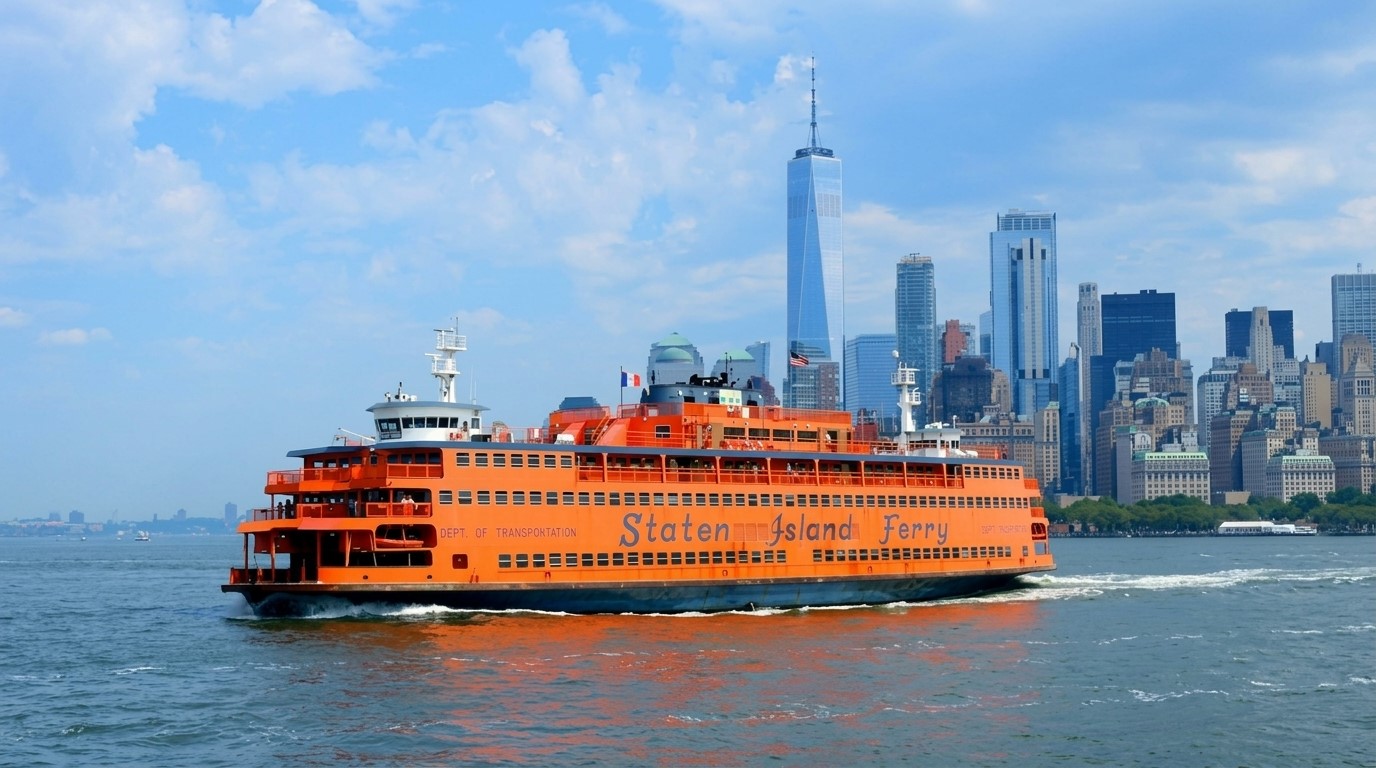
Then there’s the move that costs nothing at all: the Staten Island Ferry, 25 minutes floating you right past the Statue of Liberty with Lower Manhattan behind you. It runs around the clock and it’s completely free. Board the back-right heading toward Staten Island for the Statue-and-skyline view, time it for golden hour, and mind the wind on the open deck.

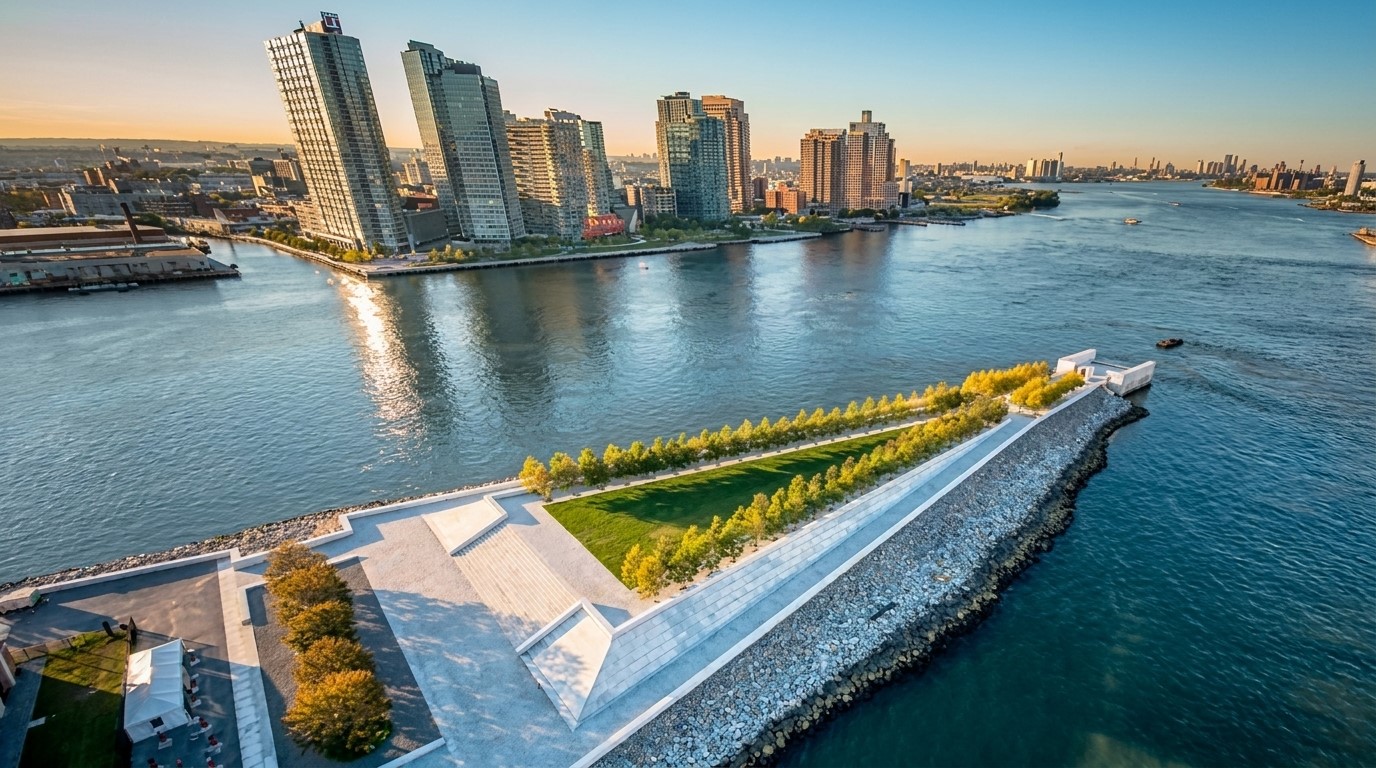
FDR Four Freedoms State Park — Roosevelt Island, Manhattan

At the southern tip of Roosevelt Island, Louis Kahn’s spare granite park narrows to a point aimed like an arrow straight at the Midtown skyline — clean lines that funnel your eye, and the moment, toward the city. Ride the tram over for the romance of the approach alone. It’s free, but it closes earlier than you’d expect, so check the hours before you plan around a late sunset.

City Island — The Bronx

The last waterfront on the list barely feels like New York: City Island, a tiny nautical village in the Bronx, all marinas, seafood shacks, and sailboats that read more coastal New England than five boroughs. That’s precisely the surprise. Wandering the waterfront is free — pair the question with dinner at one of the seafood spots and make a whole evening of it.

Observation Decks

Want spectacle and skyline? You go up. These are all ticketed, several sell dedicated proposal or VIP packages, and the trade-off is an honest one: you’re popping the question in a public, popular place. Book the package, and book the timing.

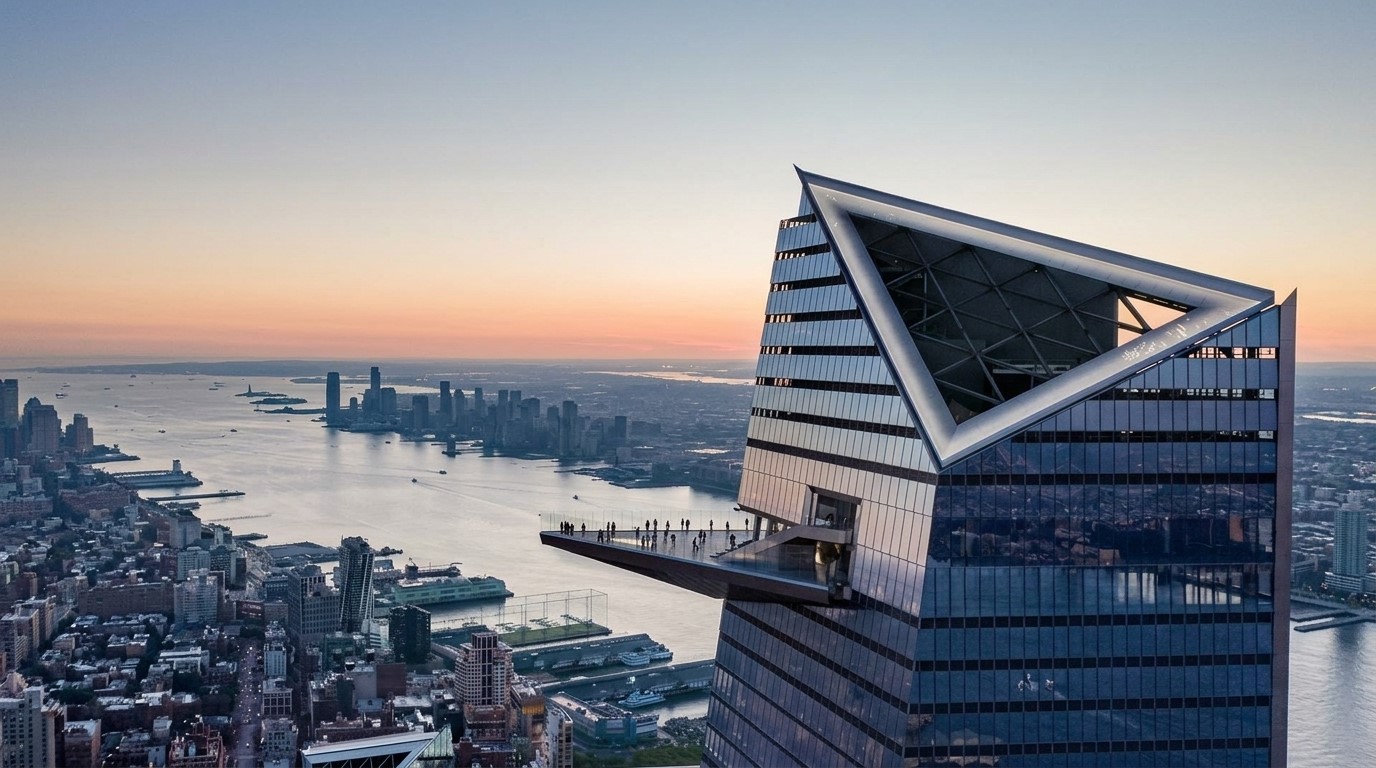
The Edge — Hudson Yards, Manhattan

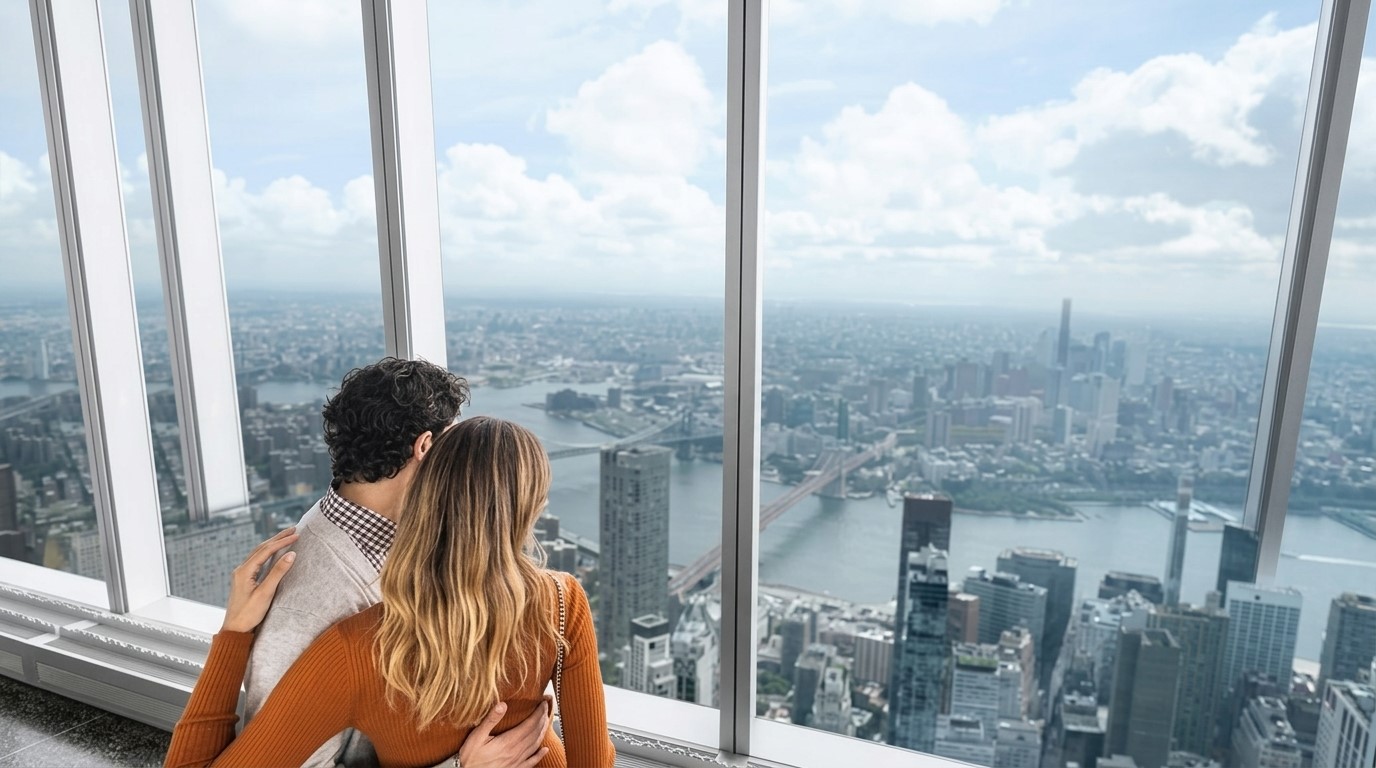
A hundred stories over Hudson Yards, The Edge juts out into open air as a triangular glass sky deck — with a glass floor, if your nerves can take it. The cantilever makes you feel like you’re floating over the city, which is the whole point of coming. It’s ticketed, and The Edge sells a proposal package with a semi-private moment and photography, so book it directly and grab a sunset slot. The glass floor makes a wild photo if you’re both brave enough.

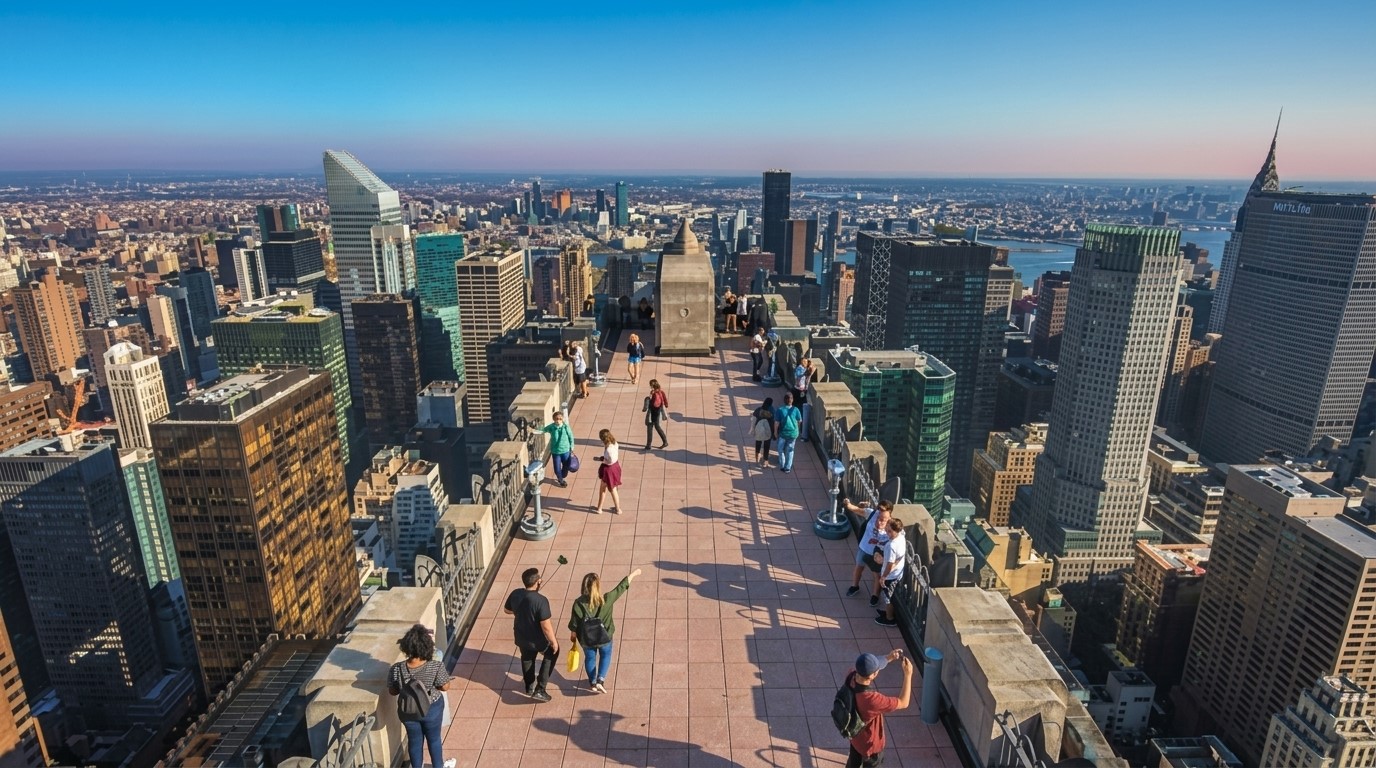
Top of the Rock — Midtown, Manhattan

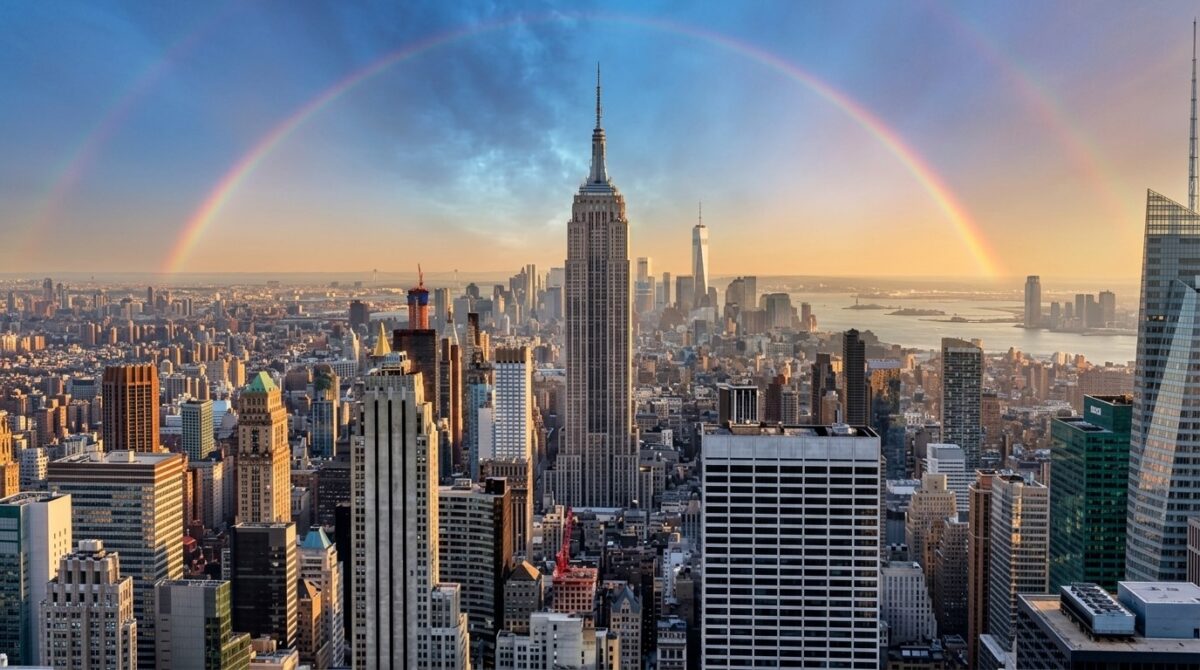
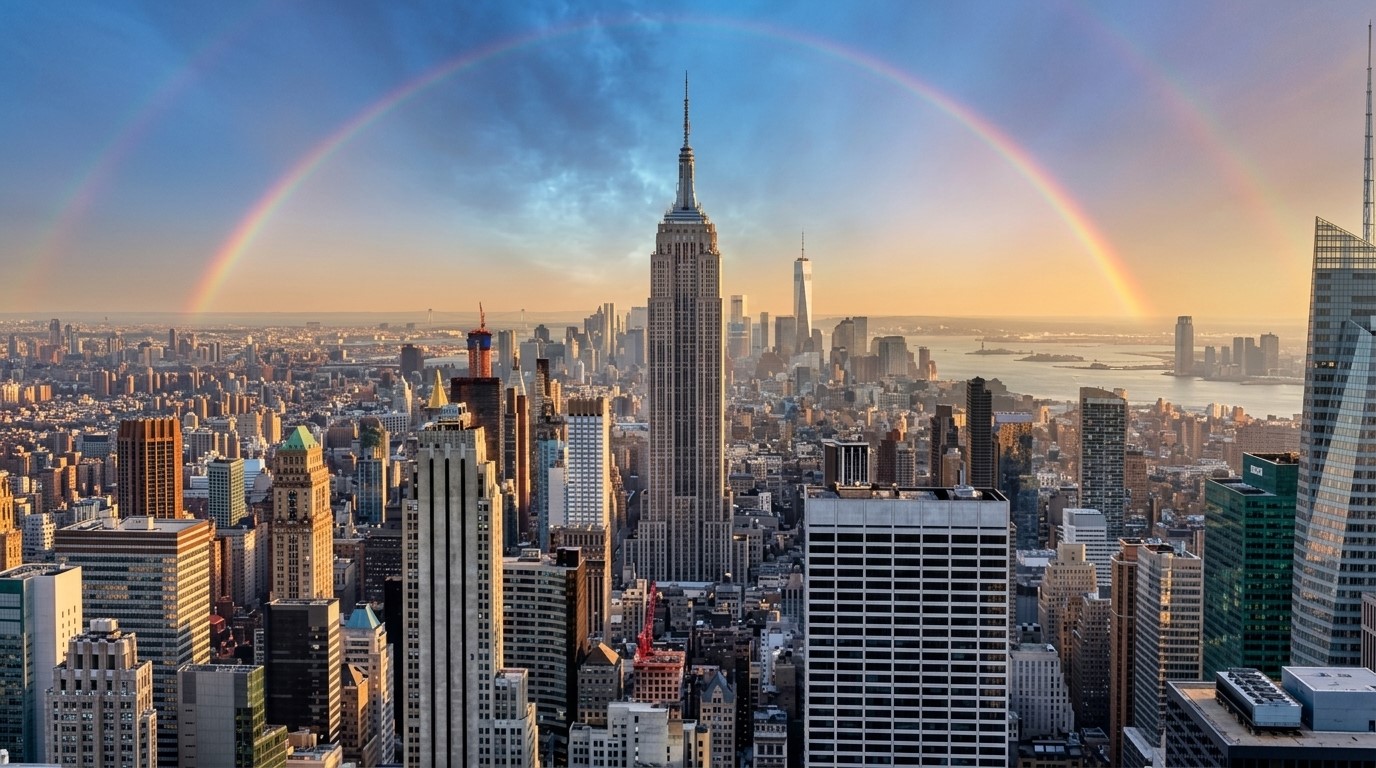
The Rockefeller Center deck holds the one card the others can’t play: the cleanest shot of the Empire State Building, because you’re not standing on it. Open-air terraces, the most iconic building in the skyline framed dead-center behind you. It’s ticketed with timed entry, and the newer Beam and elevated tiers sell out, so book the sunset-into-blue-hour window early.

Summit One Vanderbilt — Midtown, Manhattan

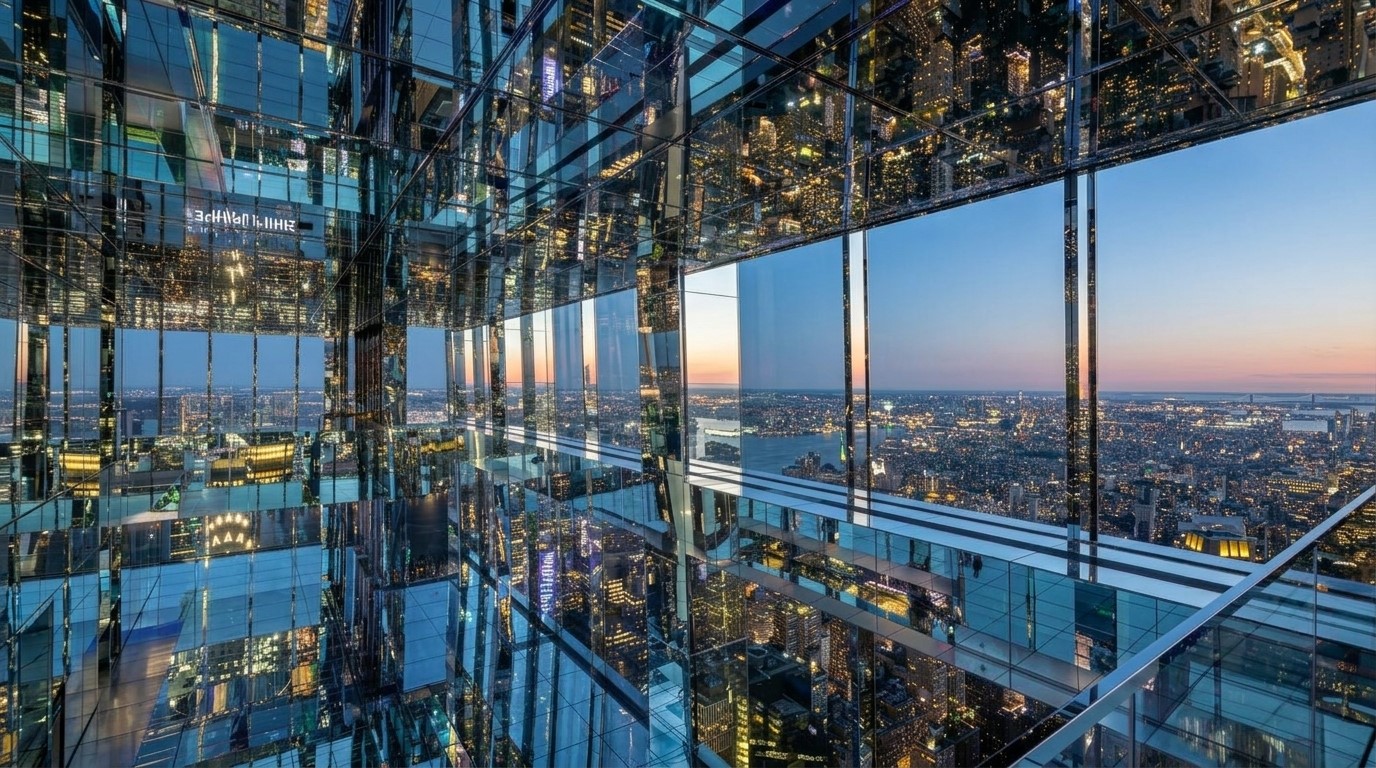
Less a deck than a dream, Summit One Vanderbilt is an immersive mirrored installation above Grand Central — reflective glass repeating the skyline into something surreal that photographs unlike anywhere else on this list. It’s ticketed, and the mirror rooms get busy, so a weekday or a late slot buys you breathing room. The glass elevator clinging to the outside of the building is a moment all on its own.

Empire State Building — Midtown, Manhattan

Then the original. The 86th-floor deck that An Affair to Remember and Sleepless in Seattle wrote into the culture — the most romantically loaded building on earth, which makes proposing here a flat-out statement. It’s ticketed, with a dedicated engagement package on the 86th floor, and late evening runs both the most romantic and the least mobbed. Book the package and the date well ahead.

One World Observatory — Lower Manhattan

Down at the harbor end of the island, One World Observatory tops the tallest building in the Western Hemisphere — a bird’s-eye sweep over the harbor and the Statue of Liberty far below, a perspective none of the Midtown decks can touch. It’s ticketed, and the floor-to-ceiling glass means weather is everything: pick a clear day, or you’ve bought the view for nothing.

Rooftops & Restaurants

For couples who want it indoors, intimate, and chased immediately with champagne. One rule covers all of them: reserve, and tell them it’s a proposal. A good room will quietly slide you the best table, time the dessert, and then get out of the way.

The River Café — DUMBO, Brooklyn

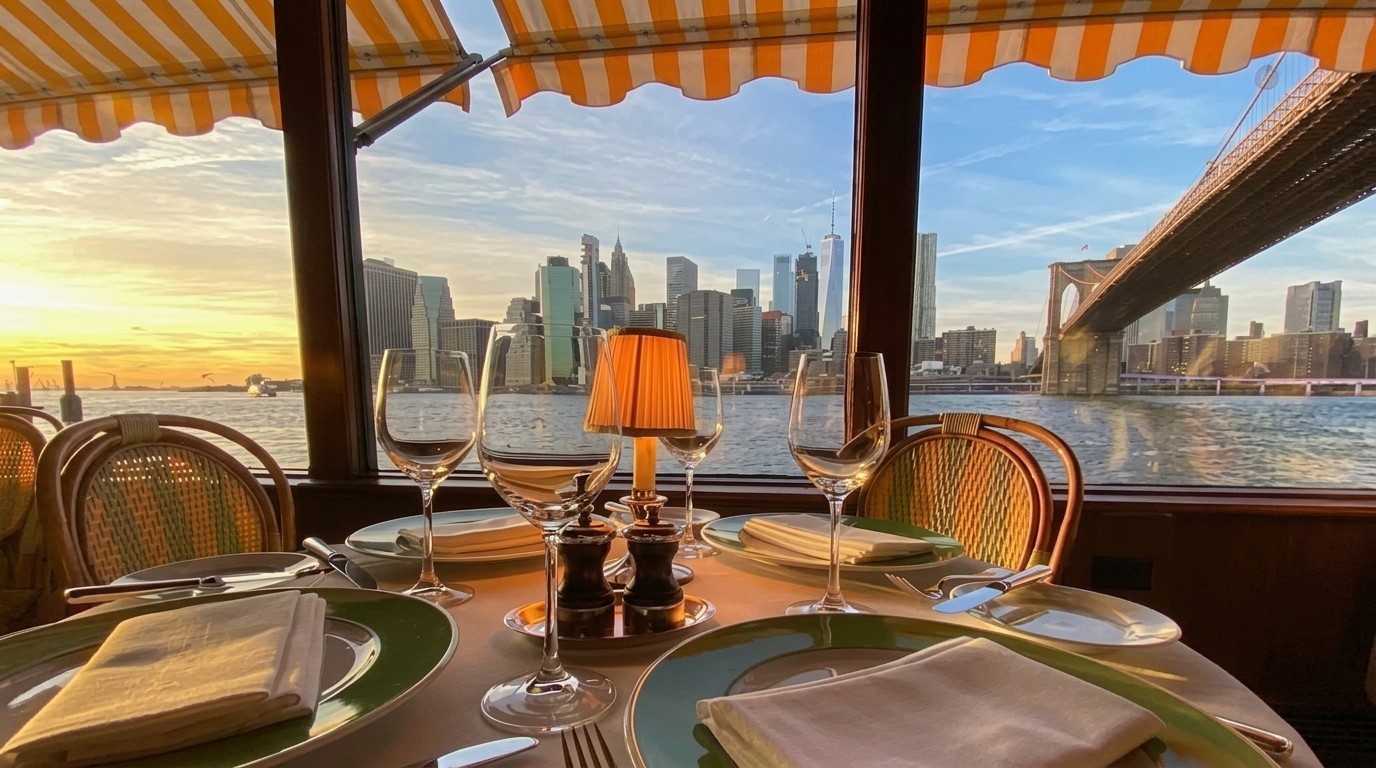
Right at the water’s edge under the Brooklyn Bridge, the Michelin-starred River Café fills its windows with the Manhattan skyline and strings its garden with lights. It’s been Brooklyn’s proposal-and-anniversary room for decades, and it earns every bit of that reputation. Reservation essential, jackets expected, and yes, it’s a splurge — tell them it’s a proposal when you book, ask for a window table, and let them carry it.

One if by Land, Two if by Sea — Greenwich Village, Manhattan

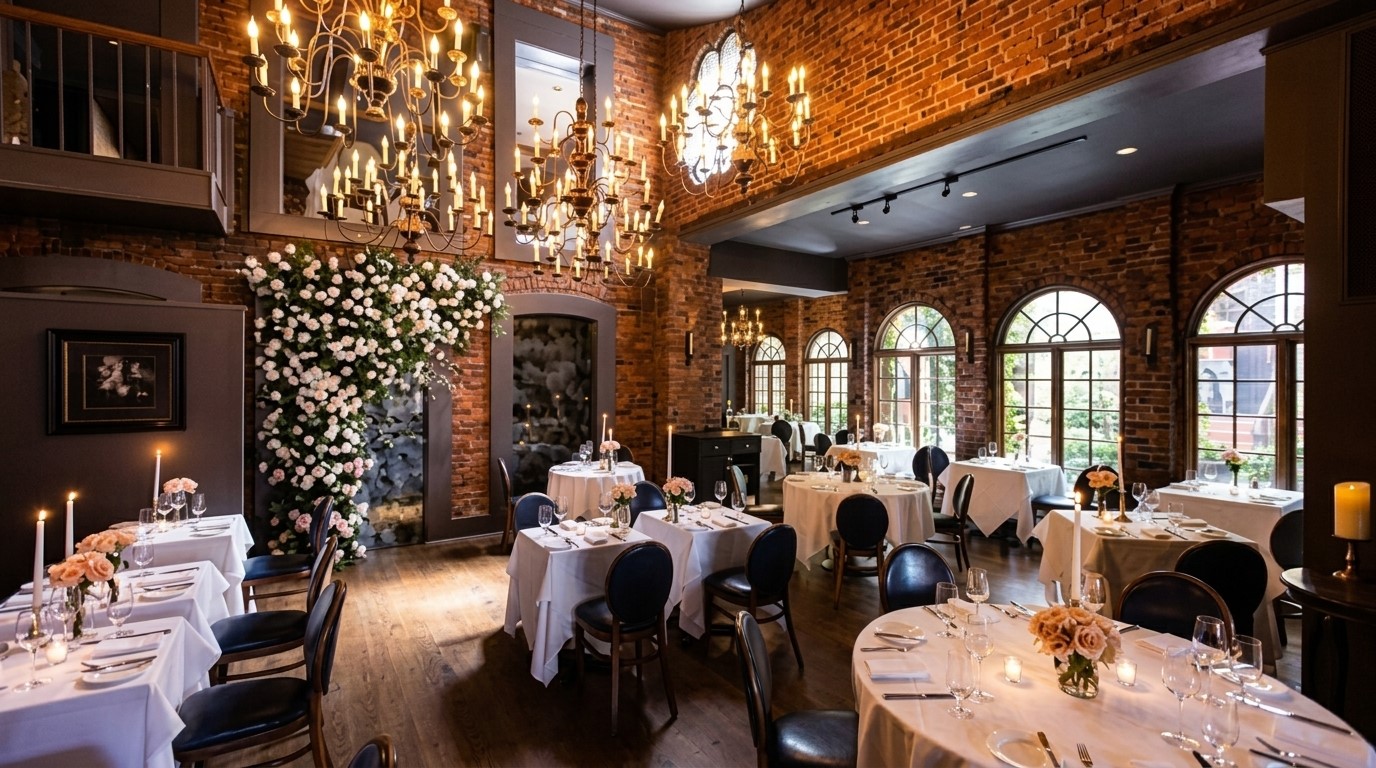
A 1767 carriage house in the Village — brick walls, working fireplaces, a live piano — One if by Land routinely gets named one of the most romantic restaurants in the country, and it is, frankly, a proposal factory in the best possible sense. The staff have seen a thousand of these and still make yours feel like the first. Reserve well ahead, flag the proposal, and if you ask, the piano will play your song.

The Skylark — Midtown, Manhattan

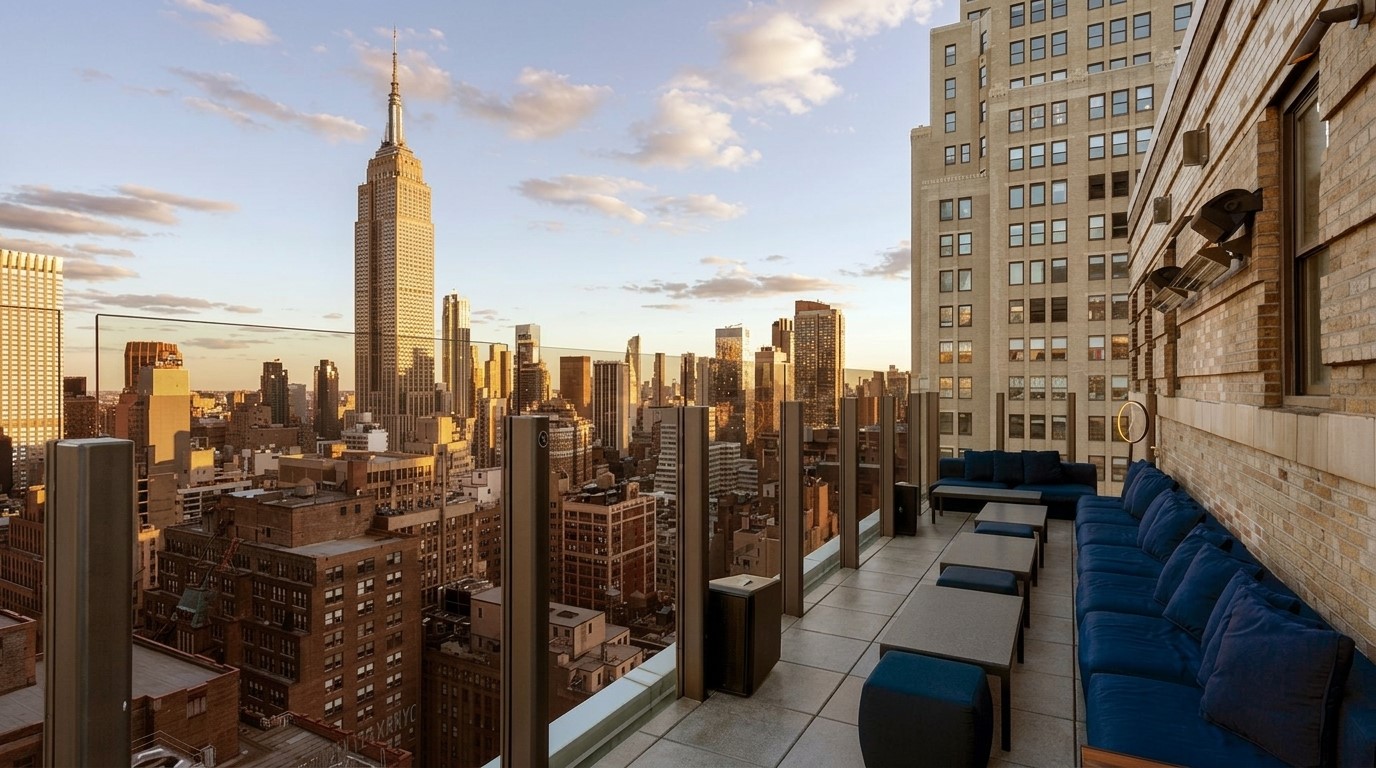
Thirty floors up in Midtown, The Skylark is a cocktail lounge with floor-to-ceiling windows and an outdoor terrace pointed straight at the Empire State Building — art-deco glamour, low light, the skyline in your glass. You get the skyline-bar moment without the observation-deck crowds. A reservation’s smart and the dress code’s sharp; the terrace is the spot, best at dusk when the ESB lights come up.

Manhatta — Financial District, Manhattan

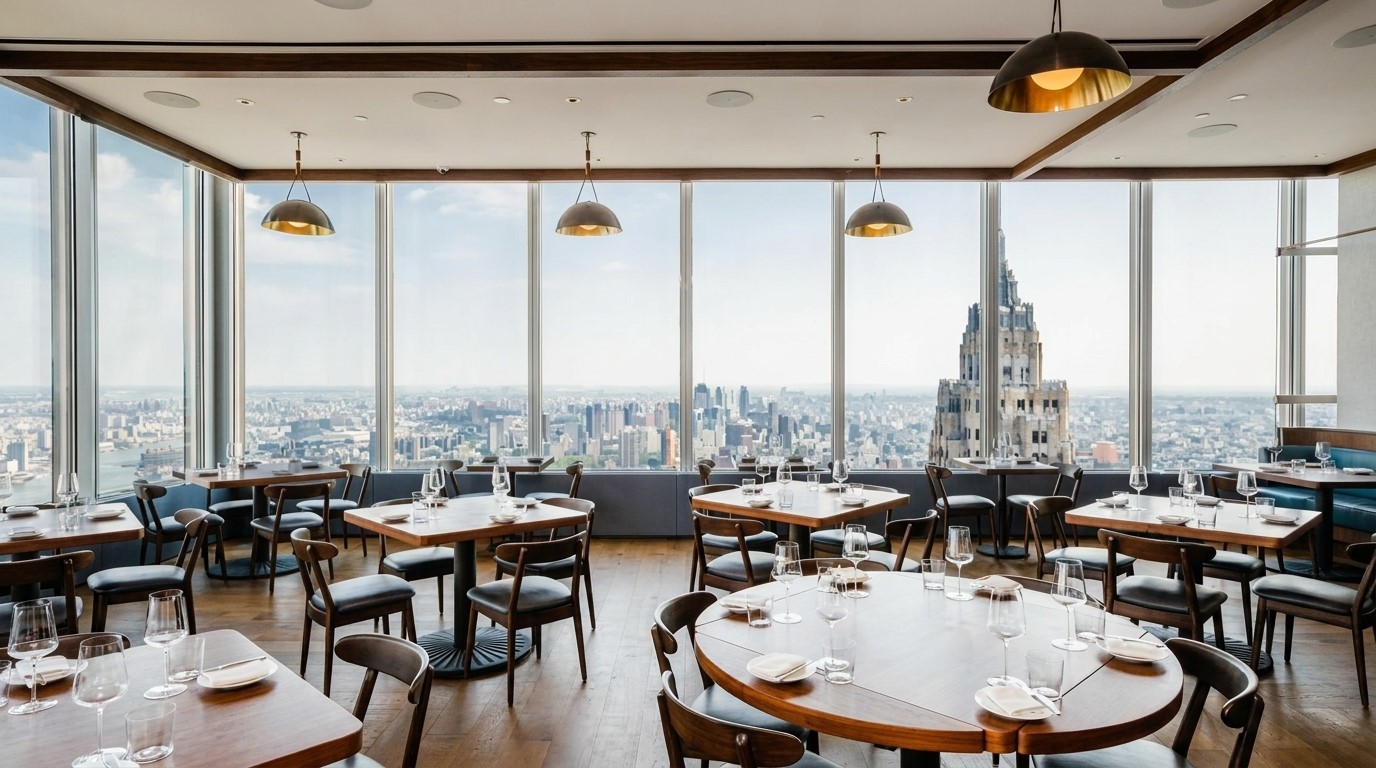
Sixty floors above the Financial District, Danny Meyer’s Manhatta wraps its windows around both rivers and the harbor — fine dining with an observation-deck view, minus the tourists and the turnstiles. Reservation essential; ask for a window table at sunset and mention the occasion. It’s the rare place where the proposal and the dinner happen in one stop.

Westlight — Williamsburg, Brooklyn

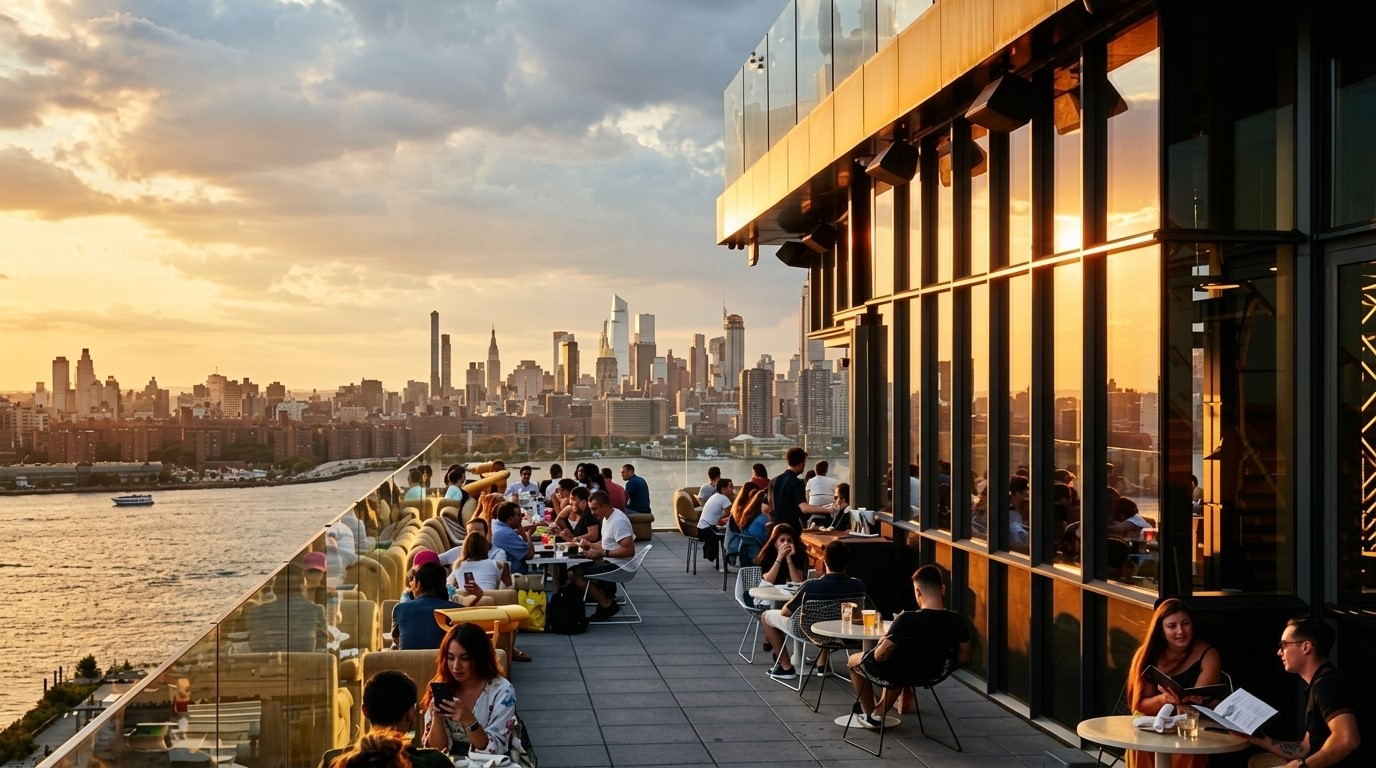
Up on the 22nd floor of Williamsburg’s William Vale hotel, Westlight runs a genuine 360-degree sweep of Brooklyn and the Manhattan skyline across the river — arguably the better angle on Manhattan, taken from the Brooklyn side. It’s a bar, so it gets lively; a weekend reservation is smart, and early evening earns you the view before the crowd lands.

Maiella — Long Island City, Queens

On the Long Island City promenade, Maiella sets elegant waterfront Italian right beside the water, with the glowing Pepsi-Cola sign and the Midtown skyline parked just outside — skyline-and-water dining without the Manhattan markup or the crush. Reserve a patio or window table at sunset and tell them it’s the night. The waterfront walk right outside makes a perfect post-yes stroll.

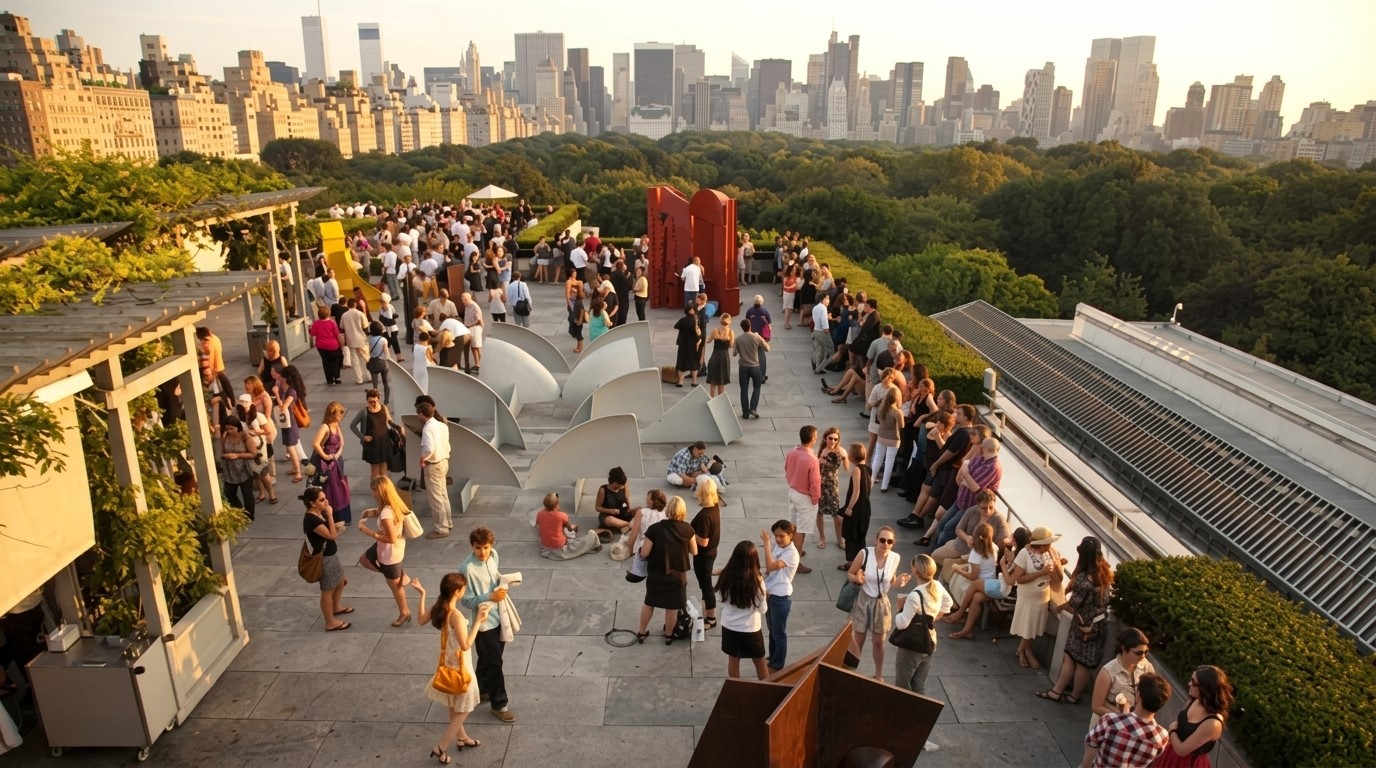
The Cantor Roof Garden Bar — The Met, Upper East Side, Manhattan

On top of the Metropolitan Museum, the seasonal Cantor Roof Garden Bar looks out over the Central Park tree canopy with the skyline rising past it — art museum below you, park in front of you, a combination that exists nowhere else. It opens roughly spring through fall and runs first-come, so arrive right at opening on a weekday to beat the line, and check the Met’s calendar, since it shuts through the cold months.

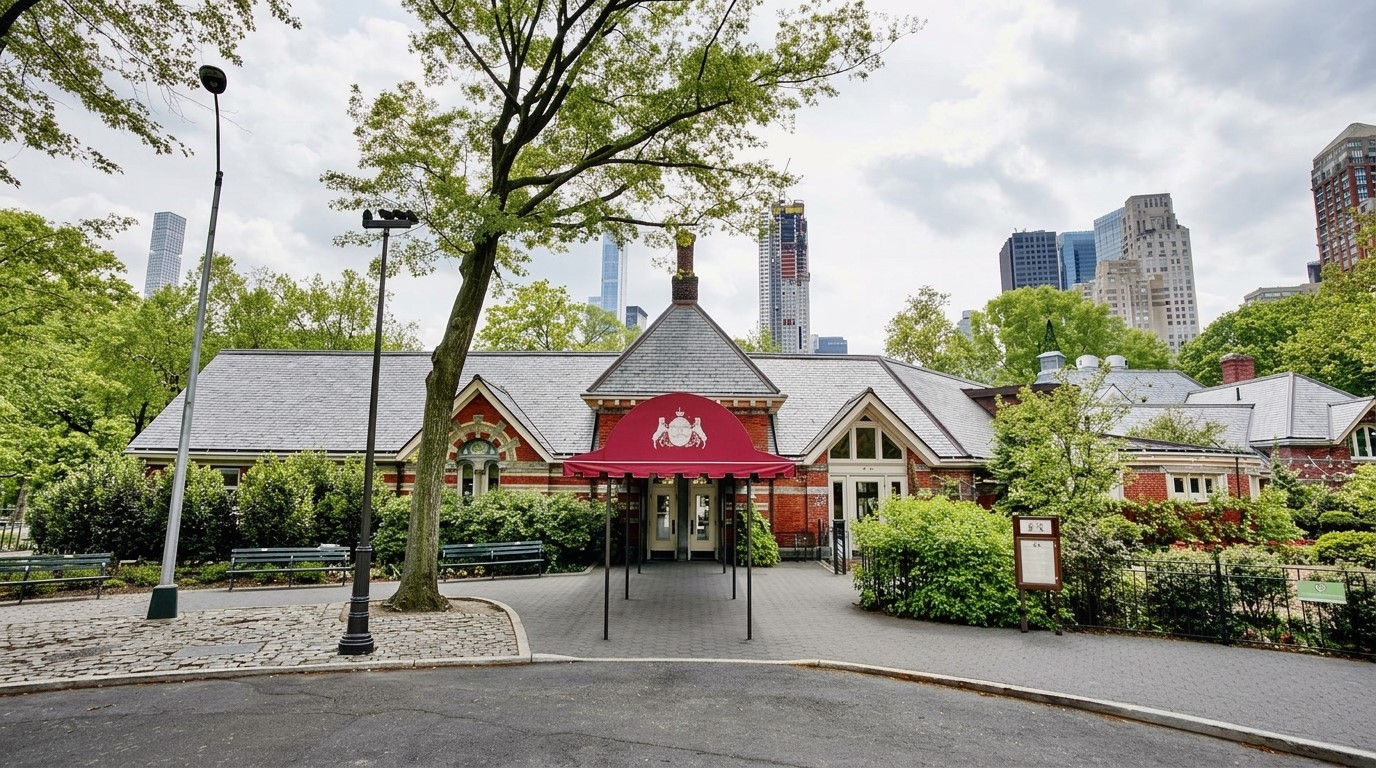
Tavern on the Green — Central Park, Manhattan

And to close where we started, in Central Park: Tavern on the Green, the storied restaurant whose tree-canopied courtyard is strung with thousands of lights — history, fairy lights, and the park all at once. Reserve and flag the proposal; in warm months the outdoor courtyard is the spot, so ask for it by name when you book.

How to Pick Your Spot

Thirty options is a lot, so here’s how I’d narrow it, based on what you actually want out of the moment:
  • If you want the iconic, in-the-movies shot — Bow Bridge at sunrise, or the Empire State Building deck at night.
  • If you want privacy above all — the Conservatory Garden, the Chinese Scholar’s Garden, or Conference House Park. Quiet corners, almost no crowd.
  • If you’re hiring a photographer (a quarter of proposers do now, per The Knot) — the Brooklyn Botanic Garden in bloom or Bethesda Terrace at dawn. Just budget BBG’s $366 photo permit and book it two-plus weeks out.
  • If the weather’s a wildcard — go indoors and up: Manhatta, the Skylark, or One if by Land. The view’s behind glass and the champagne’s already cold.
  • If you want the proposal to roll straight into a celebration — a restaurant (River Café, Maiella, Tavern on the Green) so dinner and the toast are built in.
  • If you’re on a budget — the Staten Island Ferry is free and floats you past the Statue of Liberty. Hard to beat for zero dollars.
One pattern I’ll flag, because it’s reshaping how people propose: per Zola, nearly 1 in 5 couples are already in wedding-planning mode before the proposal even happens. If that’s you, pick your spot with the wedding in mind — the proposal is the opening note of a much bigger song.

Where the Music Comes In — and Where DLE Fits

Here’s where I’ll be straight with you about what I actually do. I’m not a proposal planner — I won’t book your table or hide your ring. What I and the team at DLE Event Group bring is the part of the moment that’s hardest to get right and impossible to fake: live music.
Picture it. You’ve got your partner at the Bethesda Terrace arcade, or up on a private rooftop, and as they turn around there’s a violinist — or a sax-and-guitar duo, or a small jazz combo — already playing the song that’s yours. Not a phone in a planter. Real players, real sound, the kind that makes a stranger across the lawn stop and tear up. That’s the half of the moment people remember in their bones.

DLE Event Group has spent over a decade as NYC’s hybrid live-band-and-DJ specialists — 100+ events, eleven straight years in The Knot’s Best of Weddings Hall of Fame. Many of our musicians play premier New York rooms every week, which matters when there’s no second take: seasoned players don’t flinch when your cue lands two minutes late because your partner stopped to look at the view. We scale from a solo guitarist to a string trio (violin, viola, cello) up to a full ensemble, we’ll learn your song in your arrangement, and we bring our own best-in-class sound with backup gear, because “the music cut out during the proposal” is a sentence that should never exist.

And honestly? The proposal is where the music story starts. Most of the couples we play for at the question end up wanting that same feeling — only bigger — at the wedding. If you’re already picturing the band at your reception, let’s make the proposal the overture and thread the same song through both. For perspective: the average engagement ring runs around $4,600 to $5,200 according to The Knot, and live music for the moment is usually a fraction of that, for arguably the most-replayed thirty seconds of the whole engagement.

FAQ

There’s no single best — it depends on the moment you want. For the iconic shot, Bow Bridge in Central Park at sunrise or the Empire State Building deck at night. For privacy, Central Park’s Conservatory Garden or Staten Island’s Chinese Scholar’s Garden. For a proposal that rolls into dinner, One if by Land, Two if by Sea, or The River Café. For free with a skyline, the Staten Island Ferry.

For a quiet, just-the-two-of-you proposal, generally no. Per NYC Parks, a permit comes into play when your group gets large (the city’s threshold is around 20 people), when you want to reserve exclusive use of a spot, or when you set up structures or amplified sound. The Brooklyn Botanic Garden is a hard fact, not a maybe: a casual phone-camera proposal just needs admission, but hiring a professional photographer requires a $366 photo-session permit booked at least 14 business days ahead. Always confirm current rules with the specific park before your date.

Golden hour — the hour after sunrise or before sunset — for soft, flattering light, and “blue hour” just after sunset for skyline and observation-deck shots when the city lights come on. Sunrise has a bonus in popular spots like Bow Bridge: you’ll have the place nearly to yourself.

Yes, and yes. The Edge, Top of the Rock, the Empire State Building, and others sell dedicated proposal or VIP packages that get you a semi-private moment and often a photographer. Book directly, choose the sunset or evening slot, and reserve well ahead — these sell out.

We can. We provide the live-music side of the moment — from a solo guitarist to a string trio or small ensemble, playing your song in a custom arrangement, with our own sound system and backup gear. We don’t plan the proposal itself, but we make the soundtrack real. Call 877-534-2424 or email contact@dleeventgroup.com and we’ll quote it.

Per The Knot, the average engagement ring runs roughly $4,600–$5,200, and the proposal event itself averages around $2,900 when couples bring in vendors. Live music for the moment is typically a fraction of the ring — a small spend for the part you’ll rewatch for decades.

Let's Make the Moment Sound as Good as It Looks

The view, the timing, the ring — that’s yours to plan, and this city gives you 30 incredible places to do it. The live music that turns a beautiful backdrop into the moment — players who’ve performed the highest-stakes seconds of a couple’s life more times than they can count — that’s where we come in.
Tell us where you’re thinking of popping the question and we’ll build the sound around it: the right musicians, your song arranged the way it should be, and a moment that carries straight through to the wedding.

Call us at 877-534-2424 or email contact@dleeventgroup.com. DLE Event Group — 404 5th Avenue, 3rd Floor, New York, NY 10018.

Ready to start the conversation?

QUESTIONNAIRE

Need Assistance? Directly reach us at contact@dleeventgroup.com or 877.534.2424

Bringing NYC Energy to a Prague Castle Wedding: A DLE Event Group Destination Case Study

Bringing NYC Energy to a Prague Castle Wedding: A DLE Event Group Destination Case Study

Prague Castle in May has this color the camera can never quite catch — warm gold cut with pink, the kind of light that only happens in central Europe and only for about forty minutes. The candles inside were already lit. Glassware caught what was left of the daylight. Across the room, a saxophone took its first breath of the night, and a guitar answered back.
Then the dance floor opened. The kick drum hit. And every guest in that room — Brooklyn, Berlin, Kyiv, didn’t matter — turned their head at the same time.
You can always feel that turn. The room asks a silent question: Wait. Who are these people?
The answer that night was the DLE Event Group hybrid DJ band, flown in from New York to play Alina and William’s destination wedding in Prague, Czech Republic.

DLE Event Group is a luxury wedding entertainment company based in New York City, specialized in hybrid DJ band performances for destination weddings across the United States, Europe, and worldwide. Eleven consecutive years on The Knot Best of Weddings Hall of Fame (2013–2023). Over 100 weddings and events. Packages starting at $5,995. And, in May 2026, a six-person team in Prague.

Who are Alina & William, and why did they choose Prague for their destination wedding?

Alina and William chose Prague as the meeting point for an international guest list with friends and family in the United States, Germany, and Ukraine — a city central enough, beautiful enough, and well-connected enough to make a multicultural destination wedding work logistically.
country, let alone one zip code. So they picked neutral, gorgeous ground: Prague. A city that has been throwing world-class parties for about a thousand years longer than New York has existed, with a castle that looks like someone designed it specifically to be photographed at golden hour.
Prague made sense for a destination wedding with guests scattered across two continents. Direct flights from most major US and European hubs, a walkable old town, and a castle backdrop that frankly does half the visual work before anyone shows up. Alina and William chose Prague deliberately, and you could feel that intention in every detail of the day.
The couple could have hired a local Prague wedding band, of course. Plenty of European outfits work the Prague circuit. But Alina and William wanted something specific — the hybrid DJ band sound, the mix of live musicians layered into a DJ-driven set — and they wanted DLE Event Group. So the DLE band packed it all up and came to them.

What is the DLE Event Group hybrid DJ band, and why does it travel well to destination weddings?

The DLE Event Group hybrid DJ band is the company’s signature six-person live-and-DJ format: a DJ holding the spine of the set, with live musicians playing over and through and around it, swapping the lead between the live side and the recorded side whenever the moment calls for it. The configuration is engineered to deliver full-band energy with a footprint small enough to fit on a transatlantic flight.

For Alina and William, the booked lineup was the six-person hybrid DJ band — to my ear, the sweet spot of the format.
There’s a DJ driving the night, reading the floor in real time and MCing transitions. A vocalist front and center, the human face of every song. A saxophone, the instrument that always makes someone gasp on the dance floor (and on this trip, did exactly that on the first downbeat). Keys handle the harmonic backbone — equally at home behind a tender dinner ballad or thumping out a Motown groove. Guitar brings the texture, the rhythm, the soul of the live element. And a live drummer, which matters more than people realize: a real drummer playing on top of DJ tracks is what makes a hybrid DJ band feel like a band and not a karaoke night.
For a destination wedding DJ band setup, this configuration travels really well. Big enough to fill a room, small enough to fit on a plane. The DLE Event Group team isn’t freighting a 12-piece horn section across the Atlantic. The team brings the people whose presence on stage actually changes the energy in the room, and trusts the DJ rig to handle the orchestral muscle that doesn’t need a body to perform it. That’s the whole point of being pioneers of the hybrid DJ band model: the warmth of live without the logistical weight of a full orchestra, anywhere in the world.

How does DLE Event Group plan a wedding 4,000 miles from its New York studio?

DLE Event Group plans destination weddings through a remote-but-rigorous process: five to ten Zoom planning meetings with the couple, deep entertainment consultation, custom song work for first dances and special moments, MC pronunciation prep, and direct coordination with the on-site local planner. For Alina and William’s Prague wedding, the DLE team ran somewhere between five and seven of those meetings.
People assume the hard part of an international gig is the flight. It isn’t. The flight is the easy part. The hard part is the months of work before the team ever sets foot in an airport.
I’m a little fuzzy on the exact number because the calls blurred together in the best way — by the end, talking to Alina and William felt less like a vendor relationship and more like catching up with friends who happened to be planning a wedding.
The phrase “planning meetings” undersells what those calls actually are. They start with a deep entertainment consultation — what music has meaning to them, what songs are off-limits, what their families dance to. Which, when you’ve got American, German, and Ukrainian relatives in the same room, is not a casual question. From there the DLE team builds out the timeline minute by minute. When does dinner music shift? Where does the energy break? At what point do we go full Motown and not look back?
Then come the custom song requests — pieces the live musicians need to learn specifically for the first dance, parent dances, and special moments. MC pronunciation prep, because getting names and family names and toasts right matters more when half the guest list speaks a different first language than the other half. And running coordination with the on-site planner in Prague — the local pro handling the venue, catering, and ground logistics.
Five to seven meetings sounds like a lot. It is a lot. It’s also exactly what international wedding entertainment requires when you can’t drive over to the venue for a Tuesday afternoon walkthrough. Every detail the team would normally check in person was worked out on Zoom. Then the DLE Event Group band showed up in Prague with a plan tight enough that nothing about being 4,000 miles from the New York studio actually showed up in the performance.
White-glove service isn’t the part where the team shows off the finished product. It’s the five months of work nobody sees.

What happened on the wedding day, from elegant dinner to a multicultural dance floor?

The wedding day moved through two distinct phases: a sophisticated dinner set built on soft instrumentation and ambient texture, followed by a high-energy 1960s and 1970s Motown-anchored dance set that worked across the entire multicultural guest list. The transition between phases is exactly what the hybrid DJ band format was built to deliver.
Dinner started sophisticated. That was the brief, and that was the room.
We played soft. Keys, guitar, a little vocal underneath — the kind of texture that sits behind conversation instead of competing with it. Guests were toasting in three languages. People were finding their seats, finding each other, and somewhere in the middle of the room a grandmother from Ukraine was hugging a college friend from Boston she’d never met before.
This is the part of any wedding I watch closely — when the room hasn’t fully met itself yet, and you can feel introductions happening at every table. The band’s job at that stage is to set a tone, not steal one. Romantic. Timeless. Just enough.
Dinner wrapped, and the band shifted gears.
The couple had been clear in our planning calls: they wanted the dance floor to live in the 1960s and 70s. Motown above all. So that’s exactly where the DLE band took them. Stevie Wonder. The Temptations. Marvin Gaye. Aretha Franklin. The whole catalog of music that was designed, from the very first note, to make people dance in rooms exactly like this one.
A Motown wedding band set list at an international wedding does something almost no other genre can do — it speaks every language at once. It doesn’t matter what country you grew up in or what your first language is. The horn line in “Signed, Sealed, Delivered” hits the same in Prague as it does in Detroit. The guests from Germany were on the floor. The guests from Ukraine were on the floor. The crew from the US were dancing with people they’d met thirty minutes earlier. And the floor did not clear until the band made it clear.
Somewhere in the middle of the night, the realization started rippling through the crowd — these guys flew here from New York. You could see it land on people’s faces when they figured it out. The line the couple used afterward, the one I keep coming back to, was that the entertainment took the reception “to another level.” That’s the language the family used. I’ll take it.
The room felt vibrant. High-energy. International in the best, most meant-it sense of the word. A celebration that earned every adjective Alina and William’s planner had hoped for on paper.

What does it take to bring DLE Event Group to Europe or another international destination?

Bringing DLE Event Group’s hybrid DJ band to a destination wedding in Europe involves five coordinated workstreams: full-team travel coordination, equipment strategy (fly-with versus source-locally versus ship-ahead), venue-side technical coordination, multicultural fluency in music programming and MC work, and time-zone-aware planning communication. DLE Event Group packages start at $5,995, with travel quoted as a separate line item per destination.
A lot of couples assume Prague destination wedding entertainment — or any international wedding entertainment — is either prohibitively complicated or just not on the table. Neither is true. DLE Event Group operates out of New York City, but the service area has always extended past the five boroughs to Hudson Valley, the Hamptons, upstate New York, and increasingly anywhere in the world a couple wants the band. Prague is not the first international gig DLE Event Group has played, and it won’t be the last.
Travel coordination covers the full team — flights, accommodations, ground transport, gear shipping or on-site rentals. Equipment strategy means deciding what to fly with, what to source locally, what to ship ahead. For Prague, the DLE team built a rig that balanced studio standards with the realities of international travel. Venue-side technical coordination handled power, stage dimensions, load-in windows, and sound restrictions.
Multicultural fluency matters too, and not just musically: MC work, name pronunciation, family traditions, the cultural beats that matter to specific guest populations. And time-zone-aware planning communication — Zoom calls that work for couples whose schedules are spread across countries.
DLE Event Group packages start at $5,995, with travel quoted separately because every destination is different — Prague is different from Tuscany, Tuscany is different from Tulum. The team builds the travel side around the specific trip.
What you’re getting for that investment, beyond the obvious — six musicians, a DJ rig, professional lighting and audio, white-glove planning — is more than a decade of doing this. Eleven consecutive years on The Knot Best of Weddings Hall of Fame, 2013 through 2023. Over 100 weddings and events. A team that has been around long enough to have already solved the problems that pop up on a destination wedding before they pop up on yours.
DLE Event Group is inclusive of all cultures and religions. The team has worked Horas, Baraats, Tarantellas, Dabkes. A multicultural guest list with families from the US, Germany, and Ukraine isn’t outside what DLE Event Group does — it’s centered in what DLE Event Group does.
DLE Event Group is an international wedding entertainment company that happens to be based in NYC. Not the other way around. That same positioning is why DLE Event Group also works as a luxury wedding DJ Europe option — the hybrid DJ band model is purpose-built to cross oceans without losing what makes the live element worth booking in the first place.

FAQs

Yes. DLE Event Group has performed for destination weddings across the United States and abroad, and Alina and William’s May 2026 Prague Castle wedding is one example in an ongoing pattern. If you’ve got a wedding in Europe, Latin America, the Caribbean, or somewhere further afield, the DLE team will talk through whether the company is the right fit. Most of the time, the answer is yes.
Almost identically to a New York wedding, with a few small differences. DLE Event Group runs its standard five to ten Zoom planning meetings (Alina and William were in the 5–7 range), builds out a detailed entertainment timeline, and coordinates directly with the couple’s on-site planner and venue team. The only piece missing is the in-person venue walkthrough, and DLE Event Group compensates with extra-thorough remote technical coordination and a more detailed equipment plan than usual.
Plan for five to ten Zoom meetings with the DLE Event Group team. Destination weddings tend to land in the upper half of that range because there’s more to coordinate — travel logistics, equipment strategy, time-zone scheduling, multicultural music curation. None of it is optional, and all of it is what makes the wedding day feel effortless.
Yes, and multicultural programming is one of DLE Event Group’s strongest capabilities. The musicians come from a wide range of musical backgrounds, the DJ has an extensive song library, and the band programs the night specifically around the cultures in the room. For Alina and William, that meant a 1960s–70s Motown-heavy set list that worked across American, German, and Ukrainian guests. For a Jewish-Italian wedding, it would mean Hora into Tarantella. For a South Asian wedding, the Baraat is in the plan. DLE Event Group tailors every set to the actual room being played.
Yes. DLE Event Group hybrid DJ band packages start at $5,995, and travel for destination weddings is quoted on top of that as a separate line item. Travel costs depend on the destination, the size of the team, the gear plan, and the length of the trip. DLE Event Group always provides a transparent breakdown so there are no surprises at booking.

How do I book DLE Event Group for my destination wedding?

To book DLE Event Group for a destination wedding in Prague, elsewhere in Europe, or anywhere else in the world, contact the company directly by phone, email, or through the official website. The team will quote the hybrid DJ band package and the destination-specific travel as separate line items.
Music is what feelings sound like — that’s been the DLE Event Group philosophy from day one. Every occasion has to be epic, whether it’s happening in a Manhattan ballroom, a Hudson Valley estate, or a candlelit hall in the shadow of Prague Castle.
DLE Event Group is a luxury destination wedding entertainment team and an international wedding entertainment company built for weddings that don’t fit neatly into one country. The hybrid DJ band model travels. So does the team.
Call: 877-534-2424

Reach out, and let’s start planning what your wedding day actually sounds like.

QUESTIONNAIRE

Need Assistance? Directly reach us at contact@dleeventgroup.com or 877.534.2424

The 30 Best Wedding Destinations in the World (2025–2026)

The 30 Best Wedding Destinations in the World (2025–2026)

There’s a wedding I keep playing in my head: a keyboard carried onto a wooden boat, the villa on Lake Como growing larger across the water.
Another one I dream about happens on a Santorini cliff, where I’d be duct-taping a windscreen onto a microphone while the meltemi wind does its best to throw the whole thing into the caldera.
I imagine following a tequila-bearing donkey as it leads a wedding parade through Mexican cobblestones, and I picture a Balinese gamelan orchestra handing off, mid-song, to a DJ set that keeps a jungle dance floor moving until 3 a.m.
These are the nights I haven’t played yet — the ones on my own bucket list, the ones fellow musicians come home raving about. And every story I’ve collected points to the same truth: your wedding can happen almost anywhere on Earth, and the right live music is what turns a beautiful place into a memory people retell for the rest of their lives.
A destination wedding is part celebration, part adventure, part love letter to a place. You’re not just picking a backdrop. You’re choosing a culture, a cuisine, a quality of light, a soundtrack. And for a lot of couples, the destination they marry in becomes the honeymoon they never want to leave — which means the music you choose isn’t only for one night. It’s the song you’ll hum on the plane home, and again at your tenth anniversary.
What follows is my guide to the 30 best destination wedding locations in the world for the 2025–2026 season — the places I dream of playing — grouped by region the way I sort them in my head when I imagine packing the flight cases: Europe; the Americas and Caribbean; and Asia, Africa, and the Middle East. For each one I’ll give you the real vibe, the venues worth knowing, and — where it fits — a song that captures the spirit of the place. Because at DLE Event Group, the band can actually learn it.
Let’s go around the world.

Europe

Europe is where the destination wedding was practically invented, and you can feel the centuries in the stonework. These are the rooms players describe to me with reverb you can almost hear before the first note plays.

1. Lake Como, Italy

img-1
If a single image launched a thousand destination weddings, it’s a couple on a stone terrace above Lake Como, the Alps reflected in the water behind them.
This is the pinnacle of Italian glamour — historic lakeside villas, formal gardens that have been pruned for two hundred years, and a dramatic alpine backdrop that makes every photo look like a Renaissance painting. The water is the whole point here. Guests arrive by boat, ceremonies happen on terraces that drop straight into the lake, and the light at golden hour turns the whole basin amber. Italian weddings themselves are marathons of food and family — a Serenata the night before, where the groom serenades the bride under her balcony, and a reception that can run to fourteen courses with Prosecco for the toasts.
Top venues: Villa del Balbianello, Villa Balbiano, Grand Hotel Villa Serbelloni.
A musician’s note: Those marble halls and stone terraces are known for gorgeous, long reverb that flatters live strings and brass — but everything I know about rooms like these says sub-bass turns to mush fast. What I’d plan for is a distributed sound system rather than one big stack, and from what players who’ve worked Balbianello tell me, getting equipment in means a boat and a tight loading schedule. Plan the logistics early.
Your soundtrack: Nothing says this lake quite like Dean Martin’s “That’s Amore” or a strolling “Volare” during dinner — pure Dolce Vita.

2. Amalfi Coast, Italy

img-2
Picture a wedding stacked vertically up a cliff, lemon groves overhead and the Tyrrhenian Sea a few hundred feet straight down.
The Amalfi Coast is all verticality — cliffside terraces, pastel villages clinging to the rock, and the kind of sea views that make guests forget to sit down for dinner. Ravello sits high above the water with a cool breeze and the most famous garden terraces in Italy; Positano tumbles down to the beach in a cascade of color. The whole coast smells faintly of lemons and salt. This is a place for couples who want their wedding to feel like it’s floating.

Top venues: Belmond Hotel Caruso (Ravello), Il San Pietro di Positano, Villa Cimbrone.

A musician’s note: Cliffside terraces mean wind off the water and almost no room for a big stage. What I’d bring is a compact hybrid setup — a few musicians plus a DJ — which makes far more sense here than a full band crammed onto a ledge. And because the acoustics open straight out to sea, you lose low end fast; the live elements are what carry the emotion where the sound system can’t.
Your soundtrack: Andrea Bocelli’s “Con te partirò” at sunset over Positano is a moment guests will never forget.

3. Tuscany, Italy

img-3
Cypress-lined driveways, golden hills, and a wedding that feels like it grew out of the land itself — this is rustic-luxe Italy at its most quintessential.
Tuscany trades the drama of the coast for something slower and warmer: rolling vineyards, ancient olive groves, and stone estates that have been hosting feasts since the Medici. The light here is the famous part — that honeyed, late-afternoon glow that photographers chase across the world. Weddings lean into the harvest spirit, and if you marry in September you might catch the grape harvest itself. Expect Chianti and Brunello on the table and a multi-course dinner that becomes the main event.
Top venues: Villa Cetinale, Borgo Pignano, Castello di Vincigliata.
A musician’s note: An outdoor reception in a vineyard is an acoustic dream — open air, no harsh reflections, sound that just breathes. Power is the catch. Rural estates often run on limited or generator power, so what I’d plan for is a power conditioner and a careful map of the electrical load before the trucks roll in.
Your soundtrack: A jazzy “Tu vuò fà l’americano” during cocktail hour gets the whole vineyard tapping.

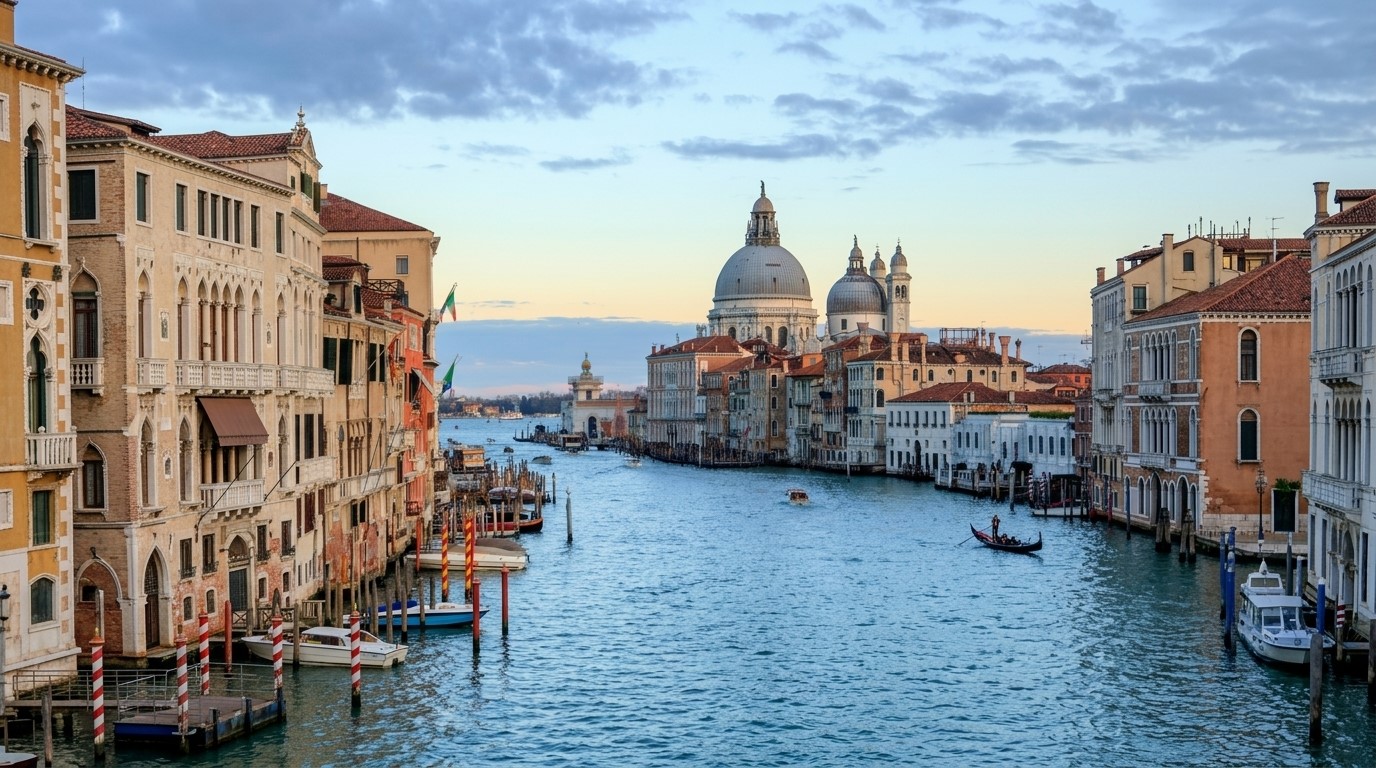
4. Venice, Italy

img-4
Nowhere else on Earth can you arrive at your own wedding by gondola, stepping out of the water onto the marble steps of a private palazzo.
Venice is unmatched historical romance — Grand Canal palazzos with frescoed ceilings, hidden gardens behind ancient walls, and the gentle slap of water against stone as your soundtrack between songs. The whole city is a stage set built over a thousand years, and a Venetian wedding leans into the theater of it: candlelight, masks if you want them, Bellinis at cocktail hour. It’s intimate by nature, since palazzos seat smaller crowds, which makes it perfect for couples who want jewel-box elegance over scale.
Top venues: Aman Venice, Belmond Hotel Cipriani, Palazzo Papadopoli.
A musician’s note: Frescoed palazzo rooms are echo chambers — beautiful for a string trio, brutal for an over-amplified DJ. What I’d do is keep volume disciplined and lean on acoustic textures through dinner, saving the bigger sound for a more controlled space. And since every piece of gear arrives by boat in this city, the smart move is to pack lean and label everything.

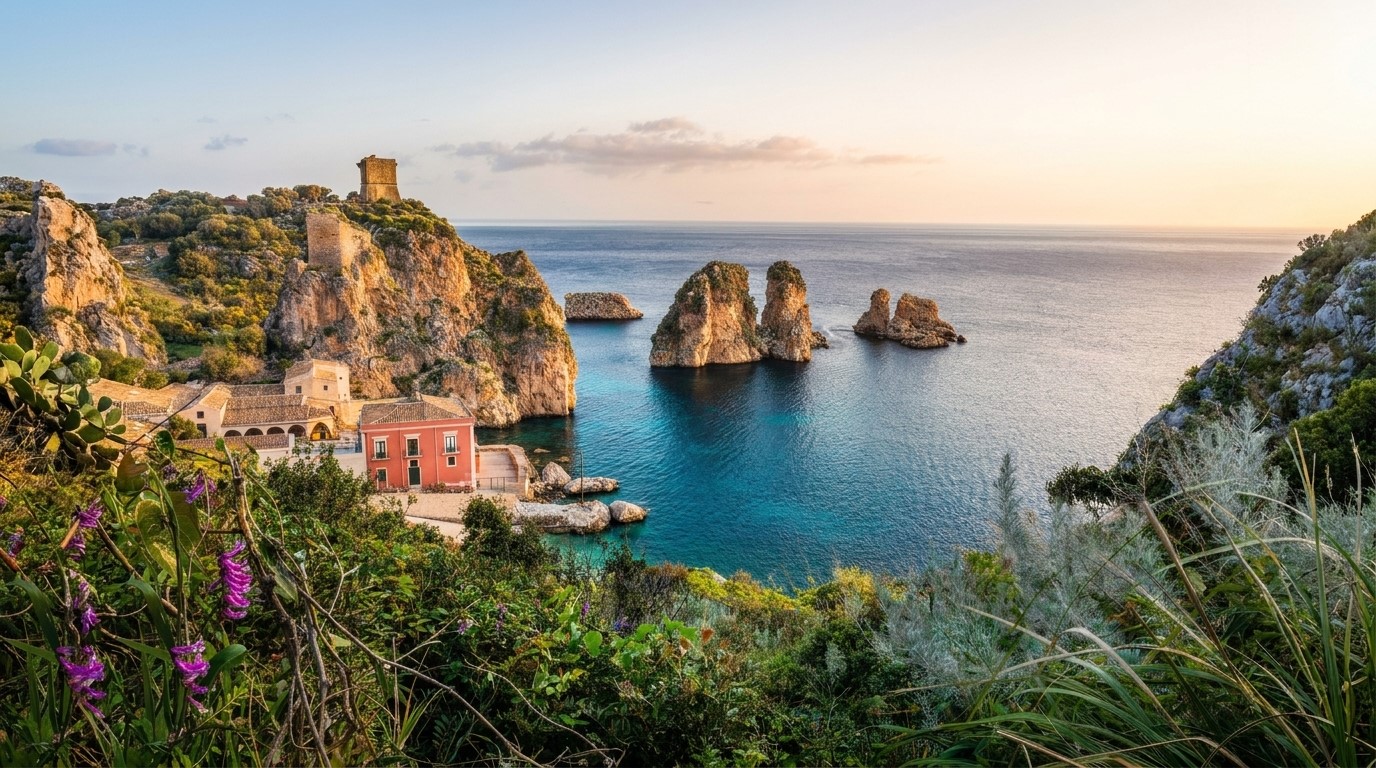
5. Sicily, Italy

img-5
Sicily’s rugged, cinematic energy hit the mainstream when The White Lotus set a season in Taormina — and the bookings haven’t slowed since.
This is the wilder, more dramatic Italy: Baroque towns, ancient Greek theaters, the smoking cone of Etna on the horizon, and a coastline that feels untamed. Taormina perches on a cliff above the Ionian Sea; the old tonnara (tuna fishery) at Scopello sits on a tiny cove that looks staged by a film crew. Sicilian hospitality is intense and generous — the food keeps coming and the celebration runs late.
Top venues: Tonnara di Scopello, Belmond Grand Hotel Timeo (Taormina).
A musician’s note: Coastal venues here mean heat and salt air, both hard on instruments and electronics. What I’d plan for is constant tuning checks and keeping gear shaded and covered until showtime. The upside is hard to overstate, and every player who’s worked the island says the same: an outdoor Sicilian dance floor with the sea behind it has an energy that’s almost impossible to kill once the party starts.

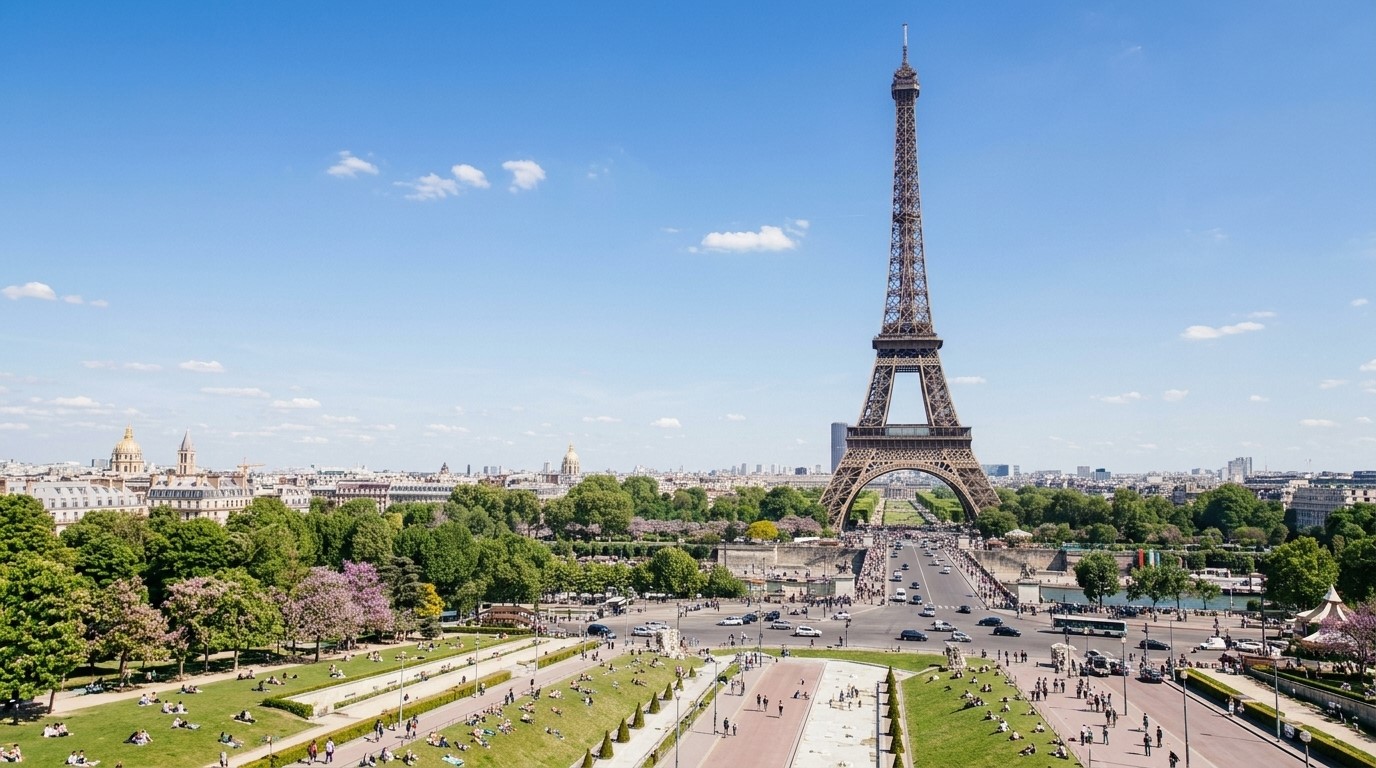
6. Paris, France

img-6
Stand on a private rooftop with the Eiffel Tower lit up behind you and say your vows — that’s the Paris pitch, and it lands every time.
Paris is sophisticated urban luxury: grand hotel ballrooms with gilded mirrors, chic hidden courtyards, and museum gardens that feel like private estates. A Paris wedding is unapologetically elegant — Champagne towers, a croquembouche tower of caramel-bound cream puffs instead of a sheet cake, and that effortless “French girl” chic in the styling. The city does refinement better than anywhere, and it knows it.
Top venues: Ritz Paris, Shangri-La Paris, Musée Rodin.
A musician’s note: Historic ballrooms like the Ritz are known for house rules and house acoustics, both of which I’d want to learn before load-in. These rooms reward a polished, well-balanced sound over sheer volume. A hybrid band sliding from a live jazz set into a curated DJ run is exactly what I’d build for a crowd that wants sophistication and a packed dance floor at the same time.
Your soundtrack: Édith Piaf’s “La Vie en Rose,” sung live during dinner, is Paris distilled into three minutes.

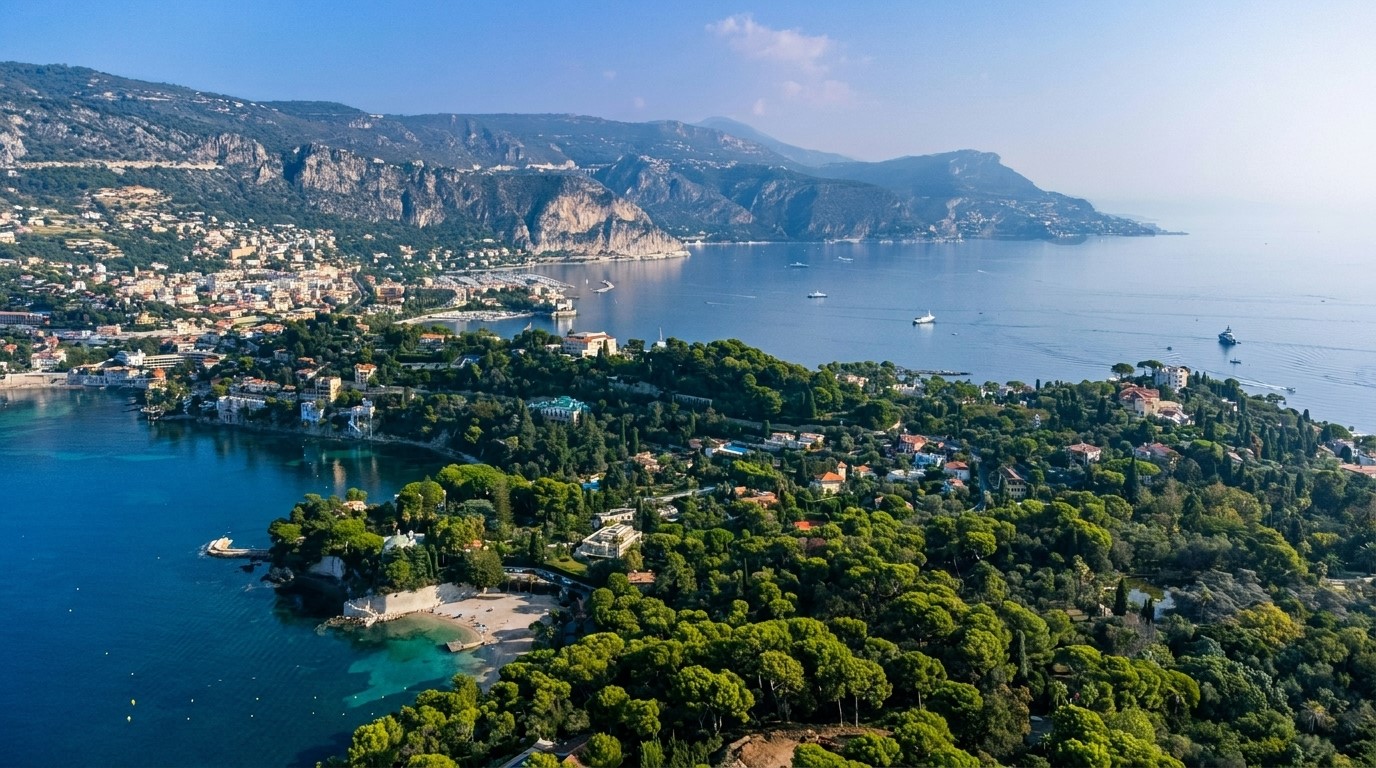
7. French Riviera (Côte d'Azur), France

img-7
Belle Époque glamour that never quite went out of style — that’s the Riviera, all exclusive beach clubs, pastel villas, and yachts bobbing in the bay.
This stretch of coast between Nice and Monaco has been the playground of the glamorous for over a century, and weddings here trade on that legacy: rose-colored villas with manicured gardens, terraces over the Mediterranean, and a golden September light that photographers swear by. It’s flashier than Provence and prouder of it. Villa Ephrussi de Rothschild, with its pink façade and nine themed gardens, is about as romantic a setting as France offers.

Top venues: Villa Ephrussi de Rothschild, Grand-Hôtel du Cap-Ferrat.

A musician’s note: Garden and terrace ceremonies catch the sea breeze, so what I’d do is weight the mic stands and run windscreens as a matter of course. The open coastal air swallows bass, but it makes live instruments sound wonderfully natural — and I dream about how a saxophone over cocktail hour on a Riviera terrace would carry.

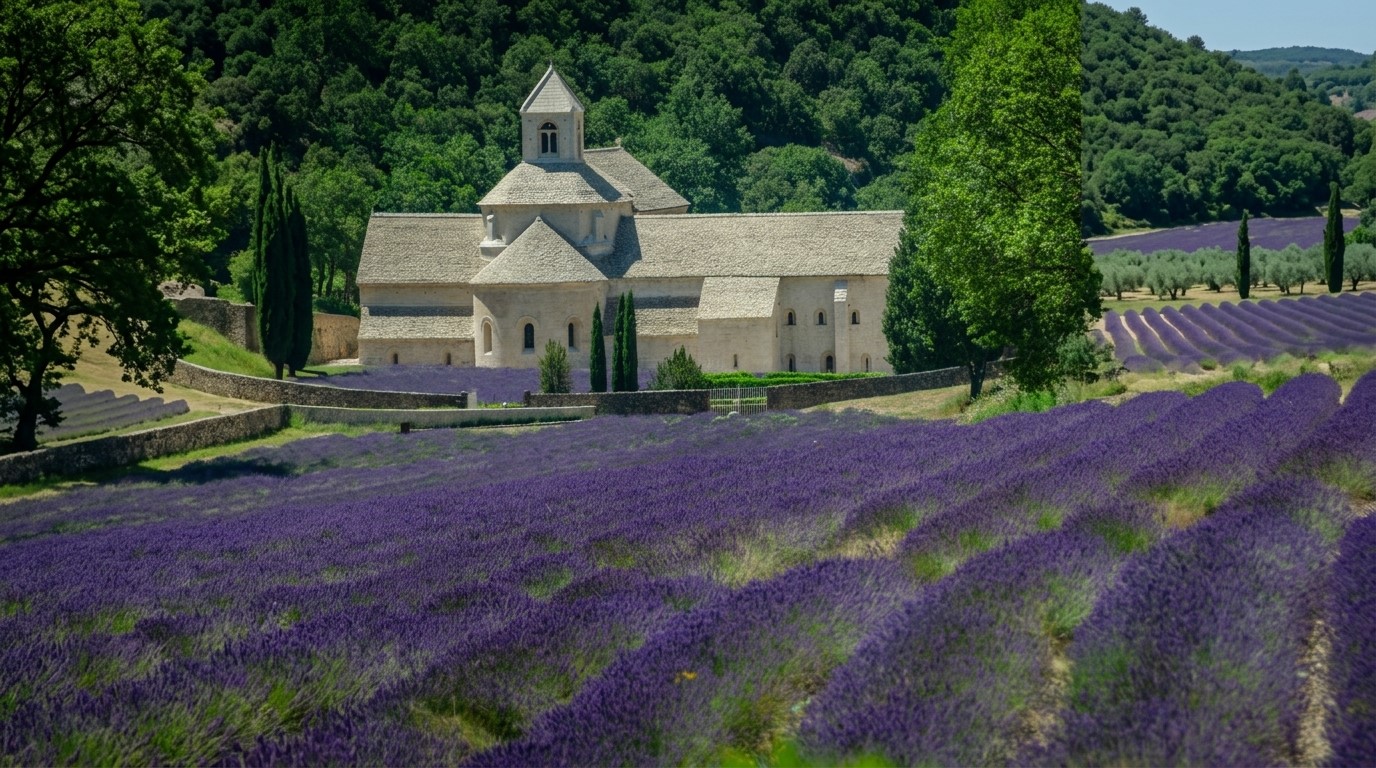
8. Provence, France

img-8
Provence was “quiet luxury” long before anyone coined the phrase — lavender fields, silver-green olive groves, and honey-stone châteaux straight out of a fairytale.
If the Riviera is about being seen, Provence is about disappearing into something beautiful. Rows of purple lavender stretching to the horizon, the hum of cicadas, long tables under plane trees, rosé that never stops flowing. It peaks in June when the lavender blooms, and the whole region smells like a candle shop in the best possible way. This is for couples who want romance without the spectacle.
Top venues: Château de Tourreau, Domaine des Etangs, Bastide de Gordes.
A musician’s note: Long farmhouse tables under open sky are gorgeous and acoustically forgiving, but rural châteaux are known for tricky power and long cable runs from the dinner area to the dance floor. What I’d do is scout the layout in advance so the energy doesn’t die during the walk from dessert to the first dance.

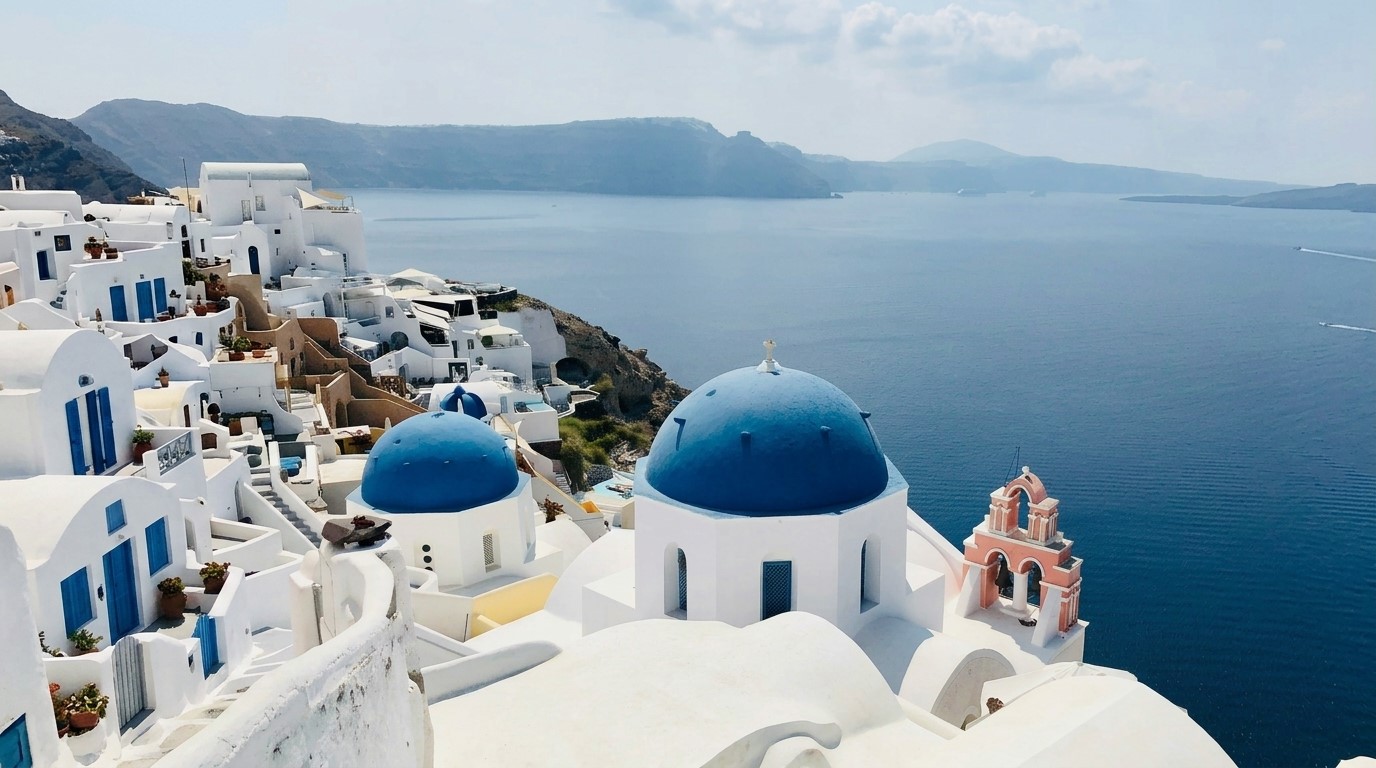
9. Santorini, Greece

Santorini
No sunset on Earth is more photographed than the one over the Santorini caldera, and couples plan entire weddings around its exact minute for good reason.
Santorini is the postcard: whitewashed villages spilling down volcanic cliffs, blue-domed churches, and that legendary caldera view where the sun drops into the sea and the whole island turns gold, then pink, then violet. Greek weddings are deeply communal affairs — the Stefana crowning ceremony where linked crowns mark the couple as king and queen, the money dance where guests pin cash to the couple’s clothes, and a hospitality so generous it has its own word, philoxenia.
Top venues: Canaves Oia Suites, Grace Hotel, Rocabella Santorini.
A musician’s note: I’ll be blunt — everything I’ve heard says the wind is the enemy here. Cliffside ceremonies face serious gusts off the caldera, so weighted stands and quality windscreens would be non-negotiable for me. Island power can also be unstable, which is why I’d plan for a conditioner and a backup. Nail those two things and you’ve got the most spectacular ceremony backdrop in the world.

Your soundtrack: The bouzouki theme from Zorba the Greek builds slow and ends in a full-on dance — perfect for getting everyone on their feet.

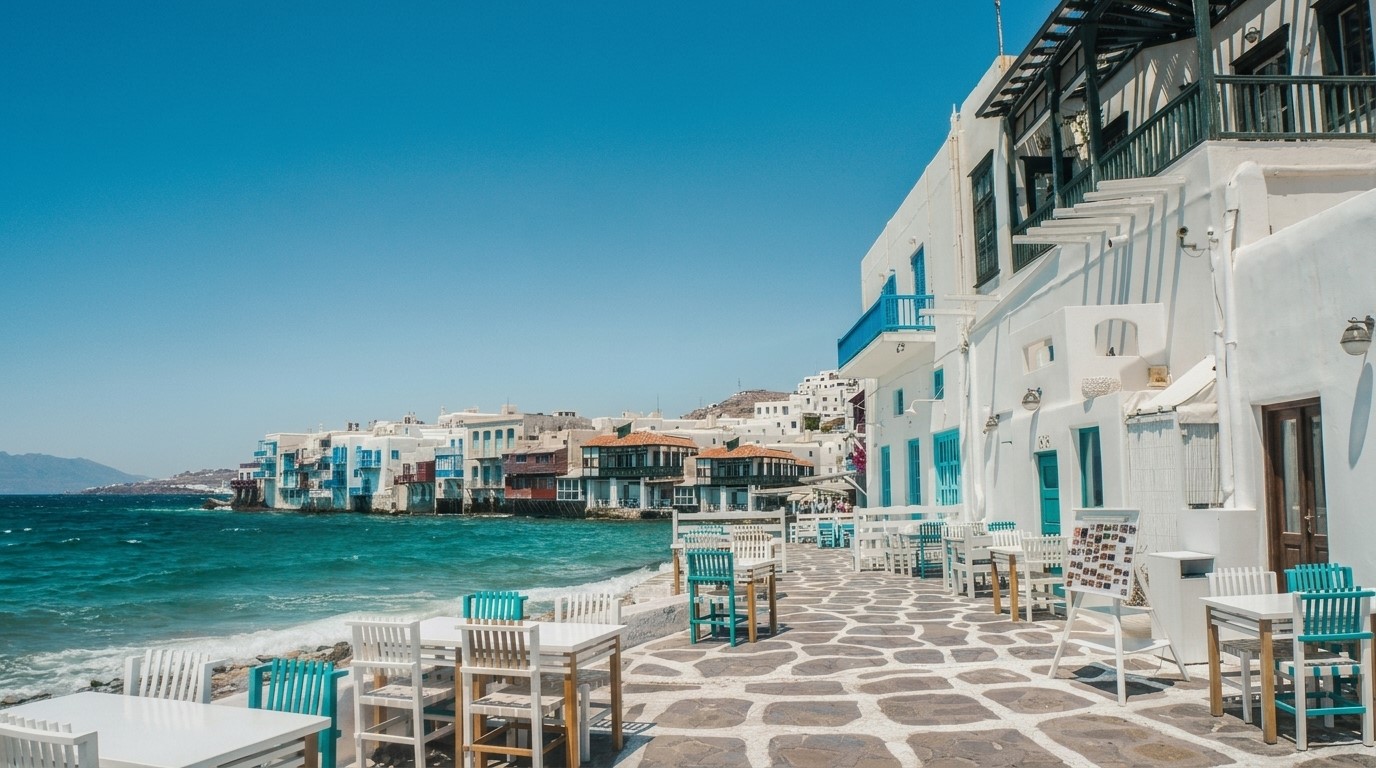
10. Mykonos, Greece

img-10
Then there’s the other side of Greece. Mykonos is bohemian-chic by day and a full-throttle party island by night, with a dance floor energy that doesn’t quit.
Where Santorini sells the quiet drama of a sunset, Mykonos sells beach clubs, whitewashed alleys, windmills on the hill, and a crowd that came to dance. Weddings here skew younger and louder, often spilling from a beachfront reception into a late-night celebration. The Grecian goddess dress code — flowing white, gold accessories — suits the island perfectly, and the same warm hospitality and communal traditions still apply.
Top venues: Santa Marina (A Luxury Collection Resort), Mykonos Blu.
A musician’s note: This is a DJ-forward crowd, so a DJ-led hybrid is what I’d reach for — a DJ driving the night with a vocalist and a sax player layering live energy on top. Beachfront setups are known for sand, salt, and the same wind issues as the rest of the Aegean, so I’d pack covers, backups, and a little patience.

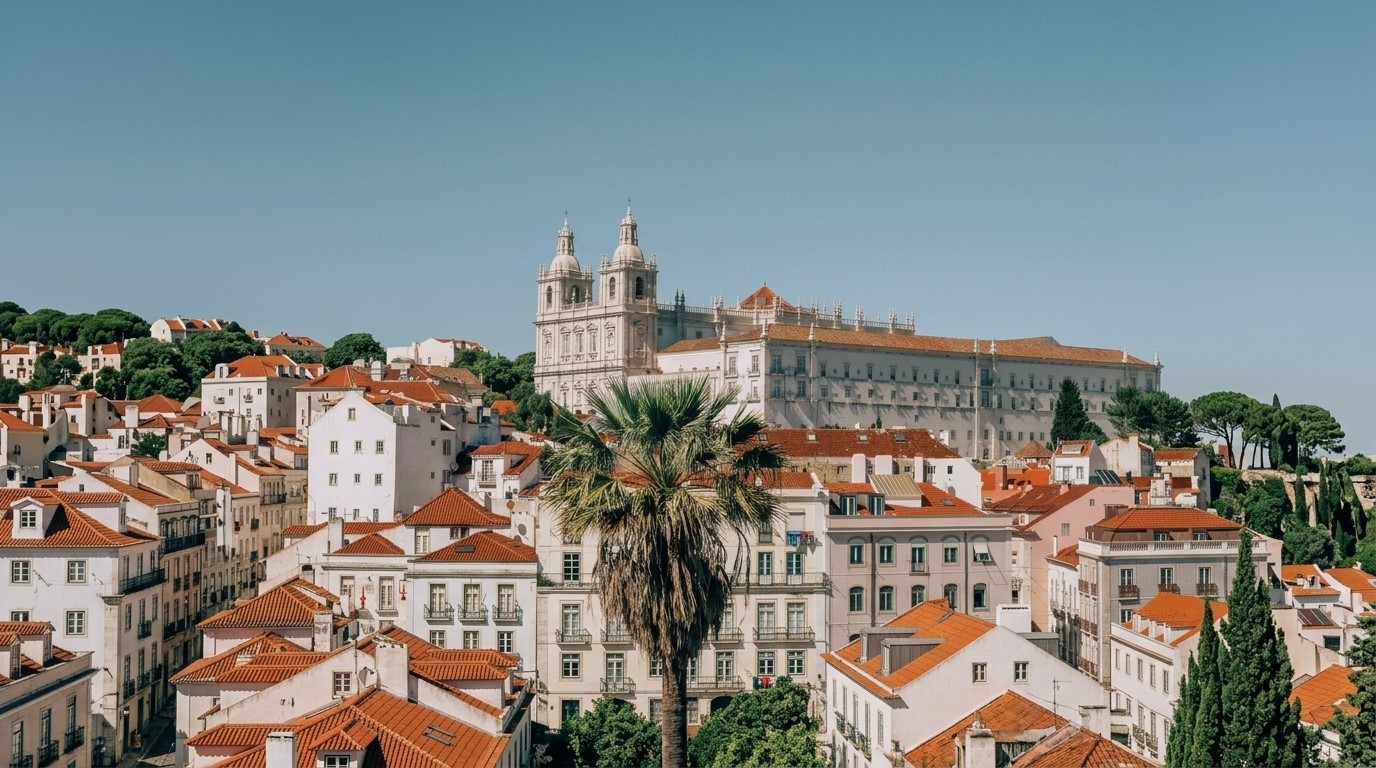
11. Sintra & Lisbon, Portugal

img-11
Portugal has quietly become the rising star of European weddings, and Sintra is the reason — mist-covered forests and candy-colored Romanticist palaces that look invented for a storybook.
Just outside Lisbon, Sintra feels like a fairytale that got lost in the hills: 19th-century palaces in pink and yellow, dense green forest often wrapped in morning mist, and azulejo tilework everywhere you look. Lisbon itself adds golden light, vintage trams, and the melancholy beauty of fado music drifting out of tavern doors. Portuguese weddings believe in abundance — often two main courses, the mandatory bacalhau (salt cod), and the gold filigree Coração de Viana heart as the signature accessory.
Top venues: Penha Longa Resort, Tivoli Palácio de Seteais.
A musician’s note: Palace interiors are stone and echo, so I’d treat them like the Italian villas — acoustic textures for the rooms, controlled volume, distributed sound. A live fado-inspired guitar piece during dinner is exactly the kind of moment I dream about: an authentic taste of place before the dance set kicks in.

12. Algarve, Portugal

img-12
Swap Sintra’s mist for sunshine and you have the Algarve — dramatic golden limestone cliffs, hidden sea caves, and some of the most reliable summer weather in Europe.
This is Portugal’s southern coast, where ochre cliffs drop into the Atlantic and the sun shows up almost every day from late spring through October. Beach clubs, clifftop resorts, and sea-cave grottoes give you backdrops that range from chic-modern to genuinely wild. It’s more relaxed and more affordable than the marquee French and Italian coasts, which is a big part of its appeal.
Top venues: W Algarve, Vila Vita Parc, Pine Cliffs Resort.
A musician’s note: Clifftop and beach receptions mean Atlantic wind and open-air bass loss — the same coastal playbook every player runs on the water, with live instruments carrying the warmth a sound system can’t. The reliable weather, though, is a gift: it’s the kind of place where I’d plan an outdoor dance floor with real confidence.

13. Ibiza, Spain

img-13
There’s a lot more to Ibiza than its superclubs. The island has a sophisticated boho soul — hidden coves, agroturismo farmhouses, and Mediterranean sunsets the locals treat as a daily event.
Yes, Ibiza is the world capital of dance music, but the wedding side of the island is dreamier than its reputation: whitewashed fincas among the pines, secret rocky coves, and sunset views (especially on the west coast) that draw crowds who applaud when the sun hits the water. You can lean into the island’s electronic heritage for a high-energy night, or keep it bohemian and barefoot. Spanish weddings bring late dinners, jamón ibérico, cava, and a party that genuinely runs until sunrise.
Top venues: Six Senses Ibiza, Nobu Hotel Ibiza Bay, Agroturismo Atzaró.
A musician’s note: Of all 30 places on this list, Ibiza is the one I think the hybrid model was made for. A live band that hands off seamlessly to a world-class DJ set is the entire spirit of the island in one package — live emotion for the dinner and first dance, then a club-grade dance floor that respects where you are. Conceptually, this is our home turf.

14. Mallorca, Spain

img-15
Of all Spain’s islands, Mallorca is the most elegant — artistic heritage in the hill villages, the dramatic Tramuntana mountains, and secluded stone estates a world away from the tourist coast.
The northwest, around Deià and Sóller, is all terraced olive groves, sleepy stone villages where artists and writers have hidden out for a century, and mountains that plunge toward the sea. La Residencia in Deià is a converted manor that captures it perfectly. Mallorca offers Mediterranean beauty with more privacy and less flash than Ibiza, paired with the same generous Spanish table and late-night celebration.
Top venues: Six La Residencia (A Belmond Hotel), Castell Son Claret.
A musician’s note: Mountain estates with stone courtyards are known for a warm, contained acoustic — easier to work with than open coast, harder than an open field. These are the rooms I dream about for a live set, because the stone adds a natural richness without the harsh echo of a fully enclosed hall.

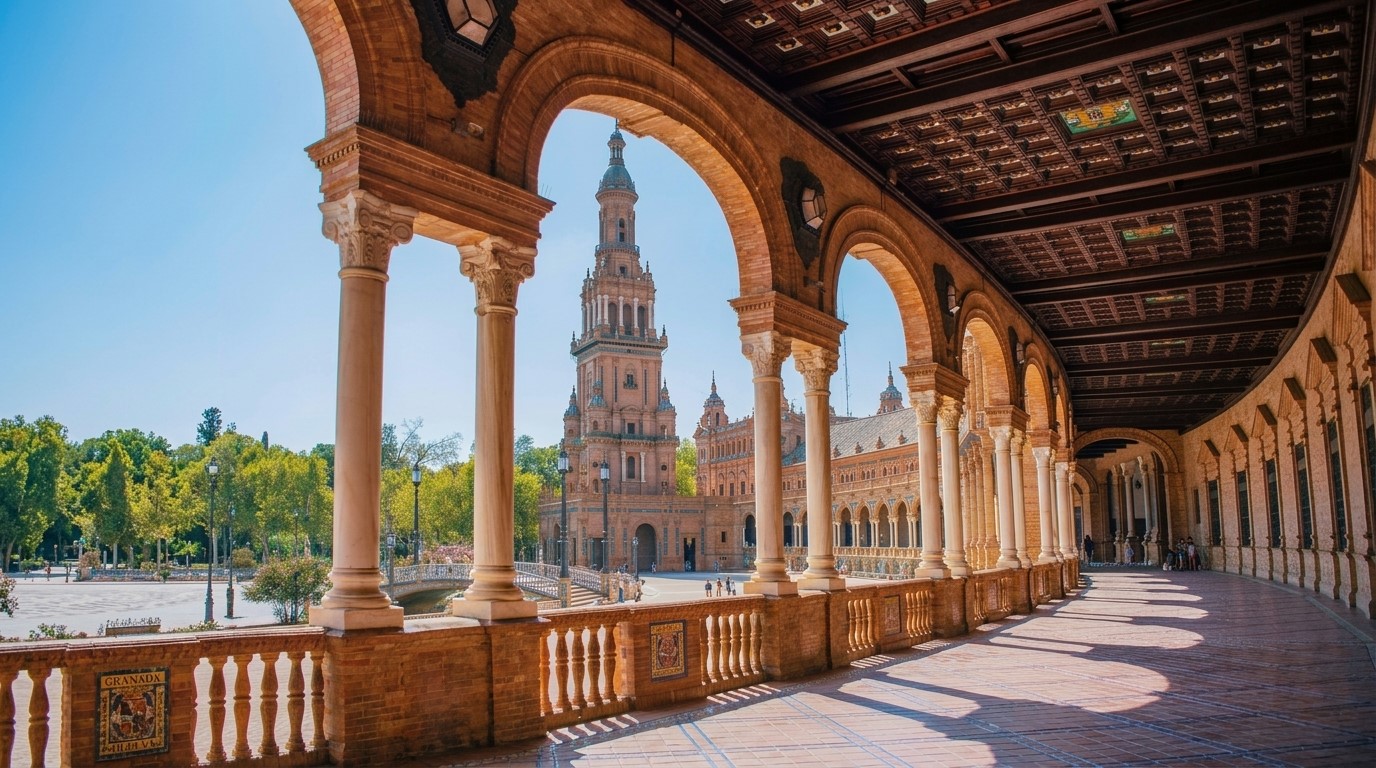
15. Seville, Spain

img-14
Seville is passion turned into architecture — Moorish palaces, orange-scented courtyards, and the deep, foot-stomping pulse of flamenco woven into the city’s bones.
Andalusia’s capital is hot, romantic, and gloriously theatrical. Tiled courtyards, the Alcázar’s Mudéjar arches, hidden patios dripping with bougainvillea, and orange trees perfuming the whole city in spring. Weddings here can incorporate the Mantilla lace veil and high comb, flamenco performers, and the Feria spirit. Spring (around the April Feria) and early autumn are the sweet spots, before the summer heat turns serious.
Top venues: Six Hotel Alfonso XIII, Casa de Pilatos, Hacienda de San Rafael.
A musician’s note: Flamenco is built on hand-claps, guitar, and a stamping rhythm, and bringing a live flamenco element into cocktail hour before transitioning into the reception is one of the cultural handoffs I most dream of getting to play. Courtyard acoustics are tiled and live, so what I’d do is keep amplification tasteful and let the natural reverb do some of the work.

16. Dubrovnik, Croatia

img-16
A walled medieval city dropped onto the edge of the impossibly blue Adriatic — Game of Thrones fans will recognize Dubrovnik instantly, and so will anyone who loves a fortress wedding.
Inside those famous stone walls, polished limestone streets gleam; just outside them, the Adriatic glows in shades of turquoise you have to see to believe. You can marry in a Renaissance fortress, on a clifftop terrace, or at a seaside villa, all within sight of the old town. Croatia delivers Mediterranean grandeur at a slightly gentler price point than Italy or France, with summer sun you can count on.
Top venues: Villa Sheherezade, Hotel Excelsior, Revelin Fortress.
A musician’s note: A stone fortress like Revelin is known to be a glorious, reverberant beast — incredible for live brass and strings, dangerous for boomy low-end. Distributed speakers and disciplined sub levels are what keep a room like that from washing out. The seaside terraces, by contrast, are open and wind-prone, so I’d plan two different sound approaches for one event and switch between them as the night moves indoors.

The Americas & Caribbean

This side of the world trades old-world reverb for open sky, warm water, and a looseness in the celebration that I’d love to be part of. From everything I’ve heard, the parties here start with the sunset and don’t ask permission.

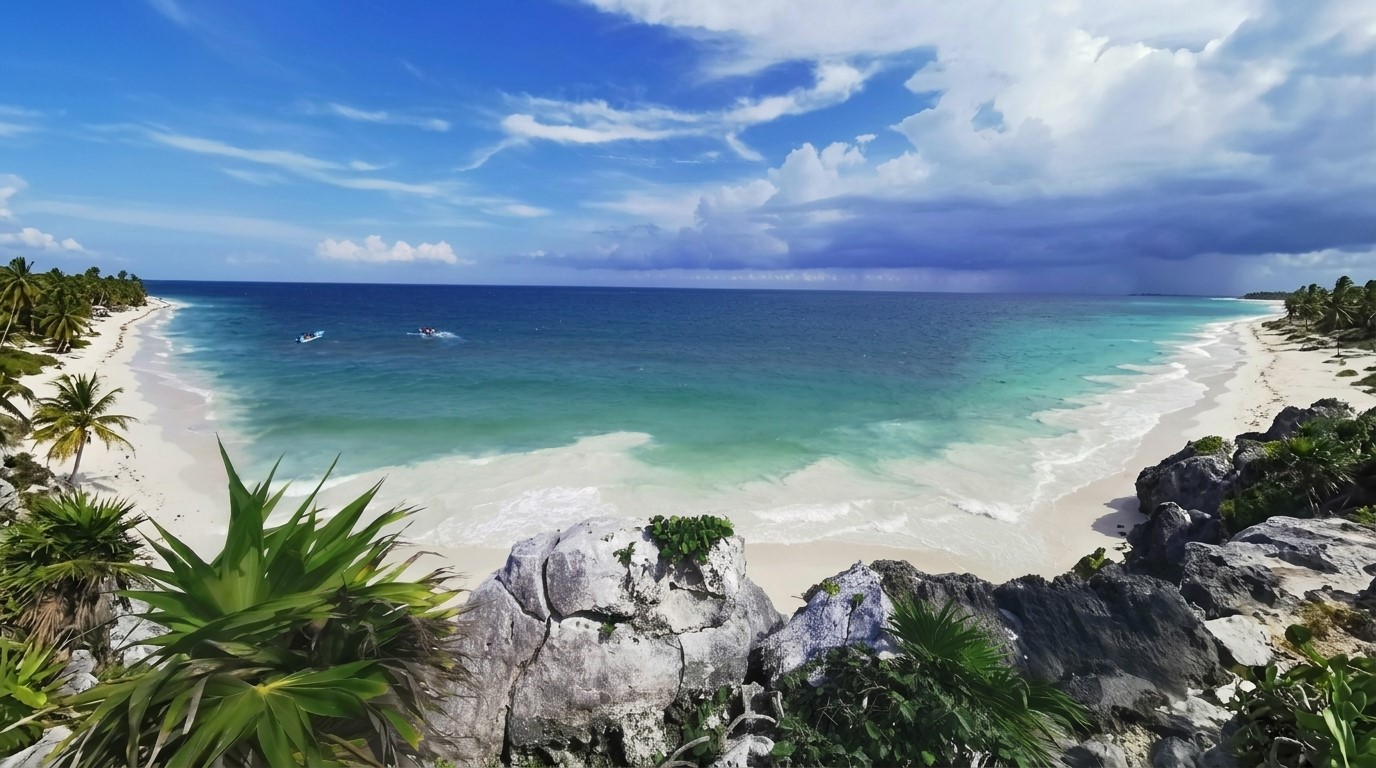
17. Riviera Maya, Mexico

img-17
Imagine swapping vows in a jungle clearing beside a cenote — a sacred underground freshwater pool the ancient Maya believed was a portal to the underworld — then dancing under the stars at an all-inclusive resort that handles every detail.
Mexico’s Caribbean coast is jungle-meets-ocean luxury: powder beaches, turquoise water, mangrove-lined lagoons, and those otherworldly cenotes. The all-inclusive resorts here make destination weddings genuinely easy — flights, rooms, ceremony, reception, all in one place. But the soul of a Mexican wedding is the culture: El Lazo (a floral cord looped in a figure-eight around the couple), Las Arras (thirteen gold coins), and a celebration that’s multi-generational, loud, and joyful until dawn.
Top venues: Rosewood Mayakoba, Banyan Tree Mayakoba, Hotel Xcaret Arte.
A musician’s note: ungle humidity is real, and everything I know says it detunes a guitar fast — constant tuning checks would be the rule. To launch the dance set, the move I dream about is kicking off with the Víbora de la Mar (the sea-snake dance), which players tell me gets every generation off their chairs and laughing within thirty seconds. From there the night runs itself.
Your soundtrack: A live mariachi set during cocktail hour, then “La Bamba” to detonate the dance floor.

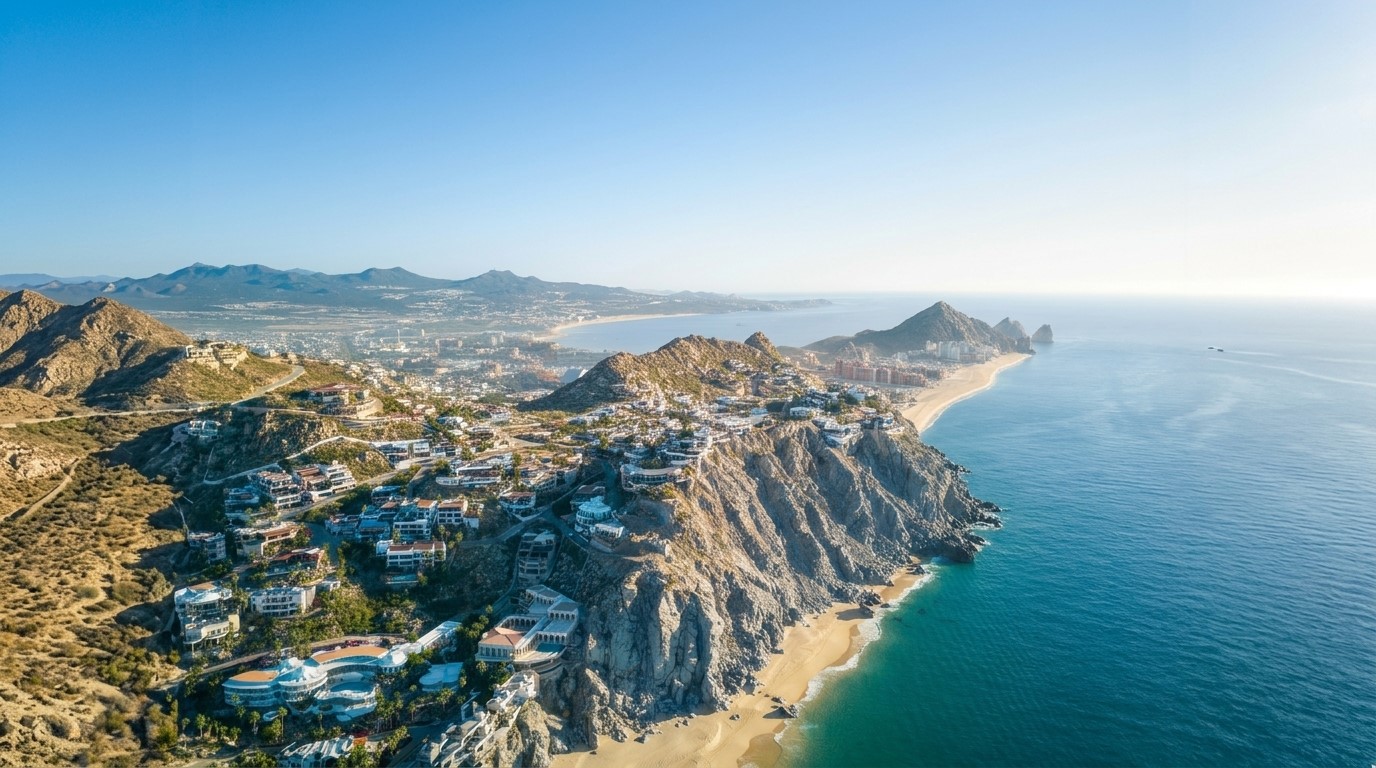
18. Cabo San Lucas, Mexico

img-18
Cabo is where the desert crashes into the Pacific — dramatic rock arches, cactus-dotted cliffs, and a reliable run of sunshine that makes outdoor planning almost stress-free.
At the tip of the Baja peninsula, Cabo offers a starker, more modern beauty than the lush Riviera Maya: golden desert hills, the iconic El Arco rock formation, and sleek contemporary resort architecture built to frame the sea. The Pacific here is dramatic and the sunsets are enormous. It draws a glamorous, design-conscious crowd, and the November-to-April dry season is about as dependable as weather gets.
Top venues: Marquis Los Cabos, Esperanza (Auberge Resorts), Waldorf Astoria Los Cabos Pedregal.
A musician’s note: Oceanfront cliffs mean Pacific wind and salt spray, so it’s the coastal kit again — weighted stands, windscreens, gear covered until the last minute. What sets Cabo apart, from what I hear, is space: its modern resorts have proper outdoor venues built for entertainment, which would give me room to build a real production rather than squeezing onto a ledge.

19. Cartagena, Colombia

img-19
A sun-soaked colonial jewel: pastel balconies dripping with bougainvillea, 16th-century stone forts, and a Caribbean party culture that turns the streets themselves into a dance floor — that’s Cartagena.
Inside the old walled city, every street is a postcard: colonial mansions in mango and coral, horse-drawn carriages, plazas that fill with music after dark. The energy is pure Caribbean — champeta, cumbia, and salsa pulsing out of every doorway. Couples can marry in a converted convent or fortress in the old town, then take guests to a private island club just off the coast. It’s romantic, vibrant, and still a relative secret next to Mexico.
Top venues: Sofitel Legend Santa Clara, Éteka Hotel (Tierra Bomba Island).
A musician’s note: This is a city that wants to dance, and from everything I’ve heard, Latin percussion is everything here. A hybrid setup with live congas and brass over a DJ foundation is what I’d build to match Cartagena’s street-party DNA. The old-town courtyards are known to be stone and lively-sounding, so I’d keep the live percussion forward and the amplification clean.
Your soundtrack: A live salsa band moment — think the horn-driven joy of “Vivir Mi Vida” — fits Cartagena like a glove.

20. Maui, Hawaii, USA

img-20
Maui delivers tropical volcanic drama without a passport — lush rainforests, black-sand beaches, waterfalls, and Pacific resorts that rank among the best on Earth.
For American couples, Maui is the dream destination that’s still home: no customs, no currency exchange, US legal simplicity, and scenery that competes with anywhere on this list. Wailea’s sunny southwest coast hosts the grand resorts; the misty uplands hide gems like Haiku Mill, a former sugar mill turned ivy-draped wedding wonderland. Hawaiian tradition adds genuine meaning — lei exchanges, conch-shell blessings, and the spirit of aloha that runs through the whole celebration.
Top venues: Four Seasons Resort Maui at Wailea, Haiku Mill.
A musician’s note: Trade winds are a daily fact of life on Maui, so the oceanfront sound kit applies. The magic move, though, is cultural, and it’s one I dream of playing: opening with traditional Hawaiian music and a ukulele or slack-key guitar set before sliding into the reception. Everything I know says live instruments handle the island’s natural, breezy outdoor acoustics beautifully.
Your soundtrack: Israel Kamakawiwoʻole’s “Over the Rainbow / What a Wonderful World” — there’s no more Hawaiian moment than that.

21. Napa Valley, California, USA

img-21
Napa is wine country elegance at its most refined — rows of vines stretching to oak-studded hills, Michelin-starred kitchens, and a sophistication that feels effortlessly Californian.
America’s most famous wine region does grown-up glamour with ease: hillside estates, working wineries, and dining at a level that rivals Europe. Auberge du Soleil looks out over the whole valley from its olive-grove perch; Stanly Ranch and Meadowood offer estate-style luxury. The harvest season (late summer into fall) is golden and warm, and the whole valley smells of crushed grapes. It’s the destination wedding for couples who want world-class without the long-haul flight.
Top venues: Auberge du Soleil, Meadowood Napa Valley, Stanly Ranch.
A musician’s note: An outdoor vineyard reception is an acoustic pleasure — open air, clean sound, no walls to fight. The catch echoes Tuscany: estate power can be limited, and there are often local noise ordinances with a hard cutoff time. What I’d do is confirm the curfew up front and build the night’s energy curve around it, so the party peaks before the plug gets pulled, not after.

22. St. Lucia

img-22
Two volcanic spires rising straight out of the Caribbean Sea — the Pitons — dominate St. Lucia, which means a wedding here is essentially staged against the most dramatic backdrop in the West Indies.
This lush volcanic island trades flat beaches for rainforest, hot springs, and those unforgettable twin peaks. Jade Mountain’s open-walled “sanctuaries” frame the Pitons like living paintings; Sugar Beach sits in the valley right between them. It’s intensely romantic and consistently rated among the most beautiful islands on the planet — a honeymoon favorite that doubles perfectly as a wedding destination.
Top venues: Sugar Beach (A Viceroy Resort), Jade Mountain.
A musician’s note: Open-air mountain and beach venues with that humid Caribbean air call for vigilant tuning and weatherproofed gear. The reward, by every account I’ve heard, is intimacy: these are smaller, jaw-dropping settings where a tight hybrid group — a couple of musicians and a DJ — fills the space with warmth without overwhelming a venue built for two people in love and their closest guests.

23. Guanacaste, Costa Rica

img-23
Guanacaste is eco-luxury with a barefoot soul — rugged Pacific coastline, surf beaches, dry tropical forest, and the unhurried “Pura Vida” philosophy baked into every interaction.
Costa Rica’s northern Pacific province pairs serious natural beauty with genuine sustainability — howler monkeys in the canopy, sea turtles nesting on the beaches, and resorts built to tread lightly. The Four Seasons on the Papagayo Peninsula is the marquee property; Las Catalinas is a car-free coastal town designed for walking. The dry season (roughly December through April) brings dependable sun, and the whole experience leans toward adventure and authenticity over formality.
Top venues: Four Seasons Peninsula Papagayo, Las Catalinas.
A musician’s note: Beachfront and jungle-edge setups bring humidity, wind, and, from the stories I’ve heard, the occasional curious wildlife guest. I’d plan power carefully, because eco-resorts sometimes run partly off-grid. The vibe here is relaxed, so that’s how I’d read it — acoustic and tropical for the ceremony and dinner, then a steady build into a celebration that matches the island’s easy energy.

Asia, Africa & The Middle East

This is the long-haul tier — the destinations that take real planning to reach and reward you with experiences you can’t get anywhere else. Different traditions, different acoustics, different rules. The kind of challenge I dream of taking on.

24. Bali, Indonesia

img-24
They call Bali the Island of the Gods, and you feel it the moment you arrive — a place where spirituality, jungle, and ocean braid together into something genuinely otherworldly.
Bali offers three distinct wedding worlds: the lush jungle ravines and rice terraces of Ubud, the dramatic limestone cliffs of Uluwatu with their famous clifftop clubs, and the beach-and-sunset scene of Seminyak. The island’s philosophy of Tri Hita Karana — harmony between people, nature, and the divine — runs through everything, including the elaborate Pawiwahan ceremony with its flower offerings and the opulent Payas Agung gold-crown regalia.
Top venues: Four Ayana Resort (Rock Bar), Bvlgari Resort Uluwatu, The Apurva Kempinski.
A musician’s note: Here’s a lesson players who’ve worked the jungle pass along: ravines and dense foliage swallow sound, so you need far more power than you’d ever guess from looking at the space. The transition I dream about most in our whole repertoire might be a traditional gamelan orchestra handing off into a modern DJ set — ancient bronze gongs melting into a clifftop beat as the sun drops into the Indian Ocean.

25. Phuket, Thailand

img-25
Phuket is the Land of Smiles at its most polished — pristine beaches, ultra-private villa resorts, and a standard of hospitality that makes guests feel like royalty.
Thailand’s largest island anchors a region of limestone karsts rising from emerald water, white-sand bays, and discreet luxury villa estates where you can take over the entire property. Amanpuri practically invented the Asian luxury resort; Trisara and Rosewood continue the tradition. Thai weddings carry beautiful symbolism — long noodles for long life, Foy Thong (golden silk threads) for everlasting love — and the Chut Thai national dress in your “lucky color,” chosen by the day of the week you were born.
Top venues: Four Amanpuri, Rosewood Phuket, Trisara.
A musician’s note: Beachfront and open-sala (pavilion) settings are warm and humid, so it’s tuning vigilance and weatherproofing again. Thai hospitality is known for a graceful, unhurried tone, and I’d match it — gentle live music for the ceremony and dinner, building to a celebration that honors the room rather than fighting it. Private villas also mean fewer noise restrictions, so the night can run long.

26. Kyoto, Japan

img-26
Kyoto is the antithesis of the resort wedding — a place of “slow-living” intentionality, where Zen gardens, bamboo groves, and centuries-old temples ask you to be fully present.
Japan’s ancient capital is all restraint and refinement: raked gravel gardens, moss so green it looks lit from within, the hush of a temple courtyard, and the seasonal poetry of cherry blossoms in spring or fiery maples in autumn. A Shinto ceremony has the bride in a Shiromuku white kimono — a “blank slate” — often changing into a colorful brocade Uchikake afterward. The food is auspicious by design: tai (sea bream, a pun on “celebratory”) and sekihan red rice.
Top venues: Four Ritz-Carlton Kyoto, Park Hyatt Kyoto, Shunkoin Temple.
A musician’s note: Kyoto is the one place on this list where I’d dial everything down and let the silence do the work. Temple and garden settings are known to reward delicate, acoustic music — a single instrument can carry more emotion than a full band here. When the reception moves to a hotel and the energy lifts, the hybrid setup is built to bring the celebration up gradually, always respecting the intentional calm that drew you to Kyoto in the first place.

27. The Maldives

img-28
The Maldives is seclusion in its purest form — your own overwater bungalow, a private atoll, and a turquoise lagoon that makes the rest of the world feel very far away.
This scatter of coral islands in the Indian Ocean is the definitive escape: villas perched on stilts over impossibly clear water, sandbank ceremonies on slivers of beach in the middle of the sea, and resorts that often occupy an entire private island. It’s built for intimacy — most weddings here are small, sometimes just the two of you plus a tiny party — and it’s the honeymoon destination so many couples dream about, which makes marrying here a two-in-one.
Top venues: Four St. Regis Maldives Vommuli Resort, Soneva Jani, One&Only Reethi Rah.
A musician’s note: Logistics are everything in the Maldives — gear arrives by seaplane or boat, so the rule would be to pack minimal and bulletproof. Sandbank and overwater settings are open, breezy, and salt-heavy, so I’d weatherproof aggressively. For an intimate, elopement-style celebration, a stripped-down acoustic duo over the lagoon at sunset is the kind of pure magic I dream about — no big production required.

28. Marrakech, Morocco

img-27
Marrakech is a sensory explosion — the call to prayer over the rooftops, the scent of spice and orange blossom, intricate riads hidden behind plain walls, and luxury desert camps under a blanket of stars.
This is Arabian Nights made real: jewel-box riads with tiled courtyards and trickling fountains, the Agafay desert just outside the city where you can pitch a luxury camp under the Atlas peaks, and palatial properties like La Mamounia. A Moroccan wedding is a theatrical, multi-day coronation — the bride carried in on the Amariya throne, up to seven dress changes representing different regions, the sacred henna night, and mint tea poured throughout.
Top venues: Four La Mamounia, Royal Mansour, Amanjena.
A musician’s note: Riads are echo chambers — tiled courtyards bouncing sound in every direction. The rule I’d follow here is acoustic instruments for the courtyard and the DJ set reserved for interior rooms where the reflections can be controlled. Bringing in live percussion to underscore the Amariya entrance procession is one of the most dramatic cultural moments I dream of getting to play anywhere in the world.

Your soundtrack: Live hand-drums and an oud for the bride’s grand entrance set a tone no recording can match.

29. Dubai, UAE

img-29
Dubai is architectural spectacle as a wedding venue — the sail-shaped Burj Al Arab, the desert at the city’s edge, and a logistics machine so smooth it can make a 500-guest celebration feel effortless.
If your vision is scale and glamour with zero compromise, Dubai delivers: skyline rooftops, opulent ballrooms, palm-island resorts, and desert dune ceremonies all within an hour of a world-class airport. It’s the easiest long-haul destination to reach, the service is relentlessly five-star, and the city is built to host enormous, lavish events without breaking a sweat. The cooler months (roughly November through March) are the season.
Top venues: Four Burj Al Arab, Raffles The Palm, Bulgari Resort Dubai.
A musician’s note: Dubai’s venues are known to be purpose-built for production — proper power, staging, and AV infrastructure, which sounds like a treat after some of the off-grid spots on this list. That means there’s room to scale up: full band, full lighting, the works. Desert ceremonies bring heat and sand, so gear would get shaded and covered, but indoors you’d have everything needed to build a genuinely cinematic show.

30. Cape Town, South Africa

img-30
Cape Town pairs two of the planet’s great landscapes in one place — the sheer face of Table Mountain on one side, the rolling Cape Winelands on the other.
This is dramatic, diverse beauty: a flat-topped mountain looming over the city, white-sand beaches, and, just inland, the Stellenbosch and Franschhoek wine valleys, where Cape Dutch estates host weddings among the vines. Delaire Graff Estate looks out over the mountains with a view that stops conversation; the historic Mount Nelson brings old-world hotel grandeur. The exchange rate also makes a high level of luxury more attainable here than almost anywhere else on this list.
Top venues: Four Delaire Graff Estate, Belmond Mount Nelson Hotel, Molenvliet Vineyards.
A musician’s note: Winelands estates are known for that lovely open-air-with-some-stone-surfaces acoustic, much like Tuscany or Napa — clean and warm. The “Cape Doctor” wind can pick up in summer, so I’d keep the coastal kit handy. South Africa’s musical culture is rich and rhythmic, and folding a bit of local sound into cocktail hour is exactly the kind of touch I dream of bringing — an authentic sense, for guests, of where they’ve landed.

Your Destination, Your Soundtrack: Why the Music Travels With You

Here’s something I feel in my bones every time I imagine these places: a place has a sound. Italy sounds like a strolling tenor and a mandolin. Greece sounds like a bouzouki picking up speed. Mexico sounds like a mariachi trumpet hitting that high note that makes everyone cheer. Bali sounds like bronze gongs dissolving into a sunset beat. When the music matches the place, the whole celebration locks into something deeper than a playlist — it becomes the memory of that destination.
That’s the heart of the hybrid band-DJ idea, and it’s why so many couples building a destination wedding end up thinking about entertainment differently. Because most of these destinations double as honeymoons, the song you choose for your first dance in a Tuscan vineyard or on a Santorini cliff becomes the song you’ll play on the anniversary — the one that snaps you straight back to that night and that view. Recorded music is wonderful, but a live band playing “La Vie en Rose” in a Paris ballroom, or learning your specific first-dance song and arranging it for the room, or sliding from a live mariachi set into a DJ-driven floor in Mexico — that’s the thing guests describe to people for years. You had to be there.
At DLE Event Group, our musicians can learn custom songs and arrange them for the moment and the room. We can lean into the local flavor — a flamenco guitar in Seville, a fado piece in Lisbon, live percussion for a Moroccan Amariya entrance — and then keep a world-class dance floor going long after dinner. That blend of, as we say, “the tenderness of live music and the energy of a DJ” is exactly what a destination demands, because the place gives you the picture and the music gives you the feeling. As the saying goes, music is what feelings sound like — and a destination wedding is nothing if not pure feeling.

Why Couples Bring DLE Event Group Across the Globe

We’re a New York City–based luxury wedding entertainment company, and we’re proud to be recognized as the pioneers of the band-DJ hybrid experience — live musicians and a professional DJ working as one seamless act, so you never have to choose between authentic live emotion and the versatility of a great DJ. Over more than a decade and 100-plus weddings and events, that approach has earned The Knot Best of Weddings Hall of Fame eleven times (2013–2023), and we’re a 2025 winner as well.
We perform from New York City to destinations across the globe — and that “across the globe” part is real, not a slogan. Our hybrid format is built to travel: configurations from an intimate two-person setup to a full ensemble, custom song learning, and genuine fluency in cultural traditions, whether that’s a Hora, a Baraat, a Tarantella, or a Dabke. We’re inclusive of all cultures and religions and proudly LGBTQ+ friendly, because a wedding should sound like the people getting married. Packages start at $5,995, with travel handled separately, and we offer three hybrid models — the ultra-luxury Celebrity Hybrid DJ Band, a Fully Capable Band with DJ, and a cost-effective DJ-Led Hybrid with 2 to 7 musicians and vocalists.
What makes the distance work is our process. It starts with a real conversation about your vision, followed by a series of planning sessions (usually 5 to 10 over Zoom, beginning around six months out) so that by the time we land in Como or Cabo or Kyoto, every song, every transition, and every cultural moment is dialed in. We bring backup equipment, test everything before the doors open, and read the room in real time. Because every occasion has to be epic — and a destination wedding most of all.

FAQs

Yes. DLE Event Group performs “from New York City to destinations across the globe,” and our hybrid band-DJ format is specifically built to travel. We scale the ensemble to the venue and the trip, learn your custom songs in advance, and handle the technical planning remotely through a series of Zoom sessions, so we arrive ready to play. Travel fees are quoted separately from the package, which starts at $5,995.
For both Italy (Lake Como, Amalfi, Tuscany, Sicily) and Greece (Santorini, Mykonos), the sweet spots are May, June, and September. You get warm but not brutal weather, beautiful light, and you sidestep the peak-August heat and crowds. September in particular lines up with the grape harvest in Italy and gentler temperatures across the Aegean.
Earlier than you think — ideally 9 to 12 months out, and sometimes more for peak-season dates at marquee venues. DLE typically begins formal planning around six months before the event with 5 to 10 collaborative sessions, but securing your date and starting the conversation well ahead of that is wise, especially for international travel and custom song arrangements.
Absolutely — this is one of our favorite things to do. Our musicians learn custom songs and arrange them for the room, whether that’s a live “La Vie en Rose” in Paris, a flamenco-tinged cocktail hour in Seville, a fado piece in Lisbon, or a mariachi-to-dance-floor transition in Mexico. We blend that local flavor with a full reception soundtrack so the music feels rooted in the place you chose.
It varies by country. Italy and Greece allow non-residents to marry legally with the right paperwork (Italy requires a Nulla Osta from your embassy; Greece requires publishing a notice in a local newspaper days before). Mexico recognizes only civil ceremonies and requires a local medical certificate. Places like Morocco are complex enough that many couples do a legal civil ceremony at home and a symbolic celebration abroad. Always confirm current requirements with the venue and a local planner — and let your entertainment team know the format so we can shape the day around it.

Let's Take Your Celebration Around the World

Wherever you’ve fallen in love with on this list — a villa on Lake Como, a cliff above the Santorini caldera, a jungle clearing in the Riviera Maya, a riad in Marrakech — the place will give you the picture. We’ll give you the feeling. DLE Event Group brings the rare combination of live musicians and a professional DJ to destinations across the globe, with a decade-plus track record, eleven Knot Hall of Fame honors, and a planning process designed to make a wedding thousands of miles from home feel effortless.
Tell us where you’re dreaming of, and let’s start building the soundtrack of your destination.

Premier Rhode Island waterfront dates book 18 to 24 months out. The same is true on our side. If you’ve already locked in your venue, the next call should be about your entertainment.

Every occasion has to be epic. A destination wedding deserves nothing less.
DLE Event Group is a premier New York City–based luxury wedding and event entertainment company and the pioneer of the band-DJ hybrid experience — combining live musicians and a professional DJ in one seamless package. With over a decade of experience, 100+ weddings and events, and 11 consecutive Knot Best of Weddings Hall of Fame awards (2013–2023), DLE serves clients from New York City to destinations across the globe.

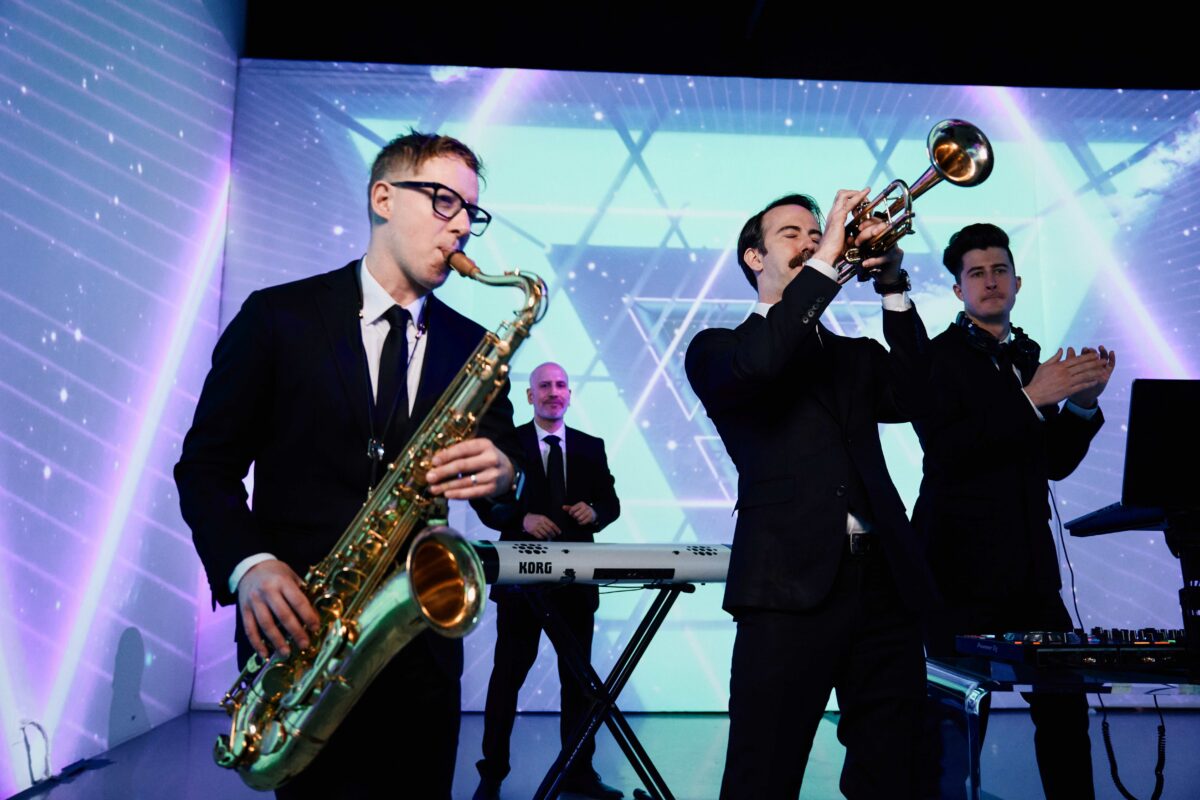
QUESTIONNAIRE

Need Assistance? Directly reach us at contact@dleeventgroup.com or 877.534.2424

Top 5 Waterfront Wedding Venues in Rhode Island: A Performer’s Insider Guide

Top 5 Waterfront Wedding Venues in Rhode Island: A Performer’s Insider Guide

The wind off Narragansett Bay does something to a wedding that no ballroom can replicate. I noticed it again last June, setting up gear for a ceremony on a Newport lawn: the briny pull of the air, halyards slapping aluminum masts down in the harbor, the way late afternoon light turns the water into a sheet of hammered copper. The bride was still hours from arriving. Her father had pulled a folding chair near the lighthouse, sleeves rolled up, just looking at the bay. He didn’t say anything. He didn’t have to.

That’s the thing about waterfront weddings in Rhode Island. The Ocean State isn’t just a marketing slogan. It’s a 400-mile coastline crammed into America’s smallest state, which means you’re never more than a half hour from saltwater, and the venues lining that shoreline have had centuries to figure out how to host a party with the Atlantic as the backdrop.

I’ve worked coastal weddings up and down the Eastern Seaboard. Cape Cod, the Hamptons, the Maryland Chesapeake. Rhode Island sits in its own category because the geography here forces a particular intimacy with the water. Newport is essentially a peninsula. Watch Hill is a fingertip of land jutting into Block Island Sound. Bristol curls around Mount Hope Bay. You don’t have water near your wedding here. You have water as your wedding. The ceremony, the cocktails, the photos, the dancing, all of it happens in conversation with the tide.

This guide covers the five best waterfront wedding venues Rhode Island has on offer, from a peninsula estate with its own working lighthouse to a marina venue where guests can arrive by yacht. These are the rooms I’d point a couple toward if they called tomorrow asking where to get married on the Rhode Island coast.

Why Waterfront Wedding Venues in Rhode Island Work

Coastal venues in this state book out 18 to 24 months in advance for a practical reason. It isn’t just the views, though the views are part of it. Waterfront properties in Rhode Island have absorbed Gilded Age money for over a century, which means the infrastructure is built for serious celebrations. Tents that don’t flap in the wind. Catering kitchens engineered for 300-plate dinners. Lawns leveled and manicured to a degree most state parks would envy.

From an entertainment standpoint, working a Rhode Island waterfront wedding means thinking about three things most ballroom gigs never require. First, the wind. Open-air receptions on the bay can hit 15-knot gusts by late afternoon, and that changes everything from microphone placement to how a vocalist projects. Second, the sunset window. Couples here build their entire timeline around when the sun drops behind the Pell Bridge or sets over Block Island Sound, and you’d better have the ceremony processional cued to land inside that 20-minute golden hour. Third, the energy transition. Most waterfront weddings move from a breezy outdoor ceremony to a tented or indoor reception, and the entertainment has to bridge those two moods without missing a beat.

The reward for navigating all of that is a wedding that doesn’t look like every other wedding. Rhode Island waterfront wedding venues give you ocean light, salt air, and a kind of New England honesty no amount of inland landscaping can fake.

The Five Best Waterfront Wedding Venues in Rhode Island

Castle Hill Inn (Newport)

A working lighthouse anchors one corner of this 40-acre Gilded Age estate, which hosts one wedding per day on a peninsula as exclusive as its guest list.

Drive down the Castle Hill Inn approach for the first time and you understand why couples mortgage their futures to get married here. The road narrows. The trees thin. The Atlantic opens up on three sides because you’re on a peninsula now, jutting into Narragansett Bay, and the only building ahead of you is the 1874 mansion Alexander Agassiz built as his Harvard marine-biology summer retreat. The lighthouse stands a hundred yards off to your left, still active, still flashing its signal at night during your reception.

The grounds form a series of stepped terraces and rolling lawn that funnel guests toward the water. Ceremonies happen on the Grand Lawn with the Atlantic as the backdrop. No edits required for the photos. The custom Sperry sailcloth tent handling the reception is engineered for the wind that comes off the bay, which is not a trivial detail in October when the gusts pick up. Inside, the estate’s Chalet (once Agassiz’s actual laboratory) handles smaller events with a more cabin-like intimacy. During WWII the mansion served as a naval lookout for the entrance to Narragansett Bay. That history is still in the bones of the place.

Capacity: Up to 400 (tented); 250 ceremony on the Lawn; 55 in the Chalet (ceremony); 40 in the Beach House Spaces: Grand Lawn, Sperry Sailcloth Tent, Chalet, Beach House, Lighthouse grounds Price Range: $60,000–$175,000+ total investment; F&B minimums $140,000+ for peak Saturdays; venue fees from $15,000 Peak Season: June–September Best For: Couples wanting peninsula exclusivity and Gilded Age prestige Pet-Friendly: Conditional. Dogs allowed for overnight guests in Harbor Houses/Beach Cottages only; restricted from event spaces May–October

The Performer’s Take: Castle Hill is one of the more acoustically forgiving outdoor venues on the New England coast because the natural bowl of the Grand Lawn pulls sound toward the water rather than letting it scatter. The Sperry tent has decent reverb characteristics for a sailcloth structure, better than the older traditional pole tents, and there’s actual power capacity for a full hybrid setup. The walk between the ceremony lawn and the tent gives you a built-in energy break, which is useful. You can let the ceremony breathe, then ramp things up for the reception entrance without the awkward bridging that hurts a lot of single-room weddings.

The Detail That Sticks: The secluded cove just below the property is known locally as “Grace Kelly Beach.” During the filming of High Society in 1956, Kelly used to hide there from the paparazzi between shoots, walking down the bluff path to disappear for a few hours at a stretch. That cove is still accessible to guests staying at the inn, and it’s the kind of footnote that ends up in someone’s toast.

Official website: https://www.castlehillinn.com

Belle Mer (Newport)

Picture 127 acres of working farm where the ceremony space overlooks the Mount Hope Bridge and the after-party can happen in an 1800s barn forty yards from the water.

Belle Mer looks nothing like any other Newport venue, which is exactly the point. The “white-on-white” Mediterranean aesthetic was carved out of a building that, until 2006, was the navy-themed “Regatta Club.” Longwood Venues stripped it down to clean lines and white walls and turned it into something that feels closer to a contemporary villa on the Amalfi Coast than a New England wedding spot. The transformation is so complete that first-time visitors regularly miss the historical layers underneath.

The layers are there, though. Goat Island used to house a military fort, then a major torpedo station during both World Wars. The original “Vanderbilt Lamp Posts” still stand on the property, small physical reminders of the Gilded Age history the white-paint makeover almost erased. The Water Salon is the headline space, anchored by that 100-foot NanaWall system that retracts completely on a good-weather day. The Island House handles smaller events. The Ocean Lawn can hold over a thousand people for cocktails if you’ve got the guest list to fill it.

The view across the water hits the Newport waterfront, the Pell Bridge, and on a clear evening, the cluster of lights coming on in downtown Newport. Couples build their timelines around the sunset hour over the bridge for a reason.

Capacity: Water Salon 280 seated / 950 cocktail; Island House 180 seated / 325 cocktail; Ocean Lawn 1,000+ Spaces: Water Salon, Island House, Ocean Lawn, multiple bridal suites Price Range: Site fees $8,000–$15,000+; per-person costs $185–$225+ (2025 estimates) Peak Season: May–October Best For: Couples wanting modern glamour with retractable indoor-outdoor flow Pet-Friendly: Yes. Leashed dogs welcome as “ring bearers” for Ocean Lawn ceremonies

The Performer’s Take: The Water Salon is one of the better-engineered hybrid spaces I’ve worked on the East Coast. With the NanaWall open, you’re essentially playing outdoors: sound disperses, vocals need more presence, and you’re pushing through ambient ocean noise. Closed, the acoustics tighten into something closer to a controlled reception room. The challenge is that the wall can go up or down based on weather, so you need an entertainment team comfortable adjusting EQ and microphone gain mid-event without anyone in the room noticing. The dance floor sightlines are clean, the ceiling height supports a full live setup, and the floor itself has enough give for serious dancing without bouncing.

The Detail That Sticks: That 100-foot retractable glass wall isn’t a marketing exaggeration. It’s a NanaWall system, the same engineering used in high-end architectural projects, and when it’s fully open there’s literally no line between the reception room and the Atlantic. Couples doing their first dance in front of it have the bay as their backdrop, with the Pell Bridge lit up in the distance. You don’t need a videographer to make the shot work. The room does it.

Ocean House (Watch Hill)

One of the only resorts in New England with a private white-sand beach reserved for ceremonies, all of it tucked inside a $140 million replica of an 1868 Victorian hotel.

Ocean House is loud in a way the other venues on this list aren’t. Visually loud. The building rises bright yellow, four stories tall, perched on a bluff over Watch Hill’s beach, visible from a mile down the coast road. It’s deliberately, theatrically Victorian, and the current structure is a $140 million meticulous reconstruction of the original 1868 hotel that was demolished in 2005. Every detail was rebuilt from archival photos and original drawings. The result is a property that wears its grandeur on its sleeve.

Wedding spaces split between the Seaside Ballroom for smaller seated events, the South Lawn Tent for larger receptions, and the resort’s beach for ceremonies of up to 350 guests. The Relais & Châteaux catering team handles food with five-star polish, and the lobster boils and champagne cocktail hours here legitimately justify the price tag. The whole Watch Hill social ecosystem orbits this hotel during the summer season, which means your wedding is happening in the middle of one of the most exclusive seaside communities in the country. Taylor Swift’s “Holiday House” is the immediate neighbor; her Fourth of July parties have made the property a fixture of celebrity-culture coverage in recent years.


What sets Ocean House apart from any other Rhode Island waterfront wedding venue is the beach itself. It’s private to the resort, one of the few in New England where wedding ceremonies happen on sand reserved for hotel guests, which means you can walk barefoot from the resort to your processional spot without dealing with public beach logistics.

Capacity: Seaside Ballroom 180 seated; South Lawn Tent 250 seated; Beach Ceremony 350 guests Spaces: Seaside Ballroom, South Lawn Tent, Private Beach, on-site spa, multiple suites Price Range: 2026 Saturday F&B minimums often $65,000+; site fees $10,000–$75,000 tented; total spend $120,000–$350,000+ Peak Season: July–August Best For: Old-money galas and full-resort destination weddings Pet-Friendly: Yes. Dogs 50 lbs and under welcome with $195 fee; includes a “Pooch Menu” and designer beds

The Performer’s Take: A beach ceremony at Ocean House photographs like a dream and runs like a logistical exercise behind the scenes. Sand absorbs sound. The wind off Block Island Sound is consistent. You’re running a wireless setup that has to account for both factors, plus the fact that you’re carrying gear across uneven terrain to a spot the staff has cordoned off that morning. The reception spaces are more conventionally workable. The South Lawn Tent has clean acoustics and proper power infrastructure, and the Seaside Ballroom is small enough that a tighter live setup actually works better than scaling up. Mandatory multi-night room blocks mean you’ll have a built-in resident audience for the welcome reception the night before, which changes how you pace the energy of the main event.

The Detail That Sticks: The hotel was immortalized in the 1916 silent film American Aristocracy starring Douglas Fairbanks, which makes it one of the earliest American resorts ever captured on motion picture film. The current building is technically newer than that film, the original 1868 structure was demolished in 2005 and rebuilt, but the location, the silhouette, and the social role of the property in Watch Hill’s identity have held steady for over 150 years.

Official website: https://www.oceanhouseri.com/

Newport Beach House (Middletown)

4

A toes-in-the-sand ceremony and a reception on the same beach, in the only luxury waterfront venue in the Newport area built for both.

Newport Beach House sits on Easton’s Beach (what locals call First Beach), and it’s the closest thing to a Newport wedding without actually being in Newport proper. It’s technically in Middletown, a fact most couples don’t catch until they’re filling out the marriage license paperwork. The location matters. Easton’s Beach is a much wider, longer shoreline than the rocky downtown Newport coast, which means you get an actual sandy beach for ceremonies rather than a manicured lawn that overlooks the water from a distance.

The building itself operated as “Johnny’s Atlantic Beach Club” for over 90 years before its 2016 transformation into a wedding venue. Longwood Venues (the same group behind Belle Mer) gutted the space and turned it into a two-story modern beachfront property with retractable glass doors, a grand floating staircase, and an outdoor terrace that sits about thirty feet from where the sand starts. The Eventide space on the top floor handles up to 300 seated. The Surfside on the ground floor handles 150–160 seated for dinner & dancing (up to 250 without dance floor). Full buyouts can scale to over a thousand for events that take over both levels plus the beach.

Where Belle Mer feels like a Mediterranean villa, Newport Beach House feels like a contemporary beach club someone’s serious money built on a serious piece of sand. The vibe is laid-back luxury, Belle Mer’s “sister venue” as the team there describes it, but with actual beachfront access that Belle Mer doesn’t have.

Capacity: Eventide 300 seated; Surfside 200 seated; Full Buyout 1,000+ Spaces: Eventide, Surfside, beach ceremony zone, outdoor terrace Price Range: Total starting cost $45,000–$60,000+; site fees $25,000–$30,000 peak; F&B minimums $25,000–$40,000 Peak Season: May–October Best For: Toes-in-the-sand couples wanting modern beach-club aesthetics Pet-Friendly: Yes. Pet-friendly for beach ceremonies with leashed animals and a designated handler

The Performer’s Take: Eventide is the better dance space of the two: slightly higher ceilings, better speaker placement geometry, and a layout that pushes energy toward the floor rather than dispersing it across the room. The retractable glass doors are great for cocktail hour transitions but tricky during the dance set. Open them and you lose low-end frequency response to the open air; close them and the room can heat up fast on a humid August night. The grand floating staircase makes for a knockout entrance moment for the couple, and we usually plan the band’s opening number to coincide with that walk down. The beach ceremony presents the same sand-and-wind challenges as Ocean House, but with shorter equipment carry distances that make the logistics meaningfully easier.

The Detail That Sticks: Easton’s Beach has drawn Rhode Islanders since the 1880s, and the original Atlantic Beach Club building (now Newport Beach House) hosted generations of Aquidneck Island families for summer dances, prom afterparties, and yes, weddings, for nearly a century before the 2016 redesign. Local couples occasionally book here specifically because their grandparents got married in the same building.

The Bohlin (Newport)

A 5,000-square-foot permanent sailcloth tent inside the Newport Yachting Center, with a teak ceremony deck where the wedding party can dock just feet from the aisle.

The Bohlin doesn’t try to be anything other than what it is: a high-end event space inside an active marina, in the city that calls itself the Sailing Capital of the World. The 5,000-square-foot sailcloth tent is permanent, climate-controlled, climate-engineered, and the teak dock where ceremonies happen sits at the edge of the harbor with multi-million-dollar yachts as the literal scenery. You eat dinner under a ceiling of sailcloth while looking up at masts.

The aesthetic was deliberately designed to mimic a classic wooden schooner. Teak floors, sailcloth ceiling, authentic marine rigging integrated into the structure. The venue takes its name from Dick Bohlin, a figure in Newport’s sailing community whose legacy informs the property’s identity. The whole space feels like the inside of an extremely well-appointed yacht club, except larger and with a kitchen capable of serving 250 guests dock-to-table seafood from Newport Restaurant Group.

What makes The Bohlin work as a wedding venue is the dual identity. It’s nautical without being kitschy. It’s elegant without losing the working-marina energy. Boats keep arriving and departing in the harbor during your cocktail hour. The sound of halyards and the occasional foghorn become part of the soundtrack. For couples with a real connection to sailing, or guests who would genuinely enjoy arriving by boat from a different point on the harbor, this venue is a one-of-one in Rhode Island.

Capacity: 250 seated dinner; up to 500 standing reception Spaces: 5,000 sq. ft. sailcloth tent, teak ceremony dock, dockage available for boat arrivals Price Range: Site fees from $2,500; peak season F&B minimums $32,000–$52,000 (2025); per-person costs approx. $100+ Peak Season: May, June, and October Best For: Sailing enthusiasts and couples wanting dockside marina ambiance Pet-Friendly: Yes. Pets welcome for ceremonies on the teak deck; typically removed before formal dinner

The Performer’s Take: A 5,000-square-foot sailcloth tent over a teak floor carries its own specific acoustic signature. The fabric softens reverb in a way that benefits live vocals, but the open-air sides mean low-end bass can escape quickly. We typically reinforce the bottom of the mix in this kind of space and pull back on overhead reverb-heavy effects. The dock ceremony location works well for microphone setups because the water actually helps carry the vocal signal back toward seated guests rather than scattering it. The dance floor area sits roughly center-tent, which gives clean sightlines from every table. The one logistical wrinkle is load-in timing. Boats coming in and out of the marina can complicate vendor truck access, so we coordinate with the venue on arrival windows.

The Detail That Sticks: The Bohlin ranks among the few venues in New England where guests can legitimately arrive at the wedding by boat. The Newport Yachting Center has guest dockage available, and a number of couples coordinate with the venue to have specific guests, or themselves for the entrance, arrive by yacht or sailboat. A teak ramp leads from the dock straight into the cocktail area. The whole sequence feels staged for a film, which it isn’t.

Official website: http://bohlinnewport.com 

How to Choose Between These Waterfront Wedding Venues in Rhode Island

Working with a guest list north of 250 and you want the Newport-prestige factor without compromising on scale? Castle Hill Inn is the obvious move. It handles up to 400 in the tent and gives you a full peninsula to work with. Belle Mer is the comparable choice for that same large-guest-list scenario but with a modern aesthetic instead of Gilded Age.

Planning something smaller, say 150 guests or fewer? Newport Beach House’s Surfside space or Belle Mer’s Island House give you a more intimate footprint without losing the waterfront access. The Bohlin works at this scale too, and it’s the only option on this list that gives you genuine working-marina atmosphere.

If budget is a meaningful constraint and you still want a Rhode Island coastal wedding, The Bohlin’s starting site fee of $2,500 is significantly lower than the others. The total spend will still climb with food and beverage minimums, but the entry point is more accessible than Ocean House or Castle Hill, where you’re looking at six-figure investments before you’ve factored in florals.

Want a beach ceremony, actual sand, actual barefoot? Your options narrow to Newport Beach House or Ocean House. Newport Beach House is the more accessible price point and gives you Easton’s Beach’s wider shoreline. Ocean House is the higher-end experience with a private beach reserved exclusively for resort guests.

Traveling with guests from out of state and want everything in one place (ceremony, reception, accommodations, after-party, brunch)? Ocean House is the only true resort on this list. Castle Hill has some on-site suites but isn’t a full hotel. Everyone else requires nearby hotel coordination.

Getting married in a shoulder season (late April, early May, or November)? Belle Mer’s climate-controlled Water Salon and The Bohlin’s permanent climate-controlled tent are your best bets. The other three lean heavily on outdoor weather cooperation. [INTERNAL LINK: DLE wedding planning timeline guide]

Why Entertainment Matters More Than You Think at Waterfront Wedding Venues

Most couples don’t realize this until they’re at a friend’s coastal wedding and watching the band struggle: open-water acoustics behave nothing like indoor acoustics. The wind carries sound away. Salt air affects equipment. Sunset photos require precise timeline coordination with the ceremony processional. And the energy shift from a breezy outdoor ceremony to an enclosed reception can either feel seamless or jarring, depending entirely on whether your entertainment team understands the transition.

Take a venue like Castle Hill or Newport Beach House. The ceremony is happening on a lawn or a beach with no walls to contain the sound. A standard PA setup that works fine in a hotel ballroom will sound thin and washed-out in that environment. You need musicians and a sound engineer who know how to project, plus gear that’s calibrated for outdoor reinforcement. Wireless microphones need to be tested in the actual wind conditions of the day. We bring extra windscreens for every microphone for exactly this reason.

Then there’s the sunset timing. Rhode Island waterfront venues face west or southwest, which means the sunset is your money shot. Couples plan their entire timeline around hitting the ceremony recessional, the cocktail-hour walk to the water, or the first dance during golden hour. An entertainment team that’s never worked these venues won’t know that you have to start the processional music three to four minutes earlier than the printed timeline says, because the bride is going to pause on the path to look at the water. We’ve seen this exact moment so many times we now build the buffer in automatically.

The ceremony-to-reception transition is the other underrated piece. At Belle Mer, the NanaWall opens or closes based on weather. At The Bohlin, you move from the dock to the tent. At Ocean House, you go from the beach to the South Lawn Tent or the Seaside Ballroom. Each of these transitions is an opportunity to either keep the energy elevated or let it crater. The hybrid DJ band model exists precisely for this kind of choreography: live musicians during ceremony and cocktails, DJ-driven energy during transitions, full hybrid mode during the reception. The right team plays the room differently at every stage of the night.

Why DLE Event Group for Your Rhode Island Waterfront Wedding

Full disclosure: this is the part of the article where I make the case for our team. I’ll keep it brief and specific.

DLE Event Group has spent over a decade as the pioneers of the hybrid DJ band model, with live musicians and a professional DJ working together as a single integrated entertainment unit rather than two separate vendors trying to coordinate. For waterfront wedding venues in Rhode Island, this format solves the problems I just outlined. Live instruments (sax, guitar, percussion, vocals, more depending on the package) bring presence and warmth to outdoor ceremonies where a laptop DJ would sound thin. The DJ component handles the genre versatility most couples want for the dance floor, from a Frank Sinatra slow dance to whatever your college friends will lose their minds over at midnight.

The track record matters here. The Knot Best of Weddings Hall of Fame eleven times running (2013–2023). Over 100 weddings and events performed at venues including The Plaza Hotel, The Pierre, Gotham Hall, Guastavino’s, Park Chateau, Ashford Estate, and properties throughout the tri-state area and beyond. Our home base is NYC, with a primary service area across the Hudson Valley, the Hamptons, Long Island, Westchester, and Upstate New York. Rhode Island is a Northeast extension we travel for when the right couples and venues call.

The planning process is what separates a smooth wedding from a stressful one. We start consultations roughly six months out. Five to ten Zoom planning meetings. Custom song learning for first dances, parent dances, and any cultural ceremonies in the program (Hora, Tarantella, Baraat, Dabke, whatever your traditions are). Detailed MC pronunciation guidance. Real-time crowd reading at the event itself. We bring backup equipment for every critical component because at a waterfront venue, you don’t get a second chance if something fails.

Packages start at $5,995. Travel fees apply for out-of-region events. Every quote is custom because every wedding is.

FAQs

For Newport-area Saturdays during peak season (May through October), expect to book 18 to 24 months in advance. The most exclusive properties (Castle Hill Inn, Ocean House) often release dates two full calendar years ahead, and those calendars fill within weeks. Off-peak dates from November through March can sometimes be booked with 6 to 9 months of lead time. The Bohlin and Newport Beach House tend to have slightly more flexible booking windows than Castle Hill and Ocean House.

For 150 guests at a mid-tier property like The Bohlin, plan for $50,000 to $80,000 total. For Belle Mer or Newport Beach House at that same guest count, $75,000 to $130,000 is more realistic. At Castle Hill Inn or Ocean House, total investment for 150 to 200 guests routinely lands between $120,000 and $250,000. These numbers include venue fees, food and beverage minimums, taxes, and service charges. Entertainment, floral, and photography are separate line items.

Yes, and all five venues on this list are designed for it. Each has dedicated ceremony spaces (lawns, beaches, decks) separate from the reception areas, which gives you a natural cocktail-hour transition window for the room flip. Castle Hill’s Grand Lawn ceremony followed by the Sperry tent reception is a textbook example. Newport Beach House handles the entire arc with even shorter walking distances: beach ceremony, cocktail hour on the terrace, reception on Eventide.

For ceremonies on a lawn or beach, a hybrid live-acoustic setup typically outperforms a pure DJ rig. Live instruments like strings, sax, and guitar carry better in open-air conditions, and wind-resistant microphones with proper windscreens are essential for the officiant and vows. We recommend wireless microphone tests on the actual day, since wind patterns shift between the morning walkthrough and the ceremony itself. For the reception, hybrid DJ band setups give you the genre range to keep the dance floor moving for three to four hours.

Newport and the surrounding Aquidneck Island area have dense lodging options. Ocean House includes on-site accommodations (with mandatory multi-night room blocks for wedding parties). Castle Hill has limited on-site suites. For Belle Mer, The Bohlin, and Newport Beach House, you’ll be coordinating room blocks at nearby hotels such as the Newport Marriott, Vanderbilt Grace, Gurney’s Newport, or smaller boutique inns in the historic district. Most couples set up two or three lodging tiers at different price points within a 15-minute drive of the venue.

Wind is a factor, not a deal-breaker. Most ceremonies are scheduled for late afternoon (typically 4:00 to 5:30 PM), which is generally when wind speeds settle. The professional venues on this list all have backup contingency spaces (tents, indoor rooms) that they can flip to with a few hours’ notice if conditions turn. A good entertainment team brings wind-rated equipment, secures all cabling, and adjusts microphone gain for ambient noise. We’ve done ceremonies in 15-knot gusts that sounded clean in the recordings because the gear and the setup were dialed for it.

Let's Talk About Your Rhode Island Waterfront Wedding

Picking a venue is the start. The entertainment is what makes the night feel like it’s actually yours.

If you’re considering one of the waterfront wedding venues in Rhode Island covered in this guide (Castle Hill Inn, Belle Mer, Ocean House, Newport Beach House, or The Bohlin) and you want to talk through what hybrid DJ band entertainment looks like for your specific vision, we’d love to start a conversation. We’ve worked the coastal-wedding playbook for over a decade and can walk you through what your timeline, your music selections, and your reception flow could actually look like at any of these venues.

Premier Rhode Island waterfront dates book 18 to 24 months out. The same is true on our side. If you’ve already locked in your venue, the next call should be about your entertainment.

Get in touch:

Phone: 877-534-2424

Ready to start the conversation?

QUESTIONNAIRE

Need Assistance? Directly reach us at contact@dleeventgroup.com or 877.534.2424

Top 5 Rustic Barn Wedding Venues Rhode Island: A Performer’s Inside Look

Top 5 Rustic Barn Wedding Venues Rhode Island: A Performer’s Inside Look

A converted textile mill in Pawtucket, brick walls, concrete floors, 20-foot ceilings. The first time I rolled cases into a room like that I expected the worst on paper: a sound engineer’s nightmare with slap-back hash echoing off every surface. Then I plugged in, ran a level check, and the room answered the way a good guitar does when you strike it cleanly. Tight. Present. Whoever restored that 1912 building knew exactly what they were doing.

That’s the trick of the rustic, barn, and industrial-chic category in Rhode Island. It looks like one thing (weathered timber, exposed brick, vineyard rows running off toward Narragansett Bay) and it behaves like another. The barns here are framed in heavy old-growth timber that holds bass frequencies the way a cello body does. The mills have been gut-renovated with acoustic treatment hiding behind every “raw” beam. The vineyards are working farms with three-phase power runs that a touring rig would respect.

Rhode Island packs all of it into roughly 1,200 square miles. You can do a vineyard wedding in Middletown, a 127-acre farm wedding in Bristol, a Norman Romanesque manor-and-vines wedding in South Kingstown, a brewery wedding in Pawtucket, and a 1920s urban industrial ballroom wedding in downtown Providence, and never drive more than 45 minutes between them. That density matters. The rustic barn wedding venues Rhode Island couples are choosing from aren’t a single look. They’re a spectrum. Here’s the honest tour.

Why Rustic, Barn & Industrial-Chic Venues Work in Rhode Island

The rustic-and-industrial category in this state benefits from something most regions don’t have: scale compression. Because Rhode Island is small and densely settled, the venues that fall under this umbrella have had to earn their keep against luxury coastal competition. A Newport-area vineyard can’t get away with a folding-chairs-in-a-field aesthetic when Belle Mer is twenty minutes down the road. So the rustic venues here have polished up. The barns have heated floors and sailcloth tents. The mills have climate control and bridal suites. The vineyards have on-site lodging and full-service catering.

For couples, that polish solves the real problem with this category nationally. Rustic spaces are gorgeous in October daylight and rough by 11 p.m. when guests want a real bathroom, a real bar, and a dance floor that doesn’t kick up sawdust. Rhode Island’s versions don’t have that problem.

From the entertainment side, three things matter here. First, timber and brick rooms have better acoustics than ballrooms because they absorb the right frequencies and let the right ones bloom. Second, power is rarely an issue at the established venues; they’ve already wired for events. And third, intimacy in these rooms is real. A 150-person reception in a restored mill feels closer and louder than 300 people in a hotel ballroom. That changes the night.

The Venues

Newport Vineyards (Middletown)

1

A working 100-acre vineyard where reclaimed barn wood meets scratch-kitchen dining, and where the bottle on your favor table can wear your face on the label.

The drive in tells you what kind of place this is. You’re on Aquidneck Island, but you’ve left the cliff-walk Newport behind. Vines run in neat rows toward the horizon. There’s a tasting room, a brewery operation (Taproot, on-site), and a series of event spaces that don’t try to disguise their farm bones. The Meadow Room has glass garage doors that roll up to open the room to the fields, and the Tank Room sits right next to working fermentation vessels. It smells like a winery in here because it is one.

Inside, the design language is industrial-chic crossed with farmhouse. Chandeliers hang from rough-hewn beams. The walls carry that warm reclaimed-wood patina that photographs beautifully under string lights. It’s not a barn pretending to be a ballroom, and it’s not a ballroom pretending to be a barn. It’s the actual middle ground, which is rarer than the wedding-blog industry pretends. The vineyard was established in 1995 to keep Aquidneck Island farmland out of the hands of residential developers, and that origin story still shapes the place. It feels lived-in and worked-on, not staged.

Capacity: 100–150 seated dinner Spaces: Meadow Room (glass garage doors), Tank Room (rehearsal dinners), outdoor ceremony lawn with meadow views Price Range: Rental $2,000–$8,000; ceremony fee $1,500; average all-in around $33,000 Peak Season: September (harvest) Best For: Foodie couples who want winery-rustic with serious in-house catering Pet-Friendly: Conditional — generally not inside; dogs occasionally permitted for outdoor ceremonies only

The Performer’s Take. The Meadow Room is one of the friendlier event spaces I’ve worked in this category. Those glass garage doors don’t just look good. They let you push some of your low-end energy out into the open air during peak dance hours, which keeps the room from boxing up. Ceiling heights are modest (this isn’t a cathedral barn), so you don’t want to overpower the space. A DJ-led hybrid with two or three live players sits perfectly here. Bigger horn sections start to crowd the band area. Power and load-in are straightforward; the staff knows event setups cold.

The Detail That Sticks. Newport Vineyards sits on a microclimate created by the surrounding waters of Narragansett Bay, giving it a longer growing season than any other inland vineyard in New England. And the wedding favor most couples don’t know about until they tour: custom estate wine bottles with the couple’s photo on the label, sent home with each guest. That’s a guest keepsake that survives the move from the fridge to the mantel.

Mount Hope Farm (Bristol)

2

Picture 127 acres of working farm where the ceremony space overlooks the Mount Hope Bridge and the after-party can happen in an 1800s barn forty yards from the water.

Of the five venues in this guide, this is the most genuinely rustic, and I mean that as a compliment. The land has serious history. It’s the ancestral home of the Pokanoket people, and while “King Philip’s Seat” (the stone throne used by Metacom in the 17th century) is located on the lands, the specific acreage containing that site was returned to a Pokanoket trust in 2024. The farm was later owned by the Haffenreffer brewing family, who treated it as a preservation project rather than a development opportunity. You feel that lineage walking the property. The grass isn’t manicured to country-club tightness. The trees are old. The barn looks like a barn.

Two spaces matter for weddings. The Barn handles a tight, energetic seated dinner for up to 140 guests (120 for optimal comfort) with dancing, and the timber frame is original 1800s construction. The Cove Cabin is the wildcard, an Adirondack-style waterfront structure on a private cove looking out at the bridge. Tented, it can hold 300-plus, while the cabin interior accommodates 60. The combination of barn for after-party and cabin for waterfront ceremony is a setup most rustic venues can’t match. Lodging on-site at the 1745 Governor Bradford House lets the wedding party stay through the weekend without a Newport-priced room block.

Capacity: The Barn (up to 140 seated, 120 optimal); Cove Cabin (60 seated inside / 300+ tented) Spaces: The Barn, Cove Cabin, garden ceremony sites, Governor Bradford House lodging Price Range: Rental fees $2,000–$10,250 depending on space/season; ceremony fee $500–$1,000; all-in for 50 guests from ~$12,000 Peak Season: May–June (garden bloom) and September–October (fall harvest) Best For: Couples who want a true farm wedding with a waterfront layer and weekend lodging Pet-Friendly: Yes — welcome for outdoor ceremonies and garden photos

The Performer’s Take. The Barn is one of those rooms where a heavy timber frame does favors for live music. Bass frequencies settle into the wood instead of bouncing around hot. The room is small enough that you don’t need a wall of PA; under-powering is actually the smarter choice. Let the natural resonance carry. For the Cove Cabin under a sailcloth tent, you’re effectively doing an outdoor show with a fabric roof. Budget for a generator backup, plan for wind off the bay, and use mid-sized arrays angled toward the dance floor rather than the open side. Sunset over the bridge is unbeatable for first-dance timing.

The Detail That Sticks. “King Philip’s Seat,” the stone throne used by Metacom in the 17th century, is still on the property and is generally considered one of the most significant indigenous historical sites in southern New England. The wedding takes place on land continuously cared for since well before the colonies were a country. That’s an opening line for a toast nobody else’s venue can give you.

Official website: http://www.mounthopefarm.org/

Shepherds Run (South Kingstown)

3

Thirty-six acres of Norman Romanesque manor that operates as a vineyard, a 26-room boutique hotel, and a spa, which means your entire wedding weekend can happen inside one stone wall.

If Newport Vineyards is the working farm and Mount Hope is the historic homestead, Shepherds Run is the Nancy Meyers movie. The main house was built in 1933 as a summer residence for Rush Sturges, a Providence lawyer with strong opinions about architecture. The result is a Norman Romanesque stone manor that, when you photograph it at golden hour, will convince half your guests you got married in Tuscany. The vineyards run right up to the building. The walled garden was designed by Beatrix Farrand, the same landscape architect who designed the White House gardens and the only female founding member of the American Society of Landscape Architects.

Then it gets weirder. In 1959 the estate became a convent for the Sisters of the Cross and Passion. It stayed that way for decades before being restored into the current vineyard-and-hotel hybrid. That layered history shows up in the bones. The stone halls feel ecclesiastical, the gardens feel European, and the newer build-outs (the Event Hall, the sailcloth tent option) feel contemporary without fighting the original architecture.

The “vertical resort” model is what makes this venue function for big weddings. Guests fly into Providence, drive 35 minutes south, check in to one of 26 luxury rooms, do the rehearsal dinner in the walled garden, get married Saturday, dance until last call, and never leave the property until Sunday brunch. The 10:30 p.m. alcohol cutoff is a venue-and-area constraint worth planning around, since it bumps the closing dance set earlier than couples expect.

Capacity: Up to 300 (Event Hall or sailcloth tent) Spaces: Event Hall, sailcloth tent, Walled Garden (ceremony/cocktails), 26 luxury guest rooms, on-site spa Price Range: Site fees $5,000–$7,500 per space; all-inclusive for 150 guests starts around $63,000 Peak Season: June (peak vineyard lushness) and October Best For: Weekend takeover weddings where the entire party stays on-property Pet-Friendly: No — per official venue FAQ

The Performer’s Take. Two acoustic environments to plan for. The Event Hall is a hard-surface, stone-influenced room that needs absorption. Drape, fabric, even body heat from a full guest list does work for you here, but a smart sound tech will high-pass cut to keep low-mid muddiness from building up against the stone. The sailcloth tent option is a different conversation entirely. Open sides mean sound dissipates fast, which is fine for dinner but flat for dancing. You want denser arrays for the tent and a wedge or two for the dance floor itself. The 10:30 p.m. alcohol cutoff means the energy needs to peak earlier; front-load the high-tempo dance set into the 9:30-10:15 window.

The Detail That Sticks. The walled garden was designed by Beatrix Farrand, the landscape architect responsible for the White House gardens and the only woman among the founding members of the American Society of Landscape Architects. Ceremonies happen inside walls she laid out by hand in the 1930s. That’s a piece of trivia worth knowing because it changes how you photograph the space; the garden’s geometry rewards wide-angle shots from the corners.

Official website: http://shepherds.run/

The Guild (Pawtucket)

4

Imagine a 1912 textile mill reborn as a working craft brewery and wedding venue, with 20-foot ceilings, exposed brick, and an event “barn” built inside the industrial shell.

This is the venue that flipped my expectations of what an industrial-chic room could be. The building was originally the Isle Brewers Guild, a cooperative for brewmasters to share space and recipes. The current operators kept the bones (red brick, heavy timber, polished concrete floors) and built what they call “The Barn” inside the larger industrial volume. It’s a barn-shaped event space tucked inside a 1912 mill, which sounds like a gimmick until you stand in it. The proportions work. The light works. The “industrial heritage” thing isn’t a sticker; it’s the building.
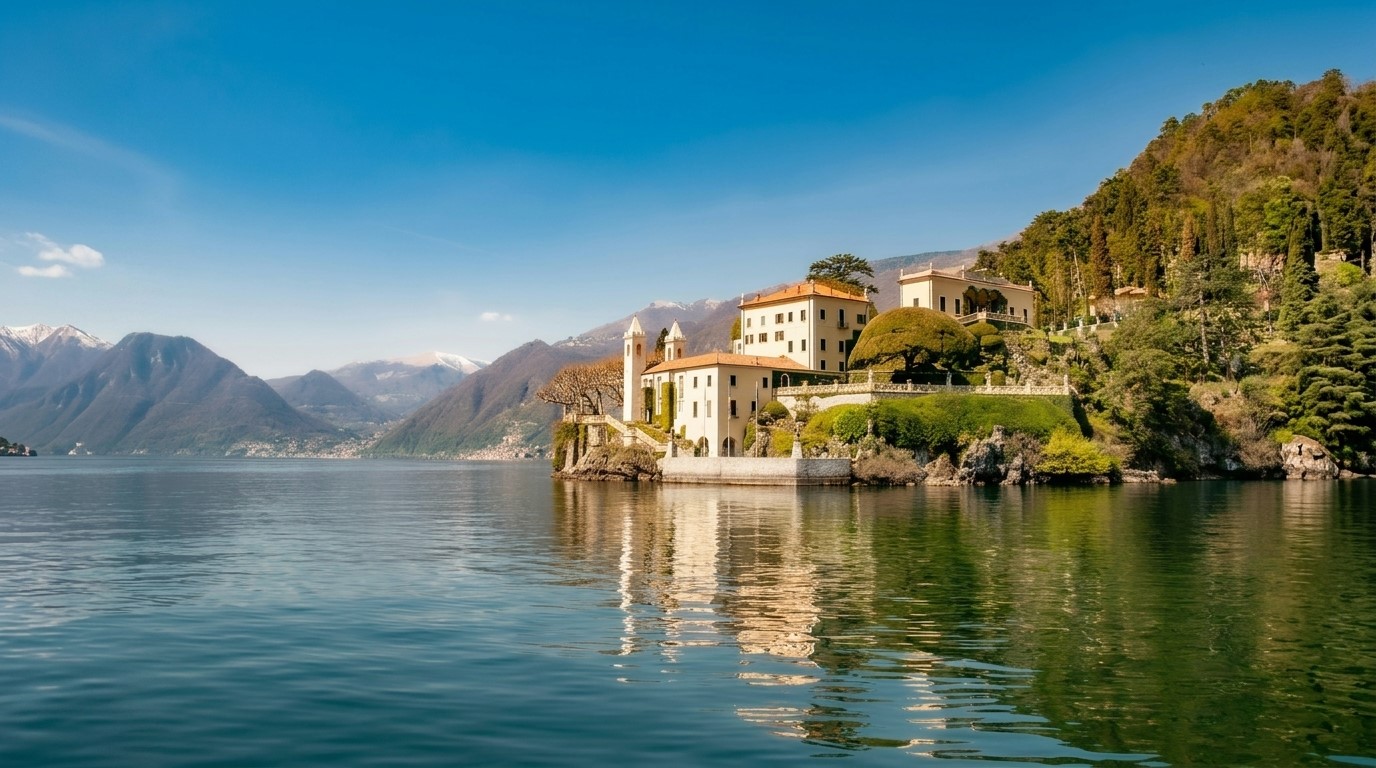
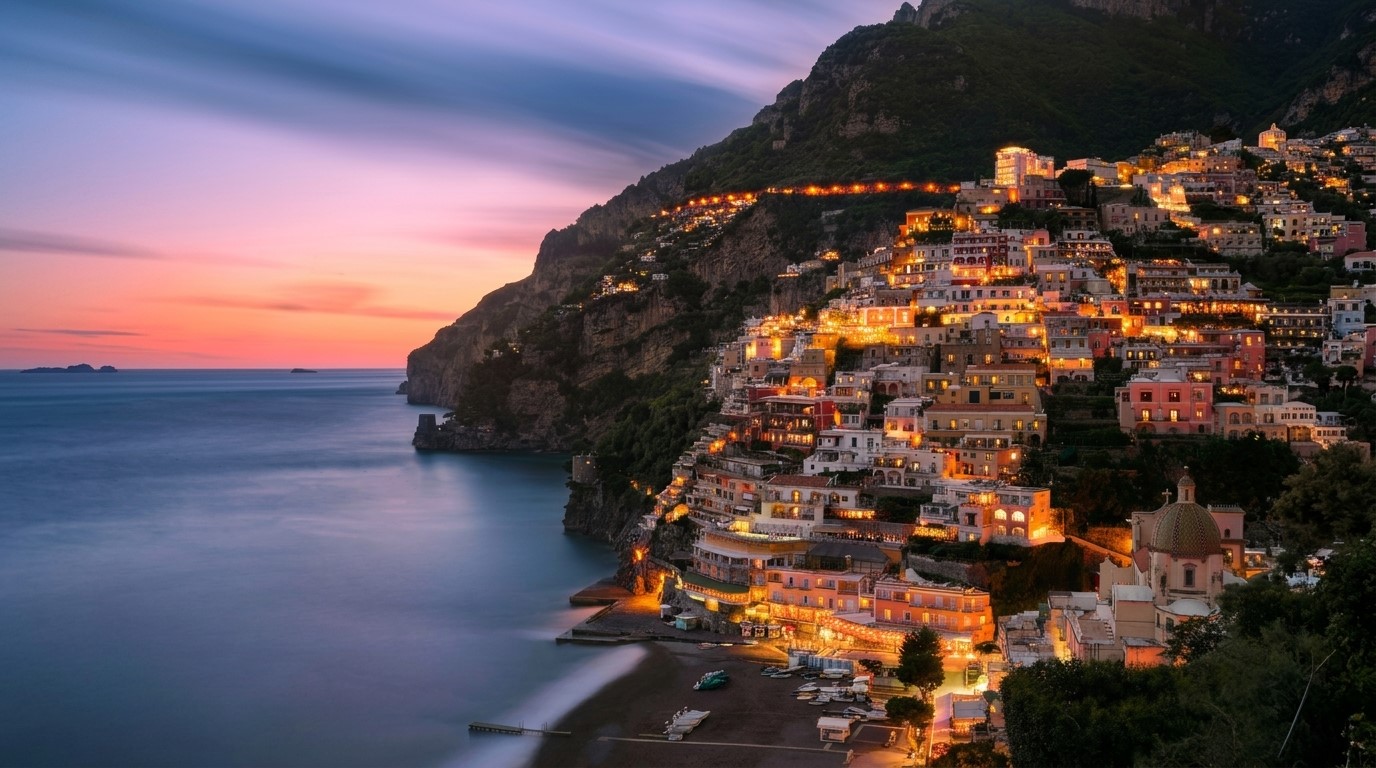
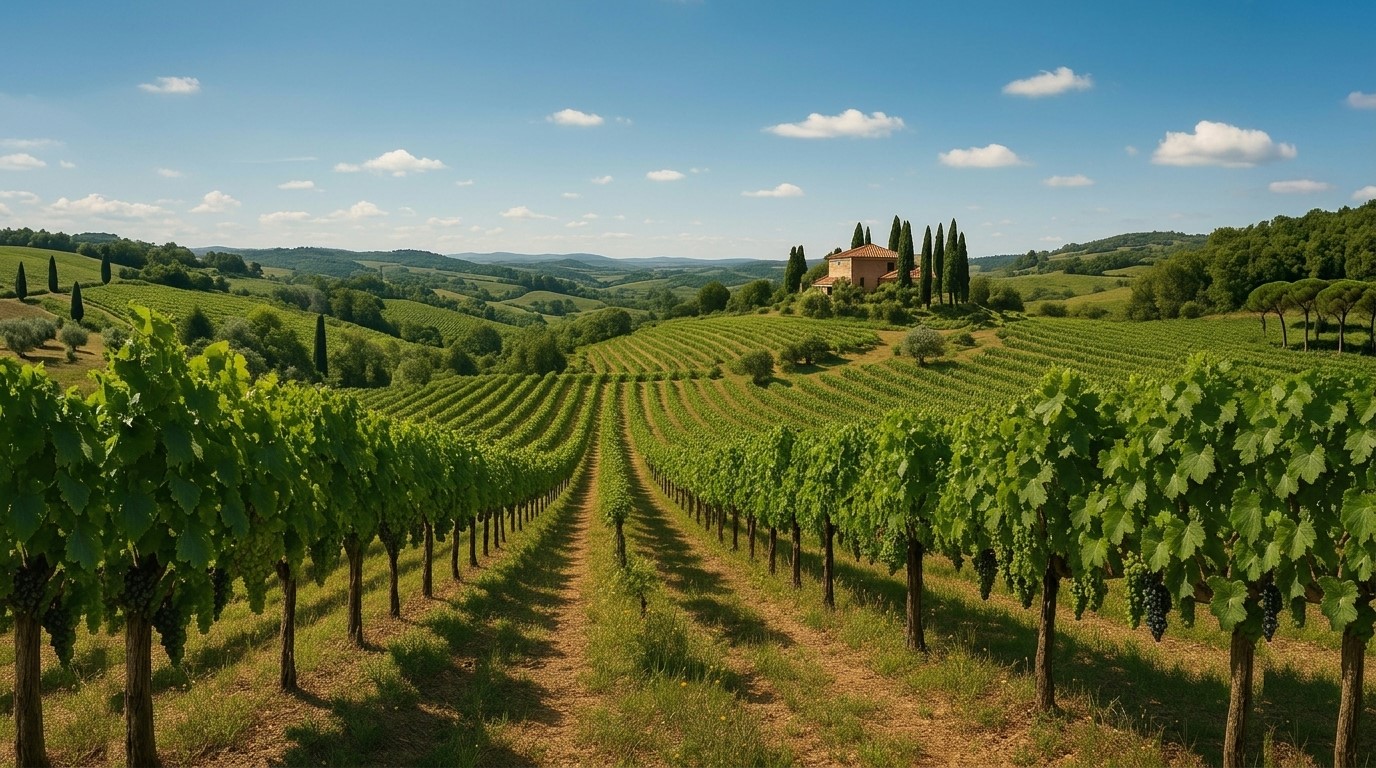
The vibe shifts from refined to functional and back as you walk through. The main event area is climate-controlled and clean, but you’re close enough to the production side that during cocktail hour you can hear the hum of working brewery equipment and smell the hops on the air. That sensory layer makes the room feel alive in a way pure event-space rentals don’t. Outside, a patio looks over the beer garden, another usable space for cocktail hour overflow or a relaxed pre-dinner gathering. The Guild also happens to be the most pet-friendly venue on this list by a wide margin. Leashed dogs are welcome both indoors and outdoors. If your golden retriever is in the wedding party, this is the room.

The DIY-friendly model matters here too. Open catering policy. Food trucks welcome. Beverages must come from the in-house brewery, but the beer is the reason most couples are touring this place anyway.

Capacity: 150 seated dinner (The Barn); 225 cocktail style Spaces: The Barn (main event), outdoor patio and beer garden, private bridal suite Price Range: Site fee $5,500–$8,500+ (covers space and bartending) Peak Season: Year-round (fully climate-controlled) Best For: Craft-beer-loving couples who want industrial authenticity with DIY catering flexibility Pet-Friendly: Yes — leashed dogs welcome indoors (with prior coordination during food service) and outdoors

The Performer’s Take. This room rewards bands. The mill’s brick-and-timber combination produces a present, slightly forward acoustic that makes guitars and horns sit beautifully in the mix. The 20-foot ceilings give vocal harmonies the headroom they need without smearing into reverb mush. The concrete floor is the one variable to plan for. It’s reflective, and at high volume the slap can build up. We typically use rugs under the rhythm section to break up the floor reflections, and we keep PA cabinets slightly elevated and angled. Load-in is friendly: wide doors, ground-level access, real power. This is the easiest setup of the five venues in this guide.

The Detail That Sticks. “The Barn” is literally a barn-shaped event space built as an architectural nest inside the heavy industrial shell of a 1912 textile mill. You can stand on the patio with a craft beer and see both the original brick warehouse wall and the modern timber event structure inside it, two layers of Pawtucket’s industrial history occupying the same footprint. The Isle Brewers Guild cooperative origin (brewmasters sharing space and recipes) is still embedded in how the building operates.

Official website: http://www.theguildri.com/

The Ballroom at Providence G (Providence)

5

Once the lobby of a 1920s utility-company headquarters, now a downtown ballroom with a rooftop ceremony space, original arched windows, and a gastropub one floor down for the after-party.

The Providence G occupies the former Providence Gas Company headquarters, built in 1920. The Ballroom was the building’s main lobby, the room your grandparents would have walked through to pay their gas bill in 1925. After decades of vacancy, it was meticulously restored as part of the downtown Providence revitalization push. The arched windows are original. The Greek key molding around the ceiling is original. The marble floor is original. What changed is everything else. It’s now climate-controlled, the lighting is on dimmers, the bar service is restaurant-grade, and the rooftop above the building has been built out as a usable ceremony space looking over the Providence skyline.

That stacked layout is the venue’s signature move. Ceremony on the rooftop. Cocktail hour as the room flips. Dinner and dancing in the Ballroom. After-party downstairs at GPub. No shuttles. No moving guests across the city in heels. Just an elevator and a staircase. The Ballroom team calls it the “progressive wedding,” and once you’ve worked one, the term makes sense. The night progresses vertically through the building.

The 1920s urban-industrial character is what places this venue in the rustic-chic category despite being downtown. The exposed mechanical elements, the original utility-era proportions, the way the room sits between historic grandeur and warehouse warmth. It doesn’t fit the historic mansion category, and it isn’t a farm. It’s the industrial-urban end of the rustic-chic spectrum.

Capacity: 250 seated (Ballroom); 200 (Rooftop ceremony); 350 standing cocktail Spaces: The Ballroom, Rooftop, downstairs GPub for after-parties Price Range: Rental $4,500–$7,000; meals $65–$130 per person; bar approximately $30 per person Peak Season: Year-round; Rooftop peaks June and September; legendary holiday décor in December Best For: Urban couples who want a vertical, no-shuttle wedding with multiple distinct spaces Pet-Friendly: Yes — welcome for rooftop ceremonies and photos in the ballroom

The Performer’s Take. The Ballroom is a tall, hard-surfaced room with arched windows that bounce mid-frequencies in interesting ways. It’s a flattering room for live vocals and acoustic instruments because the natural reverb is musical rather than washy. For the dance set, we point arrays away from the marble floor and toward the back wall to keep the bass focused instead of spreading. The Rooftop ceremony is a different animal: open-air, urban ambient noise from below (sirens, traffic, the occasional motorcycle), wind off the bay. Use lavalier mics for officiants. The Rooftop-to-Ballroom transition is a 5-minute elevator move for guests, which means you can’t drag your cocktail hour past 70 minutes without losing momentum.

The Detail That Sticks. The Ballroom you’re getting married in was once the public lobby of the Providence Gas Company, where customers paid their utility bills under those same arched windows in the 1920s. After the building sat vacant for decades, the meticulous restoration kept the original marble floors and Greek key molding intact. Most ballrooms borrow grandeur from imitation. This one earns it from utility-era civic architecture that never tried to be grand and somehow ended up that way.

Official website: http://providencegevents.com/

How to Choose Between These Venues

The five venues in this guide cover more ground than the category name suggests. They share an aesthetic vocabulary (timber, brick, raw materials, polished restoration), but the experiences they deliver are genuinely different. Here’s how I’d help a couple narrow down.

For couples building a wedding around food and wine, Newport Vineyards is the obvious starting point. The scratch-kitchen catering and estate wines are the centerpiece. The room is sized for a 100-to-150-guest celebration, which keeps it intimate. The custom-label bottle favor is a guest keepsake that travels home and gets remembered.

Looking for a true farm wedding with weekend lodging and waterfront drama? Mount Hope Farm makes more sense. The combination of the 1800s barn and the Cove Cabin overlooking the Mount Hope Bridge gives you two distinct event environments on one property. Lodging at the Governor Bradford House means your immediate family stays on-site. This is the venue for couples who want guests to settle in for two days, not just an evening.

Want one address to handle the rehearsal dinner, ceremony, reception, and Sunday brunch without moving anyone? Shepherds Run is the answer. The 26-room boutique-hotel-meets-vineyard-meets-spa model is rare. It works best for weekend takeovers in the 100-200 guest range. The 10:30 p.m. alcohol cutoff is a real planning constraint, so factor it in.

Craft-beer-leaning, dog-loving, DIY-flexible couples who want an industrial space with character should call The Guild. Year-round availability, open catering, climate control, and a setup that handles 150 seated guests comfortably. The pet policy alone narrows the field considerably; very few rustic-or-industrial venues let your dog be in the room during dinner. The Guild does.

Urban couples who want a downtown wedding with vertical flow (rooftop to ballroom to gastropub) will end up at Providence G. The “progressive wedding” structure eliminates shuttle logistics. Year-round availability and indoor capacity for 250 seated guests handle most guest counts cleanly. It’s also the best off-peak option in this guide; January and February frequently waive minimums.

On budget: the cheapest path is The Guild or Providence G with off-peak dates. Mid-range sits at Mount Hope Farm or Newport Vineyards. The premium spend is Shepherds Run, especially during peak vineyard months. The variance across this category can be a factor of three or four, so be honest about your number before you tour.

Why Entertainment Matters More Than You Think at These Venues

Rustic and industrial venues fool people. They look like rooms that don’t need much from the band; just plug in, play, the wood and brick will do the work. That’s about half true and entirely dangerous.

The half that’s true: timber-frame structures and old mills do have good acoustic foundations. They absorb high frequencies that would ring in a hotel ballroom. They give bass instruments a natural body. Live music tends to sound warmer in these rooms than it does in carpeted function halls. That part of the wedding-blog mythology holds up.

The half that’s dangerous: every one of these venues has a specific acoustic signature that punishes a generic setup. The Guild’s concrete floor turns slap-prone at volume. The Ballroom at Providence G has arched windows that bounce mids in unpredictable patterns. Shepherds Run’s stone walls eat low end if you’re not high-passing intelligently. Mount Hope’s barn handles a small ensemble beautifully and gets overwhelmed by a horn-heavy band. Newport Vineyards’ Meadow Room behaves differently with the garage doors open versus closed.

Power is the other under-considered variable. Established venues like these five have proper event power, dedicated circuits for the band, isolated runs that don’t share with kitchen equipment. The polish of these venues doesn’t mean you should bring less rig. It means the rig you bring needs to match the acoustic character of the specific room.

Then there’s the intimacy factor. A 150-person reception in a restored mill feels closer and louder than a 300-person reception in a ballroom. The energy compresses. That’s an advantage if your band knows how to play to a tight room. Dynamics matter more, the cocktail hour set can be quieter and more textured, the dance set can pull people in faster. It punishes anyone who shows up with one volume.

Finally, the polish-versus-authenticity tension. These are restored rustic spaces, not raw ones. Your entertainment should match. A four-person bluegrass band in a Pawtucket mill is going to feel like a costume. A laptop DJ in a 127-acre historic farm is going to feel like a missed opportunity. The right answer is a hybrid: live musicians for the parts of the night that need emotional weight, DJ-driven energy for the parts that need range and crowd-reading. That’s what these rooms were renovated to host.

Why DLE Event Group

The hybrid DJ band is what we built the company around. Live musicians (sax, guitar, keys, percussion, vocalists, configurable from two players up to seven or more) performing alongside a professional DJ who also handles MC duties. Live instruments carry the ceremony and the emotional inflection points. The DJ side carries the breadth: every song request, every era, every transition. You get the part of each that actually serves the moment.

For the rustic-and-industrial venues in Rhode Island, that format matters. A barn or a mill or a vineyard room wants warmth, and live instruments give you warmth no playback rig can match. But that same room also needs the range to take guests from a parent’s slow dance to a horns-up dance floor moment thirty minutes later, and that’s where a curating DJ outperforms even an excellent ten-piece band. Hybrid solves both.

 The track record matters because rustic-and-industrial venues vary widely. Over ten years in, 100+ events, The Knot Best of Weddings Hall of Fame eleven times running (2013–2023). We work venues across NYC, Long Island, the Hudson Valley, Westchester, the Hamptons, and destinations beyond the New York metro when couples bring us up. We’ve worked enough varied rooms to read a new one fast and calibrate before the first guest arrives.

The planning process is where most entertainment companies fall short, and where ours is genuinely different. Five to ten Zoom planning sessions starting roughly six months out. Custom song learning for first dances, parent dances, ceremony pieces. Tailored edits for special moments. MC scripts developed with pronunciation guidance for family names and traditions.

Backup equipment doubled at every critical point. The performance is the visible part. The months of planning is what makes the performance possible.

FAQ

For peak-season Saturdays (May through October) at the more popular venues (Shepherds Run, Newport Vineyards, Mount Hope Farm), start looking 12 to 18 months out. Bristol and Providence-area venues are slightly more flexible at 12 months. Off-peak winter dates at The Guild or Providence G can often be secured with 6 to 9 months notice. Book your entertainment on a similar timeline; the best dates for top venues are also the best dates for top vendors.

It varies dramatically. The lowest-end realistic number for a 50-guest, off-peak Mount Hope Farm wedding is around $12,000 all-in. A 150-guest peak-season Shepherds Run weekend can run $63,000-plus before you count upgrades. Newport Vineyards averages about $33,000 for a typical 100-to-150-guest celebration. The Guild and Providence G fall into the $20,000-$50,000 range depending on guest count and food choices. The “rustic” label doesn’t automatically mean cheaper. The polished restoration costs money, and venues recoup it.

Every venue in this guide accommodates both. Newport Vineyards has an outdoor ceremony site overlooking the meadows; Mount Hope Farm offers garden ceremonies, barn dances, and the Cove Cabin waterfront option; Shepherds Run uses the Walled Garden for ceremonies; The Guild handles ceremonies indoors or on the patio; the Providence G stages ceremonies on the Rooftop and receptions in the Ballroom below. Same-venue ceremonies eliminate guest transport and tighten the timeline considerably. They’re almost always the right call when the venue supports them.

A hybrid live-band-and-DJ setup is the most versatile choice. Live instruments, particularly horns, vocals, and acoustic guitar, sit beautifully in the natural acoustics of mansion rooms, which were built for unamplified performance. A DJ component lets you cover the full musical range your guest list expects. You want a team that can scale the production to the room: smaller for the carriage house at Linden Place, fuller for the ballroom at Rosecliff. And you want a team that understands the rigging, floor-protection, and sound-level rules these venues operate under.

A hybrid format (live musicians plus a curating DJ) is the most versatile match for these venues. The rooms have warm acoustics that reward live instruments, but they also benefit from the breadth and crowd-reading of a DJ. Sizing matters too. Smaller barns (Mount Hope’s Barn at 100 guests) suit two-or-three-player live setups with a DJ; larger industrial halls (The Guild’s Barn at 150 guests, Providence G Ballroom at 250) handle four-to-seven-player configurations. Avoid generic loud-band-in-a-small-room setups; these spaces reward dynamic control over volume.

Two of the five do. Mount Hope Farm offers lodging at the 1745 Governor Bradford House, with limited rooms but excellent for the immediate wedding party. Shepherds Run is the only true full-service hotel option, with 26 luxury guest rooms allowing entire wedding parties (and many guests) to stay on-property. Newport Vineyards, The Guild, and Providence G don’t have on-site lodging, but all three sit within close range of plentiful downtown and Aquidneck Island hotels that most couples block out for guests. Providence G also has its own on-site gastropub (GPub) one floor down, which makes the after-party logistics easy even when guests are sleeping off-site.

Substantially, especially for the urban industrial venues. Providence G and The Guild often waive minimums in January and February, opening real high-end wedding options at a fraction of summer pricing. Shepherds Run, Newport Vineyards, and Mount Hope Farm are warm-weather operations primarily; they technically book year-round but lose their best assets (vineyards, gardens, waterfront ceremony sites) outside of May through October. Off-peak dates at the urban venues can save 30%+ compared to peak. Off-peak at the rural venues saves less but gets you better date availability.

Let's Talk About Your Rhode Island Wedding

You’re choosing from rooms where 1800s timber meets 21st-century sound design, where a 1912 textile mill hosts a ballroom built like a barn, where a 1920s gas company lobby becomes the cocktail hour for a rooftop ceremony. The rustic-and-industrial category in Rhode Island is full of venues that don’t look like what they used to be, and that’s exactly what makes them work as wedding spaces.

What they need from the entertainment side is someone who’s done the homework. Someone who’s read the room, knows where the slap will build up in a concrete-floor brewery, knows when to dial back the horn section in an old barn, knows how to use the natural reverb of arched stone windows as part of the mix rather than a problem to fight. That’s the work we do. Every wedding, every room, every time.

DLE Event Group has been performing hybrid DJ band weddings for over a decade. We’ve earned The Knot Best of Weddings Hall of Fame eleven times. Our service area covers the Northeast and destinations beyond the New York metro when couples bring us north.

Ready to talk? 

We’d love to hear what you’re planning.

Reach out directly:

Ready to start the conversation?

QUESTIONNAIRE

Need Assistance? Directly reach us at contact@dleeventgroup.com or 877.534.2424

Top 5 Historic Mansion Wedding Venues Rhode Island

Top 5 Historic Mansion Wedding Venues Rhode Island

A century-old brass key. A side door painted the same color as the trim. A corridor that smells faintly of beeswax and lemon oil. That's how most load-ins start at the historic mansion wedding venues Rhode Island couples covet. Curators don't want amplifiers wheeled through the main foyer, and fair enough, because the foyer is usually a piece of architecture worth protecting. So you find yourself rolling road cases past portraits of robber barons who never imagined a subwoofer in their drawing room. Then you turn a corner, the ceiling jumps to twenty-two feet, and the room opens up.

I've spent more than a decade running entertainment at the Gilded Age estates that line Narragansett Bay and the Sakonnet River. After enough setups in marble ballrooms and parquet salons to know which floorboards squeak and which chandeliers tremble when the kick drum hits, what stays with me isn't the opulence. It's watching a couple walk into a room their great-grandparents could never have entered. They take off their shoes on a parquet floor that a coal magnate's daughter danced across in 1914, and the room makes space for them too. That's the strange alchemy of a Rhode Island mansion wedding. The history doesn't crowd you out. It pulls up a chair.

This guide covers the five historic mansions I'd point a couple toward if they asked me, which happens often, usually over coffee in Newport or a long phone call from out of state. We're talking Rosecliff, Blithewold, Aldrich, Glen Manor, and Linden Place. Not a brochure tour. The real story.

Why Historic Mansion Wedding Venues in Rhode Island Work

Rhode Island packs more old money per square mile than any other state in the country, and most of that money built houses you can now get married in. The advantage isn't just the photos, though the photos are absurd. It's that these properties were designed for entertaining at scale. Rosecliff exists because Tessie Oelrichs wanted Newport's biggest private ballroom for her parties. Aldrich Mansion took 200 European craftsmen 16 years to finish because the owner planned to host senators and Rockefellers there. Many of these places were event spaces with bedrooms attached.

What that means for you, practically: the bones are right. Ceilings designed for orchestras. Floors built to hold a hundred dancers. Rooms with logical flow between cocktails and dinner because that's how Gilded Age hostesses planned their nights. It also means logistical quirks.

Landmark status comes with rules about hanging anything from the ceiling, candles, decibel limits, when the music has to stop. The best historic mansion wedding venues Rhode Island offers all have those constraints. Knowing how to work inside them is what separates a beautiful wedding from a stressful one.

The Venues

Rosecliff Mansion (Newport)

20

Before you stand in front of a heart-shaped staircase to say your vows, you should know whose heart it was first.

What hits you at Rosecliff is the white. Stanford White and his firm modeled the place on the Grand Trianon at Versailles, and the exterior is terracotta tile painted bright white, so on a sunny June afternoon the whole estate seems to glow. Step inside and the ballroom takes over: 80 by 40 feet, Newport’s largest private ballroom, fronted by Palladian windows that pull the lawn and the bay right into the room. The famous heart-shaped staircase curls up from the entry hall in a single sweep, and there’s a small architectural trick to it. The proportions are exaggerated just enough that anyone descending looks like the most important person in the room. Tessie Oelrichs, who commissioned the house in 1898, knew exactly what she was doing.
The salon next door, where cocktails usually happen, is smaller but more intimate. Silk wall coverings, a fireplace that no one’s lit in decades, and tall French doors that open onto the terrace. The terrace looks out over a lawn that runs to the cliff edge, and beyond that, the Atlantic. On a clear evening you can watch the sun set into the water from the salon and not realize an hour has passed.
Capacity: 160–180 seated with dancing in the Ballroom (up to 270 using adjacent rooms); 90 seated in the Salon; 500 standing reception Spaces: Ballroom, Salon, Heart-Shaped Staircase, Terrace, Lawn (ceremony) Price Range: Venue rental $15,000–$40,000+ (2025–2026 peak); total investment typically $75k–$250k+ Peak Season: June (peak rose bloom) and September Best For: Couples planning a formal, photography-driven celebration with cinematic moments Pet-Friendly: Service animals only inside; pets rarely permitted outdoors with professional handlers
The room has reverb. Real reverb, the kind you get when you put a band in a marble-floored ballroom with twenty-foot ceilings and a coffered plaster cornice. We come in low on the bass and treat the room like a chamber, not a club, until the dancing starts. Then we shape the energy through the live instruments rather than blasting the PA. The terrace becomes the cocktail-hour stage by default. Sound travels well over the lawn, but the cliff edge eats some of it, so we mic acoustic players closer than we would inland. Load-in is through a side service door, and the Preservation Society staff is particular, rightly so, about how equipment moves through the rooms.
Rosecliff was the primary filming location for the 1974 Great Gatsby with Robert Redford. Jay Gatsby’s house in the film is, in fact, Tessie Oelrichs’s house. The famous tango scene in True Lies was shot in the ballroom. Tessie herself once threw a “fairy tale” dinner where the centerpieces were live butterflies. They released them mid-meal and the entire ballroom filled with wings. Your wedding doesn’t have to compete with that, but it’s nice to know what the room has seen.

Blithewold Mansion, Gardens & Arboretum (Bristol)

21
Thirty-three acres where the trees outrank the guest list.
Blithewold doesn’t try to be Versailles. It’s English in its bones: a 45-room manor house in the Stuart style, brick and timber and slate, set back from Narragansett Bay across a sloping lawn that ends at the seawall. The grounds are the real headline. Bessie Van Wickle hired the landscape architect John DeWolf in the early 1900s to design what’s now one of the best private arboretums in New England. A Giant Sequoia she planted herself in 1911. A Japanese garden. A rose garden anchored by a stone “Moon Door” archway. A North Garden lined with wisteria that blooms in May. Walking the property feels less like touring a venue and more like walking through a botanical novel.
Weddings here center on the Century Wedding Tent, set on the lawn with a view to the bay, but the ceremonies happen in the gardens. The North Garden for spring weddings, the Sunken Garden for early summer, the Rose Garden for October when everything else is going gold. The mansion itself is mostly preserved as a museum, but its silhouette becomes the backdrop of every wide shot. Something about getting married with a 113-year-old sequoia standing watch changes the temperature of the day. The history isn’t decoration here. It’s actually growing.

Capacity: 180 guests in the Century Wedding Tent (up to 225 with a required tent extension) Spaces: Century Wedding Tent, North Garden, Sunken Garden, Rose Garden (Moon Door) Price Range: Reception rental $8,500–$20,900 (2025 peak); ceremony fee $2,500; non-profit status often exempts couples from sales tax Peak Season: May (wisteria and spring blooms) and October (foliage) Best For: Garden-romantic couples who want the outdoors as the main character Pet-Friendly: Strictly service animals only

A tent on grass is its own animal. The Century Tent is climate-controlled and structurally substantial, but the acoustic ceiling is canvas, which means sound goes up and dies. None of the slap-back you’d get under timber. That’s a gift if you know how to work it. We tune the system flatter than we would in a hard-walled room, and the live instruments carry beautifully because the canvas absorbs the harshness. Cocktail hour usually flows from a garden ceremony to a terraced area between the mansion and the tent, and we’ll often place a small acoustic trio outside the tent entrance so guests are still hearing music as they cross. Generators and power runs are a real concern at any tented venue; the Blithewold staff has the runs mapped, which saves an afternoon of cable-laying.
The “Moon Door,” that stone archway in the Rose Garden, comes with a piece of local legend. Couples who walk through it hand-in-hand are said to be guaranteed a long, happy marriage. I won’t argue the metaphysics. I’ll just say I’ve watched a lot of couples pause under that arch on their way to dinner, and the photos are always the ones that end up framed.

Official website: https://www.blithewold.org/

Aldrich Mansion (Warwick)

A 70-room French chateau on 70 acres, built with a 150-foot supply tunnel and a story most couples don’t believe until they tour the basement.
Aldrich doesn’t look like Rhode Island. It looks like the Loire Valley got airlifted to Warwick Neck and dropped on a bluff over Narragansett Bay. Senator Nelson W. Aldrich commissioned it in 1896, brought in 200 European craftsmen, and let them work for sixteen years. The result is a French Renaissance pile with hand-carved limestone, leaded glass, parquet floors imported from a French chateau that was being demolished, and interior detailing in wood, marble, and gilt that you can’t replicate at any price today, because the trades that made it have largely disappeared.
The mansion’s main dining rooms split a wedding across two adjoining spaces, which sounds awkward and isn’t. The Aldrich team has refined the flow over decades: cocktails in the foyer and the salon, dinner across the two dining rooms with a clear sight line between them, dancing in one of the larger reception spaces or under the tent on the lawn. There’s also a private chapel on-site that seats up to 250, original to the property, with stained glass made specifically for it. That makes Aldrich one of the very few venues in the state where a religious ceremony and a full reception can happen on the same plot of land without anyone getting in a car.

Capacity: 230 guests for seated dinner (split between two dining rooms); on-site Chapel up to 250 Spaces: Foyer, Salon, two adjoining Dining Rooms, on-site Chapel, Lawn Price Range: Rental $4,000–$16,000 (2026 estimates); per-person catering from ~$128; 22% service charge applies Peak Season: May–October Best For: Couples who want chapel-and-reception on one property with BYO alcohol savings Pet-Friendly: No, strictly enforced on this religious and historic property

The split-room dining setup is the entertainment challenge here, and once you’ve worked it, it’s a strength. We set up the main band and PA in the larger dining space with the dance floor, and run a small zone fill into the second room so toasts and music feel cohesive across both. The parquet floors are works of art in their own right, and they’re delicate; we use floor-friendly cases and place riser pads under everything. The chapel acoustic is gorgeous, all wood, stone, and leaded glass, and a string trio or solo cellist will fill it without amplification, which is sometimes the right call for a ceremony in a space like that. The mandatory 22% service charge and BYO alcohol setup mean the production budget tends to have more room than at venues with full in-house bars. Couples who plan well often spend the savings on better entertainment.

The 150-foot underground supply tunnel is the detail that gets repeated at every cocktail hour. Aldrich was built with a private railway that ran from the bay up through the tunnel to the basement: supplies, coal, deliveries, all hidden from the lawn so guests would never see staff at work. The mansion was also the 1901 site of the wedding of Abby Aldrich to John D. Rockefeller Jr., which the press called the “Wedding of the Century.” A century later, you can get married in the same chapel. Meet Joe Black was filmed here. There’s also, depending on who you ask, a ghost. The “Lady in White” walks the upper floors. I’ve not seen her. I work the ground floor.

Official website: http://aldrichmansion.com/

Glen Manor House (Portsmouth)

23
Imagine the Petit Trianon shrunk, shipped, and set down on a private cove of the Sakonnet River by the architect who designed the Jefferson Memorial. That’s Glen Manor.

The first time you see it you think you’ve taken a wrong turn into Europe. The architect was John Russell Pope, the same man who designed the Jefferson Memorial, the National Archives, and a good chunk of monumental Washington D.C., and he modeled the house on the Petit Trianon at Versailles. The gardens were laid out by the Olmsted Brothers, sons of Frederick Law Olmsted, the man who shaped Central Park. So on one piece of land, you have the architect of the Jefferson Memorial and the descendants of the man who designed Central Park, collaborating on a small French chateau for a wealthy New York family.

What that produces is a wedding venue that feels grand without being intimidating. The proportions are human. The Petit Trianon was always smaller and more livable than the main palace at Versailles, and Glen Manor inherits that quality. Broad grass steps descend from the house toward the river. A formal Italian garden anchors one side of the property. The interior has the ballroom-sized salon you’d expect, but it also has rooms that feel like rooms, not state spaces. Couples often comment that Glen Manor was the only mansion they toured that felt like they could actually have lived there, which is exactly the feeling Pope was after.

Capacity: 150 guests seated with dancing; 200 for cocktail reception Spaces: Main Salon, Italian Garden, Grass Steps, Riverfront Lawn Price Range: Peak Saturday rental $13,000 (2025); ceremony fee $1,500; total investment often $35k–$60k+ for 125 guests Peak Season: May–October (Sakonnet River views and Italian garden bloom) Best For: Couples wanting European elegance at a more livable, less-museum scale Pet-Friendly: Dogs welcome for outdoor ceremonies only; must leave immediately after

The 150-guest cap shapes how we set up here. Smaller rooms mean closer relationships between the band and the dance floor, which is actually the goal at almost every reception. At Glen Manor, the architecture forces that intimacy into elegance. We can run a compact band setup, no oversized rigs, and the room repays the restraint. The salon has good wood-and-plaster acoustics, warmer than a marble-floored ballroom; horns and vocals sit naturally in the space. Portsmouth also enforces town rules around amplified outdoor sound, including an open-bar-only ordinance that sounds minor but actually keeps the pacing of the evening tight, because guests aren’t waiting in long beverage lines mid-reception. We coordinate with the mandatory police detail for the 5-hour rental window, which goes faster than couples expect, and we tend to push couples toward a tighter ceremony so dancing gets the time it deserves.

Local lore says the broad grass steps and the French design were chosen by the Taylor family as a tribute to their son, Moses Taylor Jr., who was killed in France during World War I. Before becoming a wedding venue, the house was a dormitory for a Sacred Heart academy and briefly an elementary school. The same broad steps that carried Newport debutantes to riverfront cocktail parties also carried second-graders to recess. There’s something about that layered use that makes the house feel earned, not just inherited.

Official website: http://www.glenmanorhouse.com/

Linden Place (Bristol)

24

An 1810 Federal mansion in downtown Bristol whose four-story spiral staircase still puzzles structural engineers.

Linden Place is older than most of what we call “old” in this country. Built in 1810 by General George DeWolf, it predates the Gilded Age by almost a century and represents a different architectural era: Federal-period American, with clean white columns, symmetrical proportions, and the restraint of a young republic that hadn’t yet decided to imitate European royalty. The result, sitting on Hope Street in the historic heart of Bristol, is a house that feels both regal and walkable. You can stroll to dinner in Bristol after your rehearsal. Try doing that from a Newport cliffside estate.

The signature feature is the spiral staircase. Four stories, self-supporting, made of wood, curling up through the center of the house with no central column. It rises through the mansion like a question (how does this hold itself up?) and the answer involves carpentry techniques we mostly don’t know how to replicate anymore. For weddings, it’s the most dramatic first-look location in the state. The bride or groom waits on one floor; the partner climbs from below. The reveal happens on the staircase. Photographers fight for this assignment.

Indoor ceremonies and receptions use the ballroom inside the historic carriage house, while the sculpture-filled Rose Garden hosts outdoor ceremonies. A tented courtyard, set up between the mansion and the carriage house, accommodates the larger receptions.

Capacity: 110 guests in the Indoor Ballroom; 250 seated in the Tented Courtyard Spaces: Carriage House Ballroom, Tented Courtyard, Rose Garden, Spiral Staircase (photography) Price Range: Rental $2,000–$4,500 (2025 estimates); ceremony fee $1,000; average total spend $10k–$20k+ Peak Season: May and October (peak garden beauty and foliage) Best For: Couples on a Newport-adjacent budget who want federal-era charm Pet-Friendly: Pet-friendly for outdoor ceremonies; restricted from the mansion interior

Linden Place was also a filming location for the 1974 Great Gatsby, the same movie that filmed at Rosecliff, which means a Bristol-Newport double feature is technically possible if you’re a Robert Redford completist. Four U.S. Presidents have stayed in the mansion: Monroe, Jackson, Grant, and Arthur. The actress Ethel Barrymore, of the Barrymore acting dynasty, married into the DeWolf family and spent much of her adult life on the property. The house has held presidents, movie stars, and DeWolf descendants for over two centuries. Now it holds first dances.

Official website: http://www.lindenplace.org/

How to Choose Between These Five

Got 200+ guests and want a single property where everyone can fit indoors? Aldrich Mansion is the answer. The chapel-plus-dining-rooms configuration handles a large religious or formal celebration that other venues on this list can’t. Rosecliff can hit 500 standing for a cocktail-style reception, but if you want everyone seated with dancing, you’re capped at 180.

For weddings of 150 or fewer where intimacy matters but you don’t want to sacrifice grandeur, Glen Manor House is the sweet spot. The Pope-designed proportions feel formal in photos and intimate in person, which is hard to engineer. Linden Place runs even more intimate in the carriage house ballroom (110 guests at most) and pairs well with couples who want walkable downtown Bristol included in the weekend experience.

When gardens are the deciding factor, Blithewold is uncontested. No other venue in this group offers a 33-acre arboretum with a Giant Sequoia, a Japanese garden, and a wisteria-draped North Garden. Plan a May or October date to catch the property at peak; July and August are beautiful but slightly less dramatic.

On budget: Linden Place runs the lowest at $10k–$20k+ all-in, which sounds impossible until you realize the rental fee is around $2,000–$4,500. Aldrich also runs lean because of the BYO alcohol policy, and couples can spend the savings on better catering, better flowers, or, frankly, better entertainment. Rosecliff and the surrounding Newport pricing tend to start where Linden Place tops out and go from there. Glen Manor sits in the middle at $35k–$60k+ for 125 guests.

On logistics: Aldrich is the only property here with a private on-site chapel, which simplifies religious ceremonies enormously. Blithewold and Glen Manor require tent infrastructure for the reception space, which is gorgeous and adds a layer of weather-contingency planning. Linden Place’s Bristol location means easier guest walkability than the isolated Newport and Warwick estates. Rosecliff is the closest to downtown Newport itself for guests who want to stretch the weekend into a real getaway.

Why Entertainment Matters More Than You Think at These Venues

Here’s the thing nobody tells you about historic mansions: they were never built for amplified sound. The architects who designed Rosecliff and Aldrich weren’t thinking about a six-piece band with a 5,000-watt PA. They were thinking about string quartets, gentleman pianists, and the occasional small orchestra. The rooms reflect that original use. Wonderful for ambient acoustics, a real challenge for modern entertainment.

The first issue is reverb. Marble floors, plaster ceilings, hard walls; sound bounces around historic mansion rooms like a pinball. Set up the way you would in a hotel ballroom and the bass turns to mud, the vocals get lost in their own echo, and the dance floor stalls. The fix is a flatter, lower-pressure system, well-aimed subwoofers, and live musicians who play to the room instead of blasting through it. This isn’t a setting where one DJ with a laptop and two stacks of speakers wins.

The second issue is restriction. Most historic mansion wedding venues Rhode Island offers operate under preservation rules: landmark status, religious-property regulations, town noise ordinances. Sound levels are monitored. Curfews are real (Portsmouth, where Glen Manor sits, runs strict). You can’t bolt rigging into a 200-year-old plaster ceiling. The rigging has to be freestanding, ground-supported, and respectful of the floors.

The third issue is formality matching. A Gilded Age ballroom under a chandelier from 1898 isn’t the right room for a party-band that opens with “Mustang Sally” in a bedazzled vest. The entertainment has to dress the part, visually and musically, and then shift gears from cocktail-hour standards to ceremony classics to a late-night dance floor. That kind of range is rare.

The fourth and quietest issue is floor protection. The parquet at Aldrich, the inlaid wood at Rosecliff, the original 1810 boards at Linden Place. You can’t roll a 200-pound subwoofer across those floors without consequences. Wheeled cases get lifted, not rolled. Riser feet need pads. We bring our own floor-protection layers because we’ve seen what a careless load-in can do.

Why DLE Event Group

We’re a New York-based luxury wedding entertainment company that built our reputation on landmark venues like The Plaza, The Pierre, Cipriani 42nd Street, Gotham Hall, and Guastavino’s. We’ve spent more than a decade learning how to perform inside the kinds of historic rooms that Rhode Island specializes in. We travel from NYC into the Hudson Valley, Connecticut, Cape Cod, and across New England regularly, which puts Rhode Island within our working range. We’ve earned The Knot Best of Weddings Hall of Fame eleven consecutive times, 2013 through 2023, and we’ve performed at 100+ weddings and events over that decade-plus.

The hybrid DJ band format we pioneered is specifically suited to historic mansion weddings. Here’s why. The live instruments (sax, guitar, keys, vocals, percussion) bring warmth and presence that resonates beautifully in mansion rooms, which were designed for acoustic performance. The DJ component gives us the range to cover everything from your ceremony processional to whatever your college friends want to scream at 11pm. We can scale up or down: a small acoustic trio for the chapel at Aldrich, a fuller band for the ballroom at Rosecliff, an intimate four-piece for the carriage house at Linden Place. One vendor, one contract, one team that has worked these kinds of rooms a hundred times.

Our planning process runs 5 to 10 Zoom sessions starting roughly six months before your date. We custom-learn songs for your first dance, parent dances, and ceremony processionals. We coordinate with your venue’s technical and events team on load-in, sound levels, and equipment placement. We bring backup equipment for every critical component, because at this caliber of venue, the only acceptable answer to “what if something fails” is “we have a duplicate.” Setup and breakdown are included. No upcharges, no surprises.

We’re inclusive of all cultures and religions, LGBTQ+ friendly, and experienced with cultural traditions including the hora, the tarantella, the baraat, and others. Whatever the wedding calls for, we’ve likely done it.

FAQ

For peak-season Saturdays (May through October) at Rosecliff, Blithewold, or Aldrich, plan on 18 to 24 months ahead. These properties host one wedding per day and the calendar fills fast. Bristol venues like Linden Place and Glen Manor tend to run 12 to 18 months. Off-peak dates from January through March can sometimes be secured with 6 to 9 months notice, though weather is a real variable that time of year.

Wide range. Linden Place can come in at $10k–$20k+ all-in for a smaller wedding. Glen Manor lands around $35k–$60k+ for 125 guests. Blithewold reception rentals run $8,500–$20,900 plus catering. Aldrich runs $4,000–$16,000 in rental with around $128 per person for food, plus the BYO alcohol savings. Rosecliff is the highest of the group at $75k–$250k+ depending on guest count and production scale. Catering, alcohol, rentals, florals, and entertainment account for the bulk of the difference between rental fee and total spend.

Yes, at all five. Aldrich is the only one with a private on-site chapel, which simplifies religious ceremonies. Rosecliff hosts ceremonies on the lawn or terrace. Blithewold uses the North, Sunken, or Rose Gardens depending on the season. Glen Manor uses the grass steps or the riverfront lawn. Linden Place uses the Rose Garden. Each venue has refined the ceremony-to-cocktail-to-reception flow over years; the on-site coordinators know what works.

A hybrid live-band-and-DJ setup is the most versatile choice. Live instruments, particularly horns, vocals, and acoustic guitar, sit beautifully in the natural acoustics of mansion rooms, which were built for unamplified performance. A DJ component lets you cover the full musical range your guest list expects. You want a team that can scale the production to the room: smaller for the carriage house at Linden Place, fuller for the ballroom at Rosecliff. And you want a team that understands the rigging, floor-protection, and sound-level rules these venues operate under.

Newport offers the deepest hotel inventory near Rosecliff, from the Vanderbilt to the Newport Marriott to dozens of boutique inns. Bristol, near Blithewold and Linden Place, has the Bristol Harbor Inn and a strong B&B network in the historic downtown. Glen Manor in Portsmouth typically requires guests to stay in Newport or Bristol with shuttle service to the venue. Aldrich in Warwick is close to T.F. Green Airport (PVD), which makes hotel options in Warwick and Providence both viable. Welcome-bag-and-shuttle is the norm for out-of-town guests at any of these properties.

May, June, September, and October are the strongest months across the board. Rosecliff peaks in June for rose bloom and September for the light. Blithewold peaks in May (wisteria) and October (foliage and the arboretum). Aldrich and Glen Manor are best May through October for foliage and bay views. Linden Place’s gardens are loveliest in May and October. July and August are beautiful but humid, and they’re also the most expensive months. November through April brings off-season pricing and a colder, drier formality that suits some couples and not others.

Let's Plan Your Rhode Island Mansion Wedding

If you’ve made it this far, you’re probably standing somewhere between “we love the idea of getting married in a Newport mansion” and “we have no idea how to actually pull this off.” That’s a normal place to be. The five venues in this guide are real options with real character, and the right one depends on your guest count, your budget, your vision, and your tolerance for working inside the constraints that make these properties special in the first place.
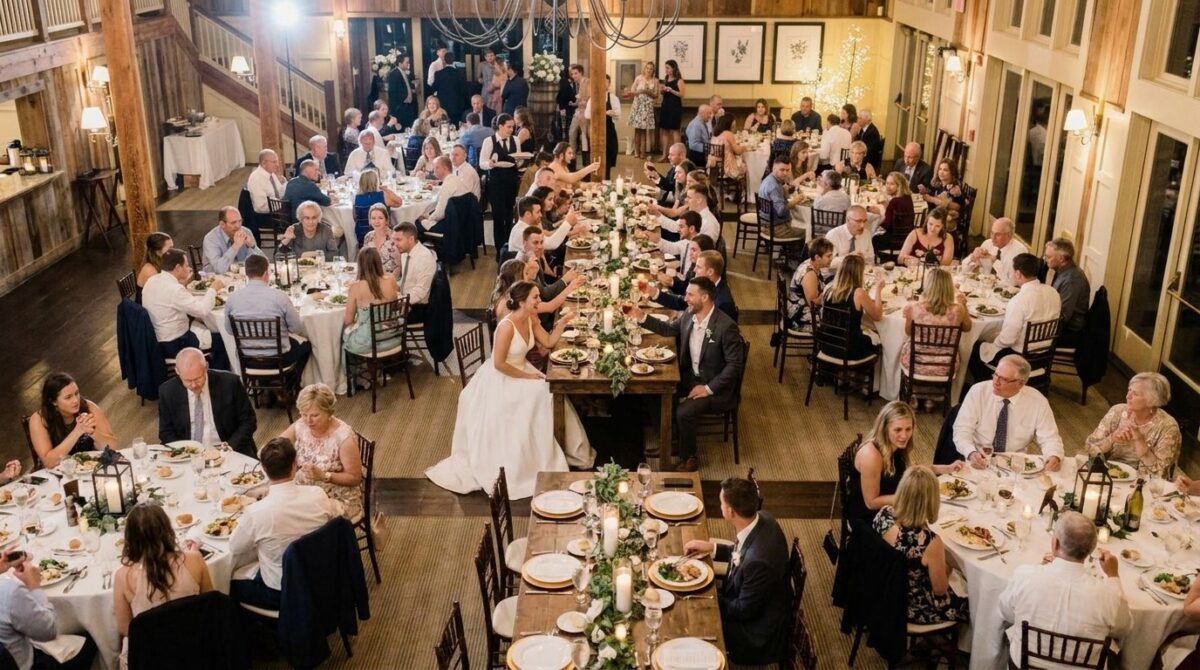
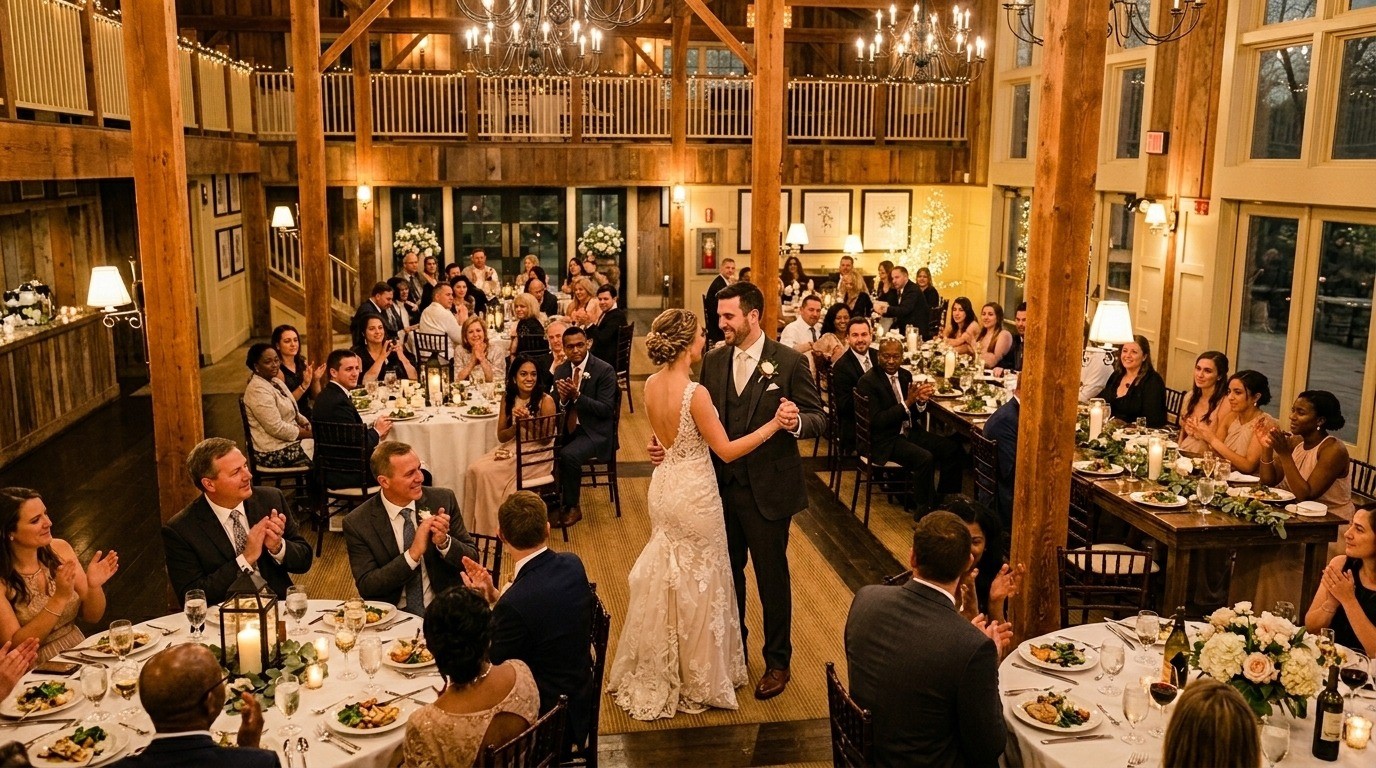
DLE Event Group has spent more than a decade running entertainment at landmark venues across the Northeast, and Rhode Island sits well within our regular travel range. We’d love to talk through your date, your venue choice (or your shortlist), and what kind of evening you’re imagining.
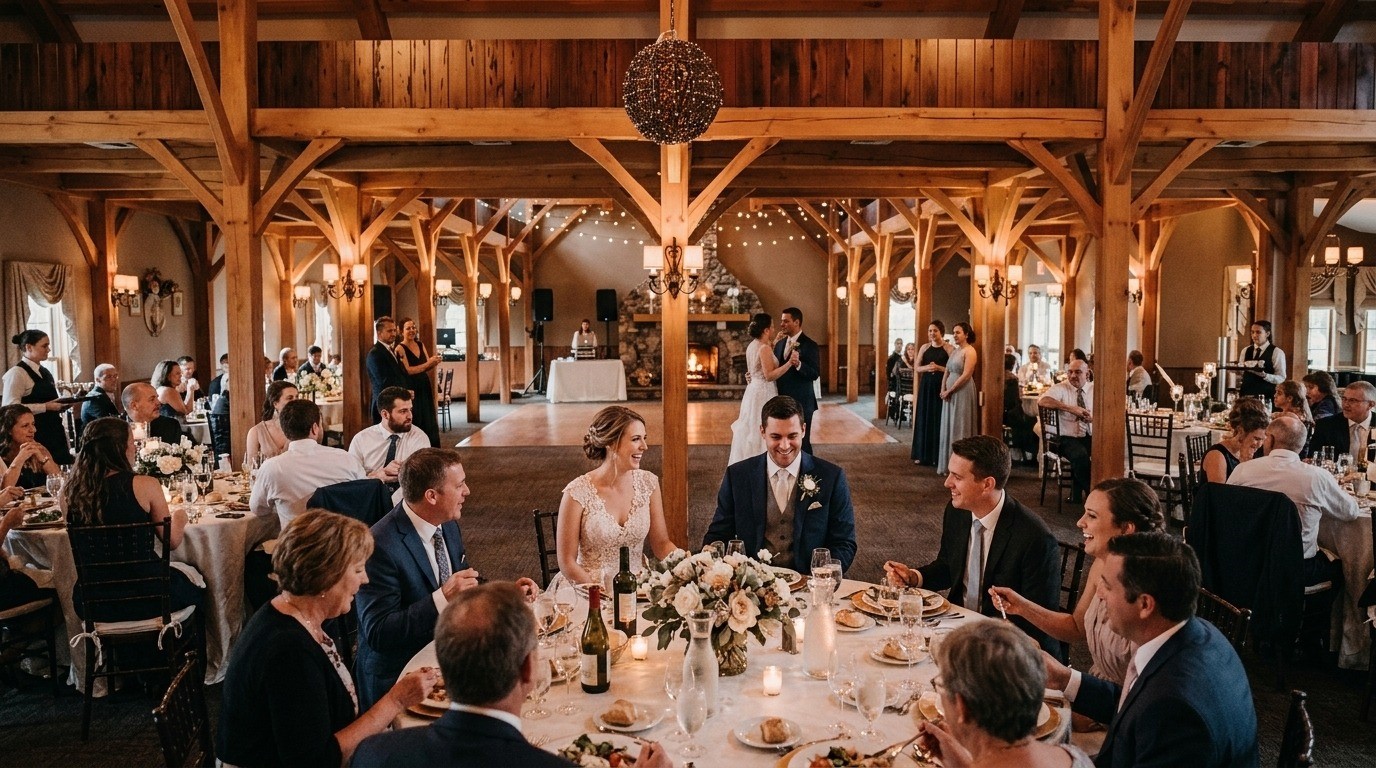
We’ll bring the music. You bring the mansion.

Reach out directly:

Ready to start the conversation?

QUESTIONNAIRE

Need Assistance? Directly reach us at contact@dleeventgroup.com or 877.534.2424

Top 5 Historic Mansion Wedding Venues in Maryland: An Entertainer’s Insider Guide

Top 5 Historic Mansion Wedding Venues in Maryland: An Entertainer’s Insider Guide

The door weighs more than your amp rack. That’s always the first thing I notice at a Maryland mansion wedding — the sheer physical weight of the entrance. Solid oak or iron-studded hardwood, hung on hinges that were forged before anyone alive today was born. You lean into it with your shoulder, roll the gear cart across a threshold worn smooth by two centuries of footsteps, and then you look up.

The ceiling is higher than it has any right to be. Crown molding so detailed it looks like it was carved by someone who had nothing but time and pride. Plaster medallions. Original hardwood floors that creak in specific places, which you learn fast because you’re going to be running cables across them in three hours. And the light — in these old rooms, the light comes through tall, narrow windows at angles that modern architects don’t bother with anymore, casting long amber rectangles across the floor that shift as the afternoon moves.

I’ve set up in historic mansion wedding venues in Maryland from Baltimore’s Mount Vernon neighborhood to the foothills of the Catoctin Mountains, and every single one of these buildings has a personality. Not a “vibe” — a personality. The walls have absorbed a century of conversations, celebrations, arguments, music. You feel it. And when you start a sound check in a room like that, the space talks back to you in ways that a hotel ballroom never will.

These five Maryland mansions and estates are among the best historic wedding venues in Maryland, and each one demands something different from the entertainment. Here’s what I’ve learned about them.

Why Historic Mansions Work for Weddings (And What Most Couples Miss)

Every couple who books an estate wedding venue in Maryland is buying atmosphere they couldn’t build from scratch. The patina on a brass doorknob, the way a garden wall has settled into the earth over 150 years, the original tile work in an entryway — that’s irreplaceable. No decorator in the world can fake it. And from an entertainment perspective, these spaces offer something critical: acoustic character.

Old rooms were built with plaster walls, hardwood floors, and high ceilings — materials that reflect and shape sound in complex ways. A 1903 ballroom doesn’t sound like a 2015 event center, and that’s a good thing if your entertainment team knows how to work with it. Live instruments, especially brass and strings, come alive in rooms with these proportions. The natural reverb adds warmth you’d otherwise need a $10,000 sound system to manufacture.

But here’s what couples overlook: historic buildings come with constraints. Some have strict noise curfews tied to landmark preservation agreements. Some have load-in paths that involve narrow staircases or gravel drives that aren’t kind to heavy equipment. Power infrastructure can be limited — a mansion wired in the 1920s wasn’t designed for modern PA systems. None of this is a dealbreaker, but it’s the kind of thing you want your entertainment company to know about before they show up on your wedding day, not after.

The Venues

The Belvedere (Baltimore)

Top 5 Historic Mansion Wedding Venues in Maryland

The Owl Bar downstairs still has the wooden owls that winked when the illegal whiskey arrived — and the ballroom upstairs hasn’t lost a single ounce of that Prohibition-era swagger.

Step into the Grand Ballroom at The Belvedere and your eyes go up before anything else. Not to gauge the size — to take in the ornamentation. This building opened in 1903 as a luxury hotel in Baltimore’s Mount Vernon district, and the architects treated the ceiling like a canvas. Gilded plasterwork, detailed cornices, the kind of craftsmanship that would cost a fortune to reproduce today and that nobody would bother trying. At 290 seated for dinner, the room hits that sweet spot where a wedding feels full and electric without becoming a logistics headache.

One floor down, the Charles Ballroom seats 220 in a more intimate scale — lower ceilings, warmer proportions. For smaller weddings or rehearsal dinners, the John Eager Howard Ballroom fits about 100. Then there’s the 13th Floor rooftop lounge, which sounds like a speakeasy in a Fitzgerald novel because that’s essentially what it is.

JFK attended events here. So did Woodrow Wilson. If you’ve watched Mad Men, you’ve seen it — Season 3 features the interior. The building earned its spot on the Historic Hotels of America registry for reasons that become obvious within five minutes of walking through. An attached parking garage solves the urban venue parking problem, full ADA accessibility means no guest is left navigating workarounds, and a dedicated coordinator who knows every quirk of the space keeps the day running tight.

Capacity: 100–290 seated (depending on ballroom) Spaces: Grand Ballroom, Charles Ballroom, John Eager Howard Ballroom, 13th Floor rooftop lounge, ready suites Price Range: Grand Ballroom starts at approximately $47,500 for 160 guests; per-person F&B from $160+ Peak Season: Year-round (indoor venue), but May and October are most popular Best For: Couples who want Gilded Age grandeur in a city setting Pet-Friendly: No (service animals only)

That ornate plaster ceiling and all those hard surfaces give the Grand Ballroom a lively acoustic personality — sound bounces around with real energy, which is exactly what you want for a packed dance floor but demands careful speaker placement if you need speeches to stay intelligible during dinner. Here’s the hidden advantage: the room’s proportions naturally channel sound toward the center, so a dance floor positioned mid-room gets a boost you didn’t have to engineer. Because the building was designed as a hotel with flowing public spaces, transitions between cocktails in one ballroom and dinner in another feel seamless rather than staged. Load-in through the service entrance is straightforward for a downtown venue, and power capacity is solid — this building has hosted major events for over a century.

Now, about those owls. The Owl Bar on the ground level was a functioning speakeasy during Prohibition — one of Baltimore’s worst-kept secrets. Two carved wooden owls perched on the back bar were rigged with a buzzer system: when a shipment of whiskey arrived, the owls’ eyes would “wink” to signal patrons that drinks were available. Both owls are still there. The bar is still open. More than a few wedding after-parties have migrated downstairs, guests toasting under the same carved birds that watched Baltimore’s bootleggers a hundred years ago.

Official website: https://www.belvedereandcoevents.com/

Woodend Sanctuary & Mansion (Chevy Chase)

img47

Forty acres of protected woodland, a mansion designed by the architect of the Jefferson Memorial, and a ceremony site where the canopy of old-growth hemlock trees forms a natural cathedral.

Nothing about the approach prepares you. You drive through the suburbs of Chevy Chase, turn onto a gravel lane, and the city vanishes. Woodend belongs to Nature Forward (formerly the Audubon Naturalist Society), and it operates as a genuine wildlife sanctuary — 40 acres of meadows, forest trails, and native plantings just minutes from the DC line. John Russell Pope designed the mansion at its center in 1927, the same architect who gave Washington the Jefferson Memorial and the National Gallery of Art. He brought that same sense of classical proportion to a more intimate scale here: a Georgian Revival manor with clean symmetry, tall windows, and a terrace that overlooks the grounds like a balcony in a period film.

Everyone who books here talks about the Hemlock Grove first. It’s a stand of old-growth trees where the overhead branches knit together into something that genuinely resembles the vaulted ceiling of a cathedral. No arch rental needed. No fabric draping. The trees do the work. In April and May, the surrounding gardens layer dogwood, azalea, and wild columbine into the backdrop. By September and October, the canopy has turned gold and copper. Either season, it’s the kind of setting that makes guests put their phones down — which, in my experience, is the highest compliment a venue can earn.

Inside, the mansion accommodates 50 to 120 for a winter reception. During tent season (April through November), the grounds expand to hold up to 170 with a climate-controlled tent. Two large dressing suites give the wedding party room to prepare. Since this is a working sanctuary, confetti and rice are off-limits — couples toss dried lavender, birdseed, or bubbles instead, which honestly photographs better anyway.

Capacity: Up to 170 (tented, April–November); 50–120 (indoors, December–March) Spaces: Hemlock Grove (ceremony), terrace tent, mansion interior, two dressing suites Price Range: $3,900–$8,800+ (rental fee; no sales tax; portion is tax-deductible) Peak Season: April/May (spring blooms) and September/October (fall foliage) Best For: Nature-loving couples who want intimate elegance near DC Pet-Friendly: Yes — dogs welcome for outdoor ceremonies (weather permitting)

Acoustically, Woodend is two different venues depending on where you’re standing. Out in the Hemlock Grove, sound disperses fast — you’re in an open forest, not an enclosed room — so the ceremony setup needs enough reach to fill the space without blasting the first three rows. Inside the mansion, the rooms run smaller with plaster walls that reflect sound generously, which means a scaled-down speaker setup actually outperforms an oversized one. On the logistics side, shuttles max out at 30-passenger minibuses because of the gravel drive, and parking caps at 70 to 90 cars. BYO alcohol with no corkage fees is a genuine budget advantage, though you’ll coordinate with one of the venue’s 8 to 10 approved caterers for food. With an 8-hour rental block, your entertainment team needs to move efficiently through setup and breakdown — no leisurely load-ins here.

Rachel Carson — the marine biologist whose book Silent Spring helped launch the modern environmental movement — walked these same trails regularly while developing the ideas that would change how the world thought about ecology. She was a frequent visitor to Woodend’s grounds, and something about knowing that sticks with you when you’re standing in the grove. Your rental fee goes directly to Nature Forward as a tax-deductible donation, which means your wedding funds the conservation of this landscape. Few venues let you celebrate a marriage and protect 40 acres of urban wilderness in the same gesture.

Official website: https://woodendsanctuary.org/

Antrim 1844 (Taneytown)

img48

A 24-acre estate with a Civil War general’s headquarters, a 20,000-bottle wine cellar in the original boiler room, and a policy of hosting exactly one wedding per day — because your celebration shouldn’t have to share the property with anyone else.

Calling Antrim 1844 a venue undersells it. When you book here, you’re taking over a small historic village: the main mansion, multiple outbuildings, 40 guest rooms spread across 11 structures, formal rose gardens, a glass-enclosed pavilion, and the Smokehouse Restaurant whose kitchen handles all the catering. Twenty-four acres of Carroll County countryside surround it, the kind of rolling green views that make you forget Baltimore and Washington are both an hour away.

Ceremony options span a wide range. The English Tea Rose Garden holds up to 250 and, in late May through June, looks like it was staged for a BBC period drama. The Glass-Enclosed Pavilion seats 180 with garden views and climate control. The Pavilion Ballroom fits 220. But listing capacities misses the point. This is an estate where General George Meade set up his headquarters in the days before leading the Union Army to Gettysburg. Original wood paneling in the mansion, drawing rooms with fireplaces and crown molding, a “Widow’s Walk” on the roof where you can see the distant Gettysburg battlefield — the property carries a weight you can’t manufacture.

Recognition from both Wine Spectator (“Best of Award of Excellence”) and The Knot (“Best of Weddings” 2024) tells you something about the caliber of the food and beverage program. And the Pickwick Pub on the property — wood-paneled, intimate, stocked from that legendary cellar — is where many wedding parties end up for a late-night nightcap long after the reception has officially ended.

Capacity: Up to 250 (garden); 180 (glass pavilion); 220 (pavilion ballroom) Spaces: English Tea Rose Garden, Glass-Enclosed Pavilion, Pavilion Ballroom, drawing rooms, Pickwick Pub, Smokehouse Restaurant Price Range: All-inclusive starting at approximately $12,600 for 75 guests; per-person $175–$250+ Peak Season: May–October (rose gardens in bloom) Best For: History-and-wine-loving couples who want an estate takeover Pet-Friendly: Conditional — pets allowed in specific guest rooms; inquire about ceremony participation

If I had to pick one space on this property to perform in, it’s the glass pavilion. Glass walls and a hard floor create a bright, reflective acoustic environment where live instruments — especially a saxophone or violin — gain a shimmer that carpeted hotel ballrooms can’t touch. The reflections add brilliance without muddiness. Garden ceremonies need a clean outdoor sound setup, and the short walk from ceremony to pavilion or ballroom reception gives your cocktail hour a natural purpose as guests drift between spaces. One thing that matters more than most couples realize: Antrim hosts only one event per day. No pressure from another party waiting for the room. Setup time is generous. Sound check isn’t rushed. That single-event policy quietly elevates everything.

Let’s talk about the wine cellar. Published accounts cite 15,000 bottles. Local lore and the venue’s own history put it closer to 20,000 — either way, it’s housed in the mansion’s original boiler room, stone-walled and underground, feeling more like a European cave cellar than anything you’d expect in Maryland. Wine Spectator’s recognition makes sense the moment you walk in. If your wedding party includes anyone who takes wine seriously, a pre-dinner cellar tour with the sommelier is the kind of detail that turns a great wedding into a legendary one.

Official website: https://www.antrim1844.com/

Strong Mansion (Dickerson)

img49

FDR loved this spot so much he nearly made it the presidential retreat — and when you see the Sugarloaf Mountain panorama from the tented patio, you’ll understand why Camp David had serious competition.

Picture a stone fortress on the side of a mountain, built by someone who wanted to see forever. That’s Strong Mansion. Perched within a 3,000-acre nature preserve on Sugarloaf Mountain — a National Natural Landmark — the views from the permanent tented patio sweep across the Monocacy Valley with the kind of scope that makes 175 guests feel like they have the entire state to themselves. Stone construction, formal gardens, a pond that catches the late-afternoon light — all of it dialed to a level of natural drama that no amount of decor could improve.

Receptions happen on the permanent tented patio, which seats 175 and faces the mountain panorama head-on. Three outdoor ceremony sites give you options: the formal garden, the pondside clearing, or the open terrace. An indoor ballroom stands ready as rain backup, though most couples booking Strong Mansion are booking it for what’s outside. Peak month? October, and it’s not close. Fall foliage on Sugarloaf Mountain turns the horizon into a wall of orange, red, and gold that looks painted rather than real.

At $3,600 to $4,300 for the site fee — which includes a 7-hour rental, the tent, and parking — this is notably lean for a venue with these views. You’ll bring in your own caterer from an approved list, and like Antrim, the venue hosts one wedding per day.

Capacity: Up to 175 (tented patio) Spaces: Permanent tented patio, three outdoor ceremony sites, indoor ballroom (rain backup), bridal suite Price Range: $3,600–$4,300 site fee (includes tent, 7-hour rental, parking); $1,000 security deposit Peak Season: October (peak fall foliage), with season running April–November Best For: Couples who want mountain panoramas without a mountain drive Pet-Friendly: Yes — for outdoor ceremonies

Playing on the tented patio presents a puzzle I actually enjoy solving. A roof overhead but open sides facing the mountain means sound escapes laterally instead of building the way it would in an enclosed ballroom. For a DJ or hybrid band setup, that means angling speakers to project inward toward the dance floor rather than letting energy bleed out toward the valley. Live music carries beautifully in this setting — the natural environment absorbs excess reverb, giving you clarity without harshness. Where it gets tricky is logistics. This is a mountaintop venue within a nature preserve. Load-in requires advance coordination, and power infrastructure is limited compared to a hotel or dedicated event center. Your entertainment company needs to plan for self-sufficient power or confirm the venue’s electrical capacity well ahead of time.

Franklin D. Roosevelt visited Sugarloaf Mountain repeatedly and came close to making it the site of his presidential retreat — what would eventually become Camp David. Security concerns ultimately pushed the choice to a site in the Catoctin Mountains, but the pull of Sugarloaf was real enough to land it on the shortlist. The surrounding nature preserve was kept private specifically to protect the mountain’s wild, untouched character. What that means for your wedding: the landscape in your photos hasn’t been commercially developed, and it won’t be.

Official website: https://sugarloafmd.com/strong-mansion/

Ceresville Mansion (Frederick)

img50

An 1888 riverside estate that someone designed to look like a French chateau in the middle of Maryland horse country — and then filled it with wisteria, lily ponds, and an all-inclusive planning team that handles every detail.

Most couples who visit Ceresville Mansion for the first time say something like “wait, this is in Frederick?” Fair reaction. Twenty-five acres along the Monocacy River, and a mansion built in 1888 with deliberate French chateau aspirations — symmetrical facades, formal proportions, an aesthetic that borrows heavily from the Loire Valley. Wisteria-covered pergolas connect the outdoor spaces. A lily-filled reflecting pool creates the scene that photographers schedule entire timelines around. Come in June, when the wisteria hits peak bloom, and the pergola walkway becomes a tunnel of cascading purple that looks more like Provence than central Maryland.

Inside, the Grand Ballroom seats 150 to 170 for a reception and carries the European feel through with high ceilings, elegant molding, and tall windows. Step outside and the Garden Terrace expands that capacity to 200 to 230 with a covered backup option. The Garden Vista Pavilion stretches the upper limit to 200 to 250, making Ceresville one of the more flexible estate venues in the Frederick area. Both the Bridal Suite and Groom’s Suite are purpose-designed prep spaces — not converted hotel rooms — where the wedding party can actually spread out and be comfortable.

Where Ceresville diverges from most historic estates is in how much it takes off your plate. Full-service in-house catering. In-house liquor license — no outside alcohol, which simplifies planning enormously. A dedicated Event Manager and personal attendant assigned to your wedding. The philosophy is straightforward: you handle the guest list, they handle the logistics. For couples who don’t want to spend months coordinating a dozen separate vendors, that tradeoff is a significant draw.

Capacity: 150–170 (Grand Ballroom); 200–230 (Garden Terrace); 200–250 (Garden Vista Pavilion) Spaces: Grand Ballroom, Garden Terrace, Garden Vista Pavilion, Bridal Suite, Groom’s Suite Price Range: Venue rental $5,000 (winter) to $12,000 (peak Saturday); catering from $130–$140 per person; financing plans available Peak Season: June (wisteria blooms) and December (holiday decor) Best For: Couples who want European elegance with all-inclusive simplicity Pet-Friendly: No (service animals only)

High ceilings, hard surfaces, a relatively compact footprint — the Grand Ballroom’s proportions work well for both live music and DJ sets. Sound fills the room evenly without the dead spots you sometimes encounter in larger, irregularly shaped reception halls. What demands attention is the timeline: a 5-hour standard reception window means your entertainment team needs a clear run-of-show with sharp transitions between dinner, toasts, and dancing. No extended cocktail hour bleeding into the schedule. On the coordination front, the all-inclusive model is a quiet advantage — your entertainment vendor talks to one in-house team rather than juggling a separate caterer, bar service, and venue manager. In practice, that streamlines planning considerably. Suite access opens six hours before the ceremony, giving the wedding party a comfortable prep buffer.

An 1818 stone mill stands next to the mansion — one of the few surviving structures from Frederick County’s early industrial period. Together with the reflecting pool, it frames what might be the most underrated photo location on the property: rough stone texture, still water, wisteria cascading overhead. In 1880s Maryland, most estates followed Georgian or Federal styles. Whoever built Ceresville had different ambitions — a piece of Europe transplanted to the Monocacy River valley. Nearly 140 years later, the illusion still holds.

Official website: https://www.ceresville.com/

How to Choose Between These Five Venues

Five mansions, five completely different experiences. Here’s how to narrow it down based on what actually matters for your wedding.

If your guest list is pushing past 200, The Belvedere’s Grand Ballroom (290 seated), Antrim 1844’s garden (250), and Ceresville’s Garden Vista Pavilion (250) give you the most room. If you’re planning something under 120, Woodend Sanctuary’s mansion interior or Strong Mansion’s tented patio will feel appropriately scaled without that echoing, “are there enough people here?” energy.

Budget reality: Strong Mansion’s site fee of $3,600 to $4,300 is the most accessible entry point, but remember you’re bringing in your own caterer on top of that. Woodend’s BYO-alcohol-with-no-corkage setup can save thousands. On the other end, The Belvedere’s Grand Ballroom starting at $47,500 and Antrim 1844’s per-person pricing of $175 to $250+ put those venues firmly in the premium tier. Ceresville falls in the middle and offers financing, which is worth knowing about.

On-site lodging makes Antrim 1844 the clear winner — 40 rooms across 11 buildings, the only venue here that functions as a true estate takeover. For non-negotiable fall foliage, Strong Mansion in October is the move. Spring blooms? Woodend in April and Antrim’s rose gardens in June are both extraordinary. The Belvedere operates year-round, making it the safest pick for winter or off-season weddings.

Couples who want the least vendor coordination will appreciate Ceresville’s all-inclusive model and The Belvedere’s in-house catering — both reduce the planning workload substantially. Prefer full flexibility? Strong Mansion and Woodend give you that freedom.

Why Entertainment Matters More Than You Think at Historic Mansion Weddings

After years of performing at estate wedding venues in Maryland and across the Mid-Atlantic, one thing keeps proving itself true: the older the building, the more your entertainment choice matters. Not less. More.

Historic mansions have acoustic personalities that modern event venues simply lack. High plaster ceilings reflect sound differently than drop-tile ceilings. Hardwood floors, stone walls, original glass windows — these surfaces interact with music in ways that can either amplify your celebration or muddy it into noise. Consider: a room built in 1903 was designed for human-scale sound. Conversation. A chamber quartet. A jazz combo. It was not designed for a subwoofer. That doesn’t mean you can’t bring modern sound equipment into these spaces, but it does mean your entertainment team needs to calibrate their setup to the room — not just plug in and hope.

Beyond acoustics, mansion weddings move through multiple spaces: a garden ceremony, a terrace cocktail hour, a ballroom reception, maybe a pub for the after-party. Every transition is a moment where energy either builds or stalls. An entertainment team that carries musical continuity across those shifts — string trio in the garden, jazz combo on the terrace, full dance party in the ballroom — creates a flow guests feel even if they can’t articulate it. That flow separates a wedding that feels like three events stitched together from one that feels like a single, evolving celebration.

Then there are the practical constraints — noise ordinances tied to landmark status, delicate floors that can’t handle heavy staging, limited power infrastructure. Your entertainment company should be asking about all of this during planning, not discovering it during load-in. Mansion weddings reward preparation. They punish improvisation.

Why DLE Event Group

A Maryland mansion wedding asks you to match modern entertainment energy to a space built for a different century. That tension — between the formality of the architecture and the live, dancing, emotional reality of a wedding celebration — is exactly where DLE Event Group’s hybrid DJ band concept thrives.

Our model pairs live musicians (saxophone, guitar, keys, percussion, vocals — scaled from 2 to 7+ players) with a professional DJ who doubles as your MC. In a rose garden ceremony, that might mean a violin and cello playing your processional live. On the terrace during cocktails, a jazz trio setting the mood. Once the reception opens up, a full hybrid band bringing the dance floor to life while the DJ ensures seamless transitions and access to any song in existence. Live instruments fill these old rooms with the warmth and presence they were designed for, while the DJ component gives you range, flexibility, and the ability to play that one song your college roommate will lose her mind over.

Eleven-time honorees in The Knot Best of Weddings Hall of Fame across more than a decade and over 100 successful events. Our service area extends well beyond New York City — we perform throughout the tri-state area, the Mid-Atlantic, and destination events worldwide. Maryland is very much in our range. Planning starts about six months out with 5 to 10 Zoom sessions where we learn your musical preferences, build your playlist, learn custom songs for special moments, and coordinate with your venue on every technical detail. We bring backup equipment for every critical component. At a venue with this much history and this much at stake, redundancy is the standard, not the upgrade.

Frequently Asked Questions

For peak-season Saturdays (May, June, September, October), 12 to 18 months is the safe range. Several of these venues — Antrim 1844 and The Belvedere especially — fill premium dates quickly because they host corporate events and galas alongside weddings. If you have flexibility on the day of the week or the season, you’ll find more availability and often better pricing. The same timeline applies to booking entertainment; premier dates go early on both sides.
It ranges widely. Strong Mansion’s site fee starts at $3,600 (plus outside catering and vendors), making a 150-person wedding feasible in the $25,000 to $40,000 range depending on your choices. The Belvedere’s Grand Ballroom starts at roughly $47,500 for 160 guests before adding on. Antrim 1844’s all-inclusive packages start at $12,600 for 75 guests and scale up with per-person pricing of $175 to $250+. Ceresville Mansion offers financing plans, which is rare and worth asking about. The honest answer: budget $30,000 to $75,000+ depending on the venue, guest count, and how much you customize.
Yes, at all five of these venues. Each one offers distinct ceremony and reception spaces on the same property, which eliminates guest transportation between locations. The typical flow is an outdoor ceremony (garden, grove, or terrace), cocktail hour in a separate space while the reception room is finalized, then dinner and dancing in the main ballroom or pavilion. Your entertainment team coordinates music for each transition.
Old buildings have acoustic characteristics that modern event centers don’t — high ceilings, plaster walls, stone, and hardwood all reflect sound. This can be beautiful for live instruments but tricky for amplified speeches. An experienced entertainment company will do a site visit or detailed technical assessment before your wedding, calibrate speaker placement for the room’s specific acoustics, and bring equipment appropriate to the space. Ask your entertainment vendor whether they’ve performed at historic venues before and how they handle sound in high-ceiling, reflective rooms.
Antrim 1844 is the standout — 40 guest rooms across 11 buildings on the property, making it the only venue in this group that functions as a full weekend retreat. The Belvedere has nearby lodging in Baltimore’s Mount Vernon neighborhood. Strong Mansion, Woodend, and Ceresville are event venues without on-site accommodations, so you’ll want to arrange hotel blocks at nearby properties and consider shuttle logistics.
In a word: yes. October in central and western Maryland delivers some of the most dramatic fall color on the East Coast, and venues like Strong Mansion on Sugarloaf Mountain and Antrim 1844 in Carroll County are positioned to take full advantage. Expect peak-season pricing and earlier booking timelines. If you want the foliage without the Saturday premium, a Friday evening or Sunday afternoon in mid-October often delivers the same backdrop at a lower price point.

Let's Talk About Your Maryland Mansion Wedding

You’ve got the mansion. You’ve got the history, the gardens, the kind of architecture that makes every photo look like it belongs in a magazine. What you need now is entertainment that understands how to bring a centuries-old room to life without fighting the space — music that fills the room the way it was built to be filled, transitions that carry your guests from ceremony to dance floor without a single awkward pause.

That’s what we do. And we’d love to hear what you’re planning.

Ready to start the conversation?

QUESTIONNAIRE

Need Assistance? Directly reach us at contact@dleeventgroup.com or 877.534.2424

Top 5 Waterfront Wedding Venues in Massachusetts: An Entertainer’s Insider Guide

Top 5 Waterfront Wedding Venues in Massachusetts: An Entertainer’s Insider Guide

The bass player was tuning up on a deck in Harwich Port when the harbor pilot boat cut across the water, trailing a wake that caught the last of the sun and threw gold light across every surface — the tables, the glassware, the faces of a hundred and fifty people who had just stopped talking mid-sentence. Cape Cod does this to you. You plan a wedding around flowers and timelines and seating charts, and then the Atlantic hands you a moment no florist could have manufactured. I watched the couple look at each other and I watched their guests look at the water and I thought, for maybe the four hundredth time in my career: this is why people get married on the coast.

Massachusetts has 1,519 miles of tidal shoreline, and the character shifts radically depending on where you are. Cape Cod’s soft sand and salt-bleached shingle cottages feel nothing like the granite cliffs of the North Shore, which feel nothing like Boston Harbor’s brick-and-steel waterfront. I’ve loaded speakers through marina service entrances, calibrated sound systems in ballrooms where floor-to-ceiling windows turned the ocean into a wall of moving light, and learned which waterfront wedding venues Massachusetts couples should have on their radar for the 2025-2026 season. These five are as varied as that coastline — from a family-owned peninsula in the smallest town in the state to a Forbes Five-Star hotel with a colonial fort beneath its foundation.

Not because they’re the most advertised, but because they’re the ones that work — for the couple, for the guests, and for the entertainment team trying to give you the night of your life.

Why Waterfront Venues Work for Massachusetts Weddings

The views sell it. What actually makes a waterfront wedding different is how the water reshapes behavior. Put a hundred and fifty people on a coastal terrace during cocktail hour and watch what happens — nobody huddles in the corners. They drift toward the railing, the deck edge, the stretch of sand. Everyone orients in the same direction, watching the same light shift over the water, and conversation opens up on its own. Ceremony to cocktails to reception — that progression runs smoother at a waterfront property because the landscape is doing half the choreography for you.

For someone running the entertainment, Massachusetts coastal venues have a structural gift that inland properties can’t offer: nearly all of them separate the outdoor ceremony space from the indoor reception room. Sunset vows on a beach or cliffside, then guests move into a ballroom where the sound system is already dialed in and the dance floor is waiting. Open air to contained energy — that’s a momentum build you can’t manufacture in a single-room venue. Time it right and your guests walk into the reception feeling like the evening just shifted into a higher gear, without anyone having to announce it.

Then there are the logistics that only matter once you’ve committed to the coast. Sound carries over open water — gorgeous when it’s a solo guitarist during vows, less gorgeous when your amplified reception bleeds across the harbor at 9 PM. Wind along the Massachusetts coast is a constant from May through September, predictable enough that experienced vendors plan for it, inconsistent enough that it still humbles the ones who don’t. And a practical bonus: most of these waterfront wedding venues Massachusetts has to offer include on-site lodging or sit minutes from it, which means your guests aren’t mapping Ubers at midnight.

The Venues

Wychmere Beach Club (Harwich Port)

img41

Twenty-eight oceanfront acres on Cape Cod, three distinct event rooms, and a private beach where the sand is warm enough to stand on barefoot through September.

Wychmere isn’t a cramped beachside restaurant with a function room tacked on — it’s a full coastal compound spread across nearly thirty acres of Harwich Port oceanfront, with manicured grounds, private beach access, and a white-on-white aesthetic that manages to feel luxurious without being cold. The venue traces its roots to 1892, when it opened as the Snow Inn, a Victorian-era lodging that served Harwich Port’s shipping families. By mid-century, the property had become Thompson’s Clam Bar — a Cape Cod institution — before its transformation into the modern beach club that now hosts some of the most sought-after weddings on the Cape.

Three reception spaces give you options that genuinely differ: the Harbor Room handles up to 320 seated guests with harbor and marina views; the Ocean Room accommodates 240 with a more open feel; and the Dune Room — the one I’d steer couples toward for 160 or fewer — features a private deck where your ceremony happens with feet in the sand, followed by a reception overlooking the Atlantic. Rooftop cocktail hours are a Wychmere signature: the elevation gives guests a panoramic sweep of Nantucket Sound that earns audible reactions, and it separates cocktails from the reception space in a way that makes the ballroom reveal feel intentional.

Capacity: Harbor Room (320 seated), Ocean Room (240 seated), Dune Room (160 seated) Spaces: Harbor Room, Ocean Room, Dune Room with private deck, private beach, rooftop cocktail area Price Range: Venue fees $4,000-$18,000; F&B minimums $36,000-$125,000 depending on space and date Peak Season: June-September Best For: Cape Cod luxury seekers who want beach access and options for 150-300 guests Pet-Friendly: No (service animals only)

Three reception rooms mean three different acoustic environments, which is unusual for a single property. The Harbor Room — 320 seats — requires deliberate speaker placement to keep sound present without bouncing off all that glass. The Dune Room is the performer’s favorite: intimate enough that a band fills it without fighting the space, and the indoor-to-deck flow lets you run an acoustic set outside during sunset before pulling energy inside for dancing. The five-hour event window keeps your timeline honest — not a limitation, but a forcing function that prevents the night from losing shape.

The Dune Room’s private deck is the detail that stays with you. Your ceremony happens on sand — not a symbolic beach, but actual Cape Cod shoreline — and then you walk your guests up to a reception with the Atlantic framed in every window. Thompson’s Clam Bar, the mid-century institution that once occupied this land, was famous enough that “Thompson’s by the Sea” became a local catchphrase. The venue’s architectural evolution from Victorian inn to clam bar to luxury beach club is a compressed history of Cape Cod tourism itself — and that story is visible in the property’s bones if you know where to look.

Official website: https://www.wychmere.com/

Beauport Hotel Gloucester (Gloucester)

img42

Samuel de Champlain named this harbor “Le Beau Port” in 1606, and four centuries later, the floor-to-ceiling windows in the ballroom prove he wasn’t exaggerating.

Gloucester has been a working fishing port since before the Pilgrims landed at Plymouth, and the Beauport Hotel sits on that heritage without sanitizing it. Lobster boats share the harbor with sailboats, the seagulls are aggressive and unapologetic, and the light off the water hits the ballroom windows with a quality photographers describe in terms usually reserved for the Italian coast. The hotel is modern boutique construction — built on the site of a former birdseed factory — but the name reaches back to Champlain’s 1606 expedition, when the French explorer designated this harbor “Beautiful Port.”

The Beauport Ballroom seats 230 and earns that number without feeling overstuffed. Floor-to-ceiling windows along the harbor side turn the water into something more than a backdrop — it shifts color as the sun tracks across the sky, a living element in the room that no decorator could have planned. Soft blues, weathered grays, driftwood accents: the design reads coastal upscale without trying too hard. Ceremonies happen on the Rooftop Terrace, which may offer the most commanding harbor perspective on the entire North Shore — an elevated, open-air platform where your vows unfold above the waterline, Gloucester’s working harbor stretched out below. Ninety-four luxury guest rooms and a complimentary bridal suite turn the hotel into a self-contained wedding weekend. Guests check in Friday, attend Saturday, brunch overlooking the harbor Sunday. Nobody is searching for a hotel at 11 PM.

Capacity: 230 seated in the Beauport Ballroom; Rooftop Terrace and Oceanside Terrace for ceremonies Spaces: Beauport Ballroom (reception), Rooftop Terrace (ceremony/cocktails), Oceanside Terrace, 94 guest rooms Price Range: Venue fees $6,500-$9,500; ceremony fee $1,500; F&B minimums vary by season Peak Season: May-October Best For: North Shore couples who want a boutique hotel wedding with harbor views and on-site lodging Pet-Friendly: No (service animals only in event spaces)

Late afternoon sun reflecting off the harbor bathes the room in warm ambient light — but it also means your lighting plan has to account for the transition from daylight to artificial as evening sets in. The ballroom’s proportions work well for 230: ceilings high enough to avoid that compressed feeling, enough soft furnishings to keep sound reflections in check. Moving guests from the Rooftop Terrace ceremony through cocktails and into the ballroom is a clean sequence — the reception room gets its final touches while everyone is occupied upstairs, and that separation builds genuine anticipation for the reveal. Ninety-four on-site rooms is the kind of number that keeps a dance floor packed past 10. When the elevator ride to bed is sixty seconds, nobody starts calculating drive times at 9:30.

Up on the rooftop pool and bar area — available for pre- or post-wedding events — your guests get a “ship-deck” vantage of the harbor that has become one of the North Shore’s most photographed wedding weekend moments. From that height, Gloucester’s fishing fleet is visible coming and going in the channel below. This is an operating harbor, not a decorative one, and that authenticity lends the venue a texture no manicured resort can replicate. Ask anyone who’s attended a Beauport wedding what they remember, and the answer is almost always the harbor — its sound, its smell, the constant working life visible through every window.

Official website: https://www.beauporthotel.com/

The Oceanview of Nahant (Nahant)

img43

A family-owned venue on a private rocky peninsula in the smallest town in Massachusetts, where 360-degree ocean views come standard and the last dance happens on the beach.

Nahant is a peculiar place. Technically a town — the smallest by area in the entire Commonwealth — it’s really a mile-long peninsula connected to the mainland by a causeway, with the Atlantic on all sides. The Oceanview sits on a private rocky point where the ocean views aren’t “on one side” — they’re everywhere, 360 degrees of unobstructed water. On a clear day, the Boston skyline hovers in the distance, giving photographs a dramatic urban-coastal layering unique to this location.

Family ownership shows up in ways you notice immediately. This isn’t a corporate hotel that bolted on an events division — the people running your wedding know every quirk of the space, every way the light shifts across seasons, which corner of the deck catches the wind at 6 PM in July. The Grand Ballroom’s panoramic windows let the ocean into the room without the weather. Outside, a private beach serves as the ceremony site — rocky New England coastline where the waves supply your processional soundtrack. Between the two, a tented cocktail lounge gives guests a sheltered transition with the sea air still in play. Fourteen Knot Best of Weddings wins and Hall of Fame status confirm what the repeat bookings already told you: this consistency is not a coincidence.

Capacity: 220 guests Spaces: Grand Ballroom (panoramic windows), private beach (ceremony), tented cocktail lounge Price Range: ~$168-$210+ per person; venue rental $3,500-$6,500 Peak Season: July-September Best For: Couples who want a private, intimate coastal feel with all-inclusive simplicity Pet-Friendly: Conditional — pets allowed for outdoor ceremonies only (restricted from indoor spaces)

Wind is a constant on this peninsula — not a dealbreaker, but the single fastest way to tell experienced coastal entertainers from rookies. Beach ceremonies demand weighted mic stands, secured music stands, and backup plans for gusts that arrive without warning. Inside the Grand Ballroom, the proportions are right for 220 — sound fills the space without needing to overpower it. The real timeline constraint is the 11 PM music curfew: your reception has to build energy efficiently, which means no meandering first hour followed by a frantic ninety-minute sprint. A smart entertainment team structures the set list to front-load the peaks and make every minute land.

What the Oceanview is known for — and what keeps drawing couples back — is the “Last Dance on the Beach.” After the reception, the couple walks onto the private beach for a final dance on sand under a spotlight, guests lined up along the deck above. Sentimental? Absolutely. But it gives the evening a cinematic close instead of the usual slow dissolve toward the parking lot. Nahant’s own lore adds an unexpected layer: the waters just off the venue’s rocks were the site of the famous “Nahant Sea Serpent” sightings of 1819, reported by local fishermen and taken seriously enough to make the Boston newspapers. Guests who know the story tend to watch the dark water a little differently during that final beach moment.

Official website: https://www.oceanviewofnahant.com/

Misselwood Estate at Endicott College (Beverly)

img44

A French chateau on a North Shore cliff, where the ceremony site literally sits at the edge of the continent and the seasonal tent glows with chandeliers after dark.

You drive onto the Endicott College campus in Beverly, past academic buildings and student parking lots, and then the landscape opens into something that belongs on the Normandy coast — a French-style chateau on cliffs above the Atlantic, manicured grounds running to the rock’s edge. The estate was originally part of a property called “Bon Jour,” built in 1845 by the Loring family. The current structure was designed to mimic French countryside architecture after the original cottage was demolished in 1926. Misselwood eventually became part of the college campus — you’re technically getting married at a university property, though nothing about the setting says “campus.”

The ceremony site is the headliner: positioned on the cliff’s edge, the Atlantic crashing against the rocks below. “Edge-of-the-world” is the phrase that gets used, and for once, it’s not hyperbole. Behind you, the estate. In front of you, open ocean. After vows, the reception moves to the seasonal tent — available Memorial Day through mid-October — which is not a pop-up canopy but a climate-controlled structure with a brick foundation and chandeliers. When it’s lit at night, it glows against the dark water in a way that looks staged but isn’t. Couples who’ve attended a Misselwood wedding (Knot Best of Weddings Hall of Fame) tend to remember the contrast: raw cliffside ceremony followed by chandelier-lit warmth.

Capacity: 200 seated guests Spaces: Misselwood House, seasonal tent (Memorial Day-mid-October), oceanfront cliffside ceremony site Price Range: Venue fees $5,000-$7,500; ceremony fee $1,000 Peak Season: June-September Best For: Couples drawn to dramatic coastal landscapes with an intimate 200-guest cap Pet-Friendly: No (service animals only)

That cliffside ceremony is exposed — wind off the ocean means planning for microphones, speaker positioning, and how much projection your officiant can actually deliver into a headwind. But that exposure is also the source of the moment’s power, and no one who’s stood on that cliff wants to trade it for shelter. Once guests move to the tent, the acoustic environment changes completely: enclosed, climate-controlled, fabric walls and chandeliers producing a warm, even sound profile that’s forgiving to work with. The short walk between spaces buys your entertainment team enough time to reset from ceremony mode to reception energy. Two hundred guests fills the tent at a sweet spot — enough bodies for real dance floor momentum, few enough that every table still feels connected to the center of the room. One scheduling note worth flagging early: the tent operates Memorial Day through mid-October. Indoor options exist outside that window, but the cliffside-to-tent sequence is what makes Misselwood unmistakable.

Why this particular stretch of Beverly coastline? The Loring family chose it in 1845 because it faces east — morning light floods the estate in a way that reminded them of the French coast they loved. That eastward orientation means sunset doesn’t happen over the water (it falls behind you), but what you get instead is the twilight afterglow — that deep blue hour when the sky is still lit and the sun has already dropped — which creates a photographic quality arguably more nuanced than a straight sunset shot. Photographers who’ve worked Misselwood know this and build their shot lists around it.

Official website: https://www.misselwood.com/

Boston Harbor Hotel (Boston)

img45

A 60-foot archway frames the harbor, a colonial fort lies beneath the foundation, and couples can arrive by boat to a reception where the city skyline and the waterfront share the same window.

This is a Forbes Five-Star, AAA Five-Diamond property on Rowes Wharf — one of Boston’s most historic waterfront addresses — where the iconic 60-foot archway functions as a gateway between the financial district and the harbor. That archway isn’t decorative. It was designed as a “Window to the Harbor,” a symbolic link between the city’s commercial identity and its maritime roots. When your guests walk through it, they’re passing through deliberate urban architecture that still earns its reputation after millions of photographs.

The Wharf Room seats 250 with floor-to-ceiling windows that keep the working harbor in your peripheral vision through every course. For larger celebrations, the Atlantic Room handles 300. Both rooms carry traditional Boston formality — dark wood, polished surfaces, a palette that reads “old money” — but the water views through the glass keep reminding you this isn’t some landlocked hotel ballroom downtown. Ceremonies can happen in the Pavilion for something more intimate, or there’s the option no other Boston venue can match: arriving by boat at the hotel’s private dock. Per-person pricing runs $220 to $320 and up, which is Forbes Five-Star territory and priced accordingly. Couples trimming costs should look elsewhere. Couples who want the highest level of city waterfront wedding Boston has ever offered should not.

Capacity: Wharf Room (250 seated), Atlantic Room (300 seated), Pavilion (smaller ceremonies) Spaces: Wharf Room, Atlantic Room, Pavilion, private dock for boat arrivals/departures Price Range: $220-$320+ per person; minimums typically start at $25,000 Peak Season: June and October Best For: High-end urban couples who want city skyline and harbor in the same frame Pet-Friendly: Yes — up to 2 pets, $100 non-refundable fee

Harbor-facing windows in the Wharf Room mean your entertainment is sharing the stage with a living backdrop — harbor lights, passing boats, the city skyline shifting from golden to electric as the night progresses. High ceilings keep the sound open and breathing, none of the compressed feeling you fight in low-ceiling hotel ballrooms. The event infrastructure here is built for professionals: clean power, proper load-in access, staff who understand vendor coordination at a level that matches the price tag. What makes this room a particular challenge is its formality. A Forbes Five-Star space demands entertainment that reads as polished from the first note — cocktail elegance into dinner ambiance into a dance floor that earns its intensity through deliberate escalation. No shortcuts, no faking it.

Beneath the hotel’s foundation lies the 17th-century South Battery, a colonial fort built to defend Boston Harbor from naval invasion. A military fortification under a luxury hotel — that duality is Boston’s waterfront identity compressed into a single address: always functional, always aspirational. The “Boat Grand Entrance” has become one of the most distinctive arrival moments at any New England wedding venue. Couples pull up to the private dock while guests watch from the Wharf Room windows above. It requires more coordination than a limousine, but the visual of approaching your own wedding across the harbor — the skyline behind you, the archway growing larger as you close the distance — is the kind of detail that rewrites how people remember the entire night.

Official website: https://www.bostonharborhotel.com/weddings

How to Choose Between These Venues

Five waterfront venues, five fundamentally different weddings. The right choice depends less on which one photographs best on your Pinterest board and more on what actually fits — your guest count, your budget, and your honest tolerance for sand in your shoes.

If your guest count is pushing 300, Boston Harbor Hotel’s Atlantic Room is your play — the only venue here that handles that scale on the waterfront. But you’re paying for it: $220 to $320 per person before a single vendor is booked. At 250, the Wharf Room delivers the same city-meets-harbor energy.

Cape Cod couples — or anyone drawn to the beach club atmosphere — should look hard at Wychmere Beach Club. Three reception rooms mean you can match your space to your guest count (160 to 320) rather than paying for room you don’t need. The food and beverage minimums ($36,000 to $125,000) reflect peak Cape Cod pricing, but the private beach ceremony and rooftop cocktail hour are genuinely difficult to replicate elsewhere on the Cape.

On the North Shore, Beauport and Misselwood sit thirty minutes apart but deliver very different weddings. Beauport is the boutique hotel route: 94 rooms, rooftop terrace, a working harbor visible through every window. Misselwood is the dramatic estate route: cliffside ceremony, chandelier tent, 200-guest cap. If on-site lodging is your deciding factor, Beauport wins. If the ceremony setting is what matters most, Misselwood’s cliff has no competition on this list.

And then there’s the Oceanview of Nahant — the wildcard pick for couples who want a private, almost secluded coastal experience that somehow still sits fifteen minutes from downtown Boston. A 220-guest cap, all-inclusive pricing ($168-$210 per person), and a family-ownership model make it the most personally run venue on this list. The “Last Dance on the Beach” tradition alone draws couples who want their wedding to end with something guests bring up for years.

Seasonality governs everything at waterfront wedding venues in Massachusetts. Peak season runs June through September. October — now the most requested wedding month in the state thanks to foliage — fills faster than summer at many venues, particularly along the North Shore. Winter bookings between January and March can shave up to 40% off venue fees, but you’re giving up the outdoor waterfront ceremony for an indoor plan. Whether that tradeoff makes sense depends entirely on how central the ocean-air ceremony is to your vision.

Why Entertainment Matters More Than You Think at Waterfront Venues

Waterfront wedding venues in Massachusetts introduce entertainment variables that simply don’t exist at inland properties — and by the time most couples realize it, the planning timeline is too compressed to adjust.

Start with wind, because it’s the one everyone underestimates. “It might be breezy” doesn’t begin to cover what happens on an exposed North Shore point in July. Gloucester, Nahant, Beverly — each gets consistent onshore winds from May through September that affect microphone quality, guest audibility during vows, and whether your sheet music stays on the stand. Cape Cod’s prevailing southwesterlies off Nantucket Sound behave differently than what you encounter in Boston Harbor, where the buildings funnel and redirect gusts along the waterfront. An entertainment team that has logged hours at Massachusetts coastal venues knows the wind direction at each property before they arrive. One that hasn’t will spend your ceremony learning it the hard way.

Then there’s the indoor-outdoor transition, which is where good waterfront weddings and great ones diverge. Nearly every venue on this list runs the ceremony outside and the reception in. Your entertainment has to handle two completely different acoustic environments in a single evening — an open-air setting where sound scatters in every direction, then an enclosed ballroom where it ricochets off walls, windows, and chandeliers. EQ settings change. Speaker placement changes. Volume balance changes. When an entertainment team has mapped that transition in advance — dialed in both setups during the site visit — guests don’t notice the shift at all. When it’s improvised on the day, you get a jarring audio gear-change that breaks the spell right when the evening should be accelerating.

Sunset timing is the third variable, and it’s the one unique to coastal weddings. Massachusetts summer sunsets range from about 8:25 PM in late June to 6:00 PM by late October — a two-and-a-half-hour swing that reshapes your entire timeline depending on the month. The strongest waterfront weddings are choreographed around that moment: ceremony timed so golden hour aligns with cocktails, the acoustic set calibrated to match the light as the sky shifts, the high-energy reception launching precisely as darkness takes over. An entertainment team worth hiring builds the set list around the sun’s schedule, not just the clock on the wall. It sounds like a small distinction. It changes the entire feel of the evening.

Why DLE Event Group

Massachusetts waterfront venues ask your entertainment to do something most setups aren’t built for: shift between an exposed outdoor ceremony, a sheltered cocktail terrace, and an enclosed ballroom — sometimes all three in a single evening — while sustaining an energy arc that builds from first note to last dance. A solo DJ can play the right songs. A band can bring the live energy. When you need both, plus the technical adaptability to handle salt air, wind, and three distinct acoustic environments before midnight, you need a format designed for exactly that kind of range. That’s DLE Event Group.

Our hybrid DJ band pairs live musicians — saxophone, guitar, keys, percussion, vocals — with a professional DJ and MC. On a cliffside ceremony at Misselwood, live instruments carry warmth and emotion without fighting the wind the way a full PA system does. During cocktail hour on a Gloucester rooftop, an acoustic configuration fits the scale and the setting. When reception doors open and the ballroom dance floor is waiting, the DJ capability lets us escalate without a gap — no break, no awkward pause where your guests reach for their phones. The live and electronic elements blend because they were engineered to work together, not bolted on after the fact.

Every event gets backup equipment — duplicates of everything critical. On the Massachusetts coast, salt air and humidity punish electronics in ways a climate-controlled Manhattan ballroom never would. Redundancy at a waterfront venue isn’t overkill; it’s the baseline of professional preparation. Over 10 years and 100+ events, we’ve earned The Knot Best of Weddings Hall of Fame 11 times because that level of preparation is audible in the performance. Our planning process starts six months before your date — 5 to 10 Zoom sessions where we learn your must-play list, your cultural traditions, your timeline, and the specific quirks of your venue.

DLE serves couples throughout the Northeast and beyond. Massachusetts is well within our range, and we’ll arrive knowing the room.

Frequently Asked Questions

Peak season (June through September) at the most competitive venues requires 12 to 18 months of lead time. October — now the most requested wedding month in the state because of foliage — often fills faster than summer, particularly on the North Shore and Cape Cod. Off-peak dates between January and March can sometimes be secured with 6 months’ notice, often at significantly reduced venue fees. Your entertainment should be locked in on the same timeline; premier waterfront dates disappear quickly on both sides of the equation.
Per-person rates on this list range from ~$168 at The Oceanview of Nahant to $320+ at Boston Harbor Hotel. Total spend for 150 guests typically falls between $50,000 and $100,000+ depending on the venue, day of the week, and season. Cape Cod venues like Wychmere carry food and beverage minimums ($36,000-$125,000) that set the floor before you add vendors. Friday and Sunday bookings often reduce costs by 20-30% at most properties. Massachusetts has a 6.25% sales tax on meals, and most venues add a 20% service charge — factor both in before comparing quotes.
At all five venues on this list, it’s the default. Each property offers a distinct outdoor ceremony space — beach, cliffside, terrace, or rooftop — paired with a separate indoor reception room, and cocktail hour bridges the gap. That outdoor-to-indoor progression is actually one of the strongest practical arguments for choosing a waterfront venue in the first place: the natural energy build from open-air vows to an enclosed dance floor is nearly impossible to replicate when everything happens in one room.
Every venue here has an indoor backup plan — no reputable coastal venue operates without one. That said, be honest with yourself about the gap: a cliffside ceremony with crashing waves and the same ceremony relocated to a ballroom are two different experiences. During your site visit, ask each venue to walk you through the rain plan in detail. Some transitions are nearly seamless (Boston Harbor Hotel simply moves everything to the Pavilion). Others involve more adjustment. One reassurance: Massachusetts coastal weather in peak season tends toward afternoon clearing, so morning clouds don’t automatically translate to a rained-out ceremony.
No. Massachusetts allows you to apply for a marriage license at any city or town clerk’s office in the state, regardless of where the ceremony takes place. Both partners must appear in person. There’s a mandatory 3-day waiting period from application to pickup, the license is valid for 60 days, and — unlike many states — Massachusetts does not require witnesses to sign the license. Plan the clerk’s office visit early in your wedding week to avoid last-minute logistics.
Boston Logan International Airport (BOS) is the primary hub for all five venues. North Shore properties (Beauport, Misselwood, Oceanview) are 30-45 minutes from Logan. For Cape Cod venues like Wychmere, guests can drive from Logan (about 90 minutes) or take the seasonal CapeFlyer train from Boston’s South Station directly to the Cape. Boston Harbor Hotel is the easiest — it’s a 10-minute cab from the airport, with a water taxi option that delivers guests directly to the hotel’s dock. Block room rates at on-site hotels or nearby lodging are worth arranging early, especially during peak season.

Start Planning Your Massachusetts Waterfront Wedding

The Massachusetts coast gives you something no inland ballroom can manufacture: a wedding where the Atlantic is in the room with you — reflected in the windows, audible through the terrace doors, visible from every seat. Cape Cod beach club, North Shore cliff, Boston Harbor archway — the specific setting varies, but the effect is the same. The water makes a hundred ordinary moments feel significant without anyone having to try.

The right entertainment makes sure the rest of the evening matches that standard. DLE Event Group’s hybrid DJ band experience was built for exactly these rooms — live instruments for the intimate moments, DJ versatility for the dance floor, and the technical preparation to handle whatever the Massachusetts coast decides to throw at you on the day.

Ready to talk?

QUESTIONNAIRE

Need Assistance? Directly reach us at contact@dleeventgroup.com or 877.534.2424

Top 5 Rustic Barn Wedding Venues in Massachusetts: An Insider’s Guide

Top 5 Rustic Barn Wedding Venues in Massachusetts: An Insider’s Guide

The first time I set up in a Massachusetts barn, I expected to fight the room. Every entertainer who’s worked a converted agricultural building knows the gamble — metal roofs that turn a snare hit into a ricochet, concrete pads that swallow bass, wind drafts that rattle mic stands. So I walked into a 200-year-old dairy barn in the hill towns west of Boston, braced for acoustic disaster, and instead heard… nothing. No echo. No ring. Just the soft creak of old timber overhead and the hum of a space that had been absorbing sound — cattle, weather, a century of New England seasons — long before anyone thought to put a dance floor in it.

That quiet sets rustic barn wedding venues in Massachusetts apart. Nothing here was shipped in on a flatbed. You’re looking at working farms in the Wachusett foothills, century-old dairy operations in the Nashoba Valley, former vaudeville theaters in old leather-tanning towns north of Boston. The buildings have calluses. You can see where ropes wore grooves into beams, where generations of farmers notched the doorframes, where the original hand-forged hardware still holds. None of it is decorative — it shapes how the room feels, how the light falls, and most importantly for someone in my line of work, how the music fills the space.

What gives Massachusetts a particular edge in this category is range. Within ninety minutes, you can go from a LEED Platinum art gallery in Boston’s Seaport to a 1763 farmhouse on Mount Wachusett’s slopes, from a 40-foot-ceiling concrete warehouse on the North Shore to a campus barn where a celebrated author helped design the renovation. Five venues, five entirely different takes on what “rustic” means in the Commonwealth.

Why Rustic and Barn Venues Work for Massachusetts Weddings

Couples rarely consider this when browsing venue photos: rustic barn wedding venues in Massachusetts solve the biggest problem in wedding entertainment before you even hire a band. The room cooperates. In a Marriott ballroom, you’re spending your first hour compensating — killing fluorescent buzz, masking HVAC drone, fighting parallel walls that turn every snare crack into a ping-pong match. In a timber-frame barn, the wood does half the mixing for you. Irregular surfaces scatter sound, exposed beams break up standing waves, and the whole room breathes.

Practically, the Massachusetts rustic category splits into two distinct lanes: the actual farms (Gibbet Hill, Harrington Farm, The Red Barn at Hampshire College) and the industrial conversions (Olio Peabody, Artists For Humanity EpiCenter). Farms give you pastoral warmth, outdoor ceremony options, and the kind of golden-hour light that makes photographers emotional. Industrial spaces give you scale, blank-canvas flexibility, and year-round climate control. Both work brilliantly for live music, but they work differently — and understanding that difference before you book entertainment is worth more than any Pinterest mood board.

But October unites the whole category. It has overtaken June as the most requested wedding month in Massachusetts because the foliage in Pioneer Valley and the Wachusett hills is that good. Plan accordingly — the best Massachusetts wedding venues in this category book 12 to 18 months out for fall dates.

The Venues

The Barn at Gibbet Hill (Groton)

img36

A rainstorm accidentally created this venue — and twenty-plus years later, it’s still the standard every other Massachusetts barn wedding is measured against.

Groton is about 45 minutes northwest of Boston, and when you pull onto the property, the first thing that registers isn’t the building — it’s the land. Rolling pasture, working cattle on the hillside, stone walls cutting across fields farmed since the colonial period. Then you step inside the 100-year-old dairy barn, and the rough-hewn beams and wrought-iron chandeliers confirm what the landscape promised: you’re standing in the real thing.

Inside, the space walks a careful line between authentic and refined. Original structural timbers frame the ceiling while iron chandeliers cast warm light that blends with ambient glow from the barn doors. Finishes are deliberately understated — the architecture does the heavy lifting, so nobody piled on decor to force a mood. Your florist works with the room rather than against it, and the natural palette of aged wood and iron means virtually any color scheme fits.

Outside, the property stretches up the hill to what might be Gibbet Hill’s greatest asset. A golf cart takes couples to the summit for portraits among the ruins of Bancroft’s Castle — a 1906 stone sanitarium that burned down, leaving a gothic shell that looks like the Scottish Highlands transplanted into central Massachusetts.

Capacity: 224 seated Spaces: Main Barn (reception), outdoor deck, hilltop ceremony area with castle ruins Price Range: Rental fees $500–$9,000; F&B minimums $3,000–$26,000 Peak Season: October (Nashoba Valley foliage at its peak) Best For: Farm-to-table couples who want a genuine agricultural setting Pet-Friendly: Yes — pets welcome for outdoor ceremonies and photos

Proportions matter here. At 224 capacity, the Barn is large enough for a substantial wedding but contained enough that the energy doesn’t dissipate into dead zones. Those rough-hewn beams overhead scatter sound in unpredictable, musical ways — high-frequency reflections get absorbed by the wood grain instead of bouncing back as harshness. Live acoustic instruments during dinner sound rich and present without amplification doing much work. When you switch to full-band dance sets, the room compresses the energy beautifully. Guests don’t drift to corners because the space naturally draws everyone toward the center. And the outdoor deck gives you a cocktail-hour staging area that’s acoustically separate from the reception — crucial for a clean sound check.

The origin story tells you everything about this place. Until 2002, this was a functional dairy farm — nothing more. Then a scheduled outdoor wedding got hit by a sudden rainstorm, and the couple moved the whole event into the unrenovated barn. Guests loved the raw atmosphere so much that the owners — the Webber Restaurant Group — pivoted from farming to events. Every restoration decision since then has been guided by that accident: keep the honesty of the original structure, don’t over-polish it, let the barn be a barn.

Official website: https://www.gibbethill.com/the-barn-at-gibbet-hill/

Harrington Farm (Princeton)

img37

Sixty acres on the slopes of Mount Wachusett, where the sunset views from the patio sit at some of the highest elevation in Central Massachusetts.

Princeton isn’t on most couples’ radar. It’s a small town in the Wachusett range, about an hour west of Boston, where the road narrows past apple orchards and cell signal gets spotty. That remoteness is Harrington Farm’s greatest asset. Once your guests turn onto the property — a 1763 farmhouse flanked by stone walls and mature maples — the outside world genuinely disappears. No ballroom can replicate that threshold.

A 1763 farmhouse anchors the property, still functional, its original architectural bones visible beneath thoughtful updates. Getting-ready rooms are inside — a space with 260 years of patina rather than a sterile bridal suite off a hotel corridor. The barn connects to the farmhouse and opens onto the Sunset Patio, which earns its name honestly: the patio faces due west at elevation, and during cocktail hour on a clear evening, you’re watching the sun drop below the ridgeline with nothing between you and the horizon but farmland and forest.

Inside the barn, a massive field-stone fireplace dominates one wall. The stonework is original — each piece fitted without mortar, held together by weight and geometry and 260 years of gravity doing its job. Nobody builds like this anymore.

Capacity: 220 guests Spaces: Farmhouse (getting ready), Barn (reception), Sunset Patio (cocktails/ceremony), garden area Price Range: Starting packages ~$15,000; per-person costs $135–$215 Peak Season: September–October (peak foliage on Wachusett Mountain) Best For: Couples who want mountaintop views with genuine New England history Pet-Friendly: Yes — dogs welcome for ceremonies and patio use

Elevation changes everything acoustically. With the patio open to the valley, sound carries outward instead of bouncing back — you get a clean throw from ceremony speakers without the reflections you’d fight at a valley-floor venue. Inside the barn, the field-stone fireplace wall acts as a massive diffuser, scattering low-frequency energy in a way that keeps bass warm without getting muddy. Patio cocktail hour to indoor reception is a short, natural transition — guests flow inside without a logistical gap. In-house catering simplifies coordination for performers, too, since there’s one team managing the timeline rather than three competing vendors. At 220 guests, the barn fills to the point where the energy is tangible but not claustrophobic — the sweet spot for getting a dance floor to ignite early.

During the late 19th century, Harrington Farm operated as a boarding house where city dwellers came for what was called “mountain therapy” — essentially an early wellness retreat on the Wachusett slopes. The original owners hosted an annual Fourth of July feast where salmon was boiled in cloth bags, a local culinary tradition so specific to Princeton that town historians still write about it. The thread of hospitality — this land as a place people came to feel better — runs unbroken from the 1800s through every wedding held here today.

Official website: https://www.harringtonfarm.com/

The Red Barn at Hampshire College (Amherst)

img38

An 1820s barn on a college campus where a children’s literature legend helped design the renovation, and a centuries-old oak tree provides the ceremony canopy.

Amherst sits in the Pioneer Valley — the five-college corridor of Western Massachusetts where intellectualism is the local industry and the landscape is almost aggressively beautiful. The Red Barn fits that character. It’s an honest-to-God 1820s barn that happens to be on one of the most progressive college campuses in the country, with wide-plank original floors, natural light from high windows, and a style that splits the difference between academic and pastoral. Nobody here is trying to be a luxury event space.

But the ceremony site is what pulls people in. A centuries-old oak tree — referred to simply as “the Wedding Oak” — stands on the lawn adjacent to the barn, and its canopy is so massive that it shades the entire ceremony guest list. You don’t need a tent or a structure. Just the tree. In June, the leaves filter sunlight into shifting green patterns across the ceremony space. In October, the Pioneer Valley foliage turns the entire backdrop into something that looks art-directed but is just Massachusetts being Massachusetts. This tree has been hosting gatherings since before Hampshire College existed, and you can feel it.

Inside, the barn is compact and warm. Wide-plank floors show their age — unevenly worn, with the kind of character that comes from two centuries of use rather than a distressing tool at a lumber yard. Seating 140 for plated service and 130 for buffet, it’s one of the more intimate barn venues in the state. Consider that a feature: every guest is close to the action, close to each other, and close to whatever is happening on the dance floor.

Capacity: 140 seated (plated); 130 seated (buffet) Spaces: Red Barn (reception), Oak Tree Lawn (ceremony), adjacent campus grounds Price Range: Rental fees $1,800–$5,000; total starting costs $8,000–$15,000 Peak Season: June (lush fields) and October (Pioneer Valley foliage) Best For: Intimate, creative weddings with an academic sensibility Pet-Friendly: Service animals only (restricted from barn interior)

Being the smallest barn on this list turns out to be an acoustic gift. You don’t need to push volume to fill the room — the proportions do the work. Those wide-plank floors have a slight flex that absorbs impact, which means even with a packed dance floor, the bass doesn’t transfer into structural vibration the way it does on concrete or stone. A hybrid setup thrives here because the barn rewards the live-instrument side of the equation: acoustic guitar, sax, light percussion during dinner fill the room naturally, and when you bring the DJ element up for dancing, the space is compact enough that moderate volume feels like a full concert. The walk from oak-tree ceremony to indoor reception takes only a few minutes, so you can pre-set the barn during the ceremony without any audience hearing the sound check. Out-of-state guests should know that Bradley International Airport in Hartford, Connecticut, is often a quicker route than flying into Boston and driving west.

Students led the barn’s 1971 renovation, and the faculty advisor who helped shape its design was Norton Juster — the Hampshire College professor who wrote The Phantom Tollbooth. Juster envisioned the space as a center for “creative community gatherings,” and that DNA is still evident in the barn’s unpretentious, flexible layout. A literary-minded couple will love that detail. And it’s the kind of provenance you genuinely can’t manufacture.

Official website: https://www.hampshire.edu/offices/event-services/red-barn

Olio Peabody (Peabody)

img39

Forty-foot ceilings, raw concrete walls, and a creative license that extends to driving a food truck through the front door.

Peabody doesn’t get mentioned alongside Nantucket or the Berkshires, and that’s part of what makes Olio work. This is the North Shore’s leather-tanning belt — a working-class industrial corridor 25 minutes north of Boston — and the venue doesn’t pretend otherwise. Built in 1912 as the Peabody Theater, one of the first entirely concrete structures in the United States, the building is raw: 40-foot ceilings, industrial-scale windows, a single massive room. It doesn’t whisper “wedding.” It shouts “do whatever you want.”

Olio’s defining feature is the total blank slate. Bring your own caterer (any licensed vendor), your own rentals, your own vision — there’s no in-house catering, no furniture package, no suggested layout nudging you toward someone else’s taste. Want a food truck parked inside the building? The doors are big enough. Want massive art installations hanging from the structural beams? The building can take it. Industrial chic in the literal sense — a structure engineered for heavy industry that now serves as a canvas for creative ambition.

No two Olio weddings look alike. The same room can host a moody, candlelit affair with draped fabric or a wide-open party with string lights, communal tables, and a DJ booth on a riser at center floor. A 10-hour rental window gives couples time to build out elaborate designs without rushing — and starting from zero means every aesthetic choice is yours.

Capacity: 300 seated; 500 cocktail-style Spaces: One massive open-concept room Price Range: Rental fees $2,500–$8,400; no F&B minimum Peak Season: Year-round (indoor venue); May/June most popular Best For: Creative couples who want total design control and industrial scale Pet-Friendly: Yes — leashed dogs welcome throughout

Forty-foot ceilings change the acoustic equation dramatically. Sound doesn’t just bounce in a room this tall — it disperses vertically, which means you lose energy upward unless your speakers are positioned to contain it. Concrete walls compound the challenge by reflecting rather than absorbing, and in a room this size, unmanaged reflections create a washy, indistinct sound that muddies vocals and kills punch. The fix is directional speaker arrays aimed at the guest area rather than the walls, plus strategic use of draping or rental soft goods to tame the worst reflection points. Performers who’ve worked industrial lofts before will know this intuitively; those who haven’t will discover it during sound check — and by then, it’s late. Worth noting: the open catering policy means no in-house team is managing the timeline, so your entertainment provider and caterer need to communicate directly. Build that into your planning.

The name has a story worth telling. “Olio” comes from the “Olio Curtain” — a miscellaneous variety act in vaudeville, performed in front of a painted curtain to keep audiences entertained while stagehands changed sets behind it. Basically the theatrical equivalent of a DJ set between band changeovers, which makes the name oddly fitting for a wedding entertainment article. The building itself, constructed in 1912 as one of America’s first all-concrete structures, has the kind of material integrity that makes architects stop and stare — poured concrete with aggregate visible in the walls, zero cosmetic finish, a building that looks exactly like what it’s made of.

Official website: https://www.oliopeabody.com/

Artists For Humanity EpiCenter (Boston)

img40

A LEED Platinum building in the Seaport that generates more energy than it consumes, with a garage-door wall that turns your reception into an open-air courtyard in seconds.

Boston’s Seaport has transformed from industrial waterfront to one of the most expensive zip codes in New England, and the Artists For Humanity EpiCenter sits right in the middle of that evolution. But unlike the glass-and-steel developments surrounding it, this building has a mission: it’s home to a nonprofit employing inner-city youth in the arts. The art on the gallery walls was created by those students. A portion of every rental fee (including a mandatory $1,000 tax-deductible membership) goes directly back to the program — your reception actively funds youth development in Boston.

Inside: 18-foot ceilings, polished concrete floors, clean white walls doubling as gallery space and blank canvas for lighting design. At 250 seated with a dance floor or 500-plus cocktail, it’s one of the larger venues in Boston proper. The defining feature, though, is the garage-door wall — a full-width retractable panel on the courtyard side. Open it, and the reception extends into outdoor space. Close it when the temperature drops or the energy needs to consolidate. That kind of flexibility is rare in urban venues and impossible to replicate.

Solar panels on the roof generate more energy than the building consumes, earning LEED Platinum certification and a designation as one of the greenest buildings in Boston. Eco-conscious couples planning in 2026 should take note: this venue walks the sustainability talk without sacrificing function.

Capacity: 250 seated with dance floor; 500+ cocktail Spaces: Main gallery/event space, outdoor courtyard (via retractable garage-door wall) Price Range: Rental fees $4,000–$6,500 plus mandatory $1,000 tax-deductible membership Peak Season: May and September (best for indoor/outdoor garage-door flow) Best For: Eco-conscious urban couples who want art, purpose, and a Seaport address Pet-Friendly: Yes — case-by-case basis; confirm gallery rules with venue

For performers, the retractable garage-door wall is the key variable. Open, your sound bleeds into the courtyard — great for cocktail ambiance, problematic if you need volume containment for a dance set. Closed, the room tightens acoustically: 18-foot ceilings with hard surfaces (concrete floor, gallery walls) create a live, reflective environment that rewards careful EQ and speaker placement. You have to treat these as two different rooms with two different sound profiles, and plan your set transitions around when that wall moves. Limited on-site parking means most guests arrive via rideshare or the MBTA Silver Line, so coordinate load-in logistics with the venue’s staff early — the Seaport isn’t the kind of neighborhood where you can double-park a gear van without consequences. An exclusive catering list simplifies vendor coordination compared to Olio’s open policy, but confirm AV and sound restrictions in advance. Gallery events sometimes carry decibel limits.

Designed from the ground up to be the “greenest” in Boston, the building delivers — solar panels on the roof produce a net energy surplus, giving back more power to the grid than it draws. But the detail that sticks with wedding guests isn’t the engineering. It’s the art. Every piece on the walls was created by a young person from Boston’s underserved communities, and the work rotates regularly. Your wedding photos won’t feature generic gallery backdrops — they’ll feature specific, original art by identifiable local artists. Knowing that your rental fee helped fund a paycheck for a young person learning their craft adds a layer of meaning most venues simply can’t offer.

Official website: https://afhboston.org/events

How to Choose Between These Venues

Five venues, five completely different experiences — and the right one depends on decisions that have nothing to do with how the photos look online..

Guest list past 250? Olio Peabody is your only option here — 300 seated, 500 cocktail. Under 150? The Red Barn at Hampshire College’s 140-capacity intimacy is hard to beat. Gibbet Hill, Harrington Farm, and Artists For Humanity fall in the 200-to-250 range, which covers most Massachusetts weddings comfortably..

Budget reality: The Red Barn starts as low as $8,000 total, and Olio’s rental begins at $2,500 (though you’re building everything from scratch — add caterer, rentals, and bar). Harrington Farm’s all-inclusive packages start at $15,000, simplifying vendor coordination. Artists For Humanity sits mid-range for Boston at $5,000–$7,500. Gibbet Hill’s pricing is variable — rental from $500 to $9,000 plus separate F&B minimums means your final number depends on date and headcount..

Pastoral, real-farm experience? Gibbet Hill or Harrington Farm. Industrial edge and creative freedom? Olio gives you the most control of any venue in the state. Sustainability and urban access? Artists For Humanity combines the Seaport with genuine environmental credentials. And if “intimate” and “literary” are your keywords, the Red Barn’s Norton Juster connection tells a story no other venue can.

For October foliage — now the most booked month in Massachusetts — Harrington Farm’s Wachusett elevation and The Red Barn’s Pioneer Valley location deliver the most saturated color. Book 12 to 18 months ahead for fall Saturdays.

Why Entertainment Matters More Than You Think at Rustic Barn Venues

Most couples book a rustic barn wedding venue in Massachusetts for the visuals. The beams, the warm wood, the string lights, the golden-hour glow through barn doors — all valid reasons. But what no venue walkthrough will show you is how profoundly the entertainment experience changes depending on whether you’re in a timber-frame barn, a concrete warehouse, or an art gallery with a retractable wall.

Barn acoustics and industrial acoustics are fundamentally different animals. At Gibbet Hill and Harrington Farm, timber absorbs high-frequency harshness and warms the mid-range — live instruments sound natural without pushing volume. At Olio, those 40-foot concrete ceilings disperse energy upward and reflect sideways, demanding precise speaker placement. At Artists For Humanity, the acoustic profile shifts mid-evening depending on whether the garage-door wall is open or closed. These differences aren’t subtle. They determine whether your dance floor feels electric or muddy.

The practical layer matters just as much. Power supply in historic structures can be limited — you can’t assume every outlet handles concert-grade draw. Some venues carry noise curfews or decibel restrictions tied to permits. Multi-space layouts at Harrington and Gibbet Hill mean your entertainment setup needs to function independently in each location — ceremony musicians in the field, full rig pre-set in the barn — with no quick-move option.

And the multi-space flow at these venues — ceremony under an oak tree, cocktails on a sunset patio, dinner and dancing inside the barn — means you’re not playing one room all night. You’re scoring a progression where each transition resets the energy. It demands a team that reads rooms in real time, not one that shows up with a preset playlist and hopes for the best.

Why DLE Event Group

We built the hybrid DJ band model for rooms exactly like these. Live musicians — sax, guitar, keys, percussion, vocals — deliver the warmth and presence that timber-frame barns amplify naturally, while the DJ component provides unlimited range: acoustic ceremony sets under the Wedding Oak at Hampshire College, a patio cocktail hour with laid-back grooves at Harrington Farm, then a packed dance floor at full energy by 10 PM. One team, one setup, one sound engineer who calibrates to the room — not the room they worked last weekend.

That calibration is never generic. Every barn sounds different. Gibbet Hill’s rough-hewn beams scatter mid-range beautifully, making it ideal for vocal-forward sets. Harrington Farm’s field-stone fireplace wall diffuses low frequencies in a way that keeps bass musical instead of boomy. Olio’s concrete canyon demands directional speaker arrays and careful volume staging. Over a decade of working venues across the Northeast has taught us these distinctions, and that venue-specific knowledge informs every pre-event planning session.

Where couples feel the difference most is in the planning process. Starting about six months before your wedding, we run 5 to 10 Zoom sessions to map every musical moment — custom song learning for your first dance, tailored edits for parent dances, pronunciation coaching for MC introductions, and timeline coordination built around your venue’s specific requirements and curfews. For venues with hard stops or noise restrictions, that timeline work is critical. No wasted minutes, no energy dips — every transition is intentional.

DLE Event Group has earned The Knot Best of Weddings Hall of Fame 11 times (2013–2023) and performed over 100 events at premier venues across New York, New England, and beyond. Our service area covers Massachusetts fully — Boston, the North Shore, the Pioneer Valley, the Wachusett region. We bring backup equipment to every event: duplicates of everything critical. When the architecture has survived centuries, the entertainment can’t be the thing that fails.

Frequently Asked Questions

Peak season (May through October) requires 12 to 18 months of lead time. October has overtaken June as the most requested month, driven by foliage demand, so fall Saturdays book fastest. Off-peak dates (January through March) can sometimes be secured with 6 months’ notice — and winter booking can save up to 40% on venue fees. Book entertainment on a similar timeline.
Wide. The Red Barn at Hampshire College starts at roughly $8,000 total. Olio Peabody’s rental begins at $2,500 (add catering, bar, and furniture rentals). Harrington Farm’s all-inclusive packages start around $15,000. Gibbet Hill varies by date and headcount — rental $500 to $9,000, F&B minimums up to $26,000. Artists For Humanity runs $5,000 to $7,500 including membership. Entertainment, photography, and florals are typically separate.
All five accommodate both. Gibbet Hill has an outdoor deck and hilltop ceremony area near Bancroft’s Castle; Harrington Farm offers the Sunset Patio; the Red Barn has the Wedding Oak. Olio’s open-concept room flexes for both, and Artists For Humanity’s retractable garage-door wall creates a natural ceremony-to-reception flow. One property means no shuttles and no timing gaps.
They’re among the best environments for live music, actually. Timber-frame construction absorbs harsh frequencies and warms sound, so acoustic instruments and vocals carry with a richness hotel ballrooms struggle to match. A hybrid setup — live musicians paired with a DJ — delivers that warmth during ceremony and dinner, then brings the DJ’s range when the dance floor opens. Industrial spaces like Olio require more careful speaker placement, but a sound engineer who knows the room makes them sing.
None offer extensive on-site lodging, so hotel blocks are essential. For Gibbet Hill and Harrington Farm, look at Leominster, Fitchburg, and Worcester-area hotels within 20 to 30 minutes. Amherst’s five-college-town options cover the Red Barn nicely. Olio is 25 minutes from Logan Airport with North Shore hotels nearby, and Artists For Humanity is in the Seaport, steps from dozens of hotels. For out-of-state guests, Logan (BOS) serves eastern venues; Bradley International (BDL) in Hartford is often more convenient for Western MA.
A few. “Telling the Bees” is an old New England custom where families decorate hives with white ribbons and whisper wedding news to the bees — fail to do so, and the insects leave, taking the family’s luck with them. Coastal couples incorporate an anchor motif for stability, and literary-minded pairs often include readings from the letters of John and Abigail Adams. On the legal side: Massachusetts has a mandatory 3-day waiting period, the license is valid for 60 days, both partners must appear in person, and no witnesses are required to sign.

Ready to Talk About Your Massachusetts Barn Wedding?

A working cattle farm in Groton, a LEED Platinum gallery in the Seaport, a 1763 farmhouse on a mountainside, a 1912 concrete theater on the North Shore — these five venues cover the full spectrum of what rustic barn wedding venues in Massachusetts offer. Each one sounds different, flows differently, and rewards a different kind of celebration

If you’re planning a wedding at any of these venues — or still deciding which direction to go — we’d welcome the conversation. DLE Event Group’s hybrid DJ band experience is built for spaces with character, and we’d love to help you figure out what the music should feel like in the room you choose.

QUESTIONNAIRE

Need Assistance? Directly reach us at contact@dleeventgroup.com or 877.534.2424